
Optimize VFD reliability with digital twin predictive maintenance. Our 2026 guide explores architecture, data needs, ROI, and implementation for industrial
A VFD doesn't give much warning when it's about to ruin your shift. One cabinet looks normal, the line is running, then the drive trips, operators wait, maintenance starts tracing alarms, and production loses time while everyone argues about whether it was heat, contamination, aging components, or a bad restart.
That's the gap digital twin predictive maintenance closes. The point isn't to replace alarms, it's to turn live condition data, equipment history, and engineering context into a model that can forecast degradation, diagnose likely failure paths, and give maintenance a window to act before the trip becomes a stoppage. A digital twin becomes useful when it stops being a visual replica and starts behaving like a decision layer for the asset, which is why the strongest systems link real-time monitoring with a high-fidelity virtual model for remaining-useful-life forecasting and fault diagnosis source.
For brownfield VFDs, its importance is often underestimated. Aging drives rarely live in clean, laboratory-like conditions, and most plants already have some combination of alarms, historian tags, and work-order history. The central issue becomes how to turn that patchwork into a practical maintenance planning tool.
Table of Contents
- Beyond Alarms How Digital Twins Redefine Maintenance
- The Architecture of a Predictive Maintenance Twin
- Fueling the Twin The Data You Actually Need
- How Digital Twins Predict VFD Failures
- Digital Twin Use Cases for Drive Assets
- Building the Business Case and Calculating ROI
- Your Phased Implementation Roadmap
Beyond Alarms How Digital Twins Redefine Maintenance
A critical VFD rarely fails in a tidy way that suits operations. A drive may keep running while a capacitor bank weakens, heat rises inside the cabinet, or airflow slips because the cooling path is starting to degrade, then it trips during a production window when the line cannot tolerate the stop. Threshold alarms still matter, but they only confirm that a limit has been crossed. They do little to show how quickly the fault is developing or which part is driving the pattern.
From reaction to foresight
A digital twin changes the maintenance posture by linking the physical drive to a virtual model that is kept current with live operating data. The twin estimates degradation, then uses simulation and analytics to support remaining useful life forecasting and fault diagnosis instead of depending on threshold alarms alone source.
That shift matters because a late-life drive usually behaves like a system, not a single bad part. Dust inside the cabinet, a fan that no longer moves enough air, and a capacitor bank under thermal stress can combine into a pattern that looks ordinary at first glance and still leads to an avoidable outage. On a VFD, a standard over-temp alarm may trip at 90°C, while a twin can flag a unit that keeps reaching 85°C during the same process phase, pointing to a cooling degradation path weeks before the trip. A good twin gives the maintenance team enough context to plan the repair, stage the parts, and pick the shutdown window with less guesswork.
Practical rule: If the model cannot point to a maintenance action, it is still just a monitoring screen.
For brownfield assets, the primary value is usually better timing, better prioritization, and fewer surprises. That matters most for VFDs, where a small component issue can turn into a full drive trip if the team only learns about it after the asset has already crossed the line.
The Architecture of a Predictive Maintenance Twin
A useful twin is not one system, it's a chain of functions. Think of it as a flight simulator for your industrial drive, where the simulator only works if the aircraft data, the physics model, and the operator interface all line up. A static dashboard shows history. A digital twin simulates what the drive is likely to do next.
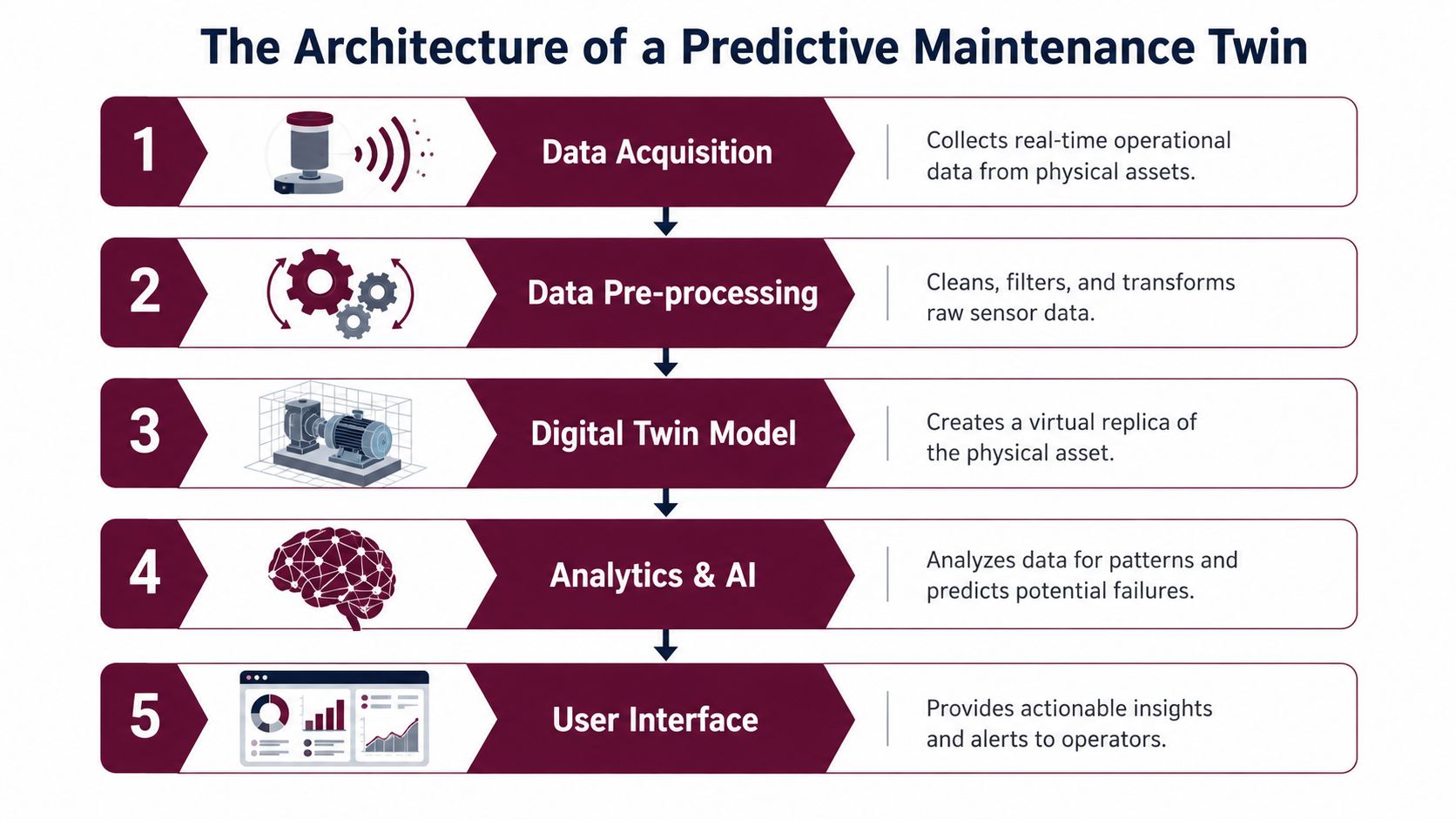
The five layers that make the model usable
Data acquisition sits closest to the asset. On a VFD, that means live signals such as temperature, current, status words, fan behavior, and relevant process variables. If the physical layer is thin, every later layer suffers.
Data pre-processing cleans and structures those signals. Raw tags are noisy, time-stamps drift, and missing values are common in brownfield plants. If this layer is sloppy, the model will faithfully learn the wrong story.
Digital twin model is the virtual replica of the drive and its operating context, encompassing engineering assumptions, thermal behavior, degradation logic, and component relationships. It's the part that separates a twin from a fancy alarm list.
Analytics and AI turn the model into prediction. They compare live behavior against expected behavior, infer degradation, and estimate the likely failure path.
User interface is where the work becomes actionable. A maintenance planner doesn't need a wall of raw traces. They need a clear call on what to inspect, when to inspect it, and what risk sits behind the next run.
A dashboard is not the product. The maintenance decision is the product.
The architecture only works when data moves in both directions. The field asset feeds the twin, the twin updates the maintenance view, and human action feeds back into the system through service history and repair outcomes. Without that loop, the “twin” is just another reporting layer.
Fueling the Twin The Data You Actually Need
Most failed digital twin efforts start with the wrong assumption, that more sensors automatically create a better model. In reality, a mature twin needs more than telemetry. It needs a multi-type data set that captures the asset's shape, behavior, and history, not just its live readings source.
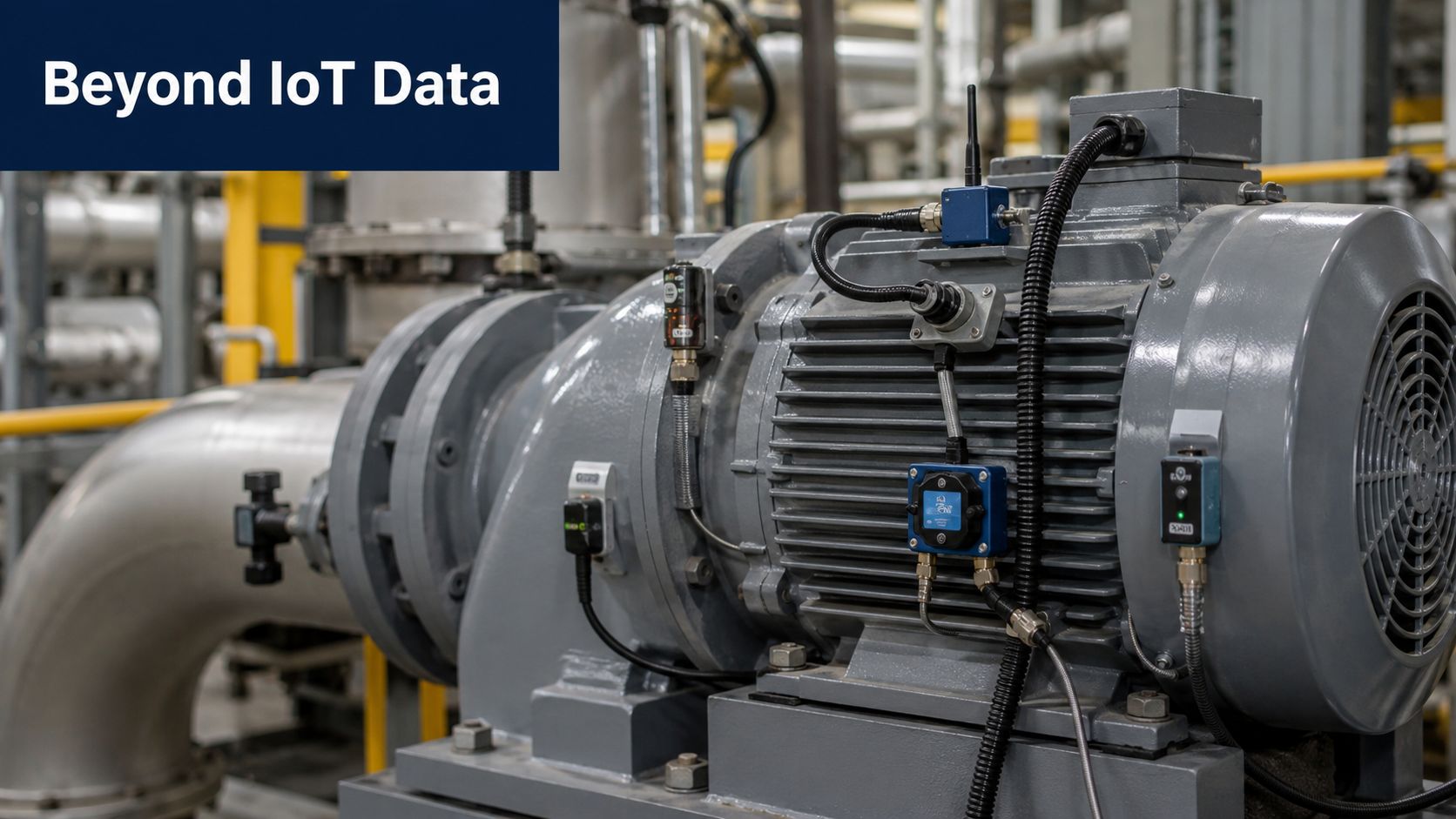
Three data groups that matter on brownfield assets
Real-time data is the live stream from the drive and its surrounding system. For VFD work, that usually includes electrical loading, temperature behavior, cabinet conditions, and any signals that reveal abnormal operation before the trip happens.
Historical data gives the model context. Work orders, repair notes, previous fault codes, operator observations, and restart history tell you how the asset has aged and which symptoms were important. Many plants struggle with this aspect, because the data exists but isn't easy to use.
Static data defines what the asset is supposed to be. Geometry, component specifications, engineering drawings, rated operating parameters, and configuration details keep the model tied to the actual machine rather than a generic abstraction.
The key point is that a twin without lifecycle context can't distinguish a normal operating variation from a true degradation signal. That's why a sensor-only mindset usually disappoints. The twin needs to understand not just what the drive is doing now, but what has changed, what has been repaired, and what the system was designed to tolerate.
A practical audit starts with one question, can you connect live data to service history and configuration data for the same asset? If the answer is no, the model may still be useful, but only as a narrow monitoring tool. For plants with mixed-brand drives and inconsistent fault naming, an internal fault-code mapping workflow can help close that gap, which is why many teams begin with a structured reference like reporting fault codes across brands.
Maintenance insight: If the model can't see repair history, it can't learn how the asset ages in your plant.
That distinction matters for brownfield facilities. New projects often assume clean commissioning data and stable operating conditions. Existing plants rarely have that luxury, so the data strategy has to be deliberate instead of optimistic.
How Digital Twins Predict VFD Failures
A VFD on an aging line rarely fails in a clean, obvious way. The first warning is often a subtle shift in temperature, current behavior, or cooling performance, and a digital twin's key benefit is turning that drift into a maintenance plan before the trip happens.
A common mistake is treating all prediction engines the same. Physics-based models and machine-learning models solve different problems, and VFD reliability improves when they work together. The strongest twin combines engineering logic with pattern recognition instead of assuming one method can cover every failure mode.
Physics first, data second
Physics-based simulation is useful because it encodes how the drive should behave under load, heat, and stress. That matters because VFD failures, driven by the complex ways VFDs age, rarely arrive in neat, repeatable datasets. Physics models are especially helpful for brownfield assets where failure history is thin, scattered, or incomplete.
Machine learning is strong at spotting patterns in history, but it struggles when the plant does not have enough labeled fault examples. A hybrid model closes that gap by simulating fault conditions and severities, then using those synthetic signals for training and validation. That approach helps fill in the missing run-to-failure data that many plants do not have, as demonstrated by MathWorks on digital twin predictive maintenance.
For a VFD, that combination matters because different failure paths look different in the field. One drive may run hot long before it trips, another may show cooling weakness first, and another may fail after contamination, repeated restarts, or poor cabinet airflow. A hybrid model lets the analyst test those paths in advance, even when the plant's own fault records are incomplete or inconsistent.
What the model is really answering
The useful question is not, can the twin predict everything. The useful question is whether the twin can improve the maintenance decision enough to matter. For brownfield equipment, recent review work points to the gap between academic promise and industrial practice, especially on aging assets, and it argues that the strongest use case is often narrowing maintenance windows and supporting repair decisions with hybrid physics-plus-AI models, according to a Chalmers University review.
That is the right lens for drive assets. If the twin can tell you a drive is unlikely to survive the next production cycle, or that a component should be swapped during the next planned stop, it has already delivered value. If it only produces a probability score with no maintenance action attached, it has not helped the crew make a better decision.
A practical example makes the difference clear. A physics model knows a capacitor's ESR should rise with age. The machine-learning model may also spot a unique thermal signature in your plant's data that showed up before the last two capacitor failures. The hybrid twin combines both and says, this capacitor is aging as expected, and it is showing the thermal pattern we saw before the last two failures. That is the kind of output a maintenance planner can act on.
Digital Twin Use Cases for Drive Assets
For VFDs, the win isn't abstract “AI maintenance.” It's spotting the failure mode early enough to schedule the repair instead of waiting for the trip. A good twin helps the team decide whether to replace a wear-prone component, clean and test a cabinet, or keep the drive in service until the next planned outage.
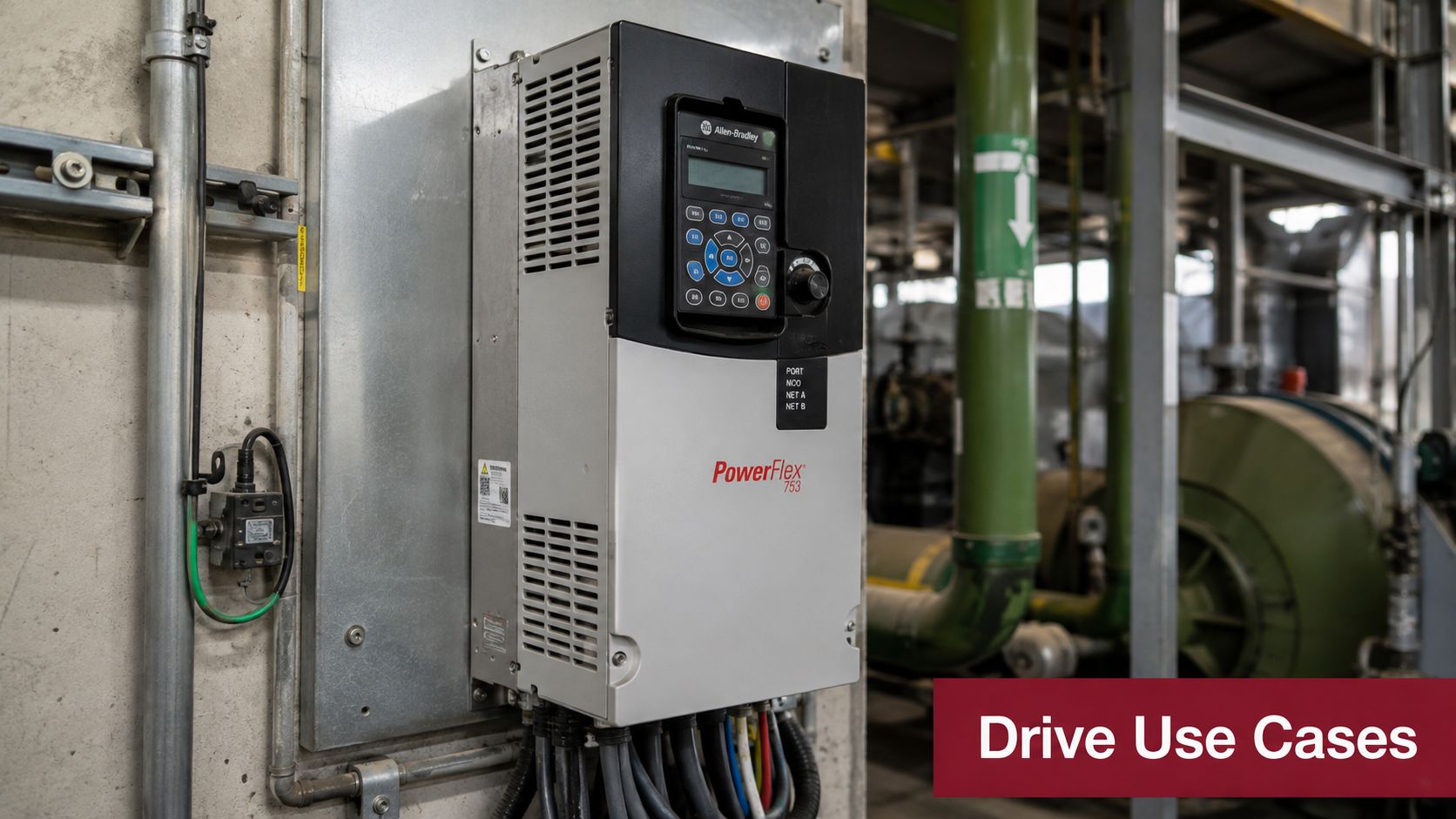
What different failure paths look like
A DC bus capacitor problem is often about aging under heat and ripple stress. The twin watches the operating pattern, compares it with expected degradation behavior, and flags when the component is drifting toward end of life. The maintenance action is usually straightforward, plan a replacement during a controlled shutdown instead of waiting for loss of stability.
An IGBT module issue is more about thermal cycling and stress history. Here the value comes from linking load patterns, cabinet cooling, and operating context to the simulated failure behavior. A twin that understands temperature transitions can warn that the drive is entering a risk window even when the current alarm state still looks acceptable.
A cooling fan failure tends to show up as a mechanical and thermal problem together. Speed deviations, vibration changes, and rising internal temperatures can signal that the fan is no longer moving enough air. The action is often a targeted inspection or replacement before the heat starts hurting other components.
The useful comparison is simple.
| Approach | Strength | Weakness |
|---|---|---|
| Physics-based model | Explains how the drive should age and fail | Needs sound engineering assumptions |
| Data-driven model | Finds patterns in historical behavior | Needs enough labeled history |
| Hybrid twin | Balances mechanism and pattern recognition | Takes more setup and better data discipline |
The hybrid option usually wins on brownfield drives because the plant data is incomplete and the operating regime can change from one campaign to the next. That is why the practical goal is not perfect certainty, it's actionable lead time.
Later, when the maintenance team uses the prediction to line up spares, confirm cabinet condition, and schedule the right labor, the twin stops being theoretical. That's the point where a model becomes a maintenance planning tool.
<iframe width="100%" style="aspect-ratio: 16 / 9;" src="https://www.youtube.com/embed/hIpxnd5RjFo" frameborder="0" allow="autoplay; encrypted-media" allowfullscreen></iframe>Building the Business Case and Calculating ROI
Finance does not approve “advanced analytics” on its own. It approves fewer outages, lower repair burden, and better use of the maintenance window. A digital twin earns credibility when the predicted change in maintenance shows up in operating results, not just in a cleaner model.
Translate the technical gains into plant value
A 2023 study reported that digital twin-enabled predictive maintenance reduced average downtime, improved asset availability, and cut monthly maintenance costs A 2023 ASRC study on digital twin predictive maintenance. The same study also said the differences were statistically significant at the 0.05 level, and regression analysis showed digital twin functions explained 68% of the variance in maintenance performance outcomes.
Those findings matter because they translate into the language a plant uses. Less downtime means more usable production time. Higher availability means fewer schedule disruptions. Lower maintenance cost means less reactive labor, fewer emergency interventions, and better planning around spare parts.
A strong business case should use the plant's own outage pain, not abstract industry averages. If a critical VFD cannot fail in the middle of a production run, even modest extra warning time can justify the pilot. The twin does not need to prove perfection. It needs to show that it can move maintenance from crisis response to controlled intervention.
Business rule: The first ROI question is not “How accurate is the model?” It is “How many bad interventions did it help us avoid?”
That matters even more for late-life assets. When a drive is already aging, the value often comes from extending useful service, narrowing the repair window, and reducing the chance of a surprise shutdown. Those gains are easier to defend than a vague promise of AI transformation.
Your Phased Implementation Roadmap
Brownfield facilities need a rollout plan that respects limited shutdown time, incomplete records, and mixed asset condition. A digital twin program works better when it starts small, proves a maintenance decision, and then expands only after the workflow is stable.
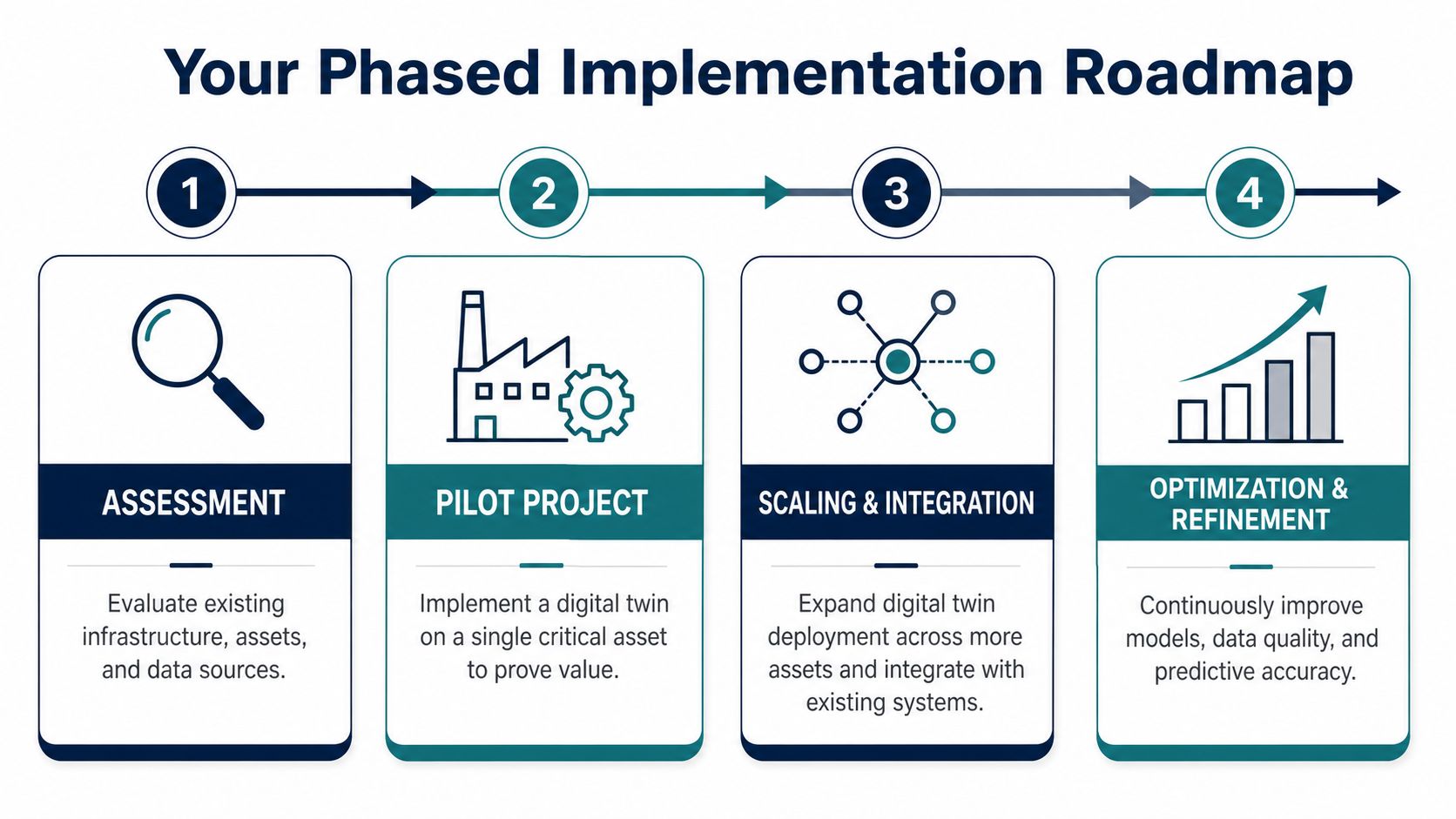
Start with one asset and one decision
Phase one is assessment. Pick a critical drive with visible pain, then audit what data exists, what history is usable, and what the team still has to capture manually. The goal is to avoid building a twin around missing information.
Phase two is the pilot. Instrument the asset properly, build the first model, and compare the predictions with actual field behavior. Don't measure success by dashboard activity, measure it by whether the model changes a real maintenance decision.
Phase three is scaling and integration. Connect the twin's insights to the maintenance workflow, then push the information into planning, inspection, and spares decisions. At this stage, the model has to fit the plant's existing process, not the other way around.
Phase four is optimization and refinement. Keep improving the data quality, tune the model against new repair outcomes, and extend the program only when the first asset has proven value. If the twin doesn't improve decision quality on the pilot drive, scaling it across the plant will only spread the confusion.
A practical pilot usually succeeds when it does three things well.
- Limits scope: One critical asset, one failure mode, one maintenance decision.
- Captures history: Use repair records and operating context, not just live tags.
- Connects action: Make sure the output changes a work order, inspection, or shutdown plan.
The wrong way to launch is to chase a fully automated vision before the data is ready. The right way is to prove that the twin can help a reliability team act earlier, with less guesswork, on the drives that matter most.
If your plant is trying to turn VFD alarms, service records, and mixed sensor data into a real maintenance decision tool, DUCHENG Industrial can help with the practical side of that work. Visit DUCHENG Industrial to discuss brownfield VFD monitoring, service-history integration, and a pilot plan that fits your shutdown windows and reliability targets.