
What is Siemens? Learn its history, scale, drive families and how to verify Siemens equipment before you buy or repair it.
What is Siemens, and which part of it built the drive in your cabinet? Siemens is a Germany-headquartered technology group founded in 1847, and most industrial drive owners deal with Siemens AG. If your only answer is "a big German electrical company," you're skipping the decision that gets a line back online: which business made this drive, which converter family it belongs to, and which paperwork proves a spare will talk to the controller.
A maintenance engineer doesn't need a corporate biography. You need a map. The badge on the cabinet can sit on industrial automation, power generation, or medical equipment, and only one of those paths stocks a SINAMICS spare. That scale is exactly why a faded nameplate still points you at a specific company, product family, and support path rather than a generic inverter.
Table of Contents
- What Siemens Is and How It Started
- Scale, Revenue and Where Siemens Operates
- Product Lines and Certifications to Verify
- SINAMICS Drive Families by Voltage Class
- How Siemens Drives Connect to Controllers and Software
- Identify Your Drive and Choose Your Next Step
What Siemens Is and How It Started
Siemens is a German technology group headquartered in Munich, and for drive owners the relevant entity is almost always Siemens AG. The name covers an ecosystem of separate businesses, not one product brand, so the first job on a trip is to decide which company owns the asset in front of you.
Say a night-shift electrician finds a cabinet labeled Siemens after a converter trip. The power section looks like every other inverter on the floor. The paperwork in the drawer, though, might belong to industrial automation, a power-generation project, or a medical imaging system that was never part of this plant. Treating those as one catalog is how the wrong spare gets ordered and the wrong hotline gets called.
| Business | Main focus | What it means for a drive owner |
|---|---|---|
| Siemens AG | Industrial automation, digitalization, infrastructure and mobility | Source of the SINAMICS drive and automation controller lines most plants use |
| Siemens Energy | Power generation and grid technology | Separate company; a Siemens Energy label does not mean a SINAMICS drive |
| Siemens Healthineers | Medical imaging and diagnostics | Separate business with no industrial drive product line |
The Siemens history timeline dates the company to October 12, 1847, when Werner von Siemens and precision mechanic Johann Georg Halske began Telegraphen-Bauanstalt von Siemens & Halske in a Berlin courtyard workshop with 10 employees to manufacture a pointer telegraph. Within one year, a Prussian government contract funded an electric telegraph line between Berlin and Frankfurt. An office opened in London in 1850, and a presence in St. Petersburg followed in 1855. In 1866, Werner von Siemens's work on the dynamo-electric principle created a basis for practical electrical power generation. Siemens & Halske became a stock corporation in 1897. On October 1, 1966, the modern Siemens AG was formed from Siemens & Halske AG, Siemens-Schuckertwerke AG, and Siemens-Reiniger-Werke AG.
Why the origin still shows up on a drive
That path ran from telegraphy into electrification, industrial systems, and infrastructure. Drive and automation lines grew out of power conversion and control, not out of a single box sold as a commodity motor starter. When you ask what is Siemens on a plant floor, the useful answer is an engineering group whose product still depends on how power, control, and communications were designed together.
Practical rule: Read the legal name on the manual and the invoice before you read the kilowatt rating. Siemens AG, Siemens Energy, and Siemens Healthineers do not share one spare-parts counter.
Scale, Revenue and Where Siemens Operates
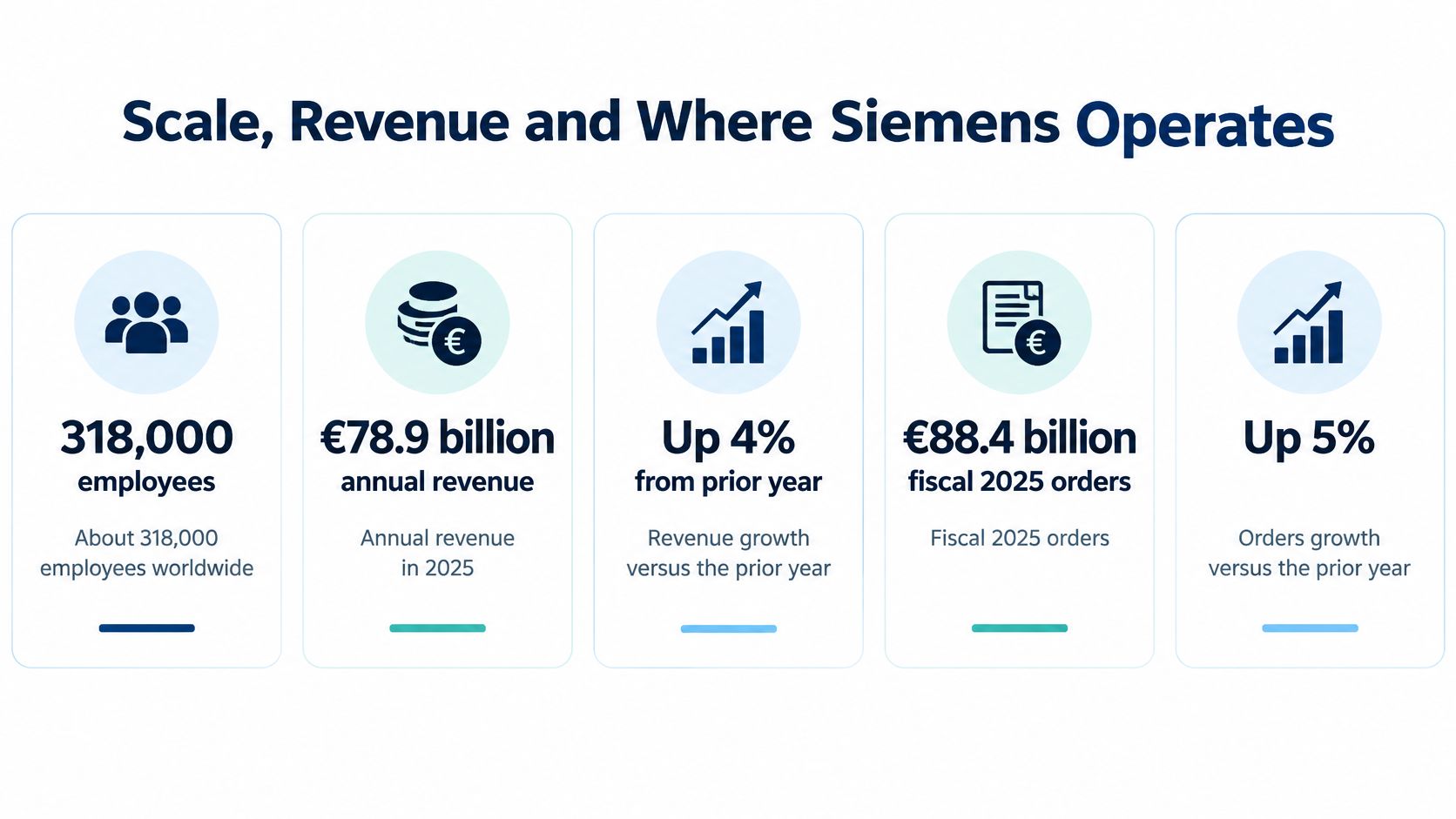
The Siemens company history overview describes a group headquartered in Munich with approximately 318,000 employees worldwide and annual revenue of €78.9 billion, up 4% from the prior year. The Siemens Annual Report 2025 reports fiscal 2025 orders of €88.4 billion, up 5% year over year, a 1.12 book-to-bill ratio, and a €117 billion order backlog.
Those figures describe commercial reach. They don't tell you whether a board for your series is on a shelf near the plant. Geography is the part you can act on.
| Region | Share of revenue | What to check as a regional plant |
|---|---|---|
| Europe, CIS, Africa and Middle East | 75% | Local service and spare-part availability are usually strongest here |
| Asia and Australia | 15% | Confirm nearest service location and spare stock before relying on it |
| Americas | 10% | Confirm regional support path and lead times for specific drive series |
75% of revenue came from Europe, the Commonwealth of Independent States, Africa, and the Middle East, 15% from Asia and Australia, and 10% from the Americas. A supplier spread across several economic regions isn't tied to one national market. The Asia and Australia share is much smaller than Europe's, so a plant in Southeast Asia shouldn't assume local stock matches headquarters depth.
Turn the split into a supplier question
Ask two things before a shutdown window is locked: where is the nearest service location for this series, and how is spare-part availability confirmed for the exact drive you run? Industrial automation, digitalization, and infrastructure are central activities, which means software and large systems sit beside the hardware. More than 175 years of expansion produced that platform. Backlog and order growth show commercial momentum. They don't, by themselves, mean shorter downtime or a longer life for an older converter.
Product Lines and Certifications to Verify
Plants meet Siemens equipment in clusters, and each cluster belongs to a business. Mixing them is how a purchase order lands on the wrong catalog.
What you are likely to see
Digital Industries, inside Siemens AG, is usually the first contact. It covers industrial automation controllers, industrial software, digital twins, and industrial artificial intelligence. A PLC, an engineering laptop, and a drive parameter set often show up together long before anyone opens a medium-voltage cabinet.
SINAMICS is the converter family this guide stays on. It spans low-voltage, medium-voltage, and DC-voltage applications. If the nameplate says SINAMICS, you're in Siemens AG drive territory, and the series code decides the manual, the option list, and the spare.
Siemens Energy and Siemens Healthineers have their own ranges. A Siemens-branded generator control, grid device, or imaging system should go back to that business's documentation. It isn't a substitute part for a plant drive, even when the logo matches.
Certifications are scoped, not general
Don't accept "authorized for Siemens" as a blanket claim. We hold Siemens and Siemens Energy service authorization and have been an approved supplier since 2019, and that still has to be checked in writing: the document, its scope, and its dates. The certificate should name the product series it covers. A letter that says "drives" without a series doesn't cover a specific SINAMICS line.
Functional features work the same way. PROFINET, PROFIsafe, and PROFIenergy are specified per product line. Confirm them against the series printed on the nameplate. Assuming the whole family shares one network stack is how a replacement powers up and then fails the safety handshake.
A certificate that doesn't name your series is a brochure, not an authorization.
SINAMICS Drive Families by Voltage Class
SINAMICS isn't one standard VFD. The SINAMICS low-voltage drives family brochure describes a family of variable-frequency and converter systems across low-voltage, medium-voltage, and DC-voltage applications. Voltage class comes first, because it decides where a trip can start and which rating you must match.
| Voltage class | Known specification | What to confirm before sourcing |
|---|---|---|
| Low voltage | 380–480 V three-phase supply, 47–63 Hz, 24 V DC electronics supply (representative system) | Exact series, firmware, option modules and interface protocol |
| Medium voltage | Rated voltage from the nameplate and the series datasheet | Exact series, voltage rating, option modules and service support path |
| DC voltage | DC bus and braking ratings from the series datasheet | DC-link and braking configuration, control supply and firmware |
What each class tells you to look at
A representative low-voltage system is specified at a 380–480 V three-phase supply, 47–63 Hz line frequency, and a 24 V DC electronics supply. On that class, check incoming voltage and frequency, then the control supply. A healthy power stage with a sagging 24 V rail will still trip, and swapping the power module won't fix it.
Medium-voltage units don't share one published voltage in that low-voltage data. Read the nameplate rating and the series datasheet before you talk about an exchange. These cabinets are large, option-heavy, and slow to move, so the support path matters as much as the kilowatts.
DC-voltage converters center on the DC link and the brake path. Record bus behavior and braking configuration before you assume the fault is in the motor.
Networks and the trip that isn't in the power stage
Specified product lines can include PROFINET, Modbus TCP/IP, EtherNet/IP, PROFIsafe, and PROFIenergy. A missing protocol on the replacement is a functional mismatch, not a minor software preference.
A trip may originate in the power stage, motor insulation, braking circuit, DC link, control supply, communications network, or safety chain. Start by reconstructing topology and operating state. Record incoming voltage and frequency, DC-link behavior, control-supply stability, fault history, motor and load data, network status, and safety-interlock state.
Nominal kW or current matching alone does not establish functional compatibility.
Before you source an exchange unit for a large or critical asset, verify the exact SINAMICS series, voltage class, firmware, option modules, and interface protocol.
How Siemens Drives Connect to Controllers and Software
Think of the drive as one instrument in an orchestra. It can be the right size and the right voltage and still play the wrong part if the score, meaning its parameters, doesn't match the rest of the section.
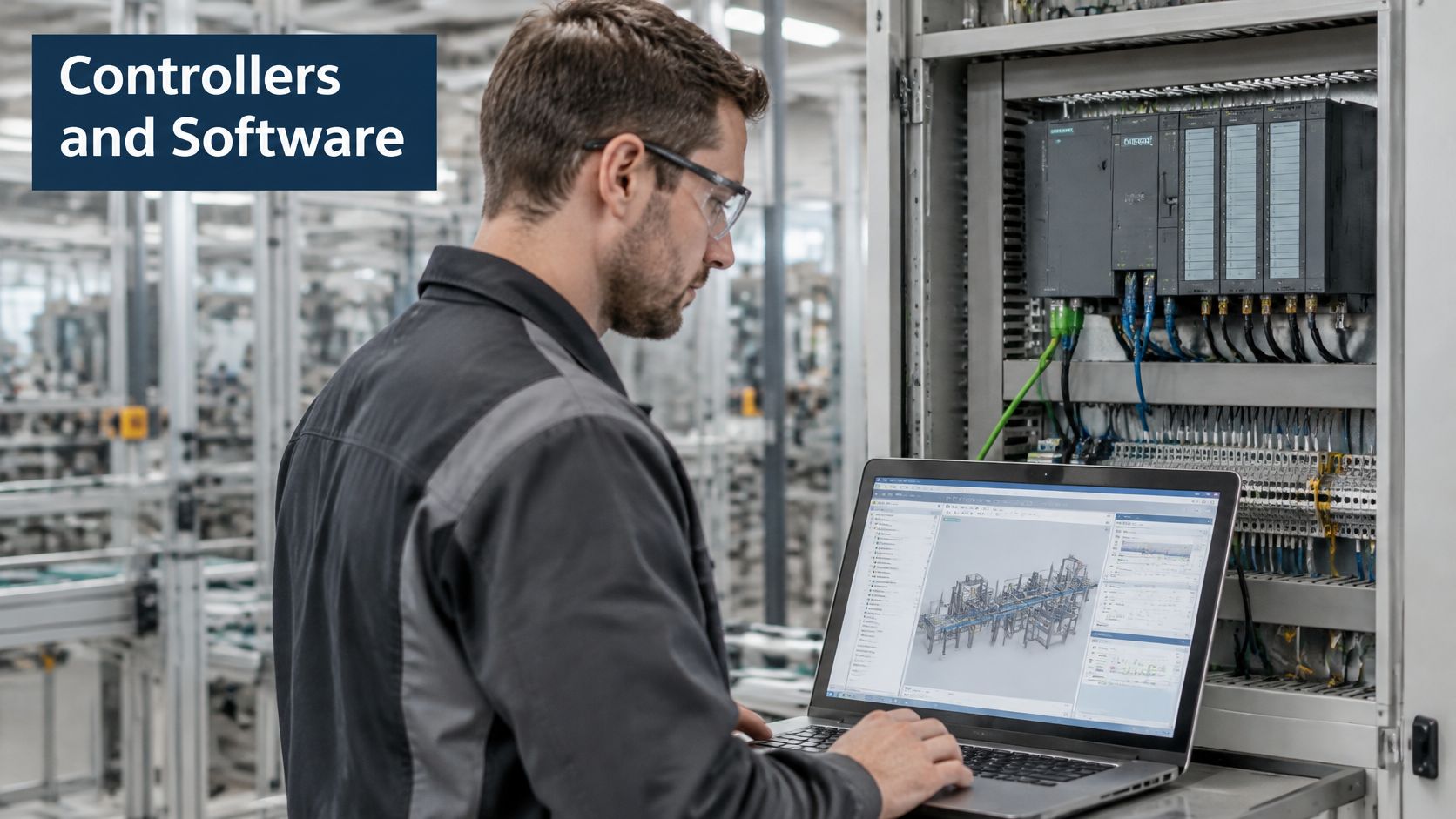
Siemens Digital Industries combines industrial automation, software, digital twins, and industrial artificial intelligence. Siemens reports that 33% of machines worldwide run on a Siemens controller and that 92% of Fortune 500 companies use its software. Drives in that footprint are rarely isolated power converters.
What sits between the drive and the controller
Four links decide whether a restart is safe.
- Controller-to-drive communication: The fieldbus and the PLC interface have to match the program that is already running.
- Parameter datasets: Motor data, limits, and ramps live in the drive, not on the nameplate.
- Safety functions: PROFIsafe or hardwired interlocks can block a start that looks electrically fine.
- Commissioning tools: The laptop project is part of the asset. Lose it and you lose the map.
A steel-mill network change shows the same point in practice. On an electric-arc-furnace line, a PROFINET network upgrade only holds if each drive's interface matches the new layout. Power rating never enters that check.
Preserve the asset before you open the cabinet
Before repair or replacement, save drive firmware, motor data, parameter backups, fieldbus configuration, the PLC interface, and safety settings. A replacement power section with the same nominal voltage and power rating can still be incompatible if that surrounding configuration isn't carried across.
In a multi-vendor plant the risk is higher, because the Siemens drive may be the only device speaking a given safety profile to a controller from another generation. Ask this before any swap: which controller, network, and safety settings does this drive depend on?
Identify Your Drive and Choose Your Next Step
A readable series code beats a complete corporate definition. Siemens AG reported €10.4 billion in net income in fiscal 2025, and the Siemens AG press materials show Digital Industries had a €10 billion order backlog at September 30, 2025. That backlog doesn't identify your unit. The nameplate and the parameter screen do. Use our guide to reading a drive nameplate when the plate is oily or partly worn.
Five checks, each with a reason
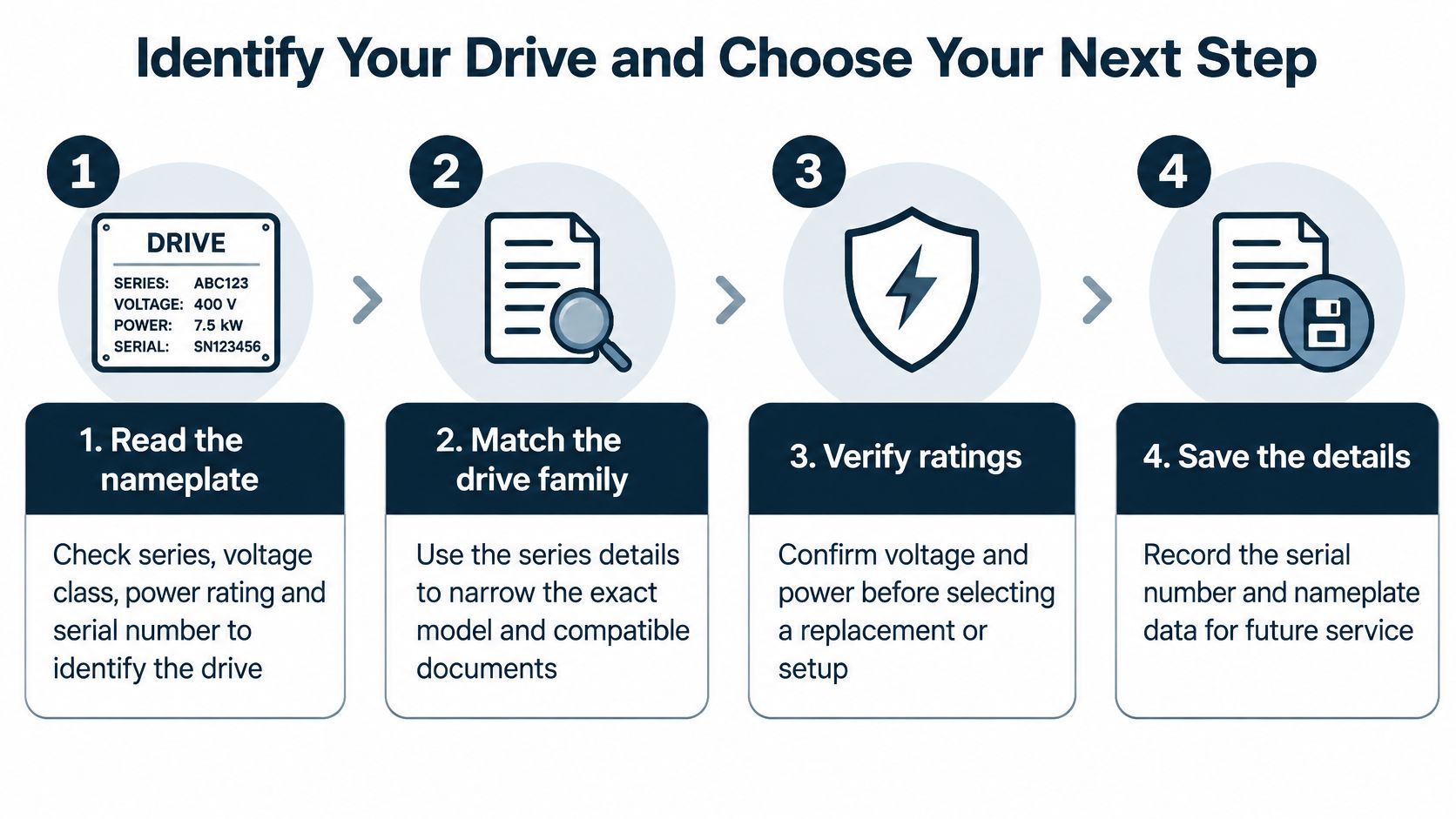
- Read the nameplate for series, voltage class, power rating, and serial number. Those fields decide which SINAMICS class applies and stop a lookalike spare.
- Record firmware and option modules from the parameter screen or service display. Unknown firmware can't be matched to a replacement, even when the hardware frame is identical.
- Confirm the Siemens entity on the documentation: Siemens AG, Siemens Energy, or Siemens Healthineers. The entity sets the parts channel and the support path.
- Sort each assembly as serviceable, renewable at subsystem level, or obsolete. A discontinued board changes the outcome from a repair into a redesign.
- Save the parameter backup, fieldbus configuration, and safety settings. The replacement depends on that context more than on the frame size.
Pick a path only after the file matches
Compare what you found with three outcomes: component repair, subsystem renewal, or full replacement. Don't source an exchange unit until firmware, parameter files, and the controller interface have passed a compatibility check. We completed a full maintenance cycle for 43 Siemens S120 drives at Shiheng Special Steel in 2026, including parameter backup, cleaning, DC capacitor replacement, and component testing, in under one month. That work started from saved parameters, not from a guess at the rating.
Treat any supplier's Siemens authorization as a claim. Ask for the written authorization, its scope, and its dates before you rely on it. Our quick repair sequence is fixed: collect the alarm and operating information, isolate the equipment and check electrical status on site, review fault records, decide whether the fix is on-site, by spare part, or by deep repair, then do a controlled restart and functional verification.
Send the nameplate data, firmware version, parameter backup, and Siemens entity name when you request that compatibility check. That's the practical answer to what is Siemens for the drive you own.
DUCHENG Industrial keeps Siemens drives in service across commissioning, fault recovery, workshop repair, and on-site reconditioning, including the nameplate, firmware, and parameter checks this guide asks you to finish first. If you have a SINAMICS series, a fault history, and a question about repair versus replacement, send them through DUCHENG Industrial so the compatibility check starts from your asset, not from a catalog guess.