
Equipment arriving in Thailand is only the beginning of an investment. Its lifecycle service, repair capability, spare-parts support and local engineering capacity determine whether industrial capability truly remains in Thailand.
Bringing equipment to Thailand is only the beginning of an investment.
Only when equipment can still be maintained, repaired and used five or ten years later can we say that industrial capability has truly remained in Thailand.
The question in Thailand’s market has changed
At the 2026 Bangkok International Motor Show, Chinese brands again took centre stage.
BYD, SAIC MG and DEEPAL led the Chinese contingent in dominating the rankings. Among the top ten by sales, only Toyota and Honda remained as Japanese brands.
Japan’s Diamond Online even used the word “shock” to describe this change in the traditional stronghold of Japanese vehicles.
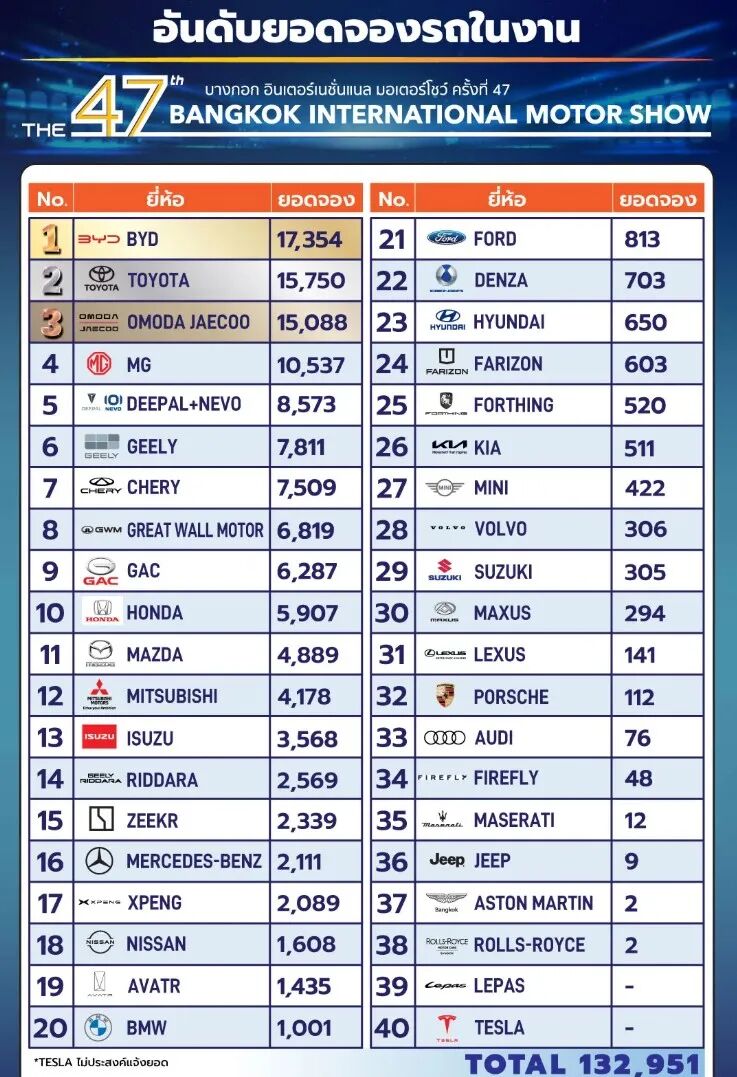
Looking at sales alone, this may appear to be another story of Chinese new-energy vehicles breaking through the moat of Japanese brands.
But while Chinese brands continue to set order records, Thailand’s market is asking a different question:
After products are sold in Thailand, who will provide the service?
After equipment enters a factory, who will keep it running for the long term?
Equipment arriving does not mean industrial capability has arrived
Over the past several years, Thailand has attracted major manufacturing investment. New factories, production lines and automation equipment continue to arrive.
Yet after equipment is installed, a more important question emerges:
Will this equipment still be able to run reliably five or ten years from now?
Completing a production line does not mean industrial capability has truly remained in Thailand. Equipment can be imported, installation can be completed by overseas engineers, and commissioning can rely on short-term support from the original manufacturer.
But once a project is delivered and overseas engineers leave, what if Thailand has no engineers able to commission, diagnose and repair the equipment; no critical spare parts; no parameters or technical documentation; and no service organisation prepared to take long-term responsibility? The equipment is still only an asset temporarily placed in Thailand.
It may look as though investment has been completed and capacity has been created, yet it can stop at any time because the service system is missing.
One inverter can stop an entire production line
Problems with industrial equipment often do not appear at procurement or installation. They emerge gradually after years of operation.
When a failure occurs, a factory may have to:
- wait for a response from an overseas original manufacturer;
- wait for an engineer to travel across borders;
- wait for parts to be shipped from abroad; or
- replace the entire unit when it cannot be repaired.
A production line worth tens of millions or even hundreds of millions of baht may stop because of one inverter, one drive module or one control board.
The loss is not only the cost of repairing a single item of equipment.
It can also include downtime losses, delayed orders, scrapped products, customer claims and the risk of disrupting the entire supply chain’s delivery rhythm.
At that point, equipment is no longer productive capacity; it can become a burden on the factory.
What customers truly need is an asset that can run for the long term
For manufacturers, the real need is not simply equipment with a lower purchase price, but an asset that can operate reliably for the long term.
- Equipment needs someone to install it, and someone to commission it.
- It needs someone to repair it, and someone to identify faults before they occur.
- Spare parts need to be available, and alternatives need to be found after an original model is discontinued.
- Overseas technical support is needed, but diagnostic and maintenance capability must also be genuinely handed to engineers in Thailand.
Equipment should therefore not be valued only at delivery. It should be re-examined three, five or even ten years later:
Can the equipment still run reliably?
Can faults be resolved in Thailand?
Can critical components still be obtained?
Have local engineers mastered the maintenance capability?
Can the factory continue producing after a supplier exits?
These are the questions that truly determine the long-term value of an industrial investment.
Localization cannot stop at production
The next stage of localization in Thai manufacturing should not look only at where equipment is made or where parts are procured. It should also ask:
- Where is the equipment maintained?
- Where are faults resolved?
- Where does technical capability accumulate?
- Who takes responsibility for the equipment throughout its lifecycle?
If equipment runs in Thailand but fault diagnosis still depends on overseas support; if a factory is in Thailand but critical repair capability has not remained there; or if equipment keeps increasing while local engineers never master the core maintenance skills—then localization is still incomplete.
True industrial localization is not only the localization of factories and equipment. It should also include localized repair capability, technical documentation, spare-parts systems, engineering teams and long-term service responsibility.
The industrial equipment aftermarket is not an auxiliary part of manufacturing
The industrial equipment aftermarket is often understood as repair service needed only after equipment fails. In reality, it carries far more than “repairing one item of equipment.”
It affects whether:
- production lines can continue operating;
- businesses can deliver orders on time;
- invested fixed assets can have their service life extended;
- ageing equipment can be replaced and upgraded;
- factories can reduce their reliance on temporary overseas support; and
- Thailand can genuinely build industrial technical capability.
The industrial equipment aftermarket is therefore not an auxiliary part of manufacturing.
It determines whether an investment can create value for three years, ten years or twenty years.
BOI needs to consider more than how much equipment has been invested
For the Thailand Board of Investment (BOI) and Thai industrial policy makers, judging whether an investment project has truly taken root in Thailand should not depend only on investment value, factory area, equipment quantity and initial employment.
They should also consider:
- whether equipment is maintained in Thailand;
- whether critical parts can be obtained in Thailand;
- whether faults can be diagnosed and repaired in Thailand;
- whether a clear service-response mechanism has been established;
- whether Thai engineers have gained genuine technical capability;
- whether alternatives exist after an original manufacturer discontinues a model; and
- whether a factory can keep producing after a supplier exits.
Thailand needs to attract more than equipment.
Thailand also needs the technical capability, service system and long-term responsibility that arrive with the equipment.
When an investment also brings local testing, local repair, local spare parts, local engineer training and equipment remanufacturing capability, what remains is not merely a factory but an industrial ecosystem that can keep developing.
Keeping equipment running in Thailand for the long term
This is the capability we hope to build: using Thai engineers, local testing and repair facilities, local spare-parts systems and clear service standards to support the long-term operation of inverters and industrial automation equipment.
Our value is not only repairing one inverter. It is:
- helping a factory restore production as soon as possible after an equipment failure;
- identifying potential risks before a failure occurs;
- finding workable alternatives after an original model is discontinued;
- providing reliable local support to Thai factories when overseas original manufacturers cannot respond in time; and
- gradually retaining diagnostic, repair and maintenance capability in Thailand.
What we protect is not only one item of equipment.
What we protect is our customers’ production capacity, orders, delivery schedules and fixed assets already invested.
In closing
Bringing equipment to Thailand is only the beginning of an investment. Completing installation and successfully powering up equipment does not mean industrial capability has truly taken root.
Only when equipment is still maintained five or ten years later; when faults can still be repaired; when discontinued models still have alternatives; when local engineers can solve problems independently; and when factories no longer depend entirely on temporary overseas support—does the investment truly become part of Thailand’s industrial system.
High-quality industrial investment is not equipment arriving. It is full-lifecycle capability arriving with the equipment.
We do not only bring equipment into Thailand. We want to keep equipment running in Thailand for the long term.