
Discover how electrical reliability services reduce downtime, improve MTBF, and protect critical assets with proven strategies.
Electrical reliability has become a hard operations issue, not a background maintenance concern. The U.S. electric distribution system's total SAIDI rose from 236.2 minutes in 2014 to 662.6 minutes in 2024 including major event days, while non-major-event SAIDI moved from 109.7 minutes to 126.0 minutes over the same period, according to the EIA's reliability table EIA distribution reliability data. For plants running VFDs, control power, and continuous process loads, that gap matters because the grid's routine performance can look stable while storm-driven or large-scale events still create long restoration windows and repeated starts that stress equipment.
The same EIA table shows SAIFI rising from 1.257 to 1.531 including major events, and from 1.019 to 1.043 excluding them EIA distribution reliability data. That split offers a critical lesson for industrial operators: reliability is not just about how often something trips, it's about how long the process stays down and how cleanly the system comes back. Electrical reliability services matter because they turn those abstract grid metrics into concrete work on drives, feeders, controls, and restoration procedures.
In bulk power, the baseline is strong, but the operating environment still demands discipline. NERC's 2025 State of Reliability overview says the Bulk Power System remains highly reliable and resilient, with key performance metrics continuing to improve or hold steady NERC 2025 State of Reliability overview. At the plant level, the question is simpler, and harder, can your facility isolate faults quickly, avoid repeated interruptions, and restart without making a bad condition worse?
Practical rule: if a drive trip forces a rushed restart, the electrical problem usually becomes a maintenance problem, then a production problem.
Table of Contents
- Why Electrical Reliability Matters More Than Ever
- Core Electrical Reliability Services Explained
- On-Site Repair Versus Workshop Removal
- Diagnostic Methodologies That Prevent Repeat Failures
- Building a Risk-Based Maintenance Program
- Measuring Reliability Service Outcomes
- Implementing Your Electrical Reliability Strategy
Why Electrical Reliability Matters More Than Ever
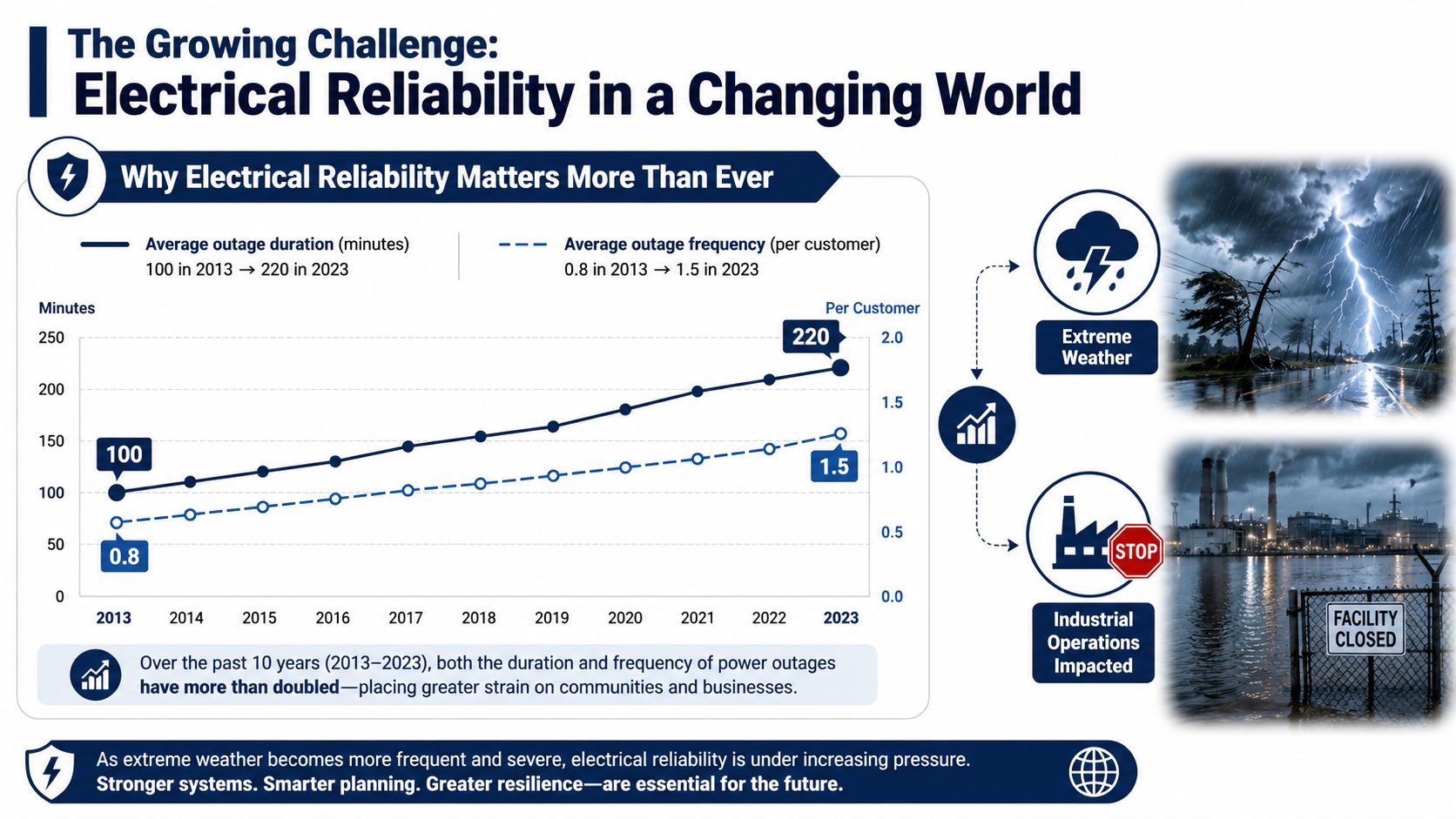
Electrical reliability now has to absorb more than routine wear. Severe weather, regional disturbances, and longer recovery windows put more stress on distribution systems, and the effect shows up in how often interruptions happen and how long they last. The practical takeaway is simple, facilities face more starts, stops, and recovery actions, so the margin for weak equipment is smaller than it used to be.
What those utility metrics mean inside a plant
A utility interruption does not stay at the service entrance. Inside a manufacturing or process facility, the event becomes a chain reaction, VFDs drop out, control power dips, permissives disappear, and operators have to decide whether to wait, isolate, or restart. IEEE 1366-style analysis separates interruption frequency from interruption duration, which matters because the corrective action changes depending on whether the issue is recurring trips or slow restoration IEEE 1366 reliability indices.
That distinction matters in the field. If failures are frequent but brief, the work often points toward nuisance trips, control instability, or upstream momentary events. If the duration is long, the underlying issue is usually fault isolation, sectionalizing, spare availability, or the time needed to verify a safe restart. In either case, the failure mode drives the repair plan, and the repair plan drives the cost of lost production.
Why the business case is stronger than the checklist
Reliability work has to be measured in operational terms. A maintenance report that says a cabinet was inspected does not answer the question plant leaders care about, whether trip rates fell, MTBF improved, or downtime-hours were prevented. The same discipline used in utility reporting should exist in industrial plants, because service quality is only useful if it reduces repeat failures and shortens recovery.
For operations teams, the useful framing is direct.
- Shorter outage duration: reduces the hours a process sits idle.
- Lower trip frequency: protects production continuity and reduces restart stress.
- Cleaner restoration: cuts the chance that a temporary fault becomes a repeat failure.
- Better contingency planning: gives maintenance and operations a repeatable playbook when power quality or equipment stress shows up.
Reliability services earn their keep when they improve those outcomes. The goal is not perfection. It is fewer trips, faster recovery, and a lower chance that a small electrical problem turns into a production event.
Core Electrical Reliability Services Explained
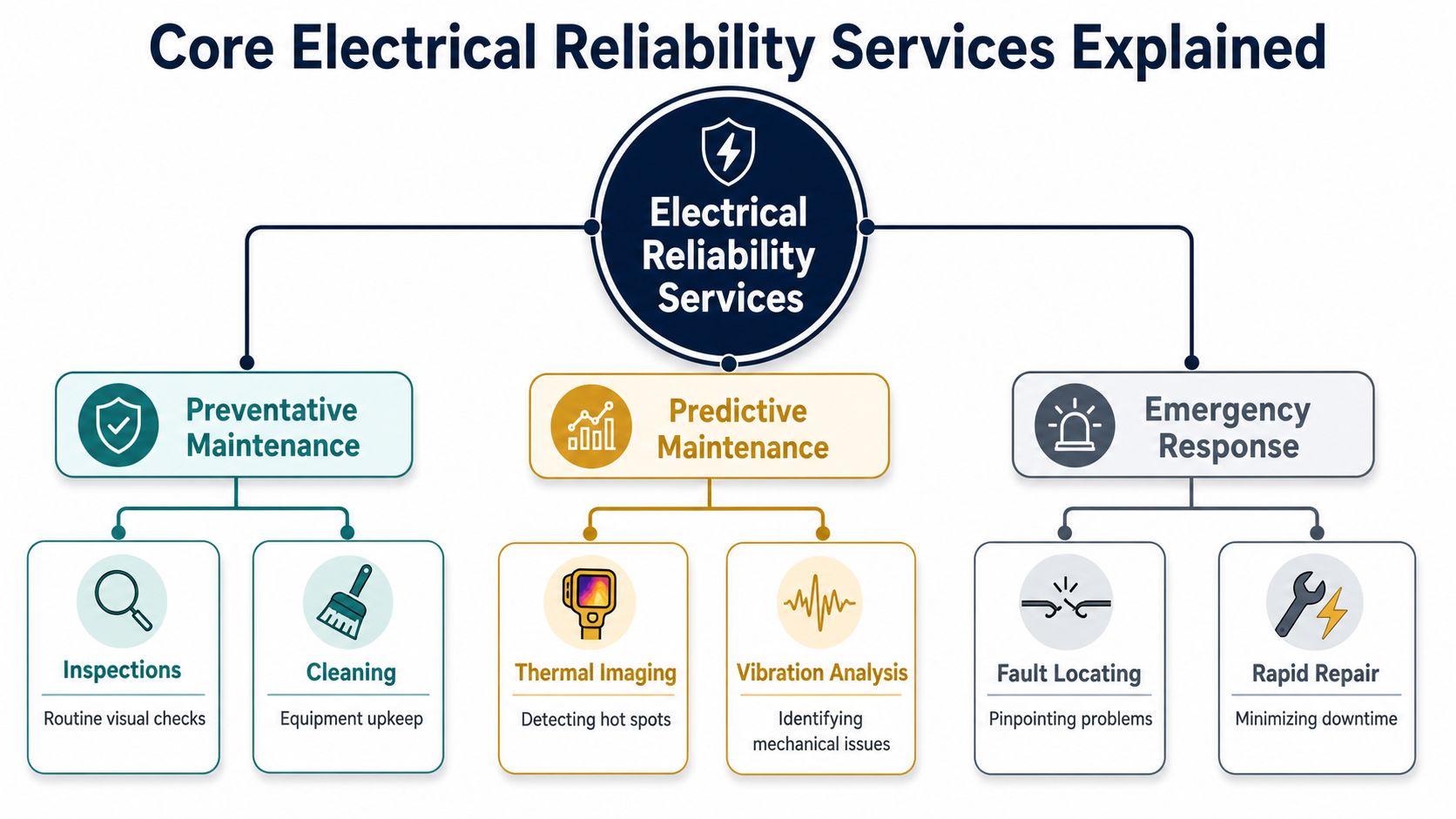
Electrical reliability work usually falls into three practical buckets, preventive maintenance, predictive maintenance, and emergency response. Each one solves a different failure pattern, and the worst programs blur them together until nobody knows whether they're buying protection, diagnostics, or rescue.
Preventive maintenance catches the slow failures
Preventive maintenance is the work that keeps contamination, loose terminations, thermal aging, and insulation degradation from turning into a trip. In a cabinet full of drives, that often means cleaning, torque checks, airflow verification, and inspection of contactors, fans, and power components before they get noisy or hot. The value is not that the work is glamorous, it's that it removes the conditions that slowly erode reliability.
A plant with recurring dust or corrosive exposure should treat cleaning as a reliability action, not housekeeping. Once contamination reaches heatsinks, filters, and control boards, the system starts losing thermal margin, and thermal margin is what keeps a drive from derating or tripping at the wrong time.
Predictive work finds drift before it becomes a fault
Predictive maintenance looks for a pattern instead of waiting for a failure. Thermal imaging can expose hot spots on bus joints, terminals, or cooling paths. Vibration analysis helps when mechanical stress is part of the failure chain, especially around motors, couplings, and auxiliaries. In electrical systems, the point is to catch change, not to admire a dashboard.
Rule of thumb: if a problem shows up only after the outage, it's late. If it shows up as drift, temperature rise, or repeat alarms, you've got a chance to intervene on your terms.
Emergency response is about controlled recovery
Emergency response is the work that gets a critical asset back online without guessing. That means fault locating, root-cause isolation, safe restart, and repair decisions made under shutdown pressure. For high-criticality processes, the difference between “back up” and “back up safely” is often the difference between one outage and two.
Lifecycle value comes from combining all three. Commissioning catches installation mistakes, maintenance slows wear, diagnostics separate symptoms from causes, and response work limits the damage when something still fails. Public service descriptions often stop at capability lists, but buyers need to know which service reduces trip rate, which shortens restoration time, and which one prevents the next failure mode from returning.
For a practical look at how fault reporting supports that workflow, see reporting fault codes across brands.
<iframe width="100%" style="aspect-ratio: 16 / 9;" src="https://www.youtube.com/embed/W0_1xRqT8uU" frameborder="0" allow="autoplay; encrypted-media" allowfullscreen></iframe>On-Site Repair Versus Workshop Removal
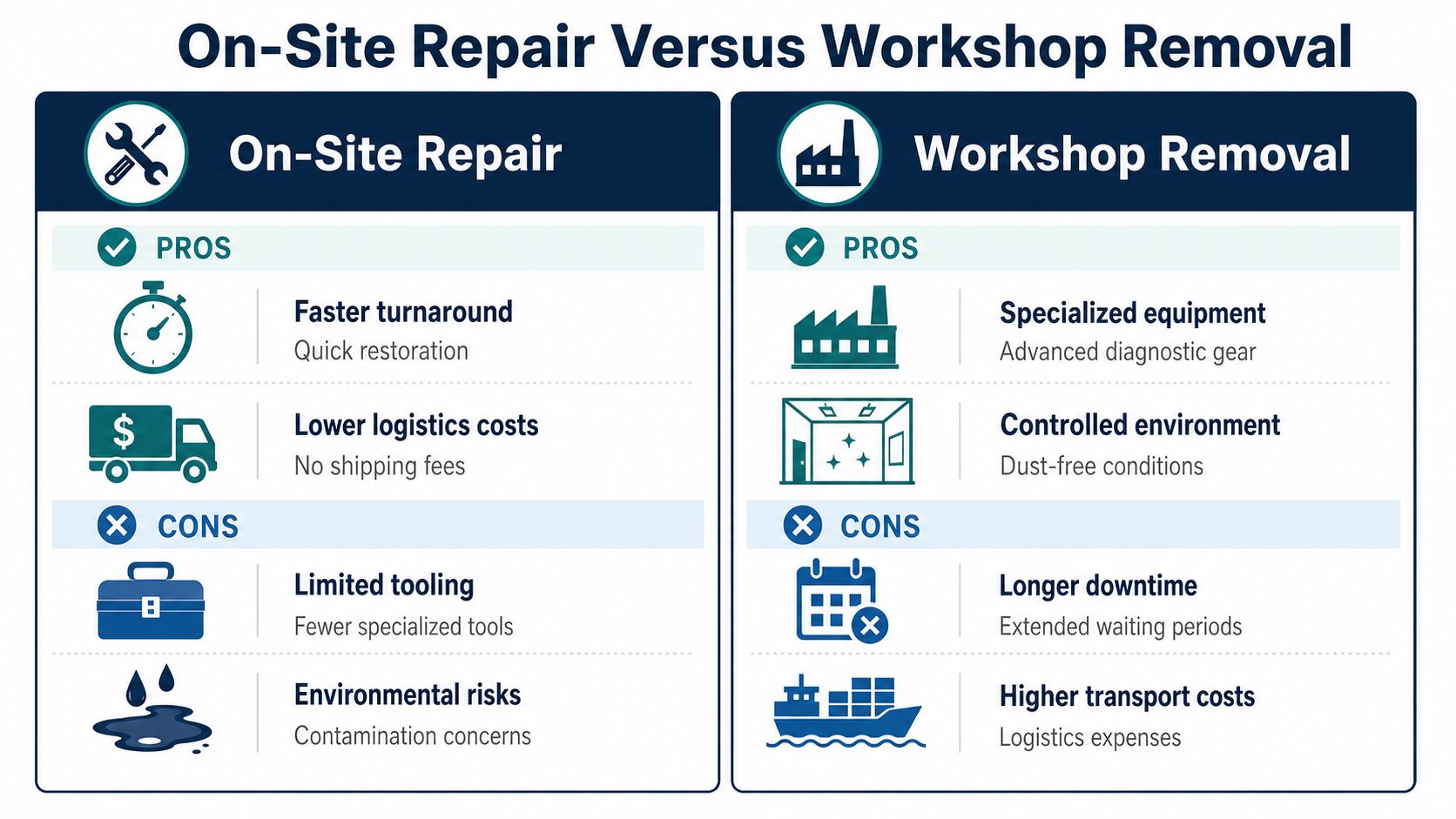
The repair location decision is usually decided by logistics before it's decided by technology. If a medium-voltage drive is large, tightly integrated, or sitting inside a restart-critical line, taking it offsite can add transport risk, handling risk, and schedule risk that have nothing to do with the actual fault. If the failure is deep in the power stack or needs a cleaner bench environment, workshop removal may still be the right move.
When on-site work wins
On-site repair works best when the cabinet can stay in place, the surrounding infrastructure is stable, and the shutdown window is short. It also helps when contamination or thermal aging is part of the problem, because you can clean, test, and recondition the asset in the environment where it runs. For operators, the main advantage is that the path back to service is usually simpler.
On-site recovery also avoids the problem of losing time to transport, unpacking, and requalification. If a line is already down and every extra day has a process cost attached to it, the fastest safe restoration path often wins.
When workshop removal is the better call
Workshop repair makes more sense when the fault needs specialized tooling, deep component access, or a controlled environment. It also fits situations where the equipment is small enough to move without exposing it to additional damage. If contamination is severe enough that field cleaning won't remove the risk, offsite work can be more dependable.
A good decision usually comes down to four questions.
- Can the asset stay in place safely? If not, move it.
- Will transport make the condition worse? If yes, keep it on site.
- Do we have enough shutdown time? If not, prioritize local recovery.
- Is the fault likely to need bench-level repair? If yes, choose the workshop.
DUCHENG Industrial is one option for facilities that need commissioning, troubleshooting, workshop repair, or on-site reconditioning of VFD assets, especially when transport is impractical and the restart window is tight.
The strongest programs don't treat the location decision as a fixed policy. They use equipment size, contamination exposure, restart urgency, and available support resources to choose the lower-risk path every time.
Diagnostic Methodologies That Prevent Repeat Failures
Recurring trips are expensive because they waste labor twice, once on the fault and again on the restart. They also hide the underlying cost of electrical reliability services, which should show up as fewer downtime hours, fewer nuisance trips, and longer time between failures. The difference between a temporary fix and a lasting one is usually fault isolation. If the team does not separate the drive, upstream power quality, control logic, and environmental stress, the same failure will come back wearing a different fault code.
Start with the failure mechanism, not the symptom
A structured diagnostic process begins by asking whether the trip is electrical, mechanical, environmental, or control-related. That sounds obvious, but field troubleshooting often skips straight to part replacement because the plant is under pressure. The better move is to preserve evidence, review event history, and test each likely path in order. That approach shortens mean time to repair, but more important, it keeps the root cause in view so the next outage is less likely to repeat the same failure.
Power quality issues can look like drive problems. Control instability can look like a hardware fault. Contamination can look like random overheating. If you do not separate those conditions, you end up replacing healthy components and leaving the underlying failure mechanism untouched.
Use runtime behavior to narrow the cause
Runtime behavior tells you a lot when it is read in context. Repeated momentary trips point one way, long restoration windows point another, and those patterns matter because the right correction is different for nuisance trips, feeder instability, and true equipment damage. That kind of interpretation is the part of IEEE 1366 reliability indices that is worth carrying into plant troubleshooting.
After the first pass, controlled restart procedures matter. A staged restart can reveal whether the fault appears under load, during acceleration, after thermal soak, or only when a specific interlock closes. Those details turn a vague “it won't run” problem into an actionable repair plan, and they also help maintenance teams compare one event against the next instead of treating every trip as a one-off.
Keep the diagnosis portable
Good diagnostics travel across brands and asset ages. The workflow should capture fault codes, input conditions, thermal evidence, and environmental context in a way that operators and technicians can reuse later. A repeatable report is more valuable than a one-time guess because it gives the next shift a clean starting point. For teams that need a consistent way to handle alarms across mixed equipment, a guide to reporting fault codes across brands helps standardize what gets recorded and how it is interpreted.
That reporting discipline pays off when the same asset fails again months later. If the fault history is recorded well, you can compare current behavior to prior events and spot the failure mode faster on the next outage. The practical result is fewer repeat trips, fewer unnecessary replacements, and better evidence for deciding whether the issue is upstream, inside the drive, or tied to the operating environment.
Building a Risk-Based Maintenance Program
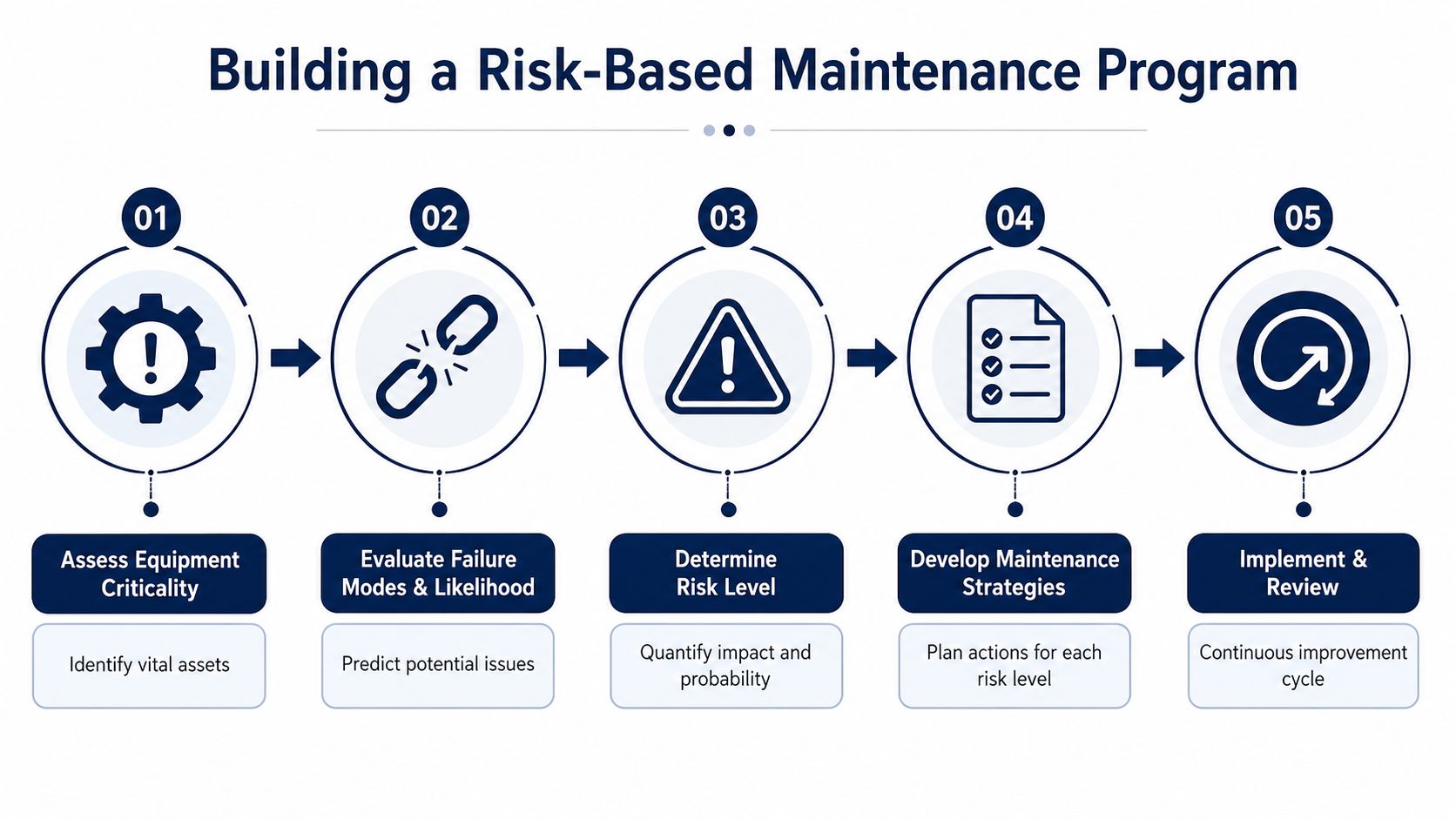
Calendar-based maintenance is easy to schedule and hard to justify when the equipment doesn't need it. Risk-based maintenance starts with the asset's role in production, then asks how failure will show up, how bad the consequence is, and what can be done before the next outage window.
Criticality decides where effort goes
Not every cabinet deserves the same attention. A spare feeder with low consequence can wait, while a drive tied to a bottleneck process cannot. The first step is to assign criticality based on what the asset does to throughput, safety, and restart complexity when it fails.
That criticality view changes the maintenance plan. High-consequence assets get closer inspection intervals, better spare coverage, and earlier intervention thresholds. Lower-risk assets can stay on a lighter touch plan without draining labor on low-value work.
Condition data should change the plan
Risk-based programs only work when the plant uses evidence. If thermal images show a hot connection, if contamination keeps returning, or if a drive's behavior drifts over time, the maintenance plan should change. Sticking to a fixed schedule after you've seen those warning signs is just another form of guesswork.
Practical advice: don't let inspection turn into paperwork. If the findings don't change the next shutdown plan, the inspection probably wasn't worth much.
Build around shutdown windows and spares
The best maintenance work happens when the plant is already down for a reason. That's when preventive deep cleaning, re-termination, reconditioning, and functional checks can be bundled into one window instead of creating a second outage later. Spare parts strategy matters too, because compatible exchange parts and verified replacements can turn a multi-day wait into a controlled recovery.
Monitoring architecture should support that discipline, not replace it. Whether the data comes from simple condition checks or more connected systems, the goal is the same, give maintenance a reason to act before the failure gets expensive. For facilities building out a monitoring and data approach, digital twin predictive maintenance is worth reading as a broader concept.
Risk-based maintenance pays off when it makes the work more selective. Fewer unnecessary interventions, more timely ones, and a better match between spend and actual failure exposure.
Measuring Reliability Service Outcomes
Electrical reliability services are easy to describe and hard to justify unless the result is measured. A plant can spend money on commissioning, maintenance, or reconditioning and still not know whether the work reduced risk. The right approach is to compare baseline behavior to post-service behavior in the same operating context, so the review reflects what changed in the field.
The metrics that matter
Mean time between failures, trip rate, downtime-hours prevented, and restoration time are the measures that matter most on site. They show whether the equipment is failing less often, whether recovery is faster, and whether the service reduced real production loss. If those numbers do not move, the work did not move risk in a meaningful way.
| Reliability Metrics Before and After Service Interventions | Before Service | After Service | Improvement |
|---|---|---|---|
| Mean time between failures | Baseline established before intervention | Tracked after maintenance or repair | Longer run intervals when root causes are removed |
| Trip rate | Repeated nuisance or fault trips | Fewer interruptions after corrective work | Lower interruption frequency |
| Downtime-hours prevented | Unplanned outage exposure before service | Reduced stoppage exposure after service | Less lost production time |
| Restoration time | Slower recovery during fault events | Faster return to service after diagnosis and repair | Shorter outage duration |
| Repeat failure pattern | Fault returns after restart | Fault does not reappear as quickly | Better fault isolation and correction |
The table is not there to promise a specific lift. It forces a before-and-after comparison that reflects the actual asset, the actual process, and the actual repair scope. That is the difference between a service record that reads well and one that helps a plant justify spend.
Build the baseline before you need the answer
A useful baseline includes fault history, operating conditions, and the context around the last outage. If the environment is dirty, hot, or vibration-prone, that belongs in the record. Without that context, post-service results get blurred by changes in load, weather, or operating mode.
The service record should show what was found, what was changed, and what was left alone. That is how maintenance teams separate real improvement from short-term luck. It is also how operations and finance see whether the spend reduced exposure or merely moved the timing of the next failure.
Use outcome language, not service language
Saying a drive was cleaned, tested, and recommissioned is not enough. Say whether trip frequency fell, whether restoration time improved, or whether the site avoided another production stoppage. Those are the measures that let a plant compare one maintenance dollar against the cost of lost uptime.
That is the opening a service provider can use in field reporting, since lifecycle VFD work is centered on commissioning, troubleshooting, repair, and on-site reconditioning rather than a simple checklist of tasks. If the reporting stays tied to measurable outcomes, the buyer can judge whether the work improved reliability or only documented activity.
Implementing Your Electrical Reliability Strategy
Start with a simple assessment of what fails, how often it fails, and what the plant loses when it does. If the current response depends on memory or individual technicians, the program is still fragile. A good reliability strategy standardizes the first response, the diagnostic path, and the decision on whether to repair on site or remove the equipment.
Ask the provider the right questions
Any service partner should be able to explain how they isolate faults, how they handle controlled restart, and when they recommend on-site work versus workshop repair. They should also be able to show experience with the type of equipment you run, because a general promise is not the same as a field-tested method. For facilities with multi-brand VFD fleets, that matters fast.
You also want to know how findings are documented, how spares are verified, and how recommendations are tied to failure modes. A report that tells you what happened is useful. A report that tells you what to do before the next outage is better.
Match the contract to the risk
Preventive maintenance contracts fit predictable assets with known shutdown windows. On-demand service agreements fit intermittent needs where response speed matters more than scheduled visits. Full lifecycle support fits critical drives and systems where commissioning, troubleshooting, maintenance, and reconditioning all touch the same asset over time.
A short checklist keeps the decision grounded.
- Define the critical loads: List the assets whose failure would stop production or create safety risk.
- Review the failure history: Look for recurring trips, contamination, and thermal stress.
- Map the shutdown windows: Identify when work can happen without creating a second outage.
- Confirm service scope: Make sure diagnostics, repair, and restart support are covered.
- Set outcome tracking: Measure trip rate, restoration time, and repeat-failure behavior.
Once those pieces are in place, the reliability program stops being a set of disconnected visits and starts operating like a managed system. That's when maintenance turns into an operational advantage instead of an emergency expense.
If your plant is dealing with recurring VFD trips, contaminated cabinets, or long return-to-service windows, DUCHENG Industrial can support commissioning, maintenance, troubleshooting, repair, and on-site reconditioning across the VFD lifecycle. Visit DUCHENG Industrial to review its field and workshop service options and see how they fit your reliability plan.