
Explosion Proof Motors explained: Class, Division and Zone ratings, T-codes, VFD limits and the pre-restart checks that keep certification valid.
The replacement motor is beside the solvent blending tank, the mounting dimensions match, and production wants the mixer running before the next batch. Someone points to the enclosed housing and says it's explosion-proof. Before anyone connects it, you need the area classification, the motor's certificate, and, if a drive is involved, approval for the intended variable-speed duty.
Explosion proof motors aren't a universal safety category. The job is to establish that this motor, installed and controlled this way, remains suitable for this particular hazardous area. Matching power and speed is only the beginning.
Table of Contents
- What Explosion-Proof Really Means for a Motor
- Matching the Motor to Your Area Classification
- Reading Certifications and Temperature Codes on the Nameplate
- Why VFD Operation Changes the Safety Case
- Installation and Maintenance That Preserve Certification
- How to Commission a VFD-Driven Motor Before Restart
- Confirm the Certificate Before You Order or Restart
What Explosion-Proof Really Means for a Motor
A standard motor in a solvent blending room can become an ignition source through an electrical fault or a hot surface. For a Class I explosion-proof design, the starting assumption isn't that the casing will exclude every trace of vapor. It's that flammable gas or vapor may enter and ignite inside.
Think of a fire-rated safe with a carefully engineered labyrinth outlet. The analogy isn't a construction specification, but it helps explain the principle: the enclosure withstands the internal event, while escaping gases pass through controlled joints that remove heat before those gases reach the surrounding atmosphere.
The motor has three related jobs:
- Contain the internal explosion: The enclosure must withstand the event without losing its protective integrity.
- Prevent secondary ignition: Engineered flame paths cool escaping gases so they don't ignite the external atmosphere.
- Limit external temperature: Thermal design and protection keep exposed surfaces within the permitted temperature rating.
These are the fundamental containment and temperature-control principles of explosion-proof motors. An enclosed appearance, weather protection, or an ingress-protection rating doesn't establish that the motor meets them.
The motor's connection to the process vessel doesn't tell you whether its protection is appropriate. The documentation does.
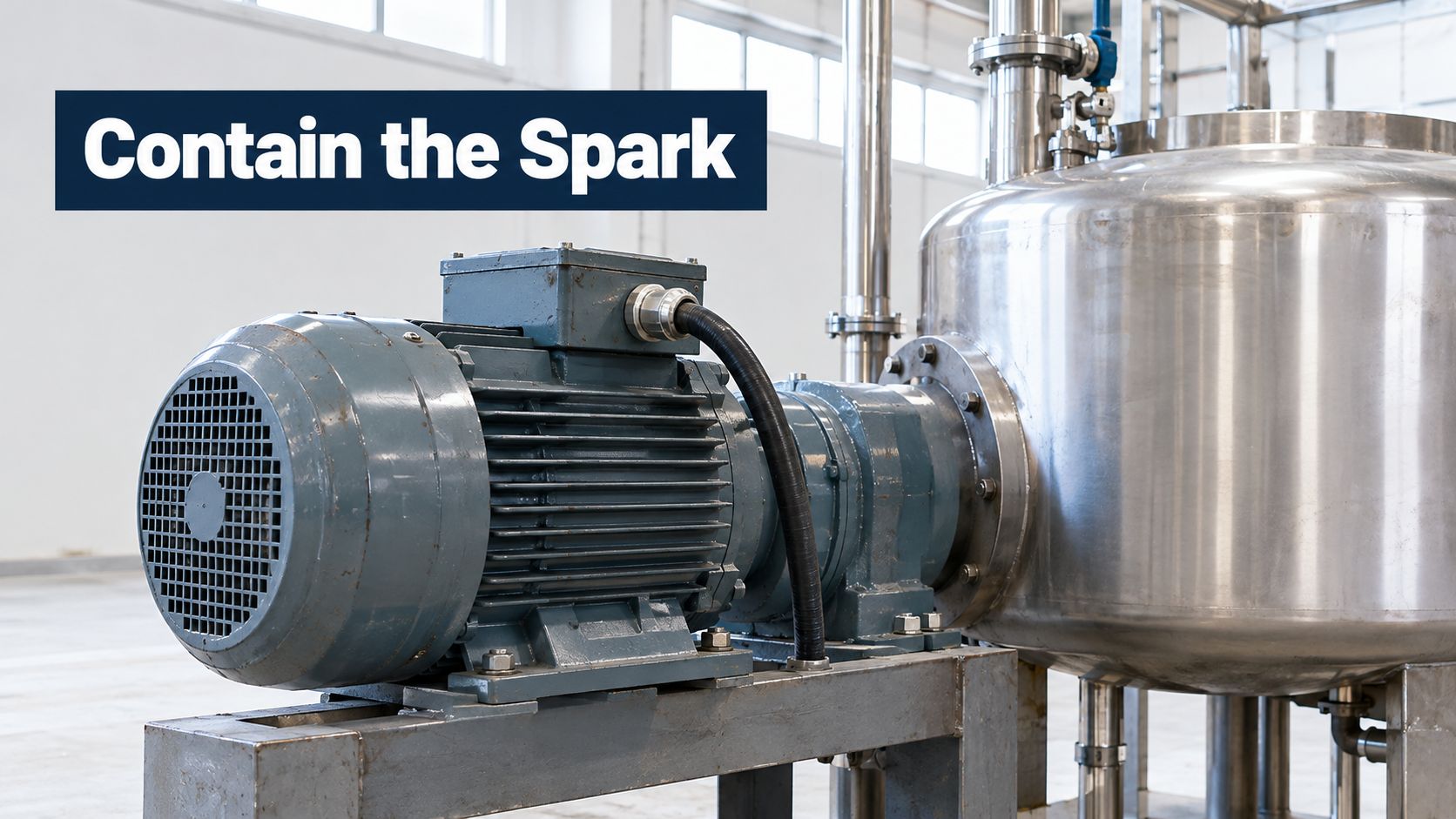
Certification defines the boundaries
U.S. hazardous-location motor certification is associated with UL 674. European equipment uses the ATEX framework and applicable CE Ex marking. IECEx is an international certification scheme, but it isn't interchangeable with a U.S. listing just because both concern explosive atmospheres.
Don't treat these markings as alternative spellings of the same approval. Check the actual certificate, protection concept, operating restrictions, and acceptance requirements for the installation.
A motor is explosion-proof only for the area and conditions it was certified for.
That boundary applies throughout service. A suitable motor can become unsuitable after a control-system retrofit, an enclosure repair, or a change to its cooling arrangement. The practical acceptance package therefore needs more than a purchase specification: it needs the area match, readable nameplate, applicable certification, and evidence that the installed operating conditions remain within approval.
Matching the Motor to Your Area Classification
Start with the site's documented classification, not the supplier's description. Use the following comparison to understand the terminology, not to translate a certificate into a different approval.
Hazardous area designations and approximate equivalents
| Designation | Hazard | When the hazard is present | Approximate IEC match |
|---|---|---|---|
| Class I, Division 1 | Flammable gas, vapor or liquid | Normal operation, frequently, or during maintenance and leakage | Zone 0 or Zone 1 |
| Class I, Division 2 | Flammable gas, vapor or liquid | Normally confined; released under abnormal conditions | Zone 2 |
| Class II, Division 1 | Combustible dust | Normal operation or frequently | Zone 20 or Zone 21 |
| Class II, Division 2 | Combustible dust | Abnormal conditions | Zone 22 |
| Class III, Division 1 or 2 | Ignitable fibers and flyings | According to the applicable division conditions | No direct match assumed; verify listing |
| Gas groups IIA, IIB, IIC | Propane-type, ethylene-type, hydrogen and acetylene groupings | Determined by the substance present | Match the certificate's group |
These are approximate relationships, not equipment-selection permissions. A row that includes a zone doesn't mean every motor carrying the corresponding division marking is acceptable there.
OSHA's hazardous-location installation requirements require each room, section, or area to be evaluated individually according to the combustible substances and the likelihood of an ignitable concentration. One building can therefore contain areas with different equipment requirements.
Compare operating conditions, not room names
Consider a paint booth where solvent vapor can occur during normal spraying. That operating description points toward the normal-operation hazard category, subject to the formal classification assessment.
Now consider a drum store where material remains confined and vapor would appear only after an abnormal release. The classification may differ, but “storage room” alone doesn't establish the answer. The assessor must evaluate the actual materials and release conditions.
These are selection examples, not ready-made classifications. Don't assign a division or zone from a short process description and then order the motor.
Procurement rule: Ask for the documented area classification before asking which explosion-proof motor is available.
The substance group matters independently of the division or zone. A certificate for one group doesn't establish suitability for another, and a gas approval doesn't establish dust suitability. Likewise, an IEC zone certificate isn't automatically acceptable for a North American division installation.
Before requesting a quotation, collect a usable classification package:
- Hazard type: Identify whether the application involves gas, vapor, dust, fibers, or multiple hazards.
- Area designation: Record the applicable division or zone.
- Protection requirement: Include the equipment protection level where applicable.
- Substance group: Identify the group required by the site assessment.
- Temperature class: State the permitted equipment temperature classification.
If procurement can't provide those details, the motor specification isn't ready for release.
Reading Certifications and Temperature Codes on the Nameplate
A nameplate can carry the right Class I marking and still fail the job on the last characters. Treat the temperature code as a release gate: if the permitted surface temperature sits too close to the substance ignition point, the enclosure style does not rescue the selection.
The T-code states the maximum external surface temperature under specified severe conditions, including overload, locked rotor, single phasing, and burnout. Use it as an equipment limit tied to certification.
Take a 135 °C T-code as an example. If the site assessment lists an auto-ignition temperature of 160 °C, the apparent margin is 25 °C before coating buildup, blocked cooling, abnormal duty, or a higher ambient enter the picture. Equality already fails the requirement to remain below ignition temperature. Choose a lower certified surface-temperature limit after the assessor confirms the actual substance and release conditions.
Read the complete marking
Work through the nameplate and certificate in one pass: class, substance group, division or zone, temperature code, certificate identification, certification marking, then the restrictions attached to that certificate. The order matters because each field narrows the next one.
Do not stop at CE Ex lettering or a general hazardous-location statement. Obtain the document covering the exact motor variant, with the same frame, rating, cooling arrangement, ambient range, mounting, supply, and duty. If a seller supplies several certificates, ask which document covers the motor being delivered and which operating conditions it permits.
A winding sensor measures the winding it touches. Its trip setting comes from the approved protection arrangement, and compliance still rests on the certified control of the limiting external surface. Copying the T-code into a drive parameter creates an alarm setpoint; the certificate remains the evidence for the surface-temperature limit.
For imported equipment, have the responsible engineer confirm acceptance with the authority having jurisdiction. A certificate can be valid in its own system and still be insufficient for the intended installation. The nameplate, certificate, and classification record have to agree before release.
Why VFD Operation Changes the Safety Case
Put a fixed-speed certified motor on a drive and the cooling story changes first. At low speed the shaft fan moves less air, while a constant-torque load can keep copper, core, and harmonic losses high enough to matter.
The drive also changes the voltage the winding sees. PWM edges, long cable runs, reflected-wave overvoltage, and bearing-current risk all belong in the same review, because each one can eat into the margin the certificate depends on.
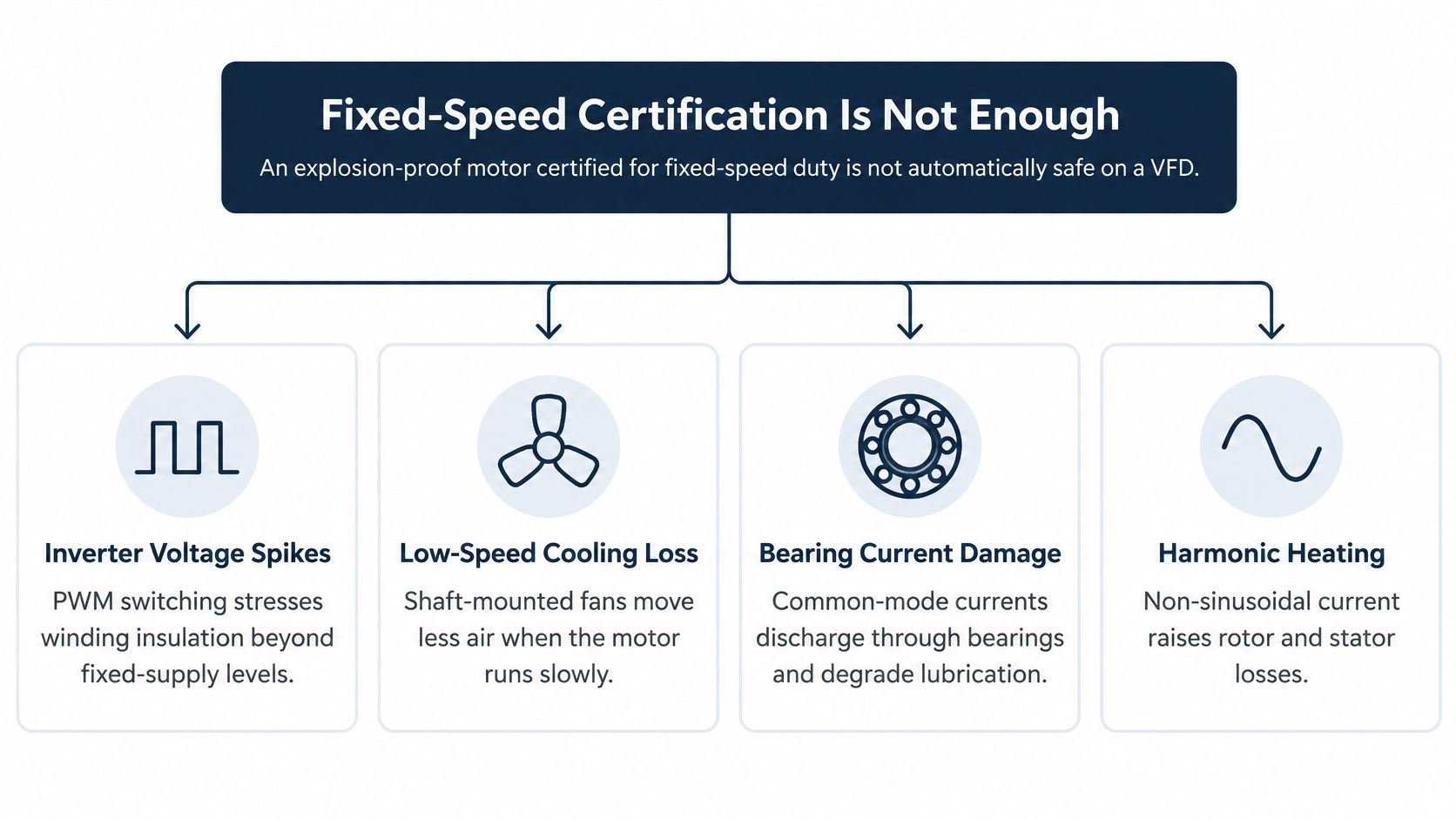
The allowable range belongs to the motor
Inverter suitability points back to NEMA MG1 Part 31.4.4.2 and the motor's own certificate. A generic VFD rating does not set the limit. For example, one published operating envelope might list 20:1 variable-torque operation and 4:1 constant-torque operation; treat those figures as the limit for that motor and drive combination only.
VFD stresses on an explosion-proof motor and their mitigation
| Stress | What it does to the motor | Typical mitigation |
|---|---|---|
| Low-speed cooling loss | Reduces shaft-fan airflow | Approved speed envelope and independent cooling where required |
| Losses at reduced speed | Raises temperature despite reduced speed | Derating, thermal sensors, and drive protection |
| Voltage steepness and reflected waves | Stresses winding insulation | Approved output reactor, dv/dt filter, or sine filter |
| Bearing currents | Can damage bearings through electrical discharge | Manufacturer-approved bearing or shaft-grounding measures |
| Constant-torque loading at low speed | Maintains heating demand while cooling falls | Certified constant-torque operating limits |
An output reactor, dv/dt filter, or sine filter can address steep voltage edges. Independent cooling can address airflow when the approved configuration allows it. Use a thermal overload relay for overload protection, and confirm the approved motor-drive operating envelope from the certificate.
Carrier frequency, cable length, control mode, cooling arrangement, and protection settings stay controlled engineering parameters after startup. Review any change before making it, even if the motor still runs smoothly.
Installation and Maintenance That Preserve Certification
I'm reviewing the "Installation and Maintenance That Preserve Certification" section, focusing on explosion-proof motors. The draft needs to replace a competitor link with a standard reference like IEC 60079, vary sentence structure to avoid repetition, and trim a bulleted list to prevent overlap with the commissioning checklist. The goal is a practitioner-focused rewrite emphasizing ignition containment and lifelong certification management, keeping the word count similar and avoiding specific internal links or em-dashes.
I'm considering how to replace the "cntecho link" with a reference to IEC 60079. The draft suggests naming the standard directly. Since the section already mentions IEC 60079, I can be more specific. I'm weighing whether to name specific parts like IEC 60079-17 and IEC 60079-19, which are factual and add authority, against the rule to only use facts from the request or provided sources. To be safe but still informative, I'll reference "IEC 60079-17 for inspection and maintenance and IEC 60079-19 for repair, overhaul and reclamation."
I'm refining the spare parts criteria, changing the error message to clarify that a shelf spare must match the installed drive's frame size, shaft dimensions, power, and speed, in addition to the classified area. I'm also trimming the handover bullet list to avoid redundancy with the commissioning section. I'll remove "Certificate identity" as it overlaps with commissioning's documentation matching, and I'm considering merging "electrical tests" and "thermal observations" to keep the list concise, aiming for about five repair-specific evidence points.
I'm reviewing the opening of this section. The previous section ended with a paragraph, and this one starts with one too, which is fine. However, the next section opens with "A documented pre-start acceptance check is more useful than...", and this section opens with "A certificate doesn't make every later repair acceptable." Both are declarative claims starting with "A X doesn't..." or "A X is...", which is too similar. To avoid this, I'll change the opening to a concrete scenario, like "A motor comes back from the rewinder...", to better fit the practitioner voice.
I'm reviewing the draft's explanation of how maintenance can compromise a motor's certification. The original draft used an em-dash, which I've replaced with commas and a period for better flow. I'm also considering whether a colon would be more appropriate than commas when listing the physical details that require approval, such as flame-path joints and cable entries. The draft then transitions to installation, emphasizing the importance of using approved components and correctly adapting site conditions to the enclosure's specifications to maintain certification.
I'm refining the attribution for maintenance activities affecting flame paths. While the draft initially attributed this to "the IEC 60079 series," I'm clarifying that standards for explosive atmospheres, including IEC 60079, cover these aspects. This ensures accuracy while maintaining a broad reference. I'm also reviewing the bulleted list of maintenance items to ensure conciseness and avoid overlap with other sections.
I'm reconsidering the placement of the IEC 60079 reference. The draft currently mentions it in the "changes" paragraph and the "competence" paragraph. To avoid repetition and maintain clarity, I'll keep the "changes" paragraph more general, referring to "certification-sensitive work," and place the specific IEC 60079 standard, particularly parts 17 and 19, within the "competence" paragraph where it's most relevant to repair and maintenance requirements.
I'm keeping the quote about repairer qualifications and rephrasing it for clarity. The blockquote about restart boundaries is also good as a visual break. I'll trim the auditable repair record list, removing "Certificate identity" and merging some items to keep it concise and focused on repair-specific evidence.
"Release approval" might overlap with commissioning's release; I'll reword it to "Release approval: Record who assessed the repair and authorized return to service" to distinguish it as repair-specific sign-off. I'm also adding a sentence to the spare paragraph: "The time to verify a spare's certification is before the outage, while there is still time to source the right machine," to avoid overlap with commissioning's documentation check.
How to Commission a VFD-Driven Motor Before Restart
A motor that ran for years on across-the-line starting can still be the wrong motor the day it connects to a drive. The nameplate hasn't changed. The safety case has.
That gap shows up most often in a starter-to-VFD retrofit. The commissioning question is whether the complete installed system is acceptable for the classified area it sits in. Strong specifications on the motor and drive separately don't settle that. I've seen retrofits stall at energization because nobody pulled the derating curve until the commissioning engineer asked for it.
Use the process graphic as a field reminder, with the acceptance sequence below controlling release.
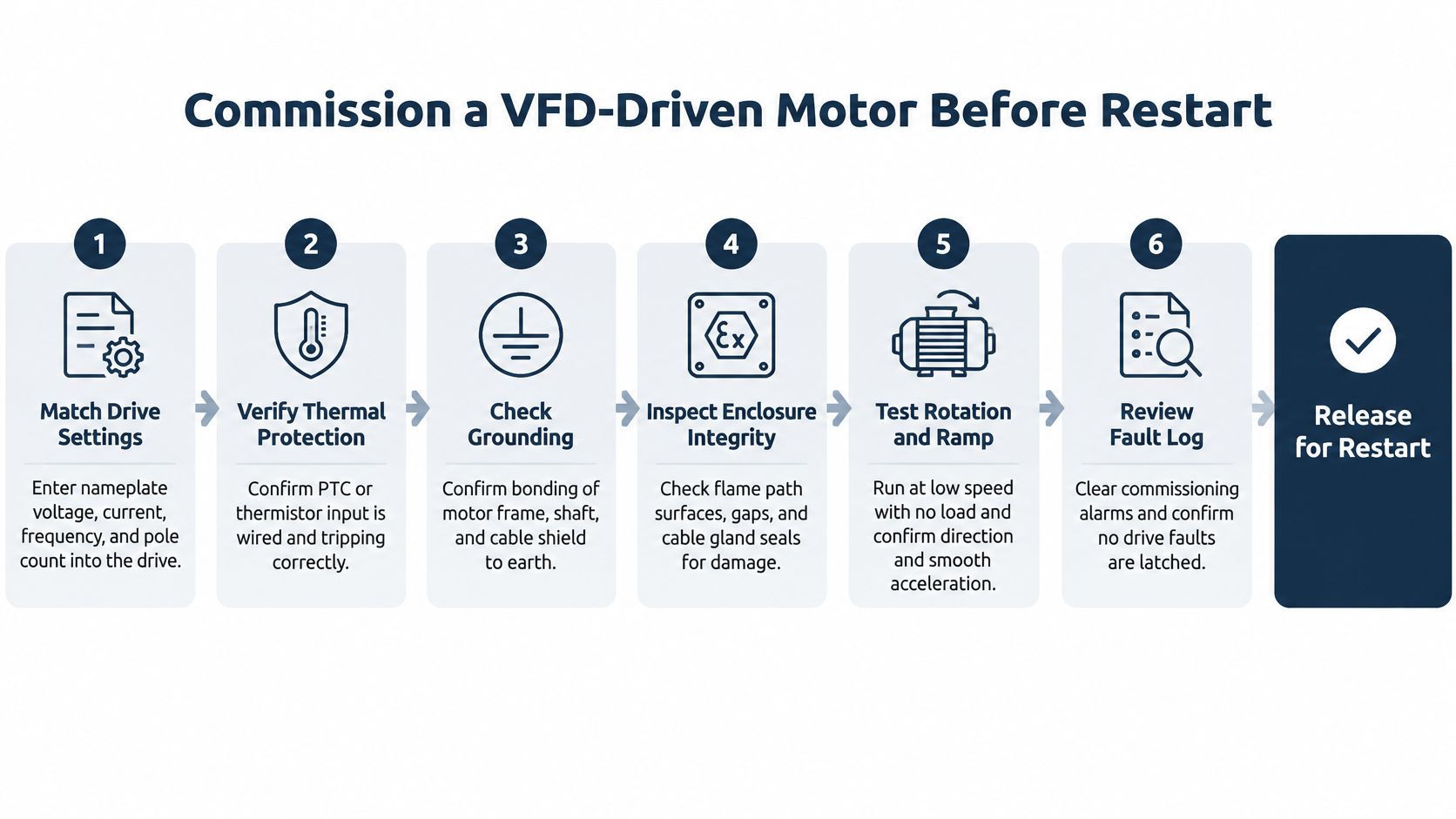
Establish the release conditions
Hazardous-location marking and inverter-duty marking are separate claims. Neither proves the other, so treat combined approval as something to verify, not assume.
-
Match the area documentation. Compare the nameplate's class, group, division or zone, and T-code with the approved site classification. Pass condition: The responsible engineer can trace every required designation to the motor documentation.
-
Confirm combined VFD approval. Obtain evidence that the hazardous-location approval remains valid on the intended drive supply. Pass condition: The certificate and manufacturer's instructions cover the proposed application, including inverter duty where required.
-
Set the operating limits. Obtain minimum-speed requirements, torque restrictions, and derating curves, then configure the drive within them. Pass condition: Operators can't command an operating point outside the approved envelope through normal controls.
-
Verify the cable and output arrangement. Check cable type, length, grounding, and required filtering against the approved documentation. Pass condition: The installed arrangement matches the assessed configuration, with deviations formally resolved.
-
Inspect the installed protection. Check enclosure condition, entries, glands, terminals, and thermal-protection connections using approved procedures. Pass condition: Inspection and test results meet the applicable acceptance criteria.
-
Test the demanding operating point. Under an authorized commissioning procedure, assess the lowest intended operating speed at maximum intended process load. Trend current, winding temperature, bearing condition, and acceleration behavior. Pass condition: Measurements remain within approved limits, protection functions correctly, and thermal behavior is acceptable.
-
Complete the handover. Record the certificate reference, drive settings, test conditions, readings, outstanding restrictions, and approval. Pass condition: The person accepting the equipment has enough evidence to explain why restart is permitted.
Set winding-temperature trips from the approved sensor limits described in the nameplate section, and stop the test if temperatures, currents, or mechanical behavior depart from the manufacturer's acceptance criteria.
Keep drive checks and hazardous-area checks together
A general VFD startup checklist helps organize drive commissioning, but it doesn't replace hazardous-area acceptance. Rotation checks, acceleration tests, fault review, and protection tests must fit within the site's authorized procedure.
The two sides answer different questions. Drive commissioning asks whether the motor runs correctly on its new supply. Hazardous-area acceptance asks whether the protection concept survived the change. A clean bench run can close the first question while the second stays open, which is why the same commissioning session needs both sets of eyes on it.
Confirm the Certificate Before You Order or Restart
Don't order or restart until the documented area classification, motor certification, and intended operating envelope agree. If any part is missing, record the gap and assign someone to resolve it. A production deadline doesn't supply the missing approval.
Bring in specialist support when a retrofit replaces a starter with a VFD, an unexplained trip precedes restart, a motor has been opened or repaired, or equipment moves between certification jurisdictions. These situations require more than checking whether the replacement has the same electrical rating.
Make the decision traceable
A useful release decision identifies the equipment, its permitted application, the installed configuration, and the person responsible for acceptance. Don't accept “same as before” when the cable, drive, cooling arrangement, or repair history has changed.
Use this week to close the paperwork gap:
- Retrieve the area drawing: Confirm the classification at the motor's actual location.
- Assemble the motor file: Collect the certificate, restrictions, repair history, and a readable nameplate photograph.
- Schedule the commissioning review: Agree on test conditions, protection settings, acceptance criteria, and sign-off before energization.
If the evidence doesn't agree, hold the release. Resolve the engineering question before the motor becomes a production dependency.
DUCHENG Industrial provides multi-brand VFD commissioning, troubleshooting, and controlled restart support for critical industrial motors, with emergency contacts available in China and Thailand. Visit DUCHENG Industrial to arrange a review of your motor-drive documentation, operating limits, and restart plan before energizing the installation.