
A practical guide to industrial asset management for VFDs and drive fleets, covering lifecycle strategy, spare parts, and digital tools.
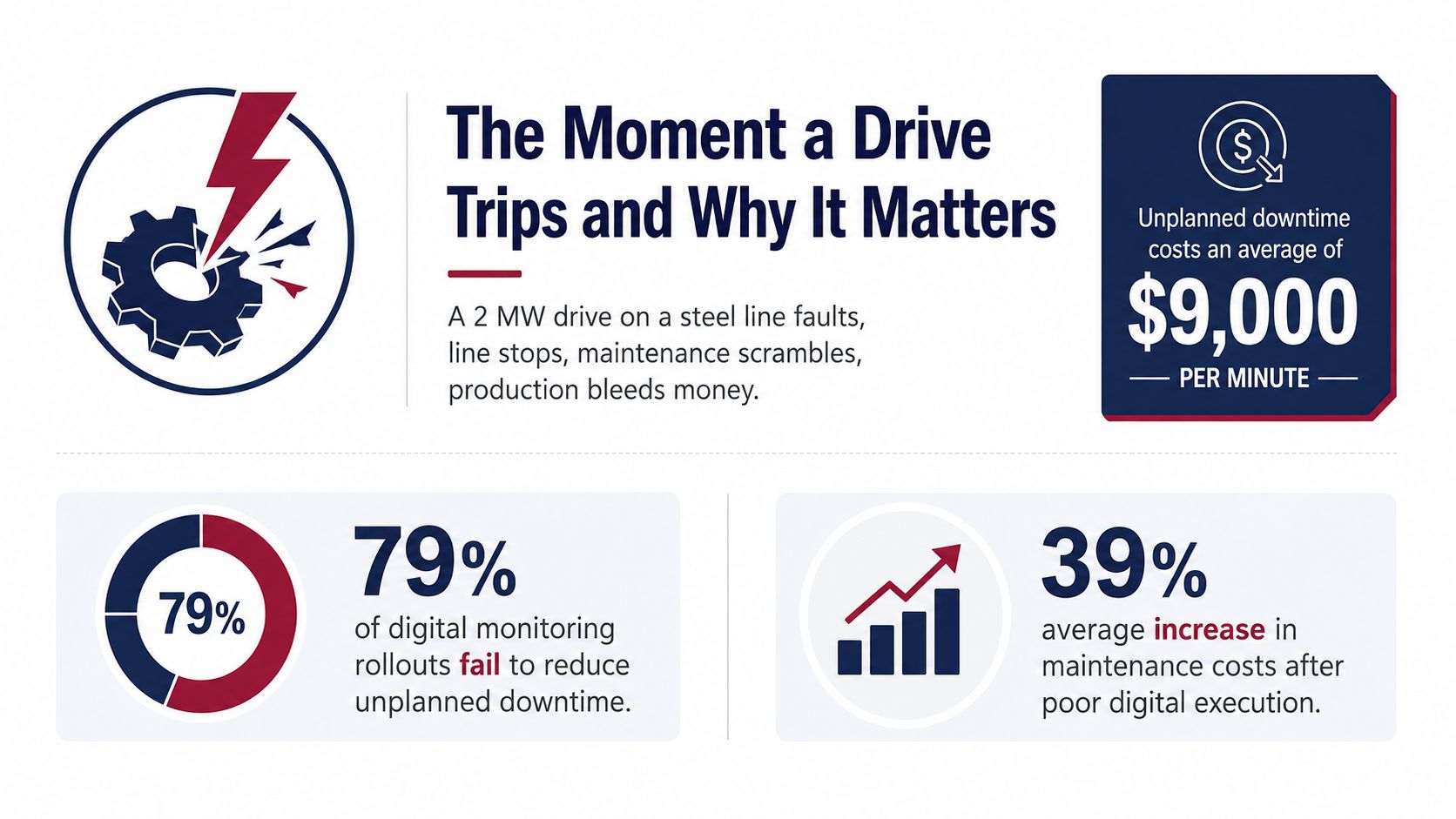
A drive fault rarely arrives at a convenient time. The line is loaded, the operator is waiting for a restart decision, production is already stopped, and the maintenance team is trying to determine whether the fault came from the drive, the motor, the load, the cabinet environment, or an earlier repair. In a VFD-heavy plant, that first decision often determines whether the outage lasts minutes, hours, or much longer.
A 2 MW drive on a steel line can trip because of a failing cooling fan, contaminated heatsink, loose termination, aging capacitor, or stressed power module. The fault code may identify the symptom, but it rarely provides the complete repair decision. Industrial asset management exists to connect condition, criticality, lifecycle stage, spare-parts readiness, and work execution before the trip occurs.
The financial backdrop is severe. One 2024 industry report cited an average unplanned-downtime cost of about $25,000 per hour, rising above $500,000 per hour for larger organizations. A separate maintenance benchmark reported that an average large manufacturing plant loses $253 million per year from unplanned downtime, while the average facility experiences 25 downtime incidents per month and approximately 326 downtime hours annually. These figures are documented in industry reporting on downtime costs and maintenance performance.
The practical questions are straightforward, even when the answers aren't: Should we repair this drive, recondition it on site, or replace it? Do we have the right spare? Who has authority to restart? What evidence supports the decision? A controlled response begins with structured diagnosis and restart procedures, such as the approach described in this guide to the first steps after a drive trip. It then depends on lifecycle planning, verified parts, consistent repair thresholds, and digital monitoring tied to people who act.
Table of Contents
- The Moment a Drive Trips and Why It Matters
- What Industrial Asset Management Really Means
- The Drive Lifecycle From Commissioning to Late Life
- Refurbishment Versus Replacement Decisions
- Spare Parts Policy as a Reliability Decision
- Digital Tools and Governance That Actually Work
- A Practical Audit for Your Asset Management Program
The Moment a Drive Trips and Why It Matters
At the control desk, the operator sees the line drop out. The drive cabinet is still energized, alarms are active, and the production supervisor wants a restart estimate. The electrical technician checks the fault history, while another person heads to the cabinet to look for heat, dust, loose wiring, or a visible component failure. Nobody wants to make the wrong call, but every minute adds operational pressure.
The dangerous response is to treat the fault as an isolated event. A reset may clear an overtemperature alarm without removing the cause. Replacing a fuse may restore power while leaving a damaged semiconductor or loose connection in place. Sending the complete drive away for repair may solve the technical problem but create a second problem through transport, handling, and a longer outage window.
Industrial asset management changes the question from “How do we get this running?” to “What intervention protects this asset and this production process?”
That distinction matters because unplanned downtime costs have risen as plants become more integrated. The cited maintenance reporting found that the hourly cost of unplanned equipment downtime roughly doubled between 2019 and 2024, making failure prevention and recovery discipline more valuable than a fast but poorly controlled reset. The same source reported that larger organizations can face downtime costs above $500,000 per hour. Those numbers don't mean every trip has the same financial impact, but they do show why a drive fleet needs decisions made before an incident.
What the maintenance manager needs ready
A reliable response starts with information that can be reached during a fault, not reconstructed afterward:
- Asset identity: The team should know the drive rating, application, motor, firmware or hardware revision, service history, and criticality.
- Failure history: Repeated overtemperature, ground-fault, overvoltage, or communication alarms should trigger a broader investigation.
- Spare status: A verified exchange unit or critical component should have a defined location, condition, and owner.
- Decision authority: Operations, electrical maintenance, engineering, and safety personnel should understand who approves a restart, repair, or replacement.
- Restart evidence: The work record should capture what was tested, what was changed, and what conditions must be monitored after return to service.
The trip is visible. The weak asset-management system behind it is usually not. Plants reduce repeat failures by governing the decisions around the drive, not by collecting more alarm screens after the line has already stopped.
What Industrial Asset Management Really Means
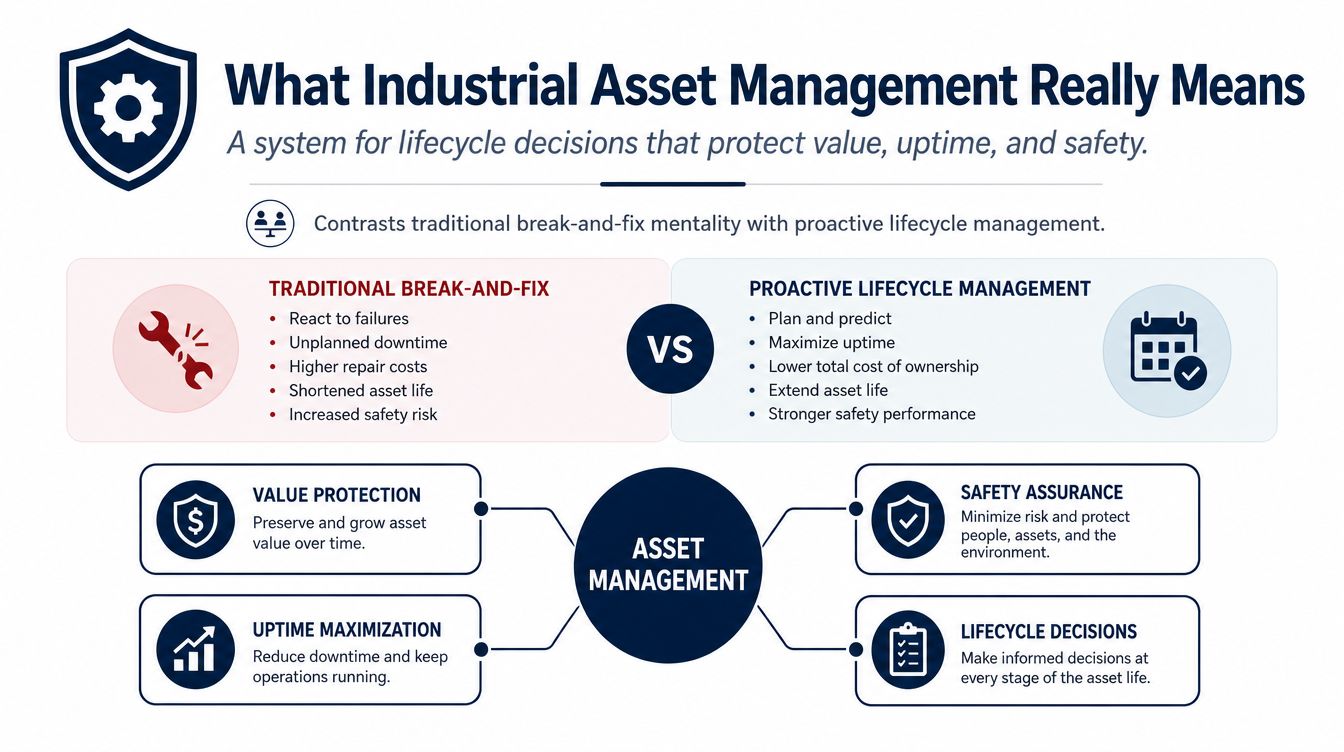
Industrial asset management is a lifecycle decision system. It coordinates how a plant identifies, operates, maintains, refurbishes, upgrades, and retires physical assets so the organization can realize value while protecting uptime, safety, and cost control. That definition is consistent with the lifecycle perspective in ISO 55000, which positions asset management around realizing value from assets rather than treating maintenance as repair activity alone.
A break-and-fix program asks whether a failed drive can be repaired. A mature program asks a wider set of questions:
- What does this drive do for the process?
- What happens if it fails?
- What condition is it in today?
- Which failure modes are developing?
- Is the installed platform still supportable?
- Which intervention gives the plant acceptable risk at an acceptable lifecycle cost?
The difference is practical. A low-criticality auxiliary drive may justify a run-to-failure approach if a compatible spare is immediately available and the process can tolerate the outage. A line-critical medium-voltage drive may require condition checks, planned component renewal, a tested exchange unit, and a documented replacement horizon even when it appears healthy.
Four decisions that keep the system grounded
Lifecycle strategy sets the maintenance and renewal approach for each asset class. The strategy should distinguish commissioning support, routine preventive care, mid-life inspection, and late-life risk management. A fleet list that shows only equipment tag numbers isn't enough. It should show condition, service history, known defects, spares, and the next decision date.
Spare-parts discipline protects recovery time. Correct identification, approved sourcing, compatibility review, and verification of exchange units prevent a technically plausible part from creating another failure.
Refurbishment judgment keeps plants from replacing healthy subsystems unnecessarily, while also preventing teams from investing in a platform with several aged or obsolete sections. The decision must account for contamination, thermal stress, component age, application duty, and transport risk.
Digital governance turns condition data into work. A dashboard can display a temperature trend, but it won't clean a heatsink, inspect a fan, approve a shutdown, or document a restart. People need clear ownership for reviewing alerts, assigning work, validating findings, and closing the loop.
Practical rule: If an asset record can't support a repair, recondition, replace, or defer decision during a real outage, it isn't yet an asset-management record. It's an inventory entry.
The software matters only after those decisions are defined. A plant can operate with different systems for maintenance records, condition monitoring, and spare parts, provided the data has clear identifiers and the people using it follow the same decision rules.
The Drive Lifecycle From Commissioning to Late Life
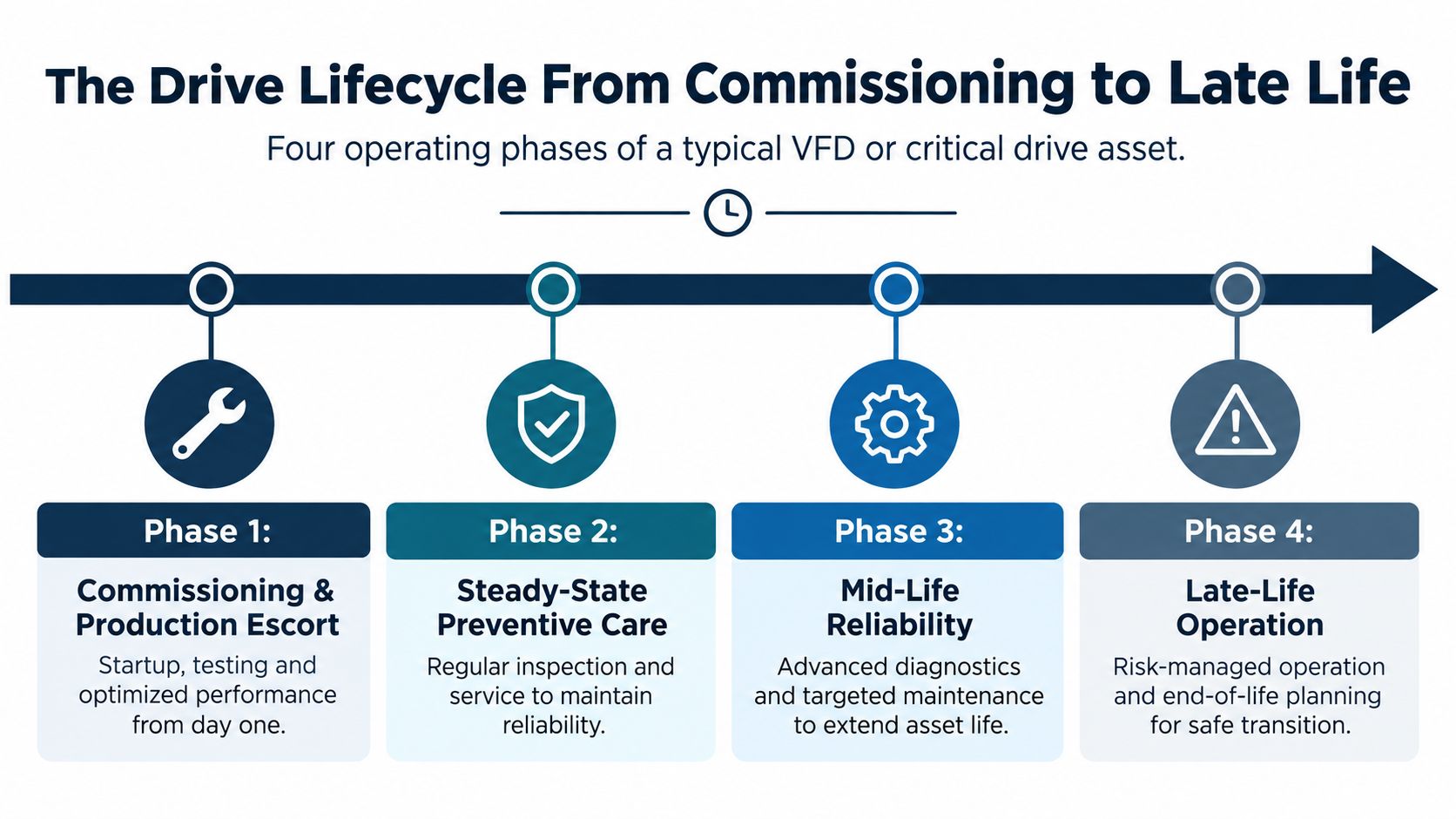
A VFD doesn't have one maintenance requirement for its entire service life. The work that protects a newly commissioned drive differs from the work that controls risk in a contaminated, late-life cabinet. Plants get into trouble when they apply one generic maintenance interval to every phase.
Commissioning and production escort
The first phase establishes the baseline. Confirm power quality, motor data, control parameters, cooling arrangements, cabinet condition, interlocks, and actual load behavior. The team should record abnormal vibration, temperature, nuisance alarms, and operating conditions during production escort.
This work is more than a startup checklist. It gives future technicians a reference point. Without a commissioning baseline, later changes are difficult to separate from normal operating variation.
Steady-state preventive care
Routine care should target the causes that technicians can control. Inspect filters and heatsinks, check airflow, look for contamination, verify terminations, review fault history, and compare operating conditions with the drive's specification. In VFD-intensive plants, overheating, contamination, loose connections, aging capacitors, and stressed IGBTs can interact. A small airflow restriction can increase thermal stress, while a loose connection can create heat that appears only under load.
The maintenance schedule should match the environment and duty. A clean indoor cabinet and a drive beside a process that produces conductive dust shouldn't receive identical inspections.
Mid-life reliability
Mid-life work focuses on evidence and planned risk reduction. Review recurring faults, inspect cooling components, test relevant electrical sections, verify spare availability, and assess whether the current platform remains supportable. A documented diagnostic methodology earns its value here. Technicians can use trend history and physical inspection to distinguish a one-off external event from a drive that is entering a higher-risk stage.
A planned shutdown is often the right time for component-level inspection, cleaning, thermal checks, and functional testing. The aim isn't to dismantle every drive. It's to identify assets whose condition or criticality justifies deeper work.
Late-life operation
Late-life assets need an explicit plan. Cooling fans are commonly replaced every 2–3 years, while DC bus capacitors are commonly addressed around 5–7 years, according to the maintenance guidance summarized in the verified asset-management data. Many drives are specified for an ambient range of approximately 0–40 °C, unless designed for higher temperatures. These intervals and conditions are not automatic replacement orders, but they are strong prompts for inspection, testing, and renewal planning.
The biggest gap often appears at the transition from mid-life to late life. The drive keeps running, so the plan remains unchanged. Then contamination, heat, component aging, and obsolete parts combine during an unplanned stop. A mature program flags late-life drives, assigns a decision owner, and chooses between subsystem renewal, on-site reconditioning, a tested spare, or full replacement before the next failure forces the choice.
Refurbishment Versus Replacement Decisions
The repair-versus-replace decision shouldn't be made from the fault code alone. It should be based on the failed subsystem, the condition of the rest of the drive, the application criticality, the availability of parts, and the practical time required to return the asset to service.
A drive with one failed fan and a clean, supportable power section is a different asset from a drive with aged fans, dry or suspect capacitors, heat-damaged boards, contamination, and an obsolete control platform. Treating both as “failed drives” hides the decision that matters.
The two paths
Refurbishment makes sense when the failure is localized and the remaining assemblies are within an acceptable service condition. The work may include component-level repair, capacitor or fan renewal, cleaning, inspection, bench diagnostics, functional testing, and a controlled return to service. On-site reconditioning becomes particularly valuable for medium- and high-voltage drives when shipping creates handling risk or consumes the available shutdown window.
Replacement is stronger when several subsystems have reached late life, the platform is obsolete, required parts are unavailable, or the repair would only postpone a larger failure. A full changeout can also be the better choice when the plant needs a new control architecture, revised safety functions, or a supportable standard across the fleet.
| Trigger | Lean Toward Refurbishment | Lean Toward Replacement |
|---|---|---|
| Failure scope | One identifiable subsystem has failed | Multiple subsystems show age or damage |
| Component condition | Fans, capacitors, boards, and power sections remain supportable | Several components are beyond their planned service horizon |
| Environment | Contamination or heat can be removed and controlled | Thermal stress or contamination has caused widespread deterioration |
| Parts position | Correct parts are available and can be verified | Critical parts are obsolete, scarce, or uncertain |
| Logistics | On-site or workshop repair fits the outage window | A planned changeout offers better long-term support |
| Fleet strategy | Repair preserves a useful standard and spare model | Replacement reduces platform diversity or operational risk |
The component intervals offer concrete prompts, not mechanical answers. Cooling fans commonly receive attention every 2–3 years, DC bus capacitors around 5–7 years, and ambient conditions should generally remain within the specified range of about 0–40 °C, as documented in the verified maintenance guidance. A drive operating outside those conditions deserves a thermal and condition review before anyone approves a simple reset or narrow repair.
A decision checklist for the next fault
- Confirm the failure boundary: Is the fault inside the drive, or did the motor, cable, load, cooling system, or supply create the condition?
- Review age and history: What has already been replaced, and are similar alarms recurring?
- Inspect the environment: Check dust, moisture, salinity, airflow, temperature, and cabinet sealing.
- Check supportability: Can the exact components, firmware-compatible boards, and test capability be secured?
- Compare risk: Which option gives the plant the more defensible lifecycle decision, not merely the fastest apparent restart?
The right answer may be an on-site blue reconditioning job, a workshop repair, a subsystem upgrade, or a complete replacement. Consistency matters more than preference.
Spare Parts Policy as a Reliability Decision
A spare part is only useful when it is the correct part, available at the right time, and ready for the specific drive that needs it. Procurement teams often focus on price and delivery while maintenance teams focus on fit. Reliability requires both groups to control identification, compatibility, condition, and verification.
A plant can hold a part that looks correct and still be unprepared. A capacitor may have the wrong electrical characteristics. A fan may fit physically but deliver the wrong airflow. A control board may belong to a different hardware revision or require firmware compatibility that the team hasn't checked. An exchange unit can appear complete while carrying an unresolved defect from a previous repair.
Four controls that prevent repeat outages
Start with identity. Record the exact drive model, rating, serial information, hardware revision, firmware requirements, and application details. Photographing labels helps, but the asset record should remain the controlled reference.
Use approved sourcing channels. The goal isn't to buy an original-looking item. The team needs a traceable source, clear technical documentation, and a process for handling substitutions.
Review compatibility before installation. Compare electrical ratings, mechanical dimensions, connectors, control revisions, environmental requirements, and application constraints. A part that is “compatible” in a catalogue may not be appropriate for the installed configuration.
Verify exchange units before dispatch. Bench diagnostics and functional testing should occur before the unit travels to a critical outage. The verification record should state what was tested, what was replaced, and what limitations remain.
A verified spare is a reliability control. An unverified spare is only a promise.
This discipline has a direct operational benefit. If the correct exchange unit is already tested, the team can spend the outage window diagnosing the root cause and validating the installation instead of discovering a second defect at the point of need. It also improves governance because the repair decision can be tied to known evidence rather than urgency.
Maintain a simple readiness register for critical drives. It should show the spare location, ownership, verification date, compatibility status, preservation requirements, and escalation contact. If the plant can't identify a verified spare on the shelf or within four hours, the asset-management plan for that critical drive is incomplete. That threshold is a practical operating rule, not a universal standard, so each site should adjust it to process criticality and logistics.
Digital Tools and Governance That Actually Work
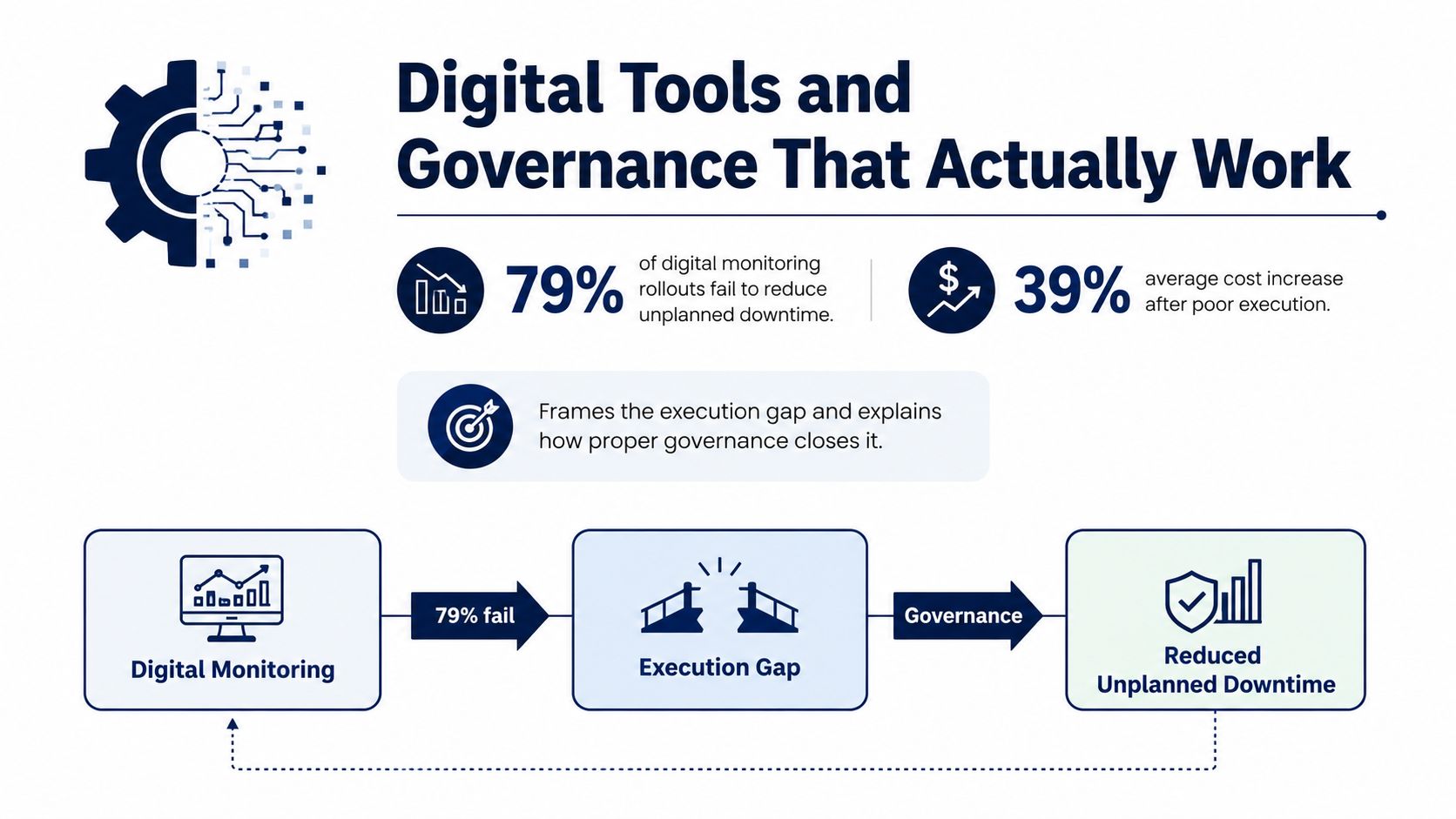
Digital monitoring fails when the plant treats an alert as the outcome. The alert is only an observation. Reliability improves when someone reviews it, confirms the condition, assigns the correct work, completes the intervention, and records what happened.
Recent industry reporting found that 79% of industrial maintenance teams saw unplanned downtime remain the same or increase over the previous year, while 39% of leaders said those events became more expensive, even as organizations expanded AI and proactive maintenance use. The findings are summarized in reporting on the execution gap in industrial maintenance. The message for plant managers is uncomfortable but useful: buying monitoring capability doesn't guarantee better maintenance performance.
The difference between a dashboard and a decision system
A dashboard shows drive temperature, current, alarms, operating hours, or other condition indicators. A decision system adds context and action:
- Alert definition: What change is abnormal for this drive and application?
- Criticality: Does the alert affect a production bottleneck, a safety function, or a recoverable auxiliary?
- Owner: Which person reviews the alert and by when?
- Work response: Does the finding create an inspection, cleaning task, planned repair, spare reservation, or replacement review?
- Closure evidence: What did the technician find, and did the condition return to an acceptable state?
Without those links, teams accumulate notifications. Shift handoffs become informal, technicians repeat inspections, and managers can't tell whether a warning led to a meaningful intervention.
Governance makes data operational
Assign decision rights before installing sensors. The electrical supervisor may own technical validation, the planner may own the work order, operations may own the production window, and reliability engineering may own the failure-mode review. The exact roles vary, but someone must be accountable for every high-consequence alert.
Data arrangements also matter. Asset identifiers should match across monitoring, maintenance, spare-parts, and engineering records. A temperature trend attached to the wrong drive can be worse than no trend because it creates false confidence. Integration should reduce duplicate entry and preserve the history needed to compare condition, intervention, and outcome.
A plant may use an IoT architecture, condition-monitoring system, or digital twin and predictive maintenance approach, but the technology should serve the decision process. DUCHENG Industrial offers an industrial-drive IoT platform with equipment management, health diagnosis, inspections, alarms, faults, and spare-parts management functions. Those capabilities are useful when the plant has already defined who acts on the information and how the action is recorded.
The plant doesn't necessarily need more sensors. It needs clearer decision rights, better handoffs, and work execution that closes the loop.
<iframe width="100%" style="aspect-ratio: 16 / 9;" src="https://www.youtube.com/embed/4yrbvWSRrBQ" frameborder="0" allow="autoplay; encrypted-media" allowfullscreen></iframe>A Practical Audit for Your Asset Management Program
Run the audit against the drive fleet, not just the maintenance department. The purpose is to expose decisions that depend on memory, individual technicians, or emergency procurement.
Lifecycle coverage
- Fleet visibility: Is there a current list of critical, aging, obsolete, and contamination-exposed drives?
- Condition records: Can the team find fault history, inspection findings, component replacements, and restart evidence?
- Phase changes: Does the plan change when a drive moves from steady-state operation into late-life service?
- Risk ownership: Does each critical drive have a named person responsible for the next lifecycle decision?
Spare-parts discipline
- Correct identification: Are exact model, hardware, firmware, and application details recorded?
- Compatibility review: Does someone approve substitutions before purchase or installation?
- Exchange readiness: Are exchange units bench-tested and documented before dispatch?
- Recovery expectation: Can the plant locate a verified spare within its required response window?
Refurbishment and replacement judgment
- Failure boundary: Does the team separate subsystem failure from widespread asset deterioration?
- Environment: Are heat, dust, moisture, salinity, airflow, and cabinet condition part of the decision?
- Late-life plan: Are fan, capacitor, power-stage, and control-platform risks reviewed before failure?
- Changeout logic: Does the plant know when transport, repair uncertainty, or obsolescence makes replacement safer?
Digital governance
- Alert ownership: Does every important alert have a named reviewer and response time?
- Work conversion: Does condition data create an inspection, repair, cleaning, or renewal action?
- Handoff quality: Do shift teams record unresolved alarms and operating restrictions?
- Outcome tracking: Does the plant compare the alert with the actual finding and completed intervention?
The trip at the beginning of this article is preventable in the broader sense. No program eliminates every failure, but a disciplined asset-management system can make the response faster, the repair choice more defensible, and repeat faults less likely. The work lives in ordinary routines, accurate records, verified parts, planned inspections, and governance that gives every warning a human owner.
DUCHENG Industrial supports VFD fleets with commissioning, structured fault diagnosis, workshop repair, preventive care, on-site medium- and high-voltage reconditioning, spare-parts verification, and industrial drive monitoring services. If your plant needs a consistent repair-versus-replace process or a practical lifecycle plan for aging drives, visit DUCHENG Industrial to discuss the next step.