
Compare industrial electrical maintenance services for VFDs and plant assets. Learn how to evaluate repair options, response times, and lifecycle support.
At 2 a.m., a critical VFD trips on a line that can't stop without dragging the rest of production with it. Operators clear alarms, maintenance gets called, and by the time someone opens the cabinet, the plant has already started paying for every minute the drive stays down, through lost throughput, heat soak, mechanical stress, and a shrinking repair window.
That's why industrial electrical maintenance services aren't just about fixing failed gear anymore. In a plant with modern drives, the work is deciding what to inspect, what to monitor, what to rebuild, and what to replace before the next failure turns into a shutdown decision nobody wanted to make.
| Capability | Basic Provider | Advanced Provider | OEM-Certified Partner |
|---|---|---|---|
| Multi-brand VFD support | Limited platform coverage, uneven parts familiarity | Broad support across common drive families, better diagnostics | Deep platform-specific knowledge, stronger fault isolation |
| Field versus workshop work | Mostly on-site resets and quick swaps | On-site triage plus controlled workshop rebuilds | Full lifecycle repair options, including commissioning and restart support |
| Spares sourcing | Depends on ad hoc purchasing | Maintains common critical spares and exchange parts | Better access to compatibility checks and verified substitutions |
| Emergency response | Calls answered, response windows vague | Defined response process and remote support | Structured 24/7 coverage, escalation, and controlled restart planning |
Table of Contents
- Why Industrial Electrical Maintenance Services Matter Now
- Core Capabilities of Modern Electrical Maintenance Providers
- Comparing Service Models for VFD and Drive Assets
- Deciding Between On-Site Repair and Workshop Rebuild
- Hidden Failure Mechanisms That Generic Checklists Miss
- Situational Recommendations by Plant Profile
- Evaluation Checklist for Selecting a Service Provider
Why Industrial Electrical Maintenance Services Matter Now
A 500 kW VFD fails on a night shift, and the problem quickly leaves the cabinet. The critical line stops, upstream equipment cycles outside its normal sequence, and operators move from production control to damage control. By the time the failure is isolated, lost throughput, heat, mechanical stress, and a narrowing repair window have already increased the cost.
The economic pressure is direct. Forbes reporting on unplanned downtime says an automotive manufacturer may lose about $22,000 per minute when a line stops. The same reporting states that the world's 500 largest companies lose about 11% of revenues to unplanned stoppages, equal to roughly $1.4 trillion annually, while the average large plant loses about $253 million per year. These figures show why electrical maintenance, fault isolation, and restart support now belong within the reliability function rather than being treated as background service work.
Why the old electrician-only model breaks down
Modern VFDs combine power electronics, firmware, sensing, communications, cooling, and protection logic. A fault may therefore appear at the drive while the initiating condition sits in the load, power quality, cabinet environment, or control system. A general repair response can clear the code and return the machine to service without addressing that cause.
Practical rule: if the report ends with “reset and monitor,” and no one checked thermal stress, contamination, power quality, or load conditions, the failure has been deferred, not solved.
That distinction should shape how a plant owner selects industrial electrical maintenance services. Response speed matters, but it is only one part of the decision. A quick reset may cost less today and more after a repeat trip; a controlled inspection or workshop rebuild may extend the decision window, while replacement may be justified when parts, condition, or restart risk make repair uncertain.
The provider must help define that choice before the next failure. Ask whether the asset should be repaired on site, rebuilt under controlled workshop conditions, or replaced, and what evidence supports the recommendation. The right service preserves those options instead of forcing the plant to decide under production pressure.
Core Capabilities of Modern Electrical Maintenance Providers
A capable provider doesn't just show up with tools. It brings a service structure that matches how drives fail, how plants run, and how little margin exists once a critical asset drops out of service.
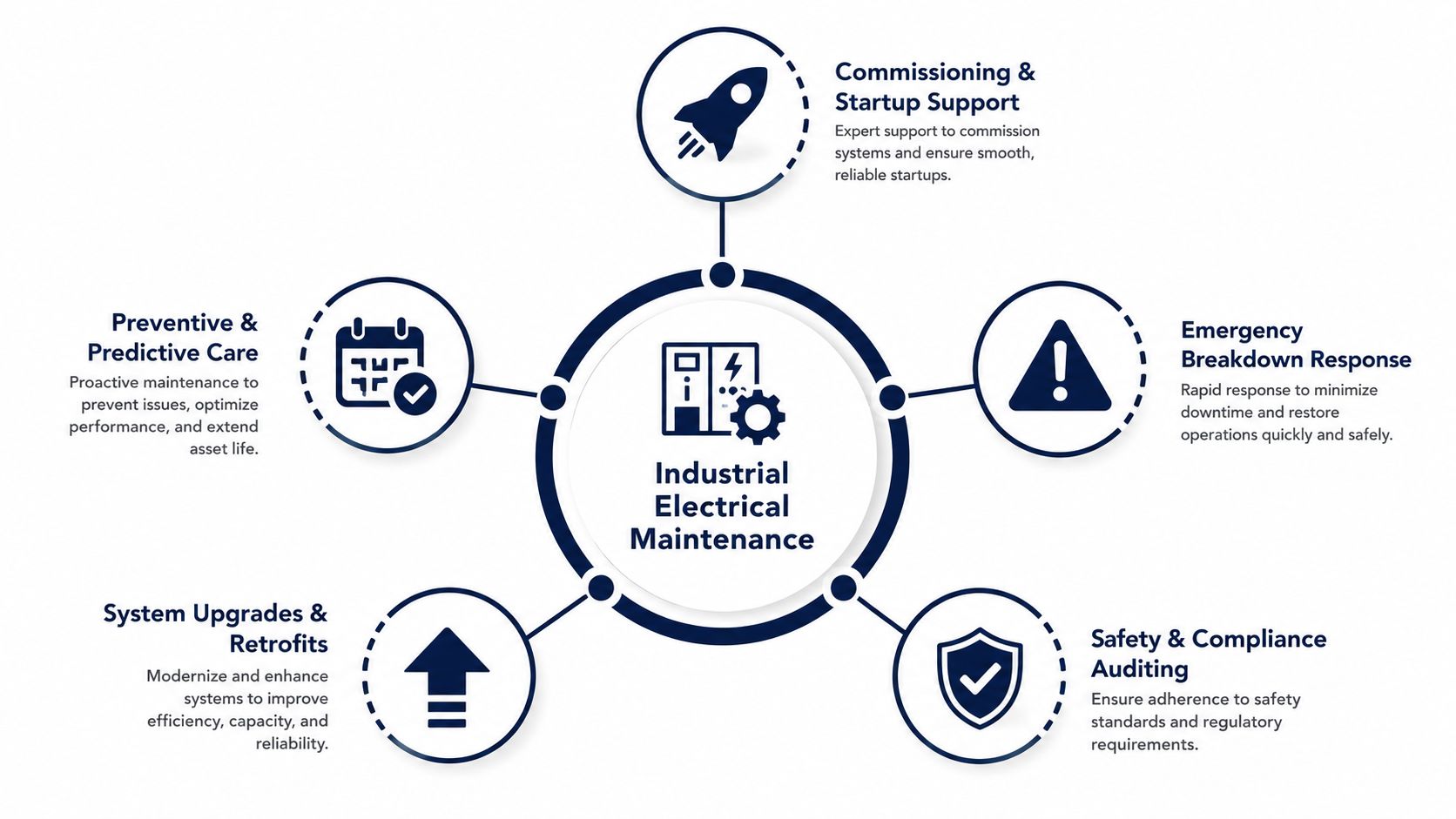
The five service layers that matter
Commissioning and startup support sets the baseline. The drive should leave startup with verified parameters, grounded wiring, cooling performance, and a documented operating condition so later troubleshooting has a reference point, not guesswork. If the provider cannot prove what “normal” looked like on day one, later diagnostics get much harder.
Preventive and predictive care keeps the asset from drifting into failure. The strongest programs combine thermal checks, contamination control, power-quality review, and condition-based inspections instead of just ticking a calendar box. Predictive maintenance can reduce maintenance costs by up to 30%, eliminate breakdowns by 70% to 75%, and increase production uptime by 20% to 25%, according to the published summary in the provided research source. The same source also reports average downtime falling from 22 hours per month under reactive maintenance to 13.5 hours per month with predictive maintenance, a 41% reduction, and one case study showing downtime falling from 400 hours to 220 hours annually while maintenance costs dropped from 20,000,000 to 12,000,000 and unexpected failures from 30 to 10 incidents per year.
Emergency breakdown response is about controlled recovery, not just arrival. A serious provider has a defined field process, remote diagnosis, temporary bypass options when safe, and a plan for restarting without creating a second fault. A vague 24/7 promise is not the same thing as a usable response model.
Deep component-level repair is where a lot of value hides. For drives, that often means replacing failed semiconductor modules, addressing bus capacitor issues, repairing gate-driver sections, updating firmware when needed, and verifying the root cause before return to service.
Reconditioning and retrofit extend asset life when replacement isn't the most rational choice. In many plants, the best outcome is not “new drive only,” but a rebuilt or upgraded unit that restores reliability without forcing unnecessary changeover risk during a shutdown.
A good maintenance partner knows the difference between a cabinet cleanup and a true life-extension intervention.
Not every provider offers all five layers. If one is missing, the plant usually discovers the gap only after the first bad event, when time is expensive and options are narrow.
Why this matters for buyers
The service mix should match asset criticality. A lightly loaded utility panel doesn't need the same depth as a high-duty extrusion line, but a VFD on a bottleneck process absolutely needs commissioning discipline, preventive care, emergency recovery, and a rebuild path. If a provider can't cover those layers, the risk just gets pushed back onto your team.
Comparing Service Models for VFD and Drive Assets
The buying mistake is treating every drive service provider like the same kind of vendor. They aren't. Some can swap obvious parts and close tickets. Others can isolate a fault down to a board, decide whether the unit should be repaired in place, rebuilt in a workshop, or retired, and then support the restart with actual evidence instead of optimism.
For a practical reference on how a drive service workflow can be structured, see the internal guide on industrial drive service.
What to compare before you sign
| Capability | Basic Provider | Advanced Provider | OEM-Certified Partner |
|---|---|---|---|
| Multi-brand VFD support | One or two familiar platforms only | Mixed-fleet capability across common drive families | Broad platform knowledge with documented service procedures |
| Field versus workshop capability | Mainly on-site resets and part swaps | On-site diagnosis plus rebuild options | Field triage, workshop repair, and return-to-service testing |
| Spares sourcing | Purchases parts after the failure | Keeps common spares or exchange units available | Verifies compatibility and tracks critical substitutions |
| Emergency response | “24/7” in marketing, unclear in practice | Remote support and defined dispatch process | Contracted response windows and structured escalation |
| Restart support | Minimal guidance | Controlled restart and verification | Commissioning, handover, and post-repair checks |
How to read the table
A basic provider can look inexpensive until the first complex failure. Then you discover the hidden costs, long diagnostic delays, repeat trips, or a replacement recommendation made because the team can't prove the asset is repairable. The advanced model costs more up front, but it usually buys shorter indecision cycles and fewer bad handoffs.
The workshop question matters just as much as the repair question. On-site work is faster when the fault is modular and the environment is clean enough to support proper handling. Workshop rebuilds make more sense when contamination, multiple subsystem failures, or test requirements make field repair risky. If the provider only offers one path, you're not buying service depth, you're buying a narrower set of outcomes.
The final filter is emergency response. Ask what “response” means, who answers the call, what remote diagnostics are available, and whether the service model includes temporary drive support when a repair window is tight. If the answer stays vague, the contract is probably vague too.
Deciding Between On-Site Repair and Workshop Rebuild
When a critical VFD fails, the pressure is immediate. Production wants the line back, maintenance wants to avoid a worse failure, and procurement wants a decision that doesn't turn into a long-tail cost problem. The right move depends less on habit and more on the condition of the asset, the environment around it, and the size of the shutdown window.
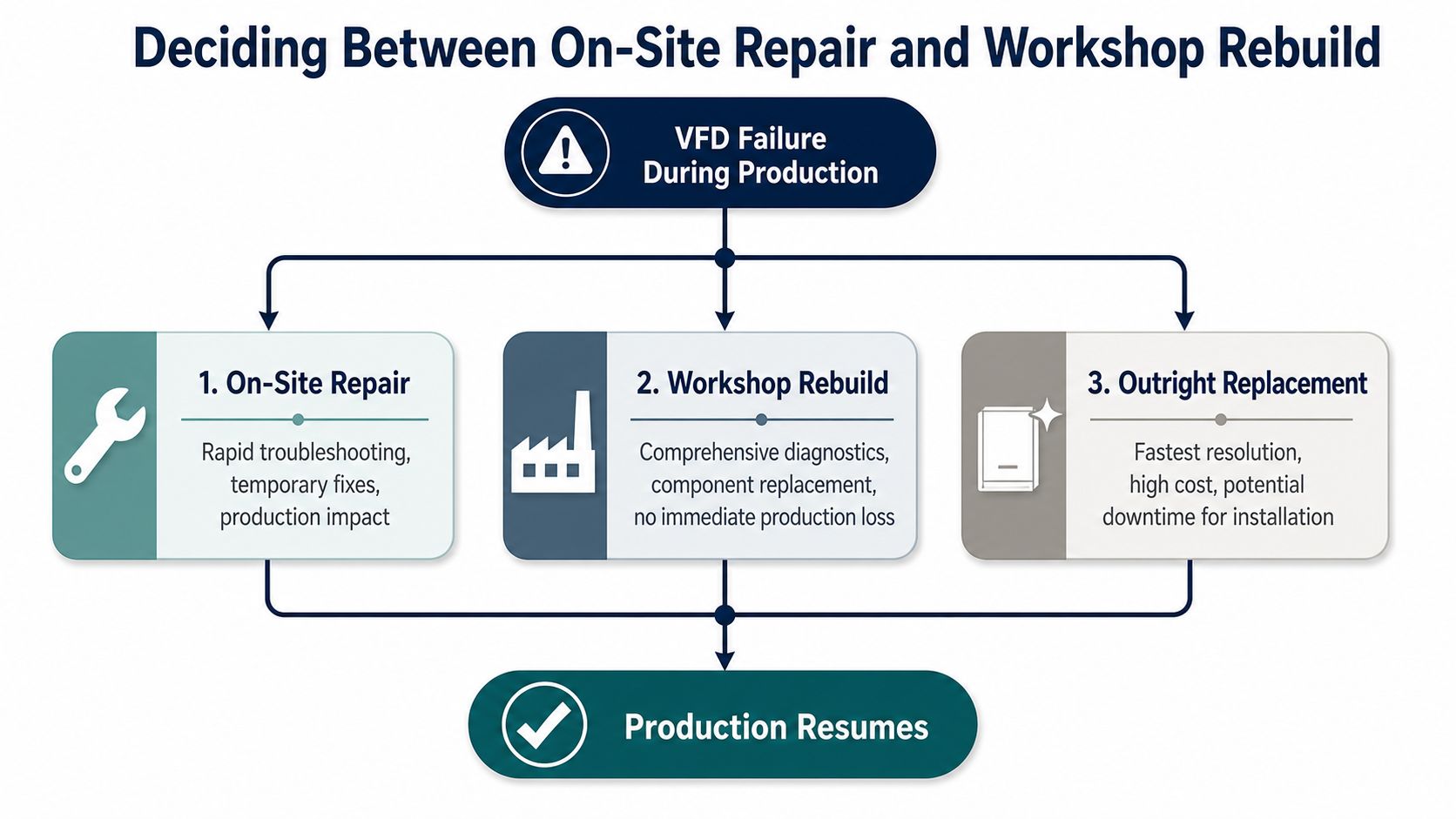
Use the failure path, not the calendar, to choose
If the fault is modular, clean, and well understood, on-site repair is often the fastest path. That's where failed IGBTs, blown fuses, loose terminations, or a control-board problem can be handled without losing the whole production window. On-site work is strongest when spares are already verified and the cabinet can be opened in a controlled condition.
Workshop rebuild makes more sense when the unit has contamination, multiple failed sections, or symptoms that don't line up with a single visible part. A bench environment lets the team load test, inspect hidden damage, and verify the repair before the drive returns to the line. That matters when a “quick fix” would only buy a few days before the next trip.
Replacement becomes rational when the repair cycle doesn't fit the shutdown schedule, the unit is close to end-of-life, or the transport and handling risk outweigh the benefit of saving the housing. A plant manager should think in terms of production risk, not just equipment cost, because a cheaper repair that misses the restart window is still the wrong repair.
A simple triage rule
- Short outage window: favor the option that restores operation without exposing the asset to avoidable handling risk.
- Planned shutdown: lean toward deeper diagnostics if the window is long enough to prove the repair.
- Contaminated or heat-stressed unit: don't assume a surface-level fix will hold.
- No verified spare path: avoid promising a same-day recovery that the parts system can't support.
The principle is simple. If the unit is repairable in place and clean enough to work on safely, on-site repair often wins. If the fault is spread across subsystems or the evidence is muddy, workshop rebuild gives you better control. If the asset is tired, unavailable for a rebuild, or too risky to move, replacement may be the least bad choice.
Don't choose the option that sounds cheapest in isolation. Choose the one that gets production back with the fewest ways to fail again.
The internal comparison on on-site versus workshop decisions is useful if your team wants a tighter decision framework for shutdown planning and restart control.
<iframe width="100%" style="aspect-ratio: 16 / 9;" src="https://www.youtube.com/embed/h6l-NfgePyE" frameborder="0" allow="autoplay; encrypted-media" allowfullscreen></iframe>Hidden Failure Mechanisms That Generic Checklists Miss
Most checklists focus on what's easy to see. They catch loose connections, dirty filters, and obvious fan failures, which helps, but they still miss the mechanisms that erode a drive long before it throws a hard fault. That gap is why a cabinet can look decent on inspection day and still be on a path to failure.
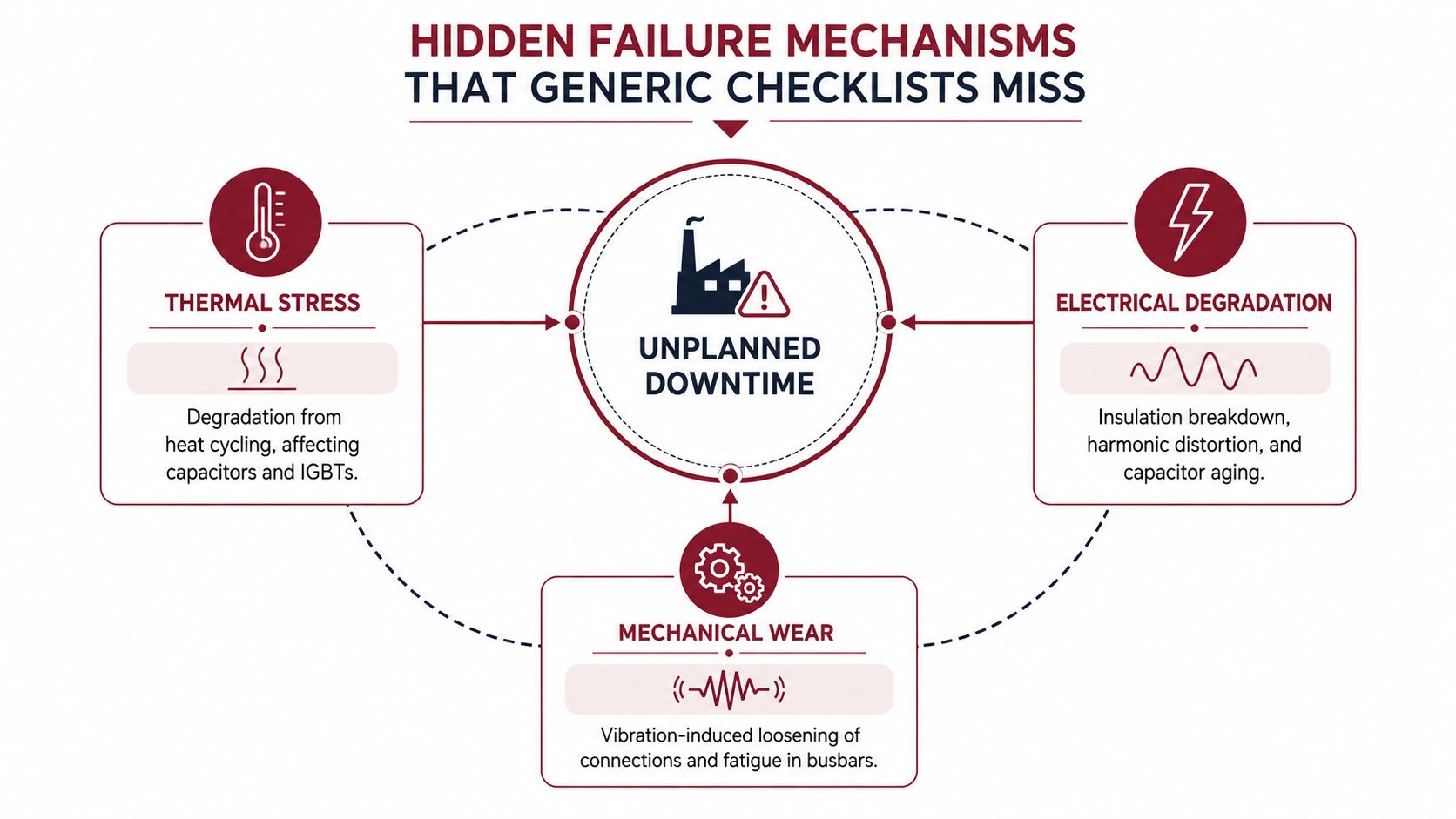
The damage that hides behind a clean door
Motor-side electrical stress is one of the most overlooked issues in VFD systems. Long cable runs, reflected-wave effects, grounding problems, and voltage stress can damage insulation in both the drive output stage and the motor windings even when the cabinet itself looks fine. A technical article in Hydrocarbon Processing notes that VFD motors may need insulated or ceramic bearings, shaft grounding, shielded cables, proper grounding, and dV/dt filters to reduce electrical discharge and voltage spikes, which shows that the failure path often extends well beyond the drive enclosure.
Contamination ingress is another slow killer. Conductive dust, oil mist, salt, and corrosive atmospheres create leakage paths across boards and bus bars, then those paths become dangerous when humidity rises or a transient event hits the system. In harsh plants, the issue is not whether contamination exists, it's whether the maintenance program removes it before it becomes conductive.
Thermal aging is the quiet one. The maintenance source in the verified data states that every 10 °C rise in component temperature can halve electronic life, which is why fan verification, filter cleaning, cabinet airflow checks, and torque checks are high-value actions. Temperature doesn't just make parts hot, it changes how long they can survive under load.
What to test instead of guessing
- Partial discharge testing for motor circuits where insulation stress is suspected.
- Insulation resistance trending under controlled conditions, not as a one-off snapshot.
- ESR measurement on capacitors, because capacitance alone can look fine late in degradation.
- Grounding and cable-path review when bearing damage or nuisance trips keep coming back.
These checks don't replace routine maintenance. They make the routine meaningful by finding the failure mechanism before it turns into an outage. In a plant with dust, salt, or heat, that's the difference between scheduled intervention and a very expensive surprise.
Situational Recommendations by Plant Profile
Different plants need different service mixes, and that's where a lot of procurement language gets too generic. A facility with large rotating loads and long restart times should not buy the same maintenance shape as a clean process plant or a utility site managing aging gear.
What each profile should prioritize
| Plant Profile | Priority Services | Response Time Target | Budget Allocation |
|---|---|---|---|
| Heavy industry | Field repair, spares verification, restart support, rebuild options | Fast on-site arrival during critical outages | More weight on response and recovery capability |
| Process manufacturing | Preventive and predictive care, documentation, multi-brand support | Defined response with planned maintenance windows | More weight on preventive coverage and compliance discipline |
| Utilities and infrastructure | Reconditioning, lifecycle extension, shutdown coordination | Planned response aligned to outage windows | More weight on rebuild and asset renewal planning |
How to think about the trade-offs
Heavy industry lives or dies by restart speed. In mining, metals, and cement, the right provider needs field repair skill for large drives, legacy parts knowledge, and the ability to stabilize the system under pressure. A failure on a bottleneck drive can ripple through the rest of the operation quickly, so the service model has to assume urgency.
Process manufacturing is different. Chemicals, food, and pharma usually care as much about documentation and repeatability as they do about raw response speed. Mixed fleets make multi-brand support valuable, and shutdown work needs to be clean, logged, and repeatable enough to satisfy both operations and audit expectations.
Utilities and infrastructure often get the most value from lifecycle extension. Aging assets, budget cycles, and scheduled outages make rebuild and reconditioning more attractive than immediate replacement. For those sites, the smart contract is one that supports planned work, verifies compatibility, and avoids unnecessary transport risk.
If the plant can tolerate a planned window, use it to buy reliability, not just temporary relief.
The right service mix is the one that matches how the plant fails. Anything else just pushes the cost into a later outage.
Evaluation Checklist for Selecting a Service Provider
A buyer should treat provider selection like a technical audit, not a pricing exercise. The cheapest hourly rate often hides weak diagnostic depth, thin parts inventory, or an emergency process that sounds good until the first real outage.
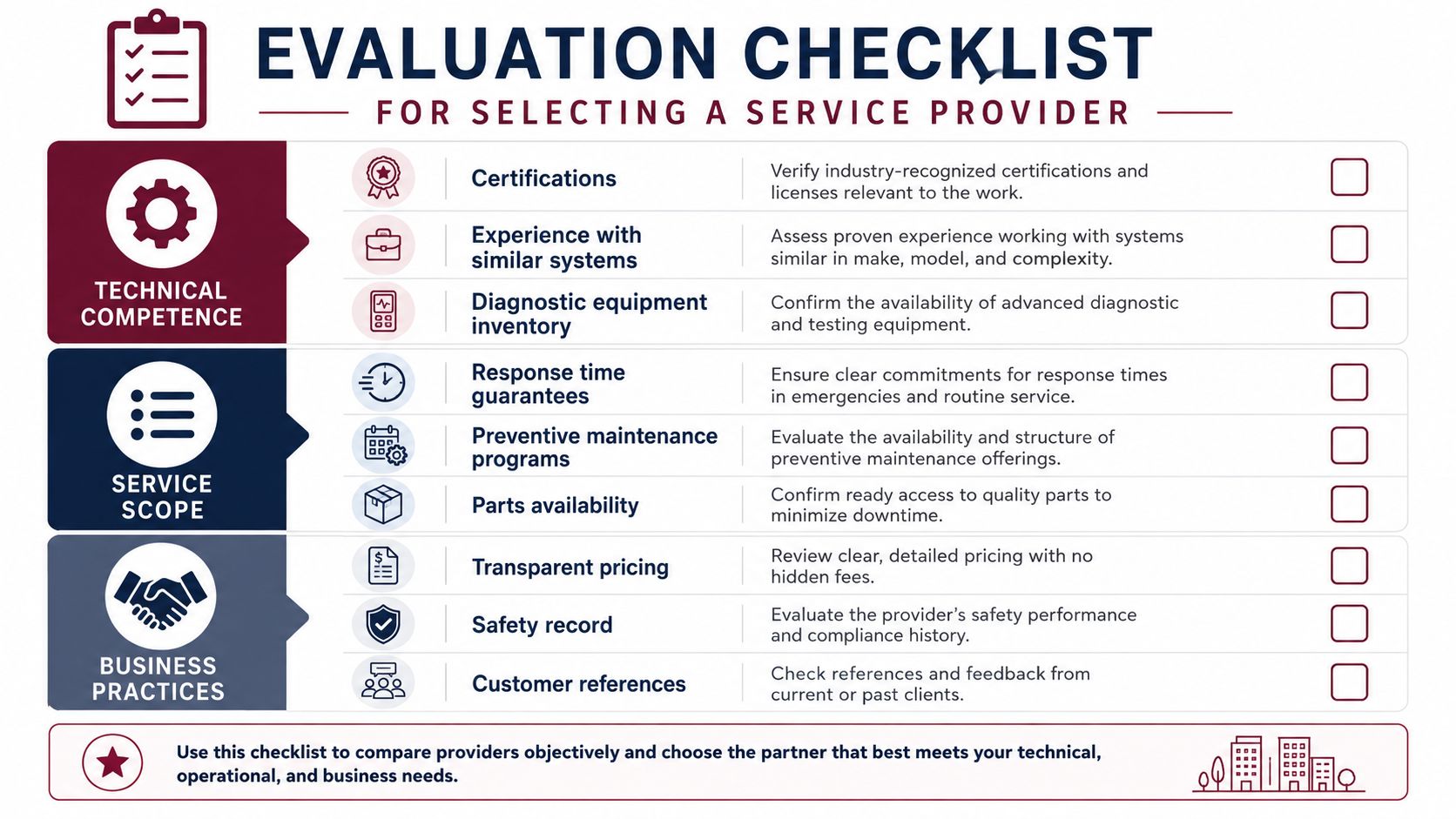
What to ask before you award work
Technical capability verification. Ask what drive families the team has serviced, what test equipment they use, and whether they can document parameter backup, fault isolation, and post-repair testing. If they can't show repair records or test protocols, they're asking you to trust a promise instead of a process.
Response infrastructure. Ask how coverage works by geography, who takes the call after hours, and what the guaranteed response path is for a critical fault. A provider with field staff but no dispatch discipline can still leave you waiting.
Parts and logistics. Ask how they source obsolete parts, whether they stock verified spares, and how they confirm compatibility before dispatch. A vague “we can get it” answer is a red flag, especially for older VFDs and legacy auxiliaries.
Quality assurance. Ask what testing happens before a drive is returned, what warranty covers the repair, and how they document defects found during teardown. Good repair work should come back with evidence, not just a cleaned enclosure and a verbal assurance.
Commercial transparency. Ask how they price diagnosis, travel, parts, workshop labor, and emergency callout work. If the proposal is cheap on paper but unclear on scope, the final invoice usually tells the story.
Red flags that deserve pushback
- No clear test bench or diagnostic method.
- No written response window for emergencies.
- No explanation of parts sourcing for obsolete components.
- No post-repair test documentation.
- No pilot project before a long-term commitment.
Before you sign a full agreement, run a pilot on a non-critical asset. That's the fastest way to see whether the provider can do clean handoffs, communicate openly, and support your team under real conditions.
DUCHENG Industrial fits this lifecycle model by covering commissioning, troubleshooting, workshop repair, on-site reconditioning, preventive care, and spare-part identification for VFD assets across their service life. If you need a provider for drive triage, restart support, or rebuild planning, visit DUCHENG Industrial and evaluate whether their service scope matches your plant's failure modes and shutdown windows.