
Discover how industrial drive service keeps VFDs reliable, efficient, and cost-effective. Learn commissioning, repair, and maintenance workflows that work.
The call comes in during the worst possible minute, the line is moving, the operator's screen flashes a fault, and production starts bleeding cash while everyone argues about whether to reboot, swap boards, or wait for maintenance. That's industrial drive service, and it's why smart plants treat VFDs as financial assets, not just electrical boxes. A drive that trips at the wrong time doesn't just stop a motor, it interrupts throughput, creates scrap risk, and turns a small component failure into a budget problem.
Industrial drive service is the discipline of keeping variable-frequency drives healthy across their whole life, from commissioning to late-life intervention. It includes startup support, condition monitoring, preventive care, fault diagnosis, workshop repair, on-site reconditioning, retrofit planning, and replacement decisions. The serious mistake is thinking service starts after the trip. It should start long before the fault code appears.
Table of Contents
- What Industrial Drive Service Actually Covers
- Why VFDs Need More Than Break-Fix Service
- Matching the Right Service to the Right Situation
- Inside a Typical Industrial Drive Service Workflow
- How to Evaluate a VFD Service Provider
- Real-World Service in Harsh and Demanding Sites
- Making the Repair, Recondition, or Replace Decision
What Industrial Drive Service Actually Covers
A drive fault rarely arrives as a neat maintenance ticket. It usually shows up in the middle of a run, like a 400 kW winder that trips on a DC bus overvoltage alarm and leaves the crew staring at a stopped process while every minute costs real money. At that point, the plant doesn't need a vague promise. It needs a structured service response that identifies the fault, protects the asset, and gets production back under control without making the problem worse.
Service Is a Lifecycle, Not a Panic Call
Good industrial drive service spans the full operating life of the asset. It starts with commissioning, where the drive is installed, parameterized, and tested under the actual process load. It continues with preventive checks, field troubleshooting, component-level repair, on-site reconditioning for large or awkward units, and end-of-life replacement planning when repair stops making financial sense.
That lifecycle view matters because VFDs sit on top of one of the biggest energy and uptime control points in the plant. Electric motors account for roughly 70% of industrial electricity use worldwide in the cited technical literature, and VFD retrofits commonly cut energy use by 15% to 35% on pumps, fans, and compressors, with some applications reaching 20% to 50% when speed matches demand instead of throttling or bypass control. Modern drive efficiency is already around 97% to 98%, so the value comes from keeping the motor system healthy and controlled, not from chasing mythical drive-side energy savings. Industrial motor system energy context and VFD savings
That is why service has to include both reactive rescue and pre-failure intervention. If you only think in terms of emergency callouts, you're already paying too much.
The Four Service Families You Actually Need
The practical service families are straightforward. Rapid restore gets a failed line moving again. Deep repair pulls the drive into a workshop for component-level work. On-site reconditioning handles large, legacy, or hard-to-move assets in place. Preventive care keeps contamination, heat, and loose connections from turning into downtime.
Practical rule: if the plant can't absorb the outage, the service plan should be built before the fault, not after it.
The right provider should be able to move between those four modes without improvising. If they can't define the handoff from diagnosis to repair to recommissioning, they're not running a service program, they're running a parts swap shop.
Why VFDs Need More Than Break-Fix Service
A VFD trip during a production run creates a financial decision under pressure. The immediate repair may restore the line, but the plant still pays for lost output, emergency labor, rush parts, and possible scrap. Service planning must therefore identify intervention thresholds before the fault, then compare the cost of repair or reconditioning with the cost of replacement and downtime per hour.
VFD failures usually follow familiar paths. Power electronics degradation develops through aging, heat, contamination, moisture, and repeated thermal cycling. Capacitors lose performance, cooling fans wear, power modules deteriorate, and control boards develop corrosion or obsolete-component problems. Waiting for the trip turns a manageable intervention into a much larger exposure.
DC-Link Capacitors, Cooling Fans, and IGBT Degradation: The Predictable Failure Paths
DC-link capacitors dry out and lose capacitance over time. The drive can appear healthy until bus faults become frequent, charging takes longer, or DC-bus behavior becomes unstable. Cooling fans create a similar risk. Bearing wear and reduced airflow raise cabinet temperatures, pushing the drive toward thermal alarms and nuisance trips.
IGBT modules absorb repeated stress from heat, dust, moisture, and load cycling. Control boards can shift from stable operation to intermittent faults as corrosion develops or aging components drift. These conditions rarely arrive without warning.
Technicians should track temperature rise, fault history, fan noise, extended start-up delays, unstable parameters, and recurring nuisance trips. Those signals support a planned decision: replace a deteriorating part during an available shutdown, recondition the drive before reliability falls further, or set a replacement threshold when repair no longer makes financial sense.
| Common VFD Failure Modes and Service Impact | Typical Service Life | Warning Signs | Planned vs Reactive Cost Impact |
|---|---|---|---|
| DC-link capacitors | Often 7 to 12 years in real plant use, depending on stress | Bus faults, longer charging, unstable DC bus behavior | Planned replacement during shutdown is controlled, reactive failure adds emergency response and downtime |
| Cooling fans | Often 3 to 5 years of bearing life | Noise, reduced airflow, thermal alarms | Planned fan change is cheap compared with heat damage and line stoppage |
| IGBT power modules | Life depends heavily on heat, dust, and cycling | Overcurrent trips, erratic output, heat-related faults | Planned repair isolates the problem, reactive failure can take the whole drive down hard |
| Control boards | Highly environment-dependent | Corrosion, communication faults, parameter drift | Planned board service is cleaner than chasing intermittent failures during production |
The financial difference is direct. A planned capacitor replacement is a controlled maintenance expense. The same failure mid-batch can trigger emergency response, rush-spare costs, lost throughput, and scrap. Break-fix service hides those costs until production stops.
Use a published VFD maintenance schedule as a starting framework, then adjust inspection timing to the drive's fault history, temperature, contamination, loading, and production role. A schedule has value only when it leads to a clear repair, recondition, or replace decision.
Matching the Right Service to the Right Situation
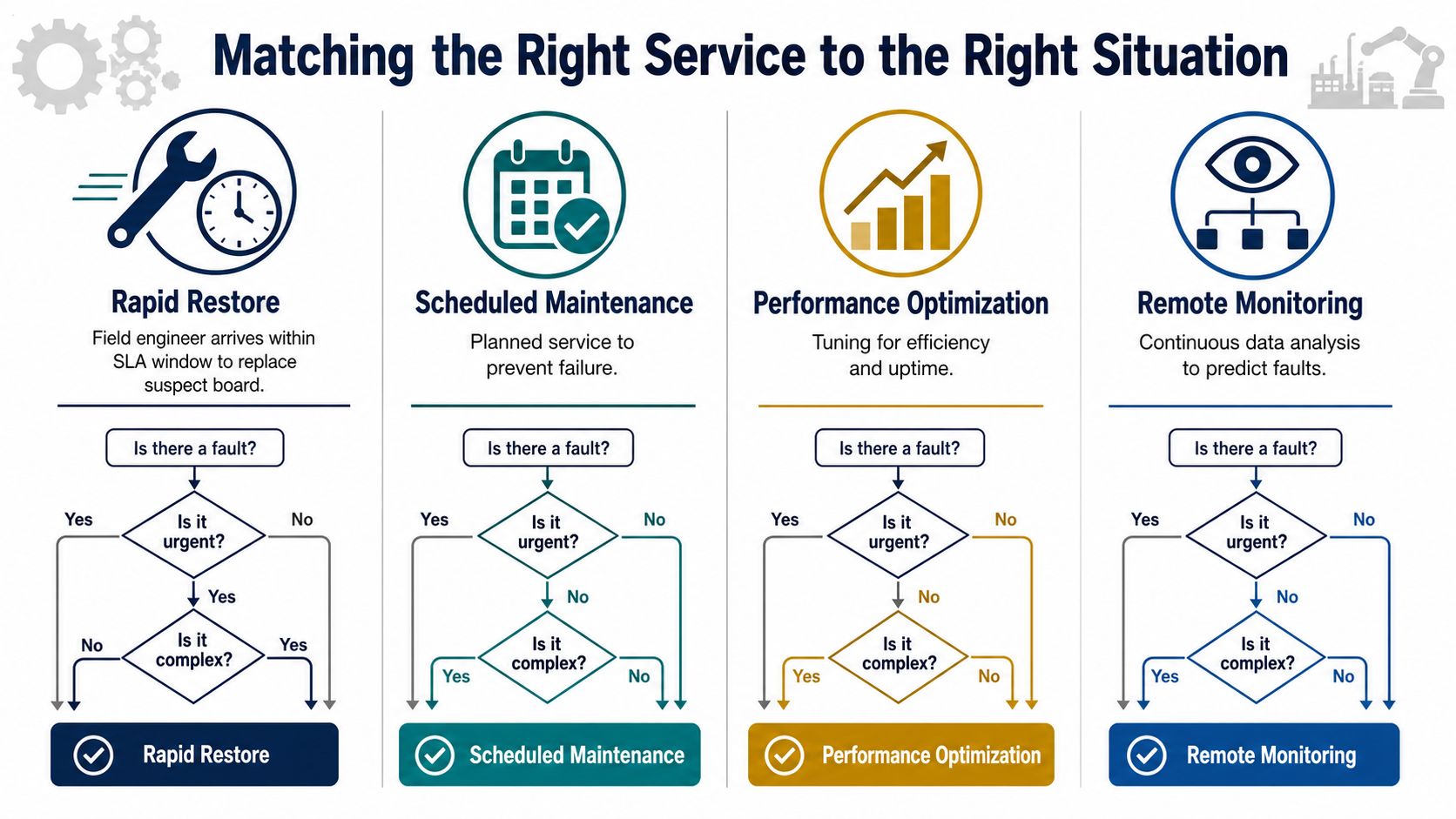
Not every drive problem deserves the same answer. If you treat every fault like a workshop rebuild, you waste time. If you treat every fault like a quick reset, you invite repeat outages. The right move depends on urgency, asset size, fault history, and whether you've got a real shutdown window.
Use the Drive's Situation to Choose the Service Mode
Rapid restore is the answer when a critical line is down, a spare isn't on the shelf, and the fastest path is to send an engineer to swap the suspect board, check parameters, and get the system back under load. That's a field decision, not a philosophical one. If production is bleeding and the unit is small enough to service in place, you want the shortest controlled path to restart.
Deep repair makes sense when the drive can come out cleanly, ship to a workshop, and receive proper bench diagnostics. This is the right call for repeat faults, out-of-warranty units, and cases where the root cause probably lives in a subassembly that needs controlled testing. It's also the sensible choice when a planned shutdown window is available and the line can absorb the removal.
On-site reconditioning is the move for large, obsolete, or hard-to-swap units. If the drive is too heavy to lift easily, tied into a critical process, or sitting in an environment where shipping just adds risk, rebuild it in place. The point is to restore the asset without turning the cabinet into a crane job.
Preventive care belongs on fleets, especially when the cabinet room is full of units and the oldest drives are past midlife. Thermal scans, fan replacement, parameter backups, and contamination checks pay off because they catch the failures before the line has to.
If the cost of downtime per hour is higher than the service path you're considering, pull the unit for a deeper intervention. If the drive can't be moved without creating a second problem, recondition it on site.
The Short Version for Maintenance Managers
Use this rule set and stop overthinking it:
- Call rapid restore when the line is down, the unit is critical, and the fastest fix is an in-place board or fan swap.
- Choose deep repair when the fault repeats, the drive is removed safely, and a workshop can test components properly.
- Pick on-site reconditioning when the drive is too large, too embedded, or too risky to ship.
- Schedule preventive care when you have a fleet, a midlife asset, or a cabinet that lives in heat and contamination.
That decision logic is more useful than a pile of generic checklist items. It forces the plant to act on economics, not habit.
Inside a Typical Industrial Drive Service Workflow
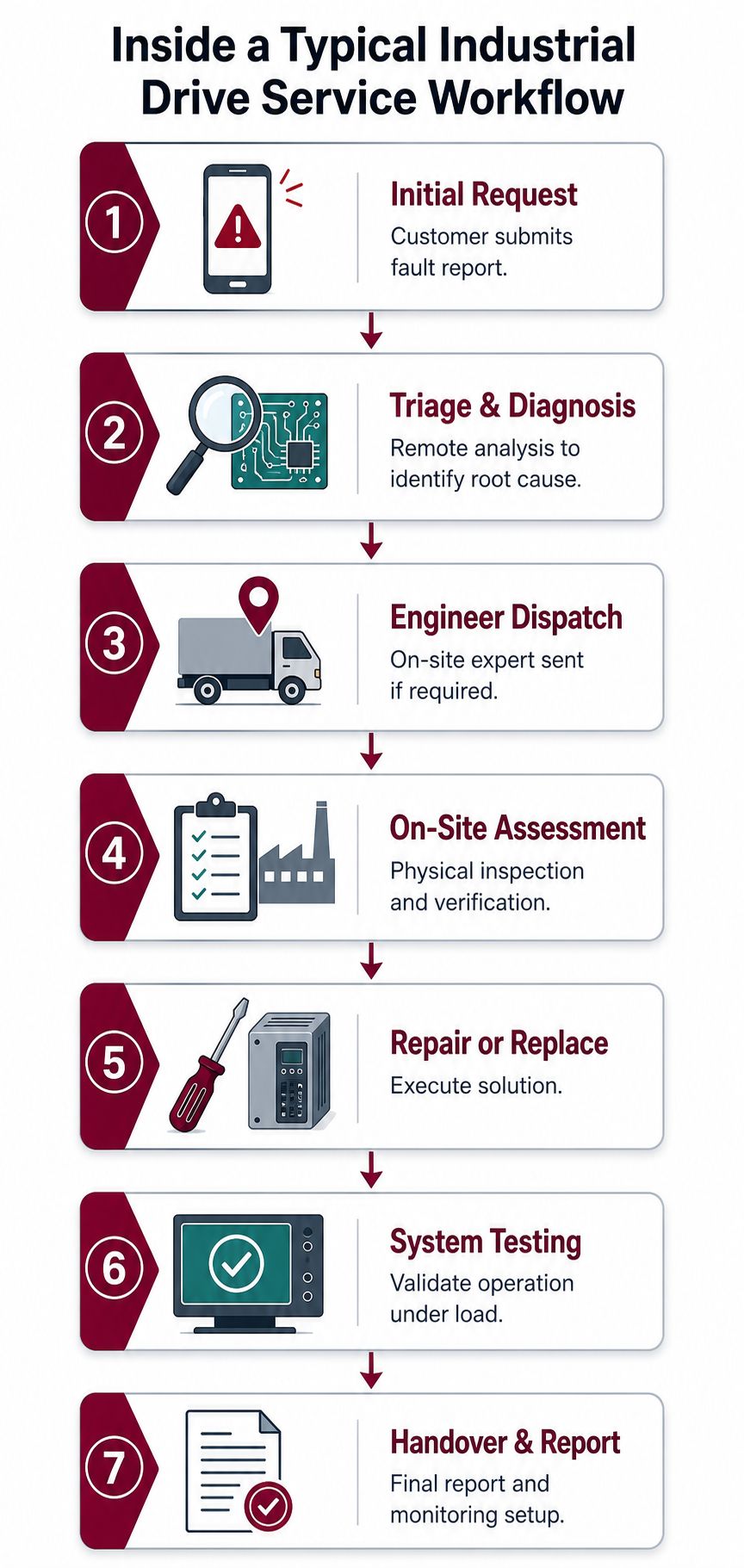
The service process should feel controlled, not improvised. A decent provider doesn't wait for chaos to reveal the next step. They collect the right data up front, diagnose remotely where possible, and only mobilize when the evidence says a site visit is the fastest path to recovery.
From Fault Report to Triage
The first contact usually comes through a customer portal, hotline, or service ticket. The dispatcher should ask for the drive tag, model, fault code, ambient conditions, and whether the asset is critical or redundant. If they don't ask for that information, they're slowing themselves down before the work starts.
Remote diagnosis comes next. Engineers pull fault history, parameter dumps, and any trend logs they can get their hands on. That's where they decide whether the issue looks like a board swap, a firmware reload, a failed fan, a capacitor problem, or something deeper. The point is to avoid sending a truck before the evidence justifies it.
Mobilization, Repair, and Handover
If the fault needs a site visit, mobilization should match the urgency. Strong providers publish SLA tiers, often framed around four-hour, eight-hour, and next-day response windows. That matters because the plant needs a real expectation, not a brochure promise. The service team should also stage spare parts before arrival whenever possible, because the fastest way to lose a day is to travel light and discover the failed part back at the cabinet.
The recommissioning step matters more than many teams admit. The drive should be run under no-load and then under load, with the engineer checking for parameter drift, unstable behavior, or hidden secondary faults. The handover should include the maintenance record, the replaced parts, and any monitoring flags that the plant should watch in the next run.
Ask for the test results, not just the verbal “it's back up.” If the provider can't show you what changed, they didn't finish the job.
If your team uses a service desk, make sure the intake form captures the fault code, process state, and whether the unit is protecting a critical utility. That one habit shortens the distance between a trip and a controlled restart.
How to Evaluate a VFD Service Provider
Choose a provider as you would choose a critical maintenance partner, through evidence rather than presentation. A weak provider promises fast response while offering limited diagnostics, incomplete records, and unclear parts sourcing. A capable provider can show its workflow, test trail, service boundaries, and the point at which repair no longer makes financial sense.
Score the Predictors of Outcome
Start with documented methodology. Require a written route from triage through diagnosis, repair, testing, and handover. It should include change control and traceable test reports. If the provider cannot explain how it isolates the fault before opening the drive, you will pay for guesswork and may still face a repeat failure.
Assess multi-brand coverage against your installed base. Plants accumulate drives from different manufacturers and generations, so the service team must understand mixed equipment without treating every platform as identical. Ask which models the team supports directly and which require outside assistance. Repeated subcontracting can extend the outage and make accountability unclear.
Check regional response time in terms that fit your site. Ask for response tiers tied to your location, the person on call, and the mobilization route. A published service level has value only when the provider can explain who receives the call, what happens next, and which conditions change the response. Your downtime cost per hour should determine how much response capacity is worth paying for.
Verify manufacturer credentials and parts traceability. Warranty work belongs in the OEM channel where applicable, while independent service still requires controlled sourcing and verifiable replacements. Ask for records covering component origin, inspection, and installation. Counterfeit capacitors and IGBTs create a direct reliability risk, so traceability is a basic purchasing requirement.
DUCHENG Industrial provides lifecycle VFD service covering commissioning, troubleshooting, repair, preventive care, and on-site reconditioning across industrial sites, with documented diagnostics and customer-portal support. That scope, lifecycle service with documented diagnostics and portal support, is what to look for when a simple swap will not solve the problem.
| VFD Service Provider Evaluation Scorecard | |||
|---|---|---|---|
| Evaluation Criterion | Weight | What to Verify | Scoring Guidance |
| Documented methodology | High | Written diagnostic flow, test reports, handover records | Score high only if the process is repeatable and traceable |
| Multi-brand coverage | High | Experience across your installed base, not just one platform | Score high if they can support mixed fleets without delays |
| Regional response time | High | Published SLA tiers and real on-call coverage for your plant | Score high if they can name the actual mobilization path |
| Manufacturer credentials | Medium | Warranty authority where relevant, clear distinction from independent repair | Score high if they can explain exactly what they can and cannot do |
| Parts traceability | High | Source control, serial tracking, verification of replacements | Score high only if the parts trail is clean |
Use the scorecard as a gate before awarding work. A provider that speaks confidently but cannot prove process discipline should not handle a drive whose outage cost exceeds the repair-versus-replacement threshold. Ask for evidence, then compare the service scope with the financial consequence of delay.
Real-World Service in Harsh and Demanding Sites
A coastal petrochemical plant is a brutal place for a drive. Salt in the air, cabinet heat, and classification rules make every intervention slower and more expensive. In that kind of site, the service decision is rarely about technical ability alone. It's about which approach causes the least operational damage.
Why On-Site Reconditioning Wins in the Right Conditions
The asset here is a 250 kW drive feeding a cooling-water pump. After nine years, it starts tripping on overcurrent and shows signs of capacitor aging. Shipping it to a workshop would mean crane work, paperwork, and time the plant doesn't have. So the engineers choose on-site reconditioning instead, with a mobile test rig, power-stage spares, and coating materials brought to the cabinet.
They bench-test the power section in place, replace the gate-driver board, recoat the PCB assemblies, and verify insulation resistance before re-energizing. That is the right sequence. They don't rush the restart just because the fault is annoying. They validate the unit first, then return it to service.
The value is clear. On-site reconditioning avoided a long outage, kept the hazardous-area paperwork from dragging on, and let the plant resume sooner than a workshop turn would have allowed. It also demanded more from the provider. They needed hazardous-area certification, a calibrated test bench, and the discipline to work in a tough environment without cutting corners.
What This Means for Plant Owners
Harsh sites punish generic service. If your facility runs in salt-laden air, heavy dust, chemical exposure, or high heat, you should expect the provider to bring mobile workshop capability, not just a field technician with a laptop. If they can't recondition in place when shipping would be disruptive, they're not really solving the late-life problem.
The wider lesson is simple. Environmental stress changes the service model. Cabinets in hard sites don't just need checks, they need intervention planning that matches the environment and the shutdown window.
Making the Repair, Recondition, or Replace Decision
A drive past midlife is no longer just a technical object. It is a financial calculation involving downtime cost per hour, remaining service life, parts availability, and the risk of repeat failure. Set the intervention threshold before the next fault forces an expensive decision.
Start With the Break-Even Point
Compare the cost of repair with the installed cost of a replacement, then add the production cost of waiting. A repair that looks inexpensive can become the wrong choice if it extends an unstable asset's life only briefly. Use the repair service overview to understand what a structured repair path includes, then assess the drive's age, fault history, and parts support.
Repair suits a contained failure on a drive with useful life remaining. Reconditioning makes sense when the core platform remains serviceable but contamination, thermal stress, or aging assemblies require broader work. Replacement is the stronger financial decision for obsolete units with scarce parts, repeated trips, or no credible recovery plan.
A Plant Example With Real Costs
Consider a production line where an outage costs $10,000 per hour. A replacement drive costs $40,000, while a repair costs $12,000 and requires six hours of downtime. The repair bill plus lost production equals $72,000. A planned replacement requiring eight hours costs $120,000 in total, so repair appears cheaper initially.
That calculation changes if the repaired drive fails again and creates another six-hour outage. The combined repair path then reaches $132,000, before counting emergency logistics or lost production beyond the scheduled window. Replacement becomes the better financial choice when repeat-failure risk is credible, even though its equipment price is higher.
Use the break-even calculation with the actual plant cost per hour. Do not compare repair and replacement invoices alone.
Decision Matrix
| Drive Signal | Recommended Action | Financial Test | Downtime Approach |
|---|---|---|---|
| Contained fault and good parts support | Repair | Repair cost remains clearly below replacement | Short planned outage or rapid restore |
| Large drive that is difficult to move, with service life remaining | Recondition on site | Avoided shipping and production loss justify the work | Use the planned shutdown window |
| Obsolete platform, repeated failures, scarce parts | Replace | Repair approaches 50% to 60% of new cost, or repeat downtime erases the saving | Schedule a controlled swap-out |
| Critical asset with no spare and production already stopped | Restore first, then reassess | Emergency spending is temporary, not the lifecycle plan | Resume production, then set the permanent intervention |
Age alone should not decide the case. Condition, failure frequency, parts access, and the cost of lost production determine the answer.
If you need a service partner for commissioning, repair, preventive care, and on-site reconditioning, DUCHENG Industrial provides those industrial drive services. Use the next outage window to make the financial decision before the drive makes it for you.