
Find reliable industrial repair services for your equipment. Compare top providers and learn how to choose the right partner in 2026.
Your line is down, production is bleeding time, and someone's standing in front of a tripped drive with a flashlight and a clock. That's the moment where industrial repair services stop being a vendor category and become a decision tool, because the wrong call turns a recoverable fault into a longer outage, a repeat failure, or a rushed replacement you didn't need.
The best buyers stop asking, “Who can fix it fastest?” and start asking, “What level of intervention matches this asset, this failure mode, and this shutdown window?” That's the difference between a panic purchase and a reliability decision.
| Model | Typical Response Window | Scope of Work | Tools & Skills | Downtime Impact | Best-Fit Situation | Relative Cost |
|---|---|---|---|---|---|---|
| On-site triage | Immediate to same shift | Fault isolation, safety checks, restart decision | Test gear, fault logs, electrical judgment | Lowest if the issue is simple | Critical assets that must be stabilized fast | Low to moderate |
| Workshop deep repair | After transport and intake | Disassembly, board-level repair, bench testing, functional verification | Deep diagnostics, component repair, load testing | Higher upfront, lower repeat risk | Drives with repeat faults or unclear root cause | Moderate |
| On-site reconditioning | Planned shutdown window | Cleaning, restoration, wear-item renewal, validation | Field tools plus restoration workflow | Lower than shipping heavy assets out | Large or hard-to-move drives nearing mid-life | Moderate to high |
| Emergency response | 24/7 contracted response | Blended triage, repair, restart support | Broad diagnostics, field readiness, parts access | Lowest when every minute matters | Unplanned outages on critical lines | Highest |
Table of Contents
- When a Drive Trips at the Worst Possible Time
- What Industrial Repair Services Actually Cover
- Comparing the Four Industrial Repair Service Models
- Reading Repair Scope Documentation Like a Reliability Engineer
- The Repair, Recondition, or Replace Decision
- Choosing an Industrial Repair Services Provider in Practice
- When the Obvious Choice Is the Wrong Choice
When a Drive Trips at the Worst Possible Time
A 400 kW VFD on a rolling mill or tire curing line doesn't trip at a convenient moment. It fails on the night shift, when the crew is lean, the line is hot, and every minute feels expensive. That's when a maintenance lead has to decide whether to call for triage, send the unit to a workshop, or keep the asset in place and repair around the process.
The first move is always the same. Isolate the drive, read the fault log, and confirm the motor and load are safe to restart. Then separate the likely problem into control-side issues, power-side failures, or peripheral problems such as cabling and cooling. That discipline keeps people from blaming the wrong subsystem and tearing into hardware that didn't fail.
Practical rule: if you haven't checked the fault record and the thermal condition of the cabinet, you're not diagnosing, you're guessing.
That's why a structured response matters. DUCHENG Industrial's first-steps-after-a-trip guidance fits the way good reliability teams work, starting with fault isolation and controlled recovery before anyone talks about full replacement. The point isn't just to get a green screen back. It's to restart safely, without creating a second outage in the process.
The same logic applies on the floor whether the fault comes from parameters, feedback, IGBT stress, DC bus deterioration, or cooling loss. Industrial repair services earn their keep right there, in the minutes when a fault becomes a business decision. If the provider can't help you distinguish between a nuisance trip and a failing power stage, they're not reducing risk, they're delaying it.
What Industrial Repair Services Actually Cover
Industrial repair services aren't a single transaction. They're a lifecycle capability that follows the asset from commissioning through late-life operation, and the scope changes as the equipment ages and the plant's tolerance for downtime shrinks.
The asset and the intervention have to match
The service category usually spans VFDs, servo drives, switchgear, motors, hydraulics, and PCBAs, but the key distinction is intervention depth. A good provider doesn't just “fix drives.” It diagnoses, isolates root cause, repairs at component level when that's the right move, reconditions where wear is cumulative, and validates the result before handing the asset back.
That's the shift from old-style break-fix work to reliability-centered practice. The repair decision is no longer isolated from uptime planning, spare-parts strategy, or post-repair verification. In other words, the provider has to think the way a plant engineer thinks, not the way a parts counter thinks.
Lifecycle stage changes the right service model
A new drive in commissioning doesn't need the same service depth as an aging unit that's already lived through contamination, heat cycling, and repeated stoppages. Mid-life assets often need targeted restoration. End-of-life equipment may need a hard decision about repair versus replacement, especially when parts are scarce or firmware support is weak.
A good repair scope reads like an engineering record, not a sales quote.
That's the core benchmark. The paperwork should show what was inspected, what was tested, what was replaced, and what was verified after repair. If the document skips those steps, it's not giving you confidence, it's asking for trust without evidence.
Mature providers also blend delivery modes. On-site triage stabilizes the fault, workshop deep repair handles complex failures, on-site reconditioning extends service life on large assets, and emergency response ties the whole thing together when downtime tolerance is near zero. That mix matters because one model does not fit every trip, every plant, or every stage of the drive's life.
Comparing the Four Industrial Repair Service Models
A drive trips at the worst possible time, and the repair choice has to match the plant's tolerance for downtime, the size of the asset, and where the equipment sits in its life cycle. Use the wrong model and you either overpay for speed or wait too long for depth.
Match the service model to the failure window
On-site triage is the fastest way to sort the problem. It is light, diagnostic, and built to answer a blunt question, can this drive be restarted safely now, or does it need deeper work? Use it when the plant needs immediate stabilization and the fault may sit in the control layer or another peripheral point.
Workshop deep repair is the slower route, but it gives technicians bench access, disassembly, and testing that cannot happen beside a live line. That is the right choice for repeat faults, unclear failures, or components that need careful inspection and controlled validation. For a closer look at industrial drive repair services, this is the model that usually exposes the failure path.
On-site reconditioning is the practical answer for immovable assets. It keeps the restoration work in the plant, which avoids the transport risk and logistical drag that large MV drives can create. When removal would add more risk than the repair itself, this is the cleaner decision.
Emergency response is the contract that ties the others together. It is not a separate philosophy, it is a readiness level. If the provider can mobilize, diagnose, repair, and verify under pressure, the plant gets a real uptime buffer instead of a promise.
DUCHENG Industrial's lifecycle VFD model fits that sequence cleanly. Production escort covers commissioning and critical restart windows, rapid restore handles unplanned faults, deep repair covers workshop-level work, and on-site blue reconditioning supports aging systems when removal is impractical. That is the right way to read the service stack, as a lifecycle path, not a one-size offer.
Industrial repair services models compared
| Model | Typical Response Window | Scope of Work | Tools & Skills | Downtime Impact | Best-Fit Situation | Relative Cost |
|---|---|---|---|---|---|---|
| On-site triage | Same shift or immediate callout | Fault logging, electrical isolation, restart decision, basic corrective work | Portable test tools, controls troubleshooting, field judgment | Lowest when the fault is simple | Critical line stoppage that needs fast diagnosis | Low |
| Workshop deep repair | After removal and intake | Disassembly, component-level repair, bench diagnostics, functional testing | Deep electronics repair, mechanical restoration, test rigs | Higher initially, lower repeat risk | Repeat failures, unclear root cause, board-level faults | Moderate |
| On-site reconditioning | Planned shutdown window | Cleaning, restoration, wear-item renewal, validation in place | Field restoration tools, cabinet work, drive-specific expertise | Lower than off-site logistics on large assets | Large or hard-to-move drives nearing aging-related risk | Moderate to high |
| Emergency response | 24/7 readiness | Blended triage, repair, spare coordination, controlled restart | Broad diagnostic coverage, rapid field deployment | Lowest under acute outage pressure | Safety-critical or revenue-critical unplanned downtime | Highest |
What the table really tells you
If the line can tolerate a short interruption, do not pay emergency rates for a fault that only needs triage. If the drive is large, costly to move, or locked into a shutdown window, on-site reconditioning is usually the better call. If the failure sits deep in the power electronics, workshop repair wins because you need the bench, not just a toolbox.
The repair-versus-replace decision sits behind every row in that table. Older equipment with scarce parts and weak support may justify a deeper repair if the asset still has useful life left. A unit with recurring faults, severe contamination damage, or unsupported electronics should move faster toward replacement. That decision is where lifecycle thinking beats habit.
Reading Repair Scope Documentation Like a Reliability Engineer
A serious repair quote tells you what was inspected before it tells you what it costs. That's not paperwork trivia. It's the difference between a provider that understands failure modes and one that swaps parts until the symptom goes away.
Start with the incoming diagnostics
Look for insulation resistance checks, DC bus capacitance checks, thermal imaging baselines, and fault-history review. Those aren't nice-to-have line items. They show the provider looked for the mechanism behind the failure instead of treating the unit as a black box.
For a furnace-rated VFD, the scope should name the likely stress points. You want to see IGBT modules, gate drivers, cooling system integrity, and encoder feedback calibration if those are relevant to the fault pattern. If the document just says “refurbished and tested,” it's too vague to trust.
Read the replacement list like evidence
A good scope separates root-cause repair from symptom replacement. If a capacitor bank failed because of heat stress, the quote should show whether the thermal source was also corrected. If a board failure came from contamination, the cleaning and sealing work should be visible in the scope, not left implied.
If the paperwork can't explain why a part failed, it probably can't prove the fix will hold.
Traceability matters too. Ask for part identification, lot numbers where available, and firmware or parameter revision records when electronics are involved. Then check the post-repair verification. A real job ends with a bench cycle, a no-load run, or a loaded test that proves the drive behaves under stress, not just on a bench with a checkbox.
The Repair, Recondition, or Replace Decision
Many plants waste money by turning a reliability question into a price comparison and ignoring lifecycle position, failure history, and downtime exposure. That's backwards.
Use three axes, not one
If the asset is still early enough in its life, the failure is isolated, and spares are available, repair is usually the cleanest move. If the unit is in mid-life and the problem pattern points to known wear items, recondition is often smarter because it restores predictability instead of just stopping the immediate fault.
If the drive is obsolete, parts are hard to source, or the next fault would put the plant in the same hole again, replace is the honest answer. Replacement isn't a defeat. It's a risk decision when the old unit no longer deserves another cycle.
The downtime math can make the decision for you. A short stop can erase the price gap between repair and replacement, especially when the line is critical and restart risk is high. That's why you shouldn't ask what the parts cost in isolation. Ask what the outage costs in context.
Repair vs. recondition vs. replace decision matrix
| Criterion | Repair | Recondition | Replace |
|---|---|---|---|
| Asset age | Earlier or mid-life with isolated failure | Mid-life with repeat wear pattern | End-of-life or obsolete |
| Failure pattern | Single fault, clear root cause | Repeated wear, contamination, heat stress | Broad degradation or unsupported design |
| Parts availability | Good, reachable quickly | Available but better handled in planned work | Poor, allocation-only, or unavailable |
| Uptime risk | Low to moderate after verification | Lower after structured overhaul | Lowest only if modernization removes risk |
| Best outcome | Fast return to service | Improved MTBF and more stable operation | Reset reliability baseline |
| Main trade-off | May not address hidden wear | Takes longer and requires depth | Highest capex, but cleaner lifecycle move |
You also need to factor in the technician shortage. Complex bench repair takes skill, and skilled hands are harder to find. That pushes some sites toward on-site reconditioning or planned replacement earlier than they would have done five years ago, especially when repeat faults are already eating the schedule.
Choosing an Industrial Repair Services Provider in Practice
The best provider is the one that can show its work. Marketing claims don't restart a drive. Documentation, test capability, and field discipline do.
Grade the provider against the plant, not the brochure
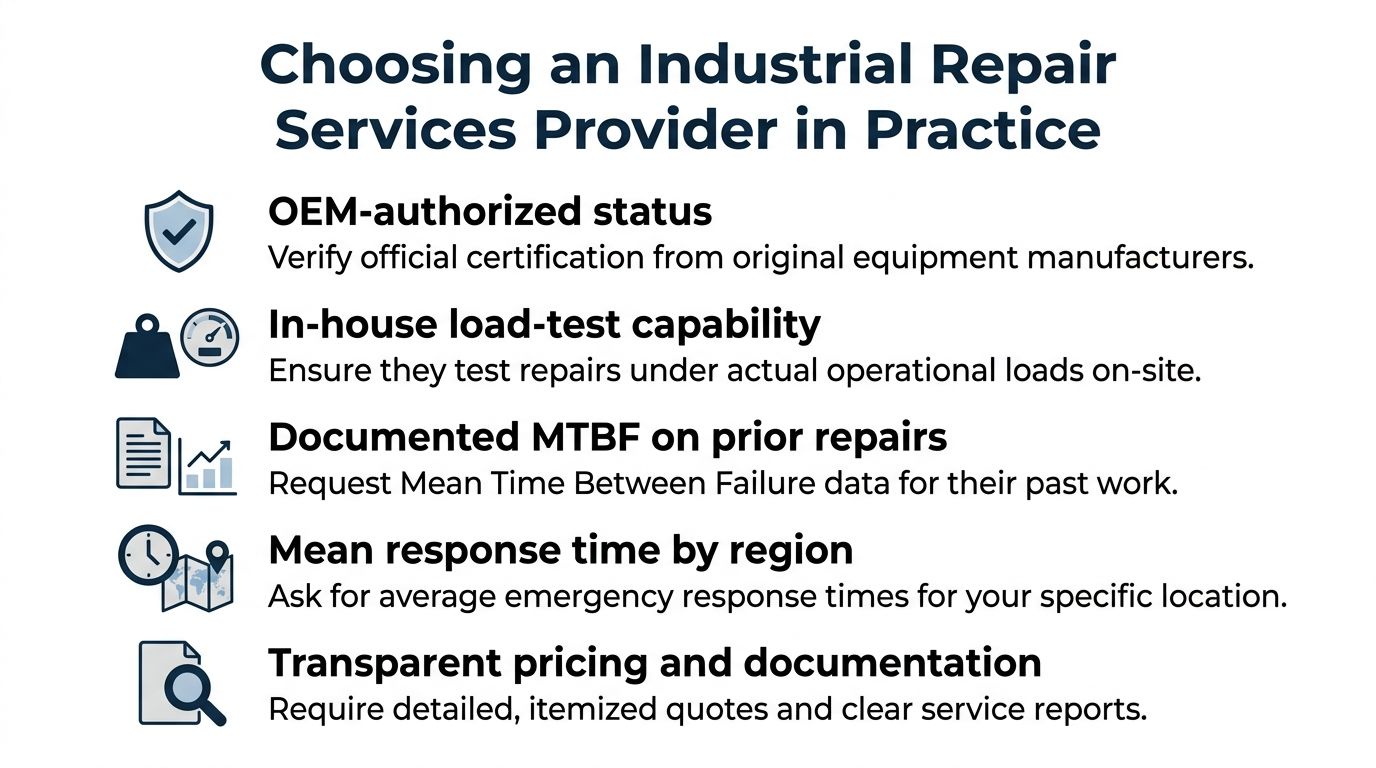
Start with OEM-authorized status, but don't stop there. Authorization matters, yet it doesn't prove the provider can diagnose a stubborn failure in your environment. Ask for in-house load-test capability, documented MTBF on prior repairs, mean response time by region, and warranty terms that clearly separate workmanship from misuse or upstream power quality issues.
For a steel mill running 24/7, I'd want on-site triage and emergency response that can stabilize a line fast, plus a workshop that can handle deep board-level repair when the fault is more than a field swap. For a tire plant with high-volume extrusion lines, scheduled on-site reconditioning tied to planned changeovers is usually the smarter fit. For a chemical facility, the provider needs hazardous-area scope handling, clearance procedures, and traceability on every replaced component.
DUCHENG Industrial is one example of a lifecycle VFD provider that combines structured on-site diagnosis, workshop deep repair, on-site reconditioning, and emergency contacts for China and Thailand. That kind of service stack is what a plant should be looking for, because it maps to the actual operating windows instead of forcing every fault through the same door.
A simple scoring template works
Use a tiered review and score each provider on four questions:
- Can they isolate the fault fast and safely?
- Can they prove the repair under test, not just claim it?
- Can they support your asset class and environment?
- Can they explain the restart risk in plain language?
If a provider can't answer those cleanly, keep looking. Procurement should reward evidence, not confidence.
When the Obvious Choice Is the Wrong Choice
The fastest response isn't always the best repair. Emergency service can get a drive back online at 2 a.m., but if the provider never shows you the root cause, you may be buying a temporary restart that repeats next week. That's why the best teams demand evidence of what failed and why it failed, not just a green panel.
Whole-unit replacement has the same problem when it's chosen by reflex. Sometimes it's a parts-availability workaround disguised as a reliability decision, and that's a costly habit when the failure is still isolated. In those cases, workshop deep repair with bench verification can preserve uptime and avoid unnecessary capex.
The bigger mistake is treating the four service models as separate camps. Serious industrial repair services blend triage, workshop repair, on-site reconditioning, and emergency response across the asset lifecycle. The right question is not “Which model wins?” It's “Which model wins for this asset, in this window, with this failure mode?”
| Default Choice | Why It Fails | Better Path |
|---|---|---|
| Fastest emergency callout | Can hide deeper power-stage or wear issues | Demand fault evidence and verification |
| Whole-unit replacement | May be a supply workaround, not a reliability choice | Compare against workshop repair and reconditioning |
| One-size-fits-all repair model | Ignores asset age and downtime tolerance | Match the intervention to lifecycle stage |
The question that exposes a weak provider is simple. What did you replace, and why? If they can't answer that in terms of failure mechanism, verification, and restart risk, they're selling speed, not reliability.
If your plant is dealing with recurring VFD faults, aging cabinets, or a shutdown window that can't absorb trial-and-error, talk to DUCHENG Industrial about lifecycle VFD support that includes structured triage, deep repair, and on-site reconditioning. Visit DUCHENG Industrial and put a real repair plan in front of the next trip instead of a guess.