
Compare plant maintenance services for heavy industry in 2026, covering preventive, predictive, corrective, and commissioning support tailored
A medium-voltage drive trips halfway through a steel mill outage. The mechanical work is ready, the electricians are standing by, and production can't restart until someone proves whether the fault sits in the power stack, gate-driver circuit, cooling path, feedback loop, or grid-side protection. The question isn't whether you have a maintenance contract. It's whether the service team can diagnose the failure, bring verified spares, restore the drive safely, and leave behind evidence that the restart is sound.
That distinction defines effective plant maintenance services in heavy industry. Maintenance affects both failure downtime and planned shutdown economics. A widely cited Plant Engineering maintenance report found aging equipment was the leading cause of unscheduled downtime in 40% of facilities, followed by mechanical failure at 24% and operator error at 12%. The same report found that one-third of facilities spent 30 hours or more each week on scheduled maintenance, compared with an average of 20 hours per week.
For VFD-heavy plants, the right answer isn't choosing one maintenance philosophy. It's combining preventive discipline, predictive evidence, corrective response, and commissioning control, then deciding when on-site MV drive reconditioning is safer and faster than workshop shipment.
Table of Contents
- What Plant Maintenance Services Actually Cover in Heavy Industry
- The Four Core Service Models Explained
- Preventive vs Predictive vs Corrective vs Commissioning
- How a Maintenance Program Runs Across an Asset Lifecycle
- Matching Service Models to Real Plant Scenarios
- Why On-Site Restoration Matters for MV Drives
- Choosing the Right Service Partner for Your Plant
What Plant Maintenance Services Actually Cover in Heavy Industry
The steel mill's tripped drive creates four immediate decisions. First, can the team isolate the fault without damaging healthy equipment? Second, are the required parts and test instruments already available? Third, should the drive be repaired in place or removed for workshop work? Fourth, what evidence will authorize a controlled restart?
Those decisions show what plant maintenance services cover. The scope extends from routine inspection to emergency restoration, and it must connect electrical condition, mechanical loading, controls, protection, and production requirements. A task-only contractor may complete a checklist. A full-scope service partner manages the asset's availability across normal operation, shutdowns, trips, and recommissioning.
The operating scope behind the contract
A serious heavy-industry program usually includes:
- Inspection routines: Cabinet cleanliness, cooling airflow, loose terminations, bus connections, grounding, fans, filters, capacitor condition, and visible thermal stress.
- Condition monitoring: Thermography, vibration checks, current signatures, insulation measurements, partial-discharge surveys, and review of alarm history.
- Fault response: Safe isolation, fault-code interpretation, component testing, root-cause investigation, controlled repair, and restart validation.
- Commissioning escort: Installation checks, protection verification, functional testing, load trials, parameter review, and documentation handover.
VFD maintenance also reaches beyond the drive cabinet. Technicians need to evaluate IGBT or power-stack health, gate-driver boards, fiber-optic communication, encoder feedback, cooling assemblies, motor insulation, incoming protection, and the quality of the control interface. A drive can appear healthy during a visual inspection while an overheating heat exchanger or unstable feedback circuit is preparing the next trip.
Why service depth appears during an unplanned trip
Scheduled preventive work is easy to present well. The true test comes when the production line is down and the initial fault indication is incomplete. A service provider that only supplies labor may need to identify parts, escalate diagnostics, and arrange transport after the event has already started.
A full-scope partner should arrive with a diagnostic method, compatible replacement parts, firmware access where required, and a documented restart procedure. For aging equipment, that capability should include on-site reconditioning, not just cabinet replacement.
Practical rule: Judge a maintenance partner by its first hour after a trip, not by the polish of its preventive-maintenance report.
The four models below, preventive, predictive, corrective, and commissioning, are useful only when tied to these operational decisions. Their value changes with asset age, failure consequence, environmental stress, and the time available before restart.
The Four Core Service Models Explained
Each service model earns its budget in a different operating situation. The mistake is treating the categories as interchangeable packages.
Preventive maintenance controls known failure modes
Preventive maintenance schedules work by calendar time, operating hours, production cycles, or shutdown opportunity. For a VFD, that can mean cleaning contamination, inspecting cooling paths, checking torque on critical connections, reviewing fans and filters, validating parameters, and replacing consumables before deterioration becomes a trip.
The advantage is control. The plant can plan labor, access, permits, and replacement parts instead of waiting for a failure. The drawback is that technicians may service healthy components, and a calendar task won't detect every developing defect.
Historical maintenance data shows why preventive work remains unavoidable. The Plant Engineering report found that 31% of facilities shut down standard production machinery every month for scheduled maintenance. Planned work still consumes production time, so the schedule must focus on actual failure modes rather than routine activity for its own sake.
Predictive maintenance turns condition into a decision
Predictive maintenance uses evidence from the asset, such as vibration, thermography, oil analytics, insulation behavior, partial discharge, capacitor measurements, or drive event history. The technology isn't the program. The program exists only when the plant agrees on alarm thresholds, ownership, escalation, and the action that follows a warning.
A thermal image of a blocked cooling path has little value if nobody owns the inspection response. A rising vibration trend matters only if the team knows whether to clean, rebalance, replace a bearing, reduce load, or schedule a controlled intervention.
Adoption remains an execution challenge. A 2025 industrial maintenance survey reported that only about 27% of industrial teams used a predictive approach, while 71% said preventive maintenance was core to their strategy. That gap supports a practical recommendation: build a reliable inspection and work-order process before adding more sensors.
Corrective maintenance protects the restart
Corrective work begins after a defect or failure has been identified. It includes emergency response, fault isolation, root-cause analysis, component repair, replacement, recommissioning, and post-repair documentation.
Corrective maintenance isn't automatically poor maintenance. A plant may deliberately run a noncritical asset to failure, provided the consequence is understood and the spare is ready. The model becomes expensive when the failed asset is production-critical, the fault is unclear, and no compatible part has been verified.
The maintenance-industry summary reports an average facility loss of around 25 hours per month to unplanned downtime. That exposure makes response speed and spare-parts depth central service requirements, not optional extras.
Commissioning maintenance establishes the baseline
Commissioning support starts before stable production. It covers installation inspection, phase rotation, protection settings, insulation checks, control verification, load testing, parameter capture, alarm review, and documentation handover.
This is a one-time service event with long consequences. If the team fails to record healthy current, temperature, vibration, and protection behavior at startup, later troubleshooting becomes guesswork. Commissioning also reveals whether the installed system matches the drawings, approved settings, motor data, and operating sequence.
Each model underperforms when isolated. Preventive work becomes box-checking, predictive work becomes unused data, corrective work becomes firefighting, and commissioning becomes paperwork. The plant needs a connected operating method.
Preventive vs Predictive vs Corrective vs Commissioning
A plant manager should compare service models by the cost and risk they create, not by the terminology in a proposal. Preventive work creates a planned spend. Predictive work creates a monitoring and interpretation obligation. Corrective work creates event-driven exposure. Commissioning creates a concentrated investment that establishes future reliability.
The following matrix applies those trade-offs to a VFD-heavy site.
Service Model Comparison for VFD-Heavy Plants
| Service Model | Cost Shape | Downtime Risk | Skill Demand | VFD Fit |
|---|---|---|---|---|
| Preventive | Planned and recurring | Reduces known failure exposure, but uses scheduled access | Moderate to high electrical and drive knowledge | Strong for contamination, cooling, connections, fans, and aging components |
| Predictive | Monitoring and intervention costs, linked to condition | Lower intrusive-work risk when data is trusted | High, because technicians must interpret signals and set actions | Strong for thermography, vibration, partial discharge, capacitor condition, and event trends |
| Corrective | Event-driven, with possible premium labor, parts, and production loss | Highest when critical assets fail without prepared response | Very high during fault isolation and restart | Essential for trips, component failures, recurring faults, and controlled restoration |
| Commissioning | Concentrated one-time or project-stage cost | Establishes safe startup and reduces unknown baseline risk | High, requiring controls, protection, drive, and motor expertise | Essential for new, overhauled, upgraded, and replacement drives |
Preventive maintenance buys certainty about when the team will work, but it can over-service assets that aren't degrading. Predictive maintenance reduces intrusive work only when measurements are repeatable and someone can translate an alarm into a field action. Without that interpretation, the plant has a dashboard and the same outage risk.
Corrective maintenance looks inexpensive in a budget that counts only labor and parts. It becomes expensive when an emergency trip interrupts production, exposes a second failed component, or forces the team to wait for an unverified replacement. A downtime benchmark citing an ABB reliability survey places industrial downtime at about US$125,000 per hour for industrial businesses. That figure makes restoration planning financially material even when the maintenance job itself appears small.
Commissioning is the least frequent model, but it sets the conditions under which the other three operate. Correct protection settings, documented parameters, verified feedback, and a usable baseline give later technicians something to compare against.
Decision rule: Use preventive work to control known wear, predictive work to identify changing condition, corrective work to restore failed assets, and commissioning work to prove the system before production depends on it.
Mature plants blend all four. A medium-voltage drive fleet needs planned care and condition evidence, but it also needs a response plan for the fault that monitoring fails to predict.
How a Maintenance Program Runs Across an Asset Lifecycle
A heavy-industry maintenance program should follow the asset's operating condition, not just a calendar. Each phase needs a trigger, a defined work package, and an auditable deliverable. That structure prevents the common failure where commissioning records disappear, preventive tasks drift, and predictive alarms never become work orders.
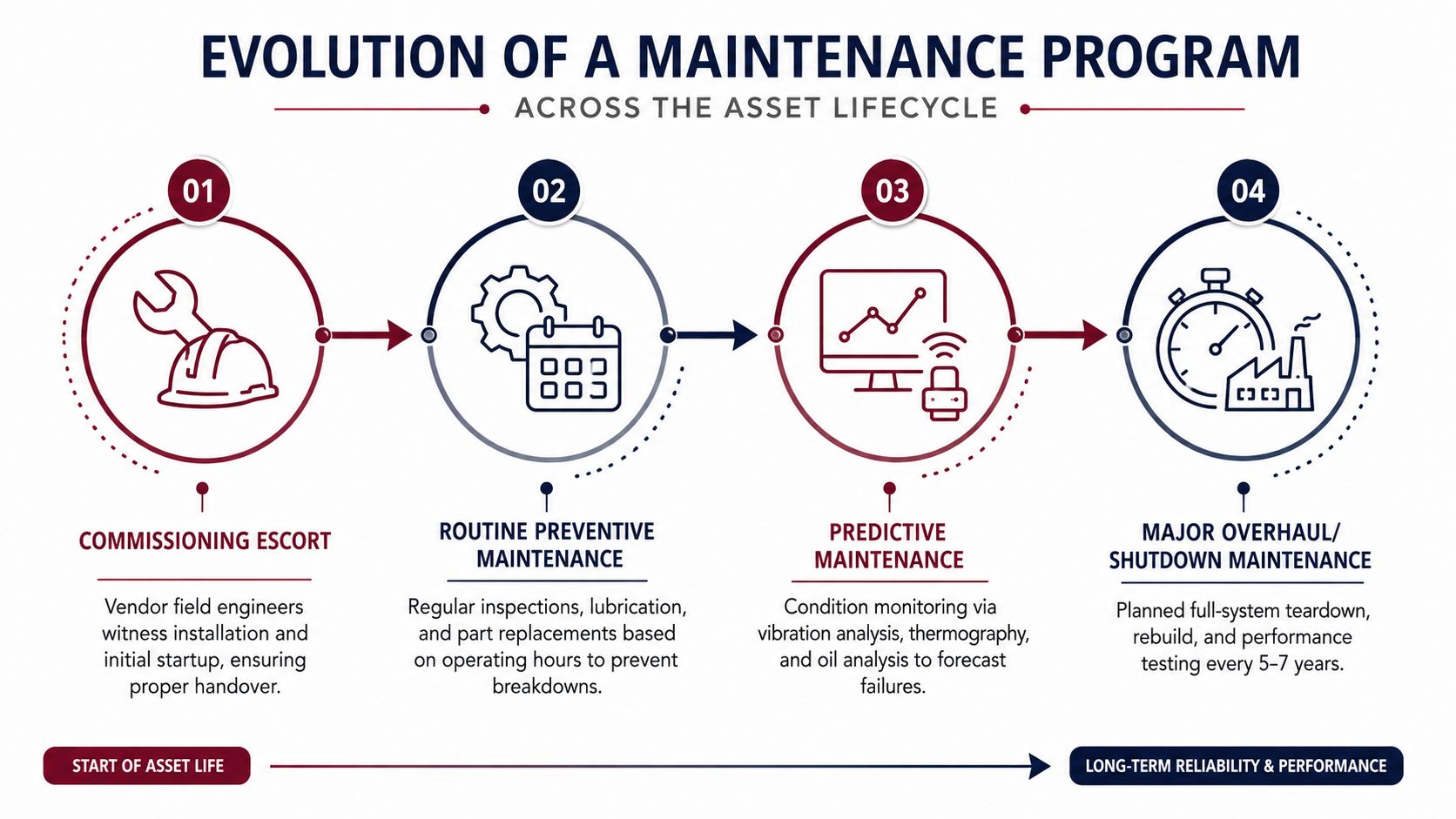
Start with a commissioning baseline
During commissioning, field engineers should witness installation and verify phase rotation, insulation condition, grounding, protection settings, control logic, and feedback signals. The drive should be tested through the operating sequence, including no-load and loaded conditions where the process allows it.
Record the initial thermal, vibration, current, alarm, and parameter signatures. The deliverable isn't merely a signed handover. It's a usable reference for future troubleshooting and predictive review.
Establish early-life preventive routines
Early operation should focus on installation-related risk and basic degradation. The team can inspect consumables, validate firmware and parameters, confirm cooling performance, and check tightening torque during planned access.
The interval should follow equipment condition, operating severity, and the manufacturer's requirements. The important point is consistency. A maintenance task that isn't recorded with findings, measurements, and corrective actions can't support reliability decisions later.
Add predictive overlays at mid-life
As the asset accumulates operating exposure, condition monitoring becomes more valuable. For MV systems, the program may include partial-discharge trending on cables, capacitor ESR checks, thermography, current-signature review, and fan-bearing vibration analysis.
The team should define what moves a measurement from observation to intervention. A drift outside an agreed alarm threshold, a repeated thermal anomaly, or a fault event should create a planned work order with a responsible person, required parts, and a restart test.
Treat late life as a restoration decision
Late-life equipment requires a different question. The plant must decide whether to repair a subsystem, recondition the drive in place, replace the cabinet, or upgrade the system. Obsolete spares and repeated component drift often make a full replacement unnecessarily disruptive.
On-site reconditioning can address power stacks, gate-driver boards, cooling assemblies, and related connections inside a controlled work area. That approach avoids moving fragile assemblies through an external logistics chain and lets the team complete verification against the installed system.
The asset lifecycle also needs a clear escalation path. When monitoring shows deterioration, the plant should schedule intervention. When a fault occurs, it should move into corrective diagnosis. When the drive reaches late life, the service plan should already identify compatible spares and restoration options.
The maintenance program should leave a record at every transition:
- Commissioning: Baseline measurements, settings, protection records, and handover documents.
- Preventive care: Inspection findings, replaced items, cleaning evidence, and torque or test records.
- Predictive monitoring: Trend results, alarm decisions, and work orders created from condition changes.
- Restoration: Root cause, parts traceability, test certificates, restart readings, and return-to-service approval.
A short visual overview of the operating sequence is useful before a shutdown briefing. The following video can support that discussion.
<iframe width="100%" style="aspect-ratio: 16 / 9;" src="https://www.youtube.com/embed/c-s_hTizqzI" frameborder="0" allow="autoplay; encrypted-media" allowfullscreen></iframe>Matching Service Models to Real Plant Scenarios
The correct service blend depends on where the plant starts. A greenfield site needs baseline control. A contaminated process site needs aggressive preventive access. A late-life drive fleet needs restoration depth and spare-part discipline.
Scenario one, a greenfield steel plant
The plant commissioned new MV drives during the previous quarter. The immediate priority isn't emergency repair capacity. It's proving that installation, protection, controls, cooling, and load behavior match the design intent.
Commissioning support remains high because the plant needs a complete handover record. Early-life preventive work also carries weight, with inspections focused on installation quality, cabinet condition, cooling, connections, and parameter integrity. Predictive monitoring should establish normal signatures before the team uses it to make major intervention decisions.
Corrective capacity still matters, but it can be structured as standby response rather than the dominant workstream. The cost shape is mainly planned service and commissioning support, while downtime exposure comes from undocumented baseline conditions and unfamiliarity with the new system.
Scenario two, a chemical site with airborne contamination
Here, the environment drives the program. Contamination can restrict heat exchangers, coat components, degrade cooling, and accelerate stress in capacitor banks and power electronics.
Preventive work should receive more frequent access, with cleaning, inspection, thermography, airflow checks, and connection verification tied to the site's contamination pattern. Predictive thermography can identify abnormal heat before an overtemperature trip, but only if the team follows through with cleaning or repair.
Corrective specialists should remain available because a strong preventive program reduces risk without eliminating every contamination-related failure. The plant should stage cleaning equipment, compatible components, and restart procedures before the shutdown window.
Scenario three, late-life MV drives with obsolete spares
The fleet has operated for many years. Components are drifting out of tolerance, documentation may be incomplete, and original replacement paths are uncertain. Waiting for a full cabinet exchange can expose the plant to an extended outage and compatibility problems.
Predictive data should help prioritize which units receive attention first. Corrective work becomes more prominent, but the preferred response may be on-site reconditioning of failed or degraded subsystems, rather than replacing an entire cabinet. Preventive shutdown work can then address contamination, cooling, loose connections, and thermal stress across the remaining fleet.
Service Model Intensity by Plant Scenario
| Scenario | Preventive | Predictive | Corrective | Commissioning Support |
|---|---|---|---|---|
| Greenfield steel plant | Medium, focused on early-life checks | Baseline and trend creation | Low to medium, with response readiness | High |
| Chemical site with contamination | High, with repeated cleaning and inspection | High, especially thermal and condition checks | Medium to high, because environmental faults can recur | Medium for modifications and replacement work |
| Late-life MV drives | Medium, focused on shutdown restoration | High, to prioritize assets and detect drift | High, with subsystem repair and on-site reconditioning | Medium, for upgrades, restarts, and handover after major work |
The comparison makes one point clear. “Predictive” isn't a maturity badge, and “corrective” isn't always a failure of planning. Each model earns its place when it matches the plant's actual failure modes and the time available to restore production.
Why On-Site Restoration Matters for MV Drives
Workshop shipment often looks simpler because the plant removes the problem and sends it elsewhere. For medium-voltage drives, that decision can create another chain of risks. Large cabinets require lifting, transport, reinstallation, reconnection, testing, and recommissioning, while sensitive power electronics and communication assemblies must survive handling without introducing a second fault.
On-site restoration is particularly compelling when the drive is heavy, the shutdown window is short, the process cannot tolerate uncertain transport time, or the failure is limited to a serviceable subsystem. Technicians can work inside a controlled environment using suitable protection against contamination and electrostatic discharge, then inspect power stacks, gate-driver boards, cooling assemblies, and fiber-optic interfaces without removing the entire cabinet.
When the field option wins
Choose on-site reconditioning when:
- The drive is production-critical: A shorter isolation and restart path matters more than a theoretically lower workshop labor rate.
- Transport creates technical risk: Fragile modules, cooling circuits, optical interfaces, and cabinet alignment can be disturbed during removal and shipment.
- The failure is localized: A power stack, gate-driver board, fan assembly, or connection problem may not justify full-unit replacement.
- Spare compatibility is uncertain: The service team can verify the replacement part against the installed configuration before dispatch.
- The plant has a controlled shutdown window: Field work can be planned with permits, environmental controls, test equipment, and restart authority already aligned.
The on-site versus workshop restoration guidance is useful for framing that decision before the outage, not after the truck has been booked.
The execution gap matters more than the dashboard. A 2025 predictive-maintenance survey found that less than 35% of industrial teams allocated most maintenance time to preventive work, and resource shortages remained a major obstacle. Plants therefore need field technicians who can interpret condition data and perform controlled restoration, not just collect another stream of measurements.
For MV drives above 1,000 kW, use a written repair decision tree. It should state when the team will recondition on site, when it will remove a module, when it will ship a subsystem, and when replacement is justified. Stage verified spares before the shutdown. Then require post-repair insulation, functional, protection, and load checks before production release.
Choosing the Right Service Partner for Your Plant
Select the partner that can execute under outage pressure, not the one with the broadest service vocabulary. A heavy-industry provider should prove how it will diagnose a trip, verify a spare, protect the work area, test the repaired drive, and hand control back to your operations team.
OEM authorization can matter, especially for proprietary procedures and firmware. It shouldn't be the only criterion. Multi-brand capability is often more practical for plants with mixed VFD fleets, provided the provider can show documented experience on the actual voltage classes, drive architectures, motors, controls, and site environments involved.
What to verify before signing
- Field-service depth: Confirm that technicians bring suitable test instruments, firmware access, diagnostic procedures, and the components required for on-site work.
- MV experience: Ask for documented work on 3.3 kV, 6.6 kV, or higher drive systems in comparable heavy-industry environments.
- Spare verification: Require evidence of compatibility review, traceability, exchange-unit checks, and pre-dispatch testing.
- Response control: Demand a written escalation path for emergency dispatch, remote triage, site arrival, isolation, repair, and restart approval.
- Testing capability: Ensure commissioning escorts, thermal imaging, partial-discharge surveys, and post-repair functional tests are delivered by accountable staff, not casually subcontracted.
- Reporting discipline: Require repair records, root-cause findings, test certificates, parameter backups, and clearly stated repair limitations.
A provider such as DUCHENG Industrial offers multi-brand VFD commissioning, troubleshooting, workshop repair, spare-part verification, and on-site reconditioning for industrial facilities. Treat those capabilities as items to verify against your site requirements, not as substitutes for a technical evaluation. Its industrial electrical maintenance services provide a useful reference point for the scope a plant may expect from a lifecycle electrical service partner.
Service Partner Evaluation Matrix for Heavy-Industry Plant Maintenance
| Evaluation Criterion | What to Confirm Before Signing | Red Flag to Avoid |
|---|---|---|
| Authorization and technical coverage | Relevant manufacturer credentials, multi-brand ability, and clear responsibility boundaries | Authorization claimed without named technical scope |
| MV field capability | Completed work on comparable voltage, power, motor, and control systems | Reliance on workshop removal for every failure |
| On-site reconditioning | Controlled work area, component-level diagnostics, suitable tooling, and restart testing | “On site” means visual inspection followed by shipment |
| Verified spares | Compatibility review, traceability, exchange testing, and pre-dispatch confirmation | Generic parts list with no installed-configuration check |
| Emergency response | Defined contacts, escalation stages, safety isolation process, and reporting times | Verbal promises with no response procedure |
| Reliability reporting | Repair duration, first-time-fix tracking, root-cause documentation, and test certificates | Closure report limited to replaced parts |
| Commissioning support | Baseline measurements, protection checks, load testing, and handover records | Commissioning reduced to energization and sign-off |
Before your next shutdown, map every critical drive to its failure modes, compatible spares, restoration method, test requirements, and decision owner. Then invite the service partner to challenge the plan at the cabinet, motor, protection, and production interfaces. That conversation will reveal far more than a standard maintenance proposal.
DUCHENG Industrial supports heavy-industry plants with multi-brand VFD commissioning, preventive care, rapid fault restoration, verified spare-part matching, workshop repair, and on-site MV drive reconditioning. Review your critical drive list and shutdown window with the team, then visit DUCHENG Industrial to discuss a service plan built around safe restoration and auditable lifecycle support.