
Plan plant shutdown maintenance with confidence, from scope freeze to controlled restart, including VFD inspection, safety, and staffing.
The shutdown date is fixed, but the scope still contains open questions. Contractors are already asking for work fronts, operations wants the outage shortened, and the electrical supervisor is trying to decide which drives can be inspected with the crew available. The punch list is longer than the window, and every late decision consumes time that should have been spent on isolation, inspection, testing, or restart.
That's the reality of plant shutdown maintenance. The schedule matters, but execution capacity decides whether the schedule survives contact with the plant. Qualified labor, simultaneous work fronts, permit flow, material readiness, and fast technical decisions determine how much work gets completed safely before production must return.
Table of Contents
- Why Most Plant Shutdown Maintenance Programs Underperform
- Building the Shutdown Plan From 12 Months Out
- Ranking Work Scope When Crews Are Already Stretched
- Permits, LOTO, and Working Safely in a Compressed Window
- VFD Inspection and On-Site Reconditioning During the Outage
- Controlled Restart and Post-Shutdown Verification
- Your Shutdown Readiness Checklist
Why Most Plant Shutdown Maintenance Programs Underperform
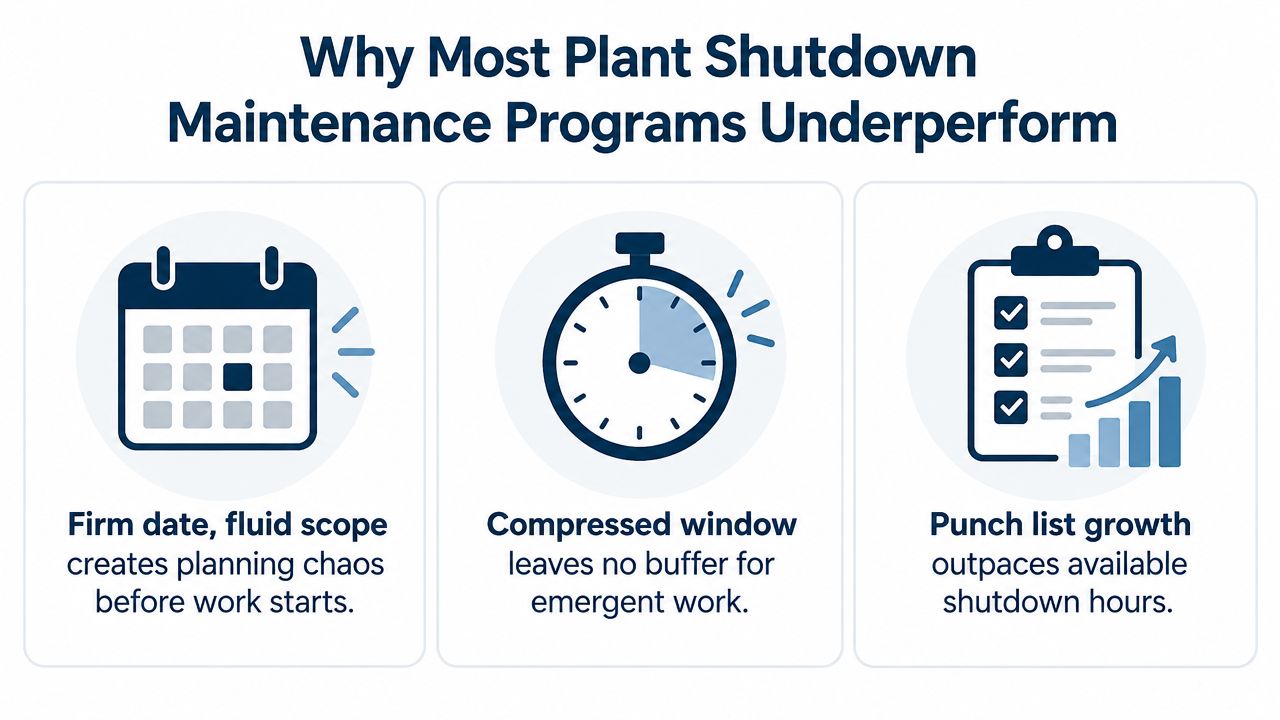
A maintenance manager can have a polished shutdown schedule and still lose hours before the first job starts. The date is fixed, the scope keeps changing, and the outage window offers little tolerance for defects found after equipment is opened. In a refinery, cement plant, steel mill, or pulp site, that combination puts immediate pressure on the people executing the work.
The recurring failures are operational:
- Scope growth: Teams add attractive but noncritical work after the freeze point, using labor assigned to critical-path jobs.
- Permit queues: Crews reach the work area at shift handover, then wait for permits, isolations, gas tests, or access.
- Idle contractors: A specialist crew stands by because isolation, scaffolding, drawings, or replacement parts are incomplete.
- Deferred verification: Inspection, insulation testing, configuration checks, and commissioning records are postponed until after re-energization.
An industry maintenance survey reported that the average facility spends 20 hours each week on scheduled maintenance and assigns about 9.2% of its annual operating budget to maintenance processes. It also reported that 31% of facilities shut down standard production machinery every month for scheduled maintenance, while one-third spend 30 hours or more each week on scheduled maintenance. The implication is clear: shutdown work belongs to a major operating program, not an occasional interruption. Plant Engineering's maintenance survey
The outage window exposes weak decisions
Downtime cost varies by facility and process. Industry analysis has estimated plant downtime at about $12,500 per hour, while other industry sources cite higher losses in some sectors, including $260,000 per hour in manufacturing and $2.3 million per hour in automotive manufacturing. Those figures explain the pressure to keep work moving. They do not justify bypassing isolation discipline or starting work before the crew, equipment, and materials are ready. The turnaround workforce analysis
Turnaround performance data shows the same capacity problem. Industry studies have reported that 82% of plant turnarounds fail to meet performance requirements, and 80% exceed budget by more than 10%. A separate benchmark found that only about 32% of turnaround maintenance events meet the criteria for success. The turnaround management benchmark from BCG
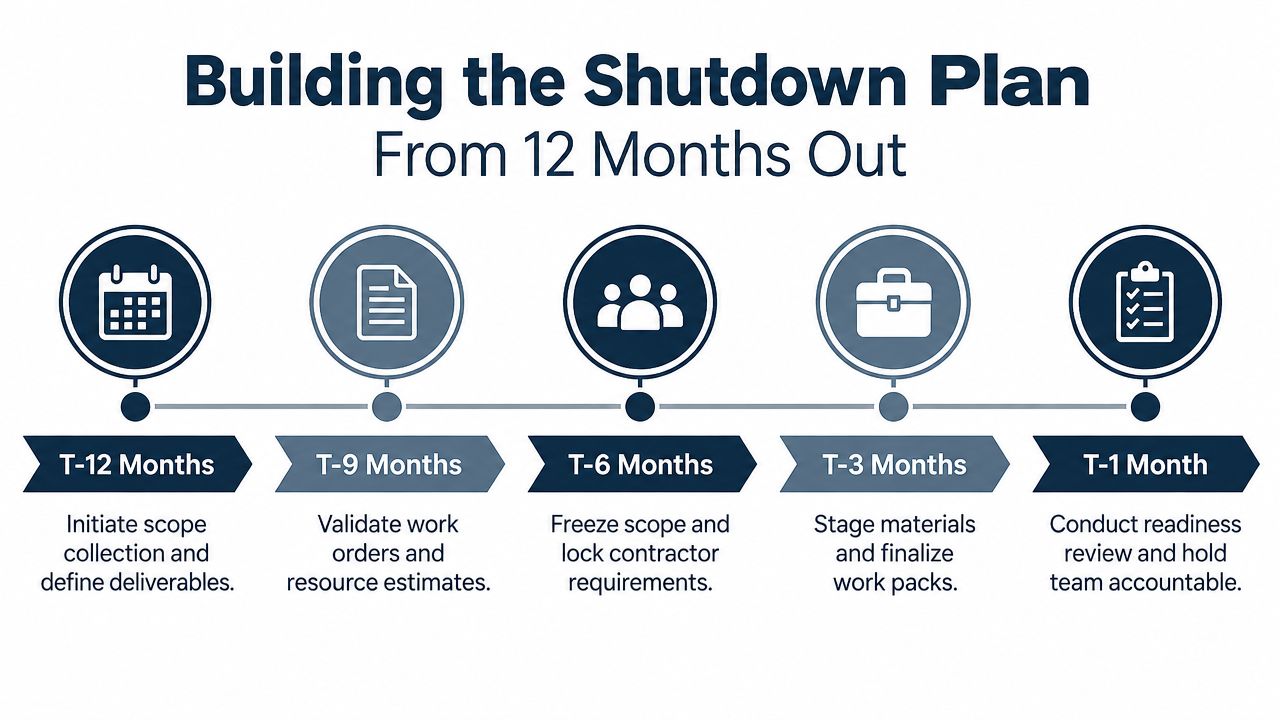
Adding labor without removing constraints rarely fixes the outage. The team needs enough planning lead time for available workers to execute without waiting, rework, or repeated technical decisions. A 12-month countdown, monthly deliverables, weekly readiness reviews during the final 60 days, and daily tier meetings during the last two weeks give supervisors repeated chances to clear constraints before the outage begins.
The same capacity test applies to VFD work. Drives need qualified electrical technicians, safe isolation, suitable test equipment, replacement fans or capacitors when required, and a defined acceptance record. If those resources are not reserved, a VFD inspection can consume the window without producing a usable decision.
Practical rule: If a job has no owner, no material confirmation, no isolation path, and no measurable completion standard, it is not ready for the shutdown schedule.
Building the Shutdown Plan From 12 Months Out
A shutdown can have a sound schedule and still fail because the plant cannot execute the work inside the available window. Build the plan around decisions, materials, skills, and field-ready work packs. Each milestone should produce an artifact that exposes a constraint early.
T-12 months to T-9 months
At T-12 months, collect current condition data instead of relying on memory or an inherited backlog. Review vibration trends, thermography, oil analysis, alarm history, and VFD event logs. Ask each asset-class owner for candidate work, then assess consequence, degradation evidence, labor demand, and readiness.
The first deliverable is a ranked candidate register. The steering group decides which items need engineering review, which belong in routine maintenance, and which require intervention before the shutdown. This prevents the outage from becoming a holding area for unresolved decisions.
At T-9 months, remove duplicate work orders and validate labor and duration estimates. Start procurement for long-lead items such as rotor kits, bearings, VFD fan assemblies, capacitor banks, gaskets, and specialist inspection services. A missing fan assembly or capacitor bank can turn a planned drive inspection into a deferral.
The output is a validated scope register, resource estimate, and procurement tracker. Management must decide whether to fund and reserve the materials, electrical testing capability, and specialist capacity required for the proposed work. A VFD task belongs in the window only when its inspection method, isolation path, test equipment, and acceptance record are defined.
For a practical overview of the planning logic, use this guide to plan the work inside a planned shutdown.
T-6 months to T-3 months
At T-6 months, lock the contractor scope and define the crew mix by trade. Count skills and shift coverage, not just headcount. Confirm supervision, inspection authority, electrical testing capability, access support, and commissioning coverage. If qualified drive technicians are unavailable, reduce the VFD scope or arrange support before the outage.
Draft permit templates and isolation packages at this stage. Identify confined-space entry, hot work, lifting, electrical testing, and specialist-access requirements while the plant is operating, when discrepancies are easier to correct.
At T-3 months, hold the formal scope freeze. Issue a written, risk-ranked backlog with accepted deferrals and named approval authority for changes. Turnaround guidance supports long-range planning, early budget approval, and controlled scope change as a management system. Scope control must govern additions, removals, and technical substitutions, rather than record decisions after the fact.
T-6 weeks to T-0
At T-6 weeks, walk drawings against the field. Verify equipment tags, isolation points, access routes, scaffolds, confined-space inventories, temporary power, lighting, and laydown areas. Close discrepancies while production continues.
At T-1 week, stage lockout kits, tools, parts, test instruments, and work packs. Test the communication tree and begin daily coordination. At T-0, execution should follow an approved sequence. Changes need a visible decision route, with an owner and documented effect on labor, materials, and restart testing.
Ranking Work Scope When Crews Are Already Stretched
During a short outage, the schedule is rarely the main constraint. Available execution capacity is. If every deferred task enters the plan, crews lose focus, the critical path expands, and high-consequence work competes with convenient improvements.
An industrial maintenance report found that 50% of teams dedicate less than 40% of their time to planned work, with labor shortages and skills gaps among the main downtime drivers. The 2026 industrial maintenance report That makes labor hours the controlling resource during a shutdown. Scope must match the crew, specialist availability, and time left for testing.
Use three tiers, then select one according to actual capacity.
| Tier | Best Use Case | Typical Crew Mix | Risk of Deferral | VFD Coverage |
|---|---|---|---|---|
| Critical-only | Window under 48 hours or sharply reduced crews | Core electrical, mechanical, operations, safety, and inspection support | High for noncritical reliability work | Safety functions, known failure modes, cooling, and protective checks |
| Balanced | Most planned turnarounds with constrained but stable resources | Core trades plus targeted specialists and commissioning support | Moderate and documented | Critical inspections, contamination, cooling, event history, and condition-based findings |
| Full-scope | Longer duration with confirmed contractors and engineering coverage | Full trade coverage, reliability specialists, project engineering, and upgrade support | Lower, provided readiness remains high | Preventive care, reconditioning, modernization, and selected upgrades |
Make the decision by hours, consequence, and readiness
Rank each job in this order:
- Hours demanded, including access, isolation, testing, and closeout.
- Consequence of deferral, including safety exposure, production impact, environmental risk, and failure severity.
- Readiness, including parts, permits, drawings, skills, and work-pack quality.
Commit work that ranks high in all three areas. A high-consequence job with poor readiness needs a named owner and recovery plan. It should not remain as an unexamined line item. Move lower-ranked work to a documented deferral list, with the condition that would return it to the next work window.
Consider a 1,200-hour proposed scope. Under critical-only, remove modernization and low-consequence corrective work so mandated inspections, safety devices, and known failure modes receive the available labor. Under balanced, add reliability-pinned preventive work and high-yield condition-based tasks. Under full-scope, include upgrades and deeper VFD reconditioning only after duration, specialist coverage, parts, and testing resources are confirmed.
VFD work belongs in the ranking logic, not as an automatic add-on. A drive with a known cooling, protective, or failure-history concern may a routine improvement. A deeper reconditioning task can wait when it would consume scarce electrical specialists without changing outage risk.
The trade-off is visible scope reduction versus hidden execution failure. A smaller completed scope with clean verification is safer than a large nominal scope that leaves critical work incomplete.
Permits, LOTO, and Working Safely in a Compressed Window
Permit-to-work, lockout/tagout, and energized-task decisions should operate as one short decision tree. Supervisors need a repeatable sequence that works at the equipment ticket level, not a general area-level assumption.
Confirm the specific energy state
Start with the exact equipment identification and isolation drawing. Don't rely on a blanket area isolation, especially when drawings or field conditions may have changed between turnarounds.
Then verify each isolation point physically:
- Identify: Match the asset tag, source, and work order.
- Isolate: Open, disconnect, block, or otherwise secure every relevant energy source.
- Lock and tag: Confirm each lock belongs to the assigned person or approved control process.
- Test: Attempt the prescribed test and verify the expected absence of energy.
- Dissipate: Release stored energy from capacitors, hydraulic accumulators, gravity-loaded equipment, pneumatic systems, and rotating assemblies.
VFDs deserve special attention because a disconnected input doesn't automatically mean the DC bus is safe. Capacitors can retain hazardous energy, so the team must follow the drive manufacturer's discharge process and verify the result with a properly rated instrument before hands-on work begins.
Match the permit to the task
Cold work should be the default where the task allows it. Hot work requires documented justification, appropriate fire controls, and atmospheric monitoring. Energized electrical work should be considered only when de-energization creates a greater hazard and the required controls are formally established.
Permit handback is another common failure point. The outgoing supervisor must identify incomplete work, temporary conditions, open isolations, test results, and equipment status to the incoming supervisor. Lock counts should be checked at handover, not reconstructed later from memory.
Stop-work authority only works when supervisors protect it. If a crew can't confirm isolation, access, atmosphere, or test conditions, the job pauses until the uncertainty is removed.
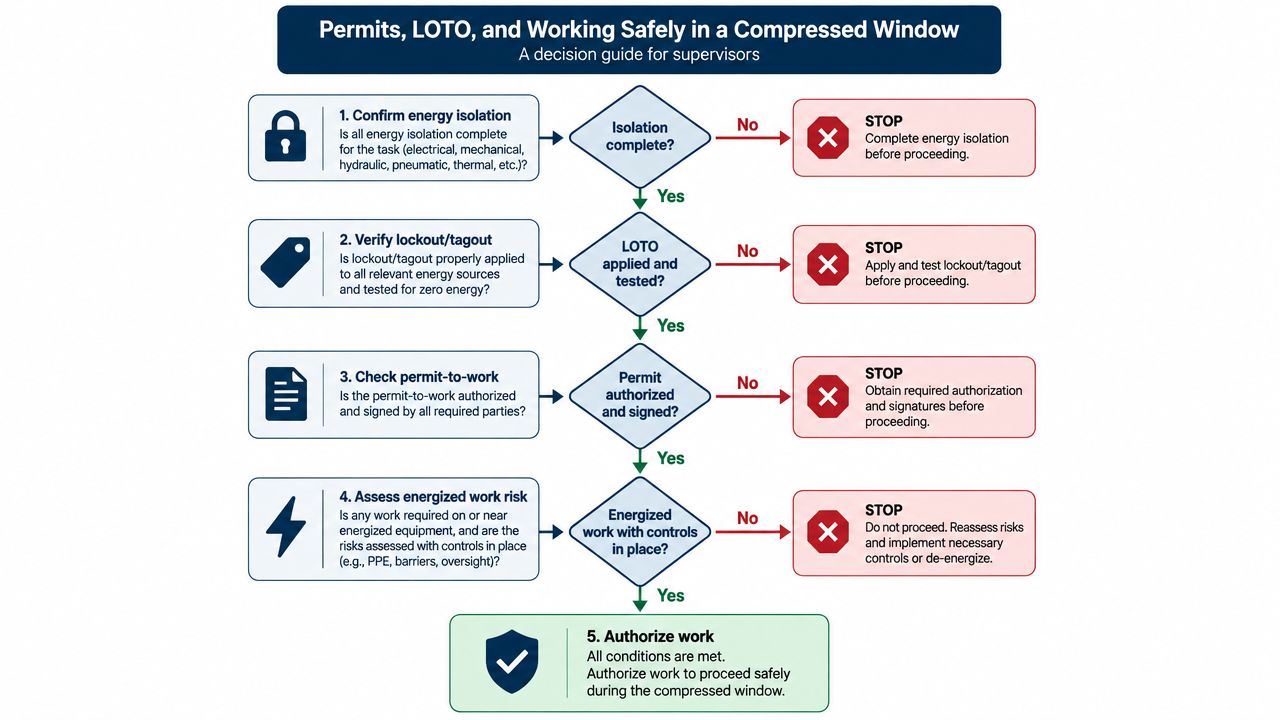
Use this decision tree as a briefing aid before the first shift begins.
<iframe width="100%" style="aspect-ratio: 16 / 9;" src="https://www.youtube.com/embed/UUfiJoe0SYE" frameborder="0" allow="autoplay; encrypted-media" allowfullscreen></iframe>VFD Inspection and On-Site Reconditioning During the Outage
A cement plant has 72 hours to return two kiln induced-draft fan drives to service. The electrical crew has one shift for inspection, cleaning, and preparation. That window cannot support every desirable task, so the supervisor sequences work by failure mode and execution capacity, rather than opening cabinets and discovering scope as the clock runs down.
Inspect in physical order
Start outside the cabinet. Check dust loading, moisture marks, damaged seals, blocked filters, loose glands, and heat discoloration. Airborne dust and moisture restrict heat transfer and can trigger protective shutdowns. Contamination control therefore belongs in the reliability scope, not in cosmetic housekeeping. Airflow, derating, and fan service are important thermal controls.
After the enclosure is safe to open, follow the heat and energy path:
- Filters and air inlets: Clean or replace filters when restriction is evident, then confirm that the intended airflow route is clear.
- DC bus capacitors: Check for bulging, leakage, damaged terminals, and other age-related warning signs. Do not replace capacitors because the cabinet is open. Use available condition indicators, including ESR results where the equipment and procedure support them.
- Cooling fans: Check bearing noise, rotor play, free rotation, wiring, and direction. A fan fault can turn an otherwise clean drive into a thermal trip.
- Heatsinks: Remove fouling that blocks the designed cooling path. Wiping visible dust away without restoring airflow leaves the failure mechanism in place.
- DC link: Measure through the access cover with a properly rated meter, follow the approved electrical safety procedure, and confirm discharge before contact.
Choose reconditioning by payoff
Heatsink cleaning and replacement of failed or degraded fans usually fit the outage because they address direct thermal risks without requiring a full drive rebuild. Capacitor replacement requires a firmer decision. Proceed when condition evidence or age indicators justify intervention and the correct parts are already staged.
A rectifier or IGBT module swap should remain a contingency. It belongs in the active scope only when the failure is confirmed, the spare is compatible, and the work pack includes testing and recommissioning. Starting a major replacement without those conditions can consume the time reserved for safe verification.
| Task | Typical Time | When to Do On-Site |
|---|---|---|
| Exterior, filter, and seal inspection | Short inspection hold | Always, before opening the cabinet |
| Fan inspection and replacement | Planned electrical work | When noise, play, fouling, or failed rotation is found |
| Heatsink cleaning | Planned electrical work | When contamination restricts airflow |
| Capacitor condition assessment | Diagnostic hold point | When age or test indicators justify intervention |
| Rectifier or IGBT replacement | Contingency repair | Only with confirmed failure, compatible spares, and test coverage |
| Baseline documentation | Closeout activity | Before and after re-energization |
Record baseline readings, capacitor age, filter service history, firmware versions, alarm history, and abnormal temperature or vibration observations. Assign one person to capture the records while technicians work. That small allocation prevents the next outage from starting with missing evidence and repeated inspection.
Use the VFD maintenance guidance to organize the checks and define the records that should remain with the drive history. The purpose is practical: preserve condition evidence, separate confirmed defects from observations, and prevent a compressed outage from turning into uncontrolled repair scope.
Controlled Restart and Post-Shutdown Verification
Restart shouldn't begin when the last mechanic leaves the area. It begins when the team can prove that every work package has reached its release condition and that temporary arrangements won't interfere with operation.
Pre-energization checks
Remove LOTO in the reverse order of application, with the responsible people confirming their own locks and the supervisor verifying the equipment status. Check cabinet doors, covers, guards, bonding, cable terminations, and ground-fault continuity wherever cable disturbance occurred.
For VFDs, confirm the cabinet is clean, the filters and fans are installed correctly, and the cooling path is open. A cooling fan that turns in the wrong direction can create a post-shutdown failure even when the drive powers up normally.
Initial energization should occur in a no-load or controlled test condition where the process permits it. Observe bus pre-charge, fan operation, drive alarms, control power, feedback signals, and motor rotation before coupling the equipment to full process demand.
Ramp the load deliberately
Don't jump from zero to full load because the schedule is tight. Use defined steps at 25%, 50%, 75%, and 100% of nameplate, with agreed dwell times and a named person responsible for recording readings at each stage.
Watch motor current, bearing temperature, vibration, speed feedback, process response, and drive fault history. Compare results with the pre-shutdown baseline, but don't force a restart through a deviation because the old baseline was already poor. A changed value needs a decision, an owner, and a documented disposition.
Close the loop
At handback, upload final readings to the maintenance management system, close permits, clear temporary equipment, and confirm operators have the final operating limits. Schedule a 72-hour follow-up walk to identify bearing, alignment, thermal, or contamination-related issues that may appear only after sustained operation.
The restart gate should answer one question clearly: is the equipment fit for service, fit for restricted service with controls, or not fit for service? Ambiguous handback language transfers risk to the next shift.
Your Shutdown Readiness Checklist
A shutdown checklist should force decisions, not record optimism. Each line needs a deliverable, an owner, and a pass-or-fail signal. If the team can't show the evidence, the gate isn't complete.
The one-page planning gate
| Phase | Deliverable | Owner | Pass Signal |
|---|---|---|---|
| T-12 months | Condition-based candidate register and risk ranking | Reliability manager | Approved ranked scope exists |
| T-9 months | Validated work orders, hours, skills, and long-lead material list | Planner and procurement lead | Estimates and purchase status are visible |
| T-6 months | Contractor scope, crew mix, permits, and isolation templates | Shutdown manager and E&I supervisor | Required coverage is assigned |
| T-3 months | Written scope freeze and approved deferral list | Steering group | Late additions require formal approval |
| T-2 weeks | Permit, LOTO, access, confined-space, and emergency readiness review | Operations and safety leads | Walkdowns are closed or assigned |
| In-window | VFD inspection hold points and baseline records | Electrical supervisor | Filters, fans, cooling paths, capacitors, and readings are documented |
| Restart | Energization, load ramp, protection, and handback records | Commissioning lead | All restart gates pass |
| Post-restart | Follow-up walk and lessons captured in the asset record | Reliability manager | Deviations receive owners and due dates |
Items crews drop under pressure
The most vulnerable controls are often the ones that don't stop the first energization. Trend insulation resistance on stored drives rather than treating storage as risk-free. Confirm capacitor discharge instead of assuming the prescribed waiting period solved the hazard. Capture load-ramp readings instead of closing the work order with a simple “running” status.
A printed checklist beside the schedule makes these controls visible during shift meetings. The document should travel into the next turnaround unchanged, with only scope deltas, lessons, and equipment-specific findings updated.
The value is discipline. A checklist won't create labor, but it will prevent the available labor from being consumed by preventable waiting, rework, and unclear release decisions.
DUCHENG Industrial supports plant shutdown maintenance with multi-brand VFD inspection, troubleshooting, on-site reconditioning, spare-part compatibility review, and controlled recommissioning for industrial sites. If your next outage includes aging, contaminated, or difficult-to-ship drives, visit DUCHENG Industrial to discuss a shutdown-window service plan.