
A spare parts interchangeability record shows which VFD spare or exchange unit fits, what was checked, and the limits of that match.
It is 2 AM, a drive has tripped, and there is a candidate module sitting on the shelf. Someone has to make the call right then — can that part safely take the place of the one that failed? A spare parts interchangeability record is the controlled document that settles it, linking the installed asset to an approved spare or exchange unit with the evidence to back it up.
What a Spare Parts Interchangeability Record Answers
Think of a labeled key ring, not the key itself. The record doesn’t do the work of the spare. It shows which key was tested in which lock, what checks were done, and who approved the fit.
That difference matters on nights. A bin label gives you a part number. It won’t tell you whether that module was ever checked against the voltage class, the actual duty, or the exact brand and model of the tripped drive. The record will.
Interchangeability is proven before the part leaves for site, not discovered after it arrives.
A good file answers four questions in plain terms:
- The equipment, pinned down by nameplate data and the tag it serves
- The requested part, whether a matched spare or an exchange unit
- The compatibility conclusion, stated clearly for that brand, model, and voltage class
- The checks completed before dispatch, so the next shift can see the proof
One honest caveat. A finished record documents a decision, not a promise of stock. Availability, lead time, and exchange terms still hinge on the specific brand, model, and service agreement, so the file captures what was accepted rather than guaranteeing what is on the shelf.
The Minimum Fields to Expect
Before we unpack each field in detail, here is the smallest set a credible record should include:
| Field | What It Captures |
|---|---|
| Asset identity | Tag number, nameplate data, voltage class |
| Candidate identity | Matched spare or exchange unit details |
| Compatibility result | The stated conclusion and open uncertainties |
| Pre-dispatch check | Proof the part was physically verified |
| Sign-off | Who accepted the match, and when |
That is what separates a guess from a documented decision. When the supervisor reaches for the shelf spare, the record makes it clear whether that choice was already justified — or whether dispatch needs to wait until the review is reopened.
Open a spare parts interchangeability record the way you'd walk a unit from the cabinet to the truck. Every line should help someone make the next call — not just copy what's already on the box.
What Belongs Inside the Interchangeability Record

Start with identification evidence. Note the equipment tag, nameplate data, voltage class, and what the installed part actually does.
That context matters. “Drive module for conveyor duty” tells a reviewer far more than a loose part number ever will. Where you can, attach clear photos of labels and nameplates. And if something's missing, flag it — don't guess.
A part-number match is a starting clue, not a finished compatibility decision.
Next, spell out the sourcing path. A matched spare and an exchange unit aren't the same thing, so give each one its own entry with the candidate details and why it's in the frame.
- Installed identity ties the request back to the real machine.
- Candidate identity separates the proposed unit from everything else in stock.
- Sourcing notes clarify if you're dealing with current or legacy equipment.
- Open questions list what still needs an answer before anyone says yes.
Capture the Review and Dispatch Evidence
The compatibility review is essentially the reviewer's notebook, saved for the next shift. It should show what was compared, what proof was used, what was decided, and any limits on that decision.
A good note might say the ID details lined up but one application point is still unconfirmed. That's far more helpful than a bare “approved” tick, because the coordinator knows exactly what to chase.
| Record Entry | Evidence to Preserve |
|---|---|
| Compatibility review | Comparison, conclusion, unresolved details |
| Pre-dispatch verification | Checks completed, results, date, responsible person |
| Exchange coordination | Outbound identity, recipient, return arrangements |
Pre-dispatch verification proves the candidate was checked before it left for site, not just ordered. Keep that result linked to the specific unit going out the door.
DUCHENG Industrial’s spare-parts support covers identification, compatibility review, sourcing for current and legacy equipment, pre-dispatch checks, replacement or exchange coordination, failed-part return and repair coordination, and traceable service and logistics records. Learn about DUCHENG Industrial’s service support.
Keep the Handover and Repair Trails Distinct
Finally, keep the movement history right next to the technical call.
- Record who arranged dispatch and who received the unit.
- Link the failed part’s return to that same request.
- Keep service references intact so later shifts can trace ownership and decisions.
A workshop repair file does a different job. It holds intake, diagnosis, replaced components, tests, key parameters, and suggested next maintenance. The interchangeability record answers one question: is this outbound part right for this application?
Before your next dispatch, get the coordinator and electrical supervisor to review both files side by side — and close out any acceptance condition that isn't written down.
A spare parts interchangeability record helps the coordinator and electrical supervisor choose a replacement that can carry the installed duty. An empty slot in the cabinet is not the goal. A part that fits the space but can't handle the load creates a bigger problem than a short delay.
Table of Contents
- What a Spare Parts Interchangeability Record Answers
- The Minimum Fields to Expect
- What Belongs Inside the Interchangeability Record
- Capture the Review and Dispatch Evidence
- Keep the Handover and Repair Trails Distinct
- How the Record Guides Safer Spare Selection
- Checking Compatibility Before a Part Is Dispatched
- VFD Maintenance Examples That Show the Record at Work
- Plan Renewal During a Shutdown
- Track Exchanges During On-Site Reconditioning
- When the Bin Label Replaces the Check
- A Handover Checklist for the Next Shift
- How Is This Different From a Workshop Repair Record
- Does a Completed Record Mean the Part Is in Stock
- Who Signs Off Before Installation
- When Should the Record Be Updated
How the Record Guides Safer Spare Selection
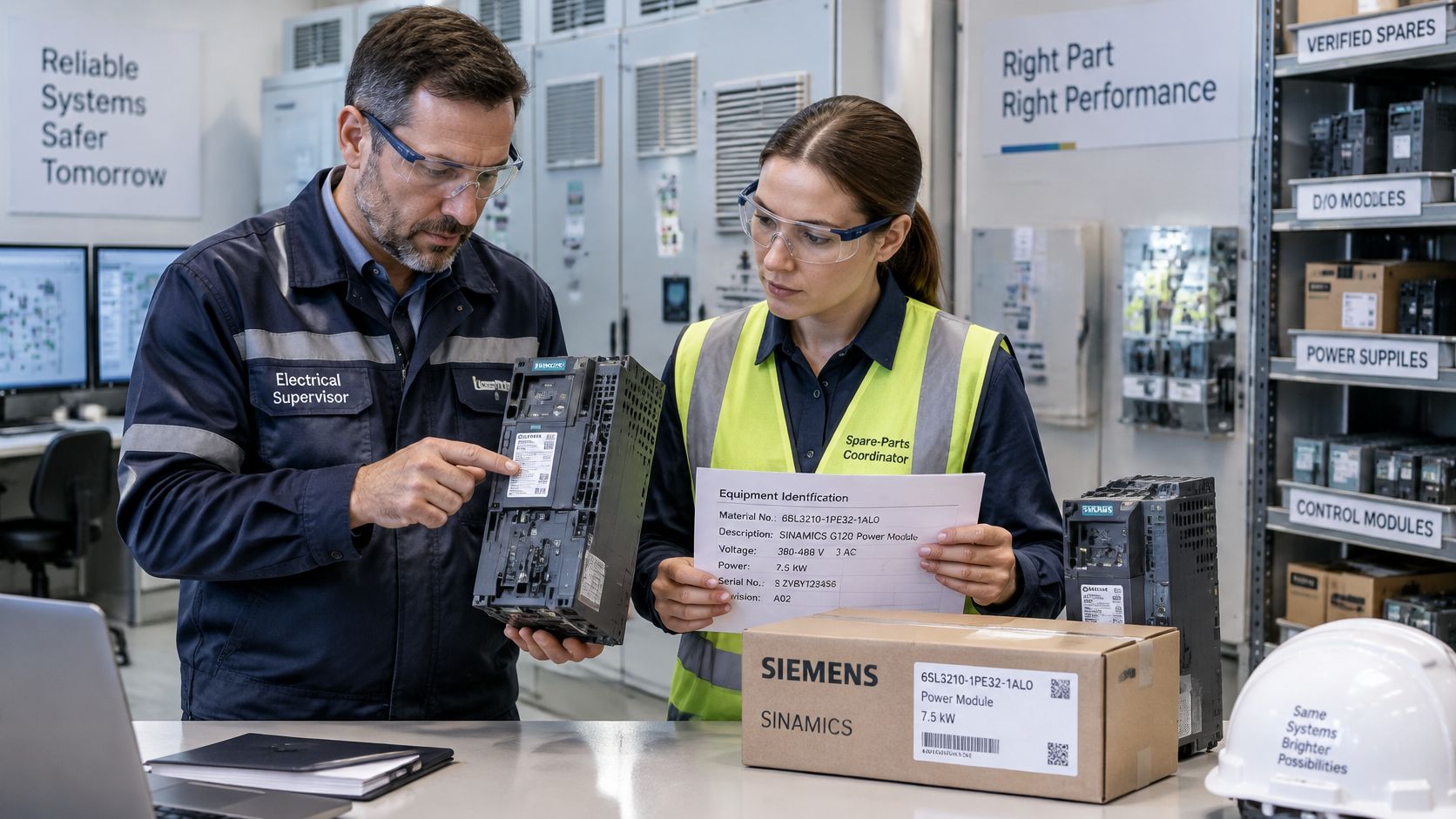
Think of it like bringing in a relief operator. Showing up is not enough. The person has to be able to do the job they're stepping into, on that line, with that equipment.
The record earns its keep on sites where mistakes are expensive, such as a steel conveyor, a tire production line, a chemical process, or a utility installation. On those sites, the file works best when both roles go through it together, one step at a time:
- Confirm the asset details. Collect the equipment tag, readable nameplate photos, model identification, voltage class, and a description of the installed duty.
- Identify the failed item. Separate the module being replaced from the complete drive assembly, and note any gaps in identification.
- Review the candidate. Compare the proposed spare against that specific installation before committing to sourcing or an exchange.
- Choose the recovery path. Record whether the evidence supports a matched spare, an exchange, or further repair assessment.
Step three is where most problems get caught. It's easy to skip, and it's expensive to skip.
An available unit is a candidate, not an approved substitute.
Match the Decision to the Available Evidence
Compatibility for a specific brand, model, and voltage class is confirmed request by request, using the equipment details the customer provides. Keep those inputs attached to the conclusion. Don't record one blanket approval that covers an entire equipment family, because the next unit in that family may differ in ways that matter. Learn about DUCHENG Industrial's service support.
Once the facts are in hand, the next question is which route they support. The table below works as a decision checklist. It doesn't replace technical review.
Spare Path and the Record Evidence Required
Each recovery route asks for different proof. The table compares a matched spare, an exchange unit, and a hold for repair, along with the evidence each one needs and what goes wrong when that evidence is missing.
| Path | Record Must Show | Decision Risk If Missing |
|---|---|---|
| Install a verified matched spare | Installed duty, candidate identity, accepted compatibility review, completed checks | A shelf label substitutes for evidence |
| Send an exchange unit | Specific outbound identity, compatibility conclusion, verification, failed unit return arrangements | An exchange is assumed equivalent |
| Hold for deeper repair | Unresolved mismatch, missing information, assessment owner, next action | Dispatch proceeds despite uncertainty |
Consider a common case. A legacy drive module fails, and purchasing finds a current replacement with a similar description. It's tempting to treat "newer" as "compatible." The record should block that shortcut and require a specific comparison against the installed unit.
Each row of the table is a checkpoint. If the record can't answer the questions in the middle column, the route it points to isn't ready yet.
Make Uncertainty Visible Before Sourcing
When the evidence is incomplete, write hold pending review and name the person who needs to supply the missing details. That gives purchasing a clear next step without treating an unresolved match as a confirmed one.
- For urgent recovery, state the open question plainly so the team knows what is blocking the decision.
- For planned shutdowns, settle candidate suitability before any replacement is scheduled.
Before the next spare request goes out, the coordinator and electrical supervisor should agree on the route and the evidence that supports it. That short conversation prevents much of the rework that follows a wrong part. It also fits neatly with your variable frequency drive maintenance planning, so replacement preparation stays in step with the site's maintenance schedule.
Treat compatibility checks like a dispatch gate — not paperwork you fill in after the courier's already booked. A good spare parts interchangeability record makes that gate obvious to everyone on shift.
Checking Compatibility Before a Part Is Dispatched
Think of a boarding pass. It only works when the traveler, the name, and the flight all line up.
A spare is the same. It needs a clear match to the installed equipment, not just a shipping label.
- Read installed asset identity. Check the nameplate data, voltage class, and what the equipment actually does on site.
- Read candidate part identity. Confirm the exact spare or exchange unit being proposed for that spot.
- Record the compatibility result. Note what you compared, what’s still open, and your conclusion for that brand, model, and voltage class.
- Sign the pre-dispatch check. Keep proof that someone physically checked the outbound unit before dispatch.
If a label photo is blurry and you can’t read the voltage class, hold the shipment. Wait until the reviewer clears it.
A booking deadline isn't evidence of compatibility.
Connect the Dispatch Gate to Recovery
The chart below puts those four dispatch checks next to the recovery decisions that decide whether you even need a spare.
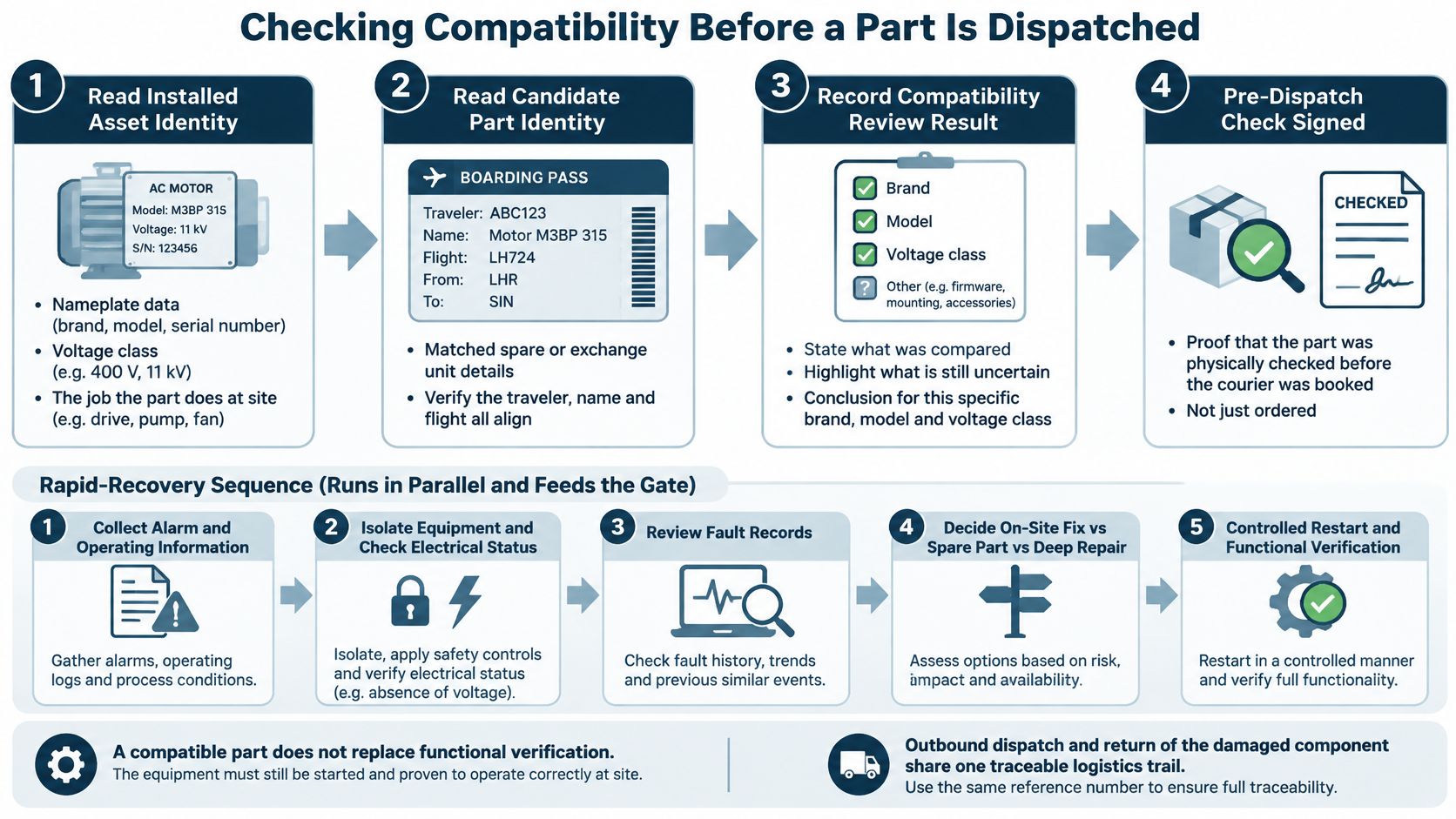
The important point: dispatch approval supports one recovery path. It doesn’t give you permission to restart right away.
A quick repair has its own order. Gather alarm and operating data, isolate the equipment and check electrical status on site, review the fault history, then choose between an on-site fix, spare-part replacement, or deeper repair. After that comes controlled restart and functional checks. Learn about structured recovery support.
- If replacement is selected, the interchangeability record provides the evidence to accept the outbound candidate.
- After replacement is agreed, you still need testing, commissioning, and a controlled return to service.
A compatible part never replaces functional verification. Keep dispatch acceptance separate from the later proof that the equipment does its job correctly.
Keep Both Component Movements Traceable
The replacement going out and the failed part coming back for inspection belong on one traceable logistics trail. Log their identities, movement references, responsible contacts, and current status so the next shift can track both units without digging through messages.
| Movement | Keep Visible |
|---|---|
| Outbound replacement | Accepted unit and dispatch reference |
| Damaged component return | Removed unit and return reference |
Before you book that next courier, walk through the signed gate with the electrical supervisor and lock in the return plan. Use the equipment identification guide when you pull the candidate details together for that review.
A spare parts interchangeability record earns its keep when maintenance teams have to pick a recovery path under pressure. These three VFD examples show how one file can support very different decisions — without letting availability become automatic approval.
VFD Maintenance Examples That Show the Record at Work

First, picture an unplanned conveyor drive trip. A shelf spare is ready, but an exchange unit is on offer too. Neither should win just because it can get there first.
- The reliability manager uses the file to review open risks before recovery starts.
- The electrical and instrumentation engineer checks identification, the compatibility conclusion, and the recorded verification.
- The spare-parts coordinator confirms which accepted unit will move, its dispatch evidence, and return arrangements for the failed part.
Together, those entries stop the team repeating an unchecked substitution. The accepted candidate still needs installation checks, a controlled restart, and functional verification. Dispatch approval is not permission to run.
The file explains why this candidate was accepted for this asset, not merely why it was available.
Plan Renewal During a Shutdown
Next, imagine a planned shutdown after inspection finds contamination and thermal aging. The buying question isn’t just whether to purchase another drive. It’s which existing subsystems are still serviceable.
Replacement service assesses what can be renewed before the customer commits to a whole-machine replacement. Learn about renewal and replacement assessment support.
Think of the interchangeability record next to that assessment like a checked shopping list beside the inspection report.
- The reliability manager reviews remaining risks and the proposed maintenance scope.
- The electrical and instrumentation engineer records technical acceptance for each proposed substitution.
- The spare-parts coordinator stages accepted components against the shutdown schedule.
That keeps purchasing focused on the approved scope, instead of assuming every cabinet component needs replacing.
Track Exchanges During On-Site Reconditioning
Finally, take a medium- or high-voltage drive that stays on site because shipping isn’t practical. Any exchanged module or auxiliary still needs its own acceptance trail.
The reliability manager reviews residual risk, the electrical and instrumentation engineer confirms technical fit, and the spare-parts coordinator tracks incoming and removed items. Keeping the drive stationary doesn’t make component identities interchangeable.
Before your next maintenance handover, tie each accepted part to its compatibility decision, verification results, and service reference. Ask the incoming shift to confirm it can see why the part was accepted, who approved it, and what follow-up is left.
A weak spare parts interchangeability record can cause the exact outage it was meant to stop. In most cases, it comes down to a few repeat habits. And every one of them has a straightforward fix.
The first trap is treating a similar part number as proof. A near-match is a starting point, nothing more.
Recapture the asset details, reopen the compatibility review, and compare the candidate against the real installation.
The second trap is leaving out the voltage class or installed duty. Two modules can sound identical on paper and still be wrong for each other's roles. Write down what the part actually does on site, not just what it's called.
When the Bin Label Replaces the Check
The third mistake is skipping the pre-dispatch check because the bin is already labeled. That label only tells you what should be inside.
It says nothing about what's really in the box. Hold the dispatch until the check is documented and signed off.
The fourth is forgetting to record the return of the failed part. Break that link, and you break the repair history with it. Then the next failure starts from scratch. Keep the logistics trail connected to the technical decision.
The record should make the basis of acceptance visible, whatever that basis is.
Two opposite assumptions cause problems here. One is that an exchange unit is automatically the same as the removed unit. The other is that only a factory-new part can be trusted. Both are shortcuts. Show why the candidate was accepted, whether it was new, exchanged, or reconditioned.
A Handover Checklist for the Next Shift
Before shift change, the incoming crew should be able to confirm five things at a glance:
- Asset identity is confirmed
- Candidate identity is confirmed
- Compatibility result is stated
- Pre-dispatch check is signed
- Return path is noted
If even one is missing, the handover isn't done.
Two questions usually stay open, and good teams call them out. How long does an acceptance hold before the record needs a fresh look? And how is this file different from a repair report? The next section answers both, so the line between a dispatch decision and a workshop record stays clear.
Four questions tend to surface once teams actually start working with a spare parts interchangeability record for VFD spares and exchange units. Here are the straightforward answers.
How Is This Different From a Workshop Repair Record
Think of them as answering two separate questions.
The interchangeability record backs up the outbound match. It shows the spare or exchange unit suits the installed drive before anything ships to site.
A workshop repair record picks up later, after a unit arrives for service. Intake condition, findings, parts replaced, test results, parameters, next maintenance due — that all lives there. In short, one supports the dispatch call. The other captures the repair history.
Does a Completed Record Mean the Part Is in Stock
No, and this trips people up.
A finished record confirms compatibility, nothing more. It does not confirm inventory.
Availability, lead time, and exchange terms still depend on the specific brand, model, and service agreement. The record tells you the match is valid. Purchasing still needs to confirm it can be delivered when and how the site needs it.
Who Signs Off Before Installation
This is a shared check, not a one-person approval:
- The spare-parts coordinator confirms outbound identity and the logistics trail
- The electrical supervisor confirms the compatibility result for that brand, model, and voltage class
- The technician doing the controlled restart and functional check accepts the installation
A compatible part does not replace functional verification. That final technician sign-off is what closes the loop.
When Should the Record Be Updated
Reopen it any time the facts behind it shift. That usually means:
- A model change on the installed equipment
- A legacy-to-current substitution that changes the comparison basis
- A returned unit that gets repaired and redeployed somewhere else
- Any new asset detail that affects the earlier compatibility call
The rule of thumb is simple. The record is only current for the equipment details it references. Change those details, and the acceptance deserves a fresh review.
If your team needs help building reliable interchange records for VFD spares and exchange units, DUCHENG Industrial provides spare-part identification, compatibility review, sourcing, and pre-dispatch verification, with traceable service and logistics records. Start your request at DUCHENG Industrial.