
Plan turnaround maintenance for VFDs and electrical drives: lead times, scope decisions, on-site reconditioning and restart checks.
Your shutdown work list is nearly ready, but the electrical scope still reads like a backlog: inspect every drive, replace suspect fans, check capacitors, update firmware, and deal with whatever turns up. Operations wants a firm restart date. Procurement wants part numbers. The drive technician wants to know which cabinets can be isolated.
Turnaround maintenance starts with deciding what not to put inside the outage. Move safe online work out, protect the tasks that require isolation, and accept deferral only with evidence and an accountable owner. For variable frequency drives, that decision matters as much as the repair itself.
Table of Contents
- Turnaround Phases and Lead Times at a Glance
- Deciding Which Drive Tasks Belong in the Outage
- Job Packs, Materials and Crew Planning for Drives
- How to Recondition MV Drives on Site Within the Outage
- Safety Holds and Quality Gates Before Restart
- Review Restart Results Before Signing Off the Outage
Turnaround Phases and Lead Times at a Glance
| Phase | When | Output to Confirm |
|---|---|---|
| Governance and budget | 12–24 months before outage | Approved budget and named owners |
| Equipment work list and challenge | Following governance | Every task challenged and justified |
| Online versus shutdown split | Before job packs are finalized | Online work moved out of the outage |
| Job packs and long-lead materials | Before supplier lead times threaten the execution date | Packs issued and critical spares ordered |
| Scope freeze | After technical and readiness reviews | Frozen baseline under change control |
| Execution and restart | Outage window | Daily milestone reviews and signed handover |
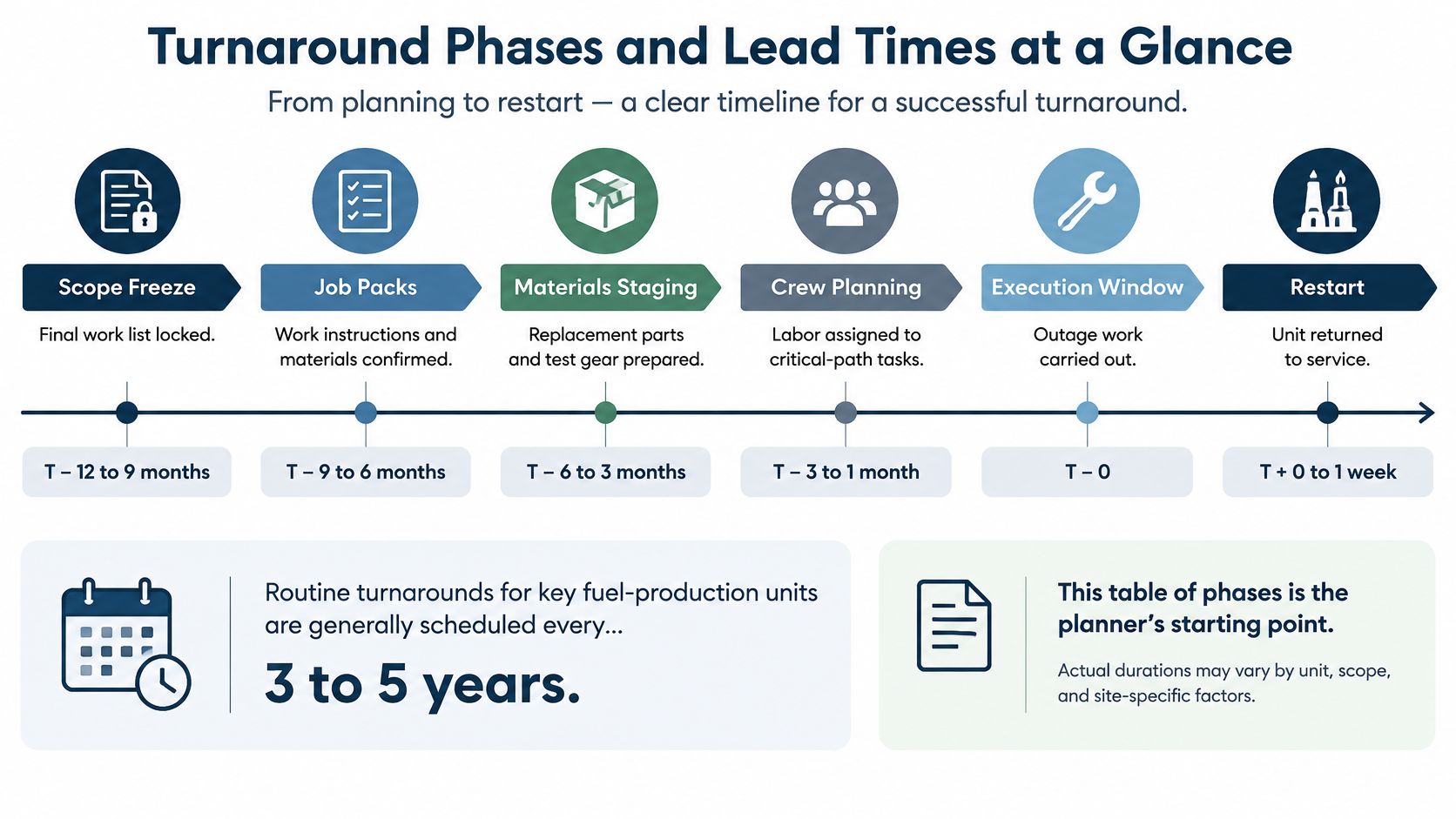
The calendar starts early for a reason. The U.S. Energy Information Administration reports that routine turnarounds for key fuel-production units are generally scheduled every 3–5 years, preparation commonly begins 1–2 years beforehand, and the unit may remain offline for several weeks to several months. Major equipment changes can require longer preparation.
Those are refinery benchmarks, not mandatory intervals for every industrial drive. Build the detailed planning splits backward from your plant's access constraints, supplier commitments, and commissioning needs rather than treating a generic calendar as a fixed rule.
Close each phase on evidence
Governance finishes when operations, maintenance, engineering, and procurement agree on the budget boundary and decision authority. A meeting invitation isn't an approved execution structure.
The equipment work list finishes when each task identifies the asset, defect or obligation, consequence of not acting, and proposed intervention. Challenge blanket instructions such as overhaul all drives.
The online-versus-shutdown split finishes when safe operating checks have their own work orders. Reading event logs shouldn't occupy a shutdown slot merely because it appears on the same checklist as internal cleaning.
Job-pack development finishes when instructions, resources, materials, and acceptance criteria agree. Scope freeze then establishes the controlled baseline, not permission to ignore a newly discovered unsafe condition.
Execution closes through daily milestone checks against actual field progress. Restart and handover finish only when the authorized team accepts the test evidence and outstanding restrictions.
Planning rule: A phase isn't complete because its target date passed. It's complete when someone accepts its named output.
The financial exposure makes that distinction material. In a global survey of plant maintenance leaders, the 2023 industrial reliability survey reported a median unplanned-outage cost of approximately $125,000 per hour, equivalent to roughly $1 million for an eight-hour interruption before secondary effects. That's a cross-industry benchmark, not your plant's automatic hourly loss, but it explains why electrical inspections, configuration capture, and restart resources belong in the original calendar.
Deciding Which Drive Tasks Belong in the Outage
Uncontrolled additions can undermine an otherwise sound turnaround. Digital Refining's turnaround benchmarking article, drawing on more than 1,350 turnaround observations, reports average scope growth of approximately 19% between freeze and execution; more than two-thirds exceed planned cost or schedule by at least 10%, or experience a post-startup trip.
The answer isn't to freeze an incomplete list harder. Classify each candidate task before the freeze by statutory requirement, safety or environmental risk, reliability consequence, and production impact. Use failure modes and effects analysis, or risk-based inspection where appropriate, to distinguish a plausible failure mechanism from a general concern about equipment age.
| Task | Best Window | Defer Only When |
|---|---|---|
| Thermal and visual inspection | Online trend review, confirmed in shutdown | Trends remain stable, no hot spots appear, and required coverage is complete |
| Cabinet contamination cleaning | Shutdown | Contamination is demonstrably acceptable; don't defer necessary cleaning in dusty, humid, or corrosive service |
| Cooling fan and filter replacement | Shutdown | Condition and remaining service life support continued use, with compatible spares available |
| Capacitor and power-module diagnostics | Shutdown | Suitable monitoring supports stable condition and no mandatory test is due |
| Insulation and termination checks | Shutdown, de-energized | Required checks aren't deferred; isolation must be available |
| Parameter and firmware backup | Online, before the outage | Not deferrable before changes |
| Spare drive or module verification | Before shutdown | Not deferrable; complete before freeze |
| Controlled restart and functional test | Outage commissioning window | Never |
These are decision conditions, not permission to skip manufacturer requirements. Stable temperatures, for example, don't prove that an unmonitored capacitor bank is healthy.
Make the deferral decision explicit
Ask these questions for every item:
- Can the deferral risk be accepted? State the failure consequence, supporting condition evidence, monitoring method, and person authorized to accept it.
- Can the work be done safely online? Reviewing alarms is different from opening an energized cabinet. Don't convert shutdown work into live electrical work to improve the schedule.
- Does it need the plant offline? Separate document recovery, spare identification, and trend analysis from intrusive testing.
A predictive maintenance program should supply the condition evidence behind these choices. It shouldn't become a reason to defer inspections when the relevant failure mode isn't detectable with the installed monitoring.
Consider a drive feeding a critical process fan. An intermittent cooling alarm with deteriorating temperature trends deserves outage priority; a cosmetic enclosure defect may be deferred if it doesn't compromise ingress protection, access, or electrical safety.
Route discovery through a controlled decision
After freeze, use a predefined disposition: clean and test, repair on site, exchange a verified compatible module or unit, remove for workshop repair, or defer with approved risk.
Every addition needs a documented technical, schedule, and cost review. Record who approved the disposition, what evidence supports it, and what acceptance test will close it.
A replacement that fits physically isn't necessarily compatible electrically, thermally, or through its control interface.
Don't let a technician discover firmware restrictions or cooling differences while operations is waiting for permission to start.
Job Packs, Materials and Crew Planning for Drives
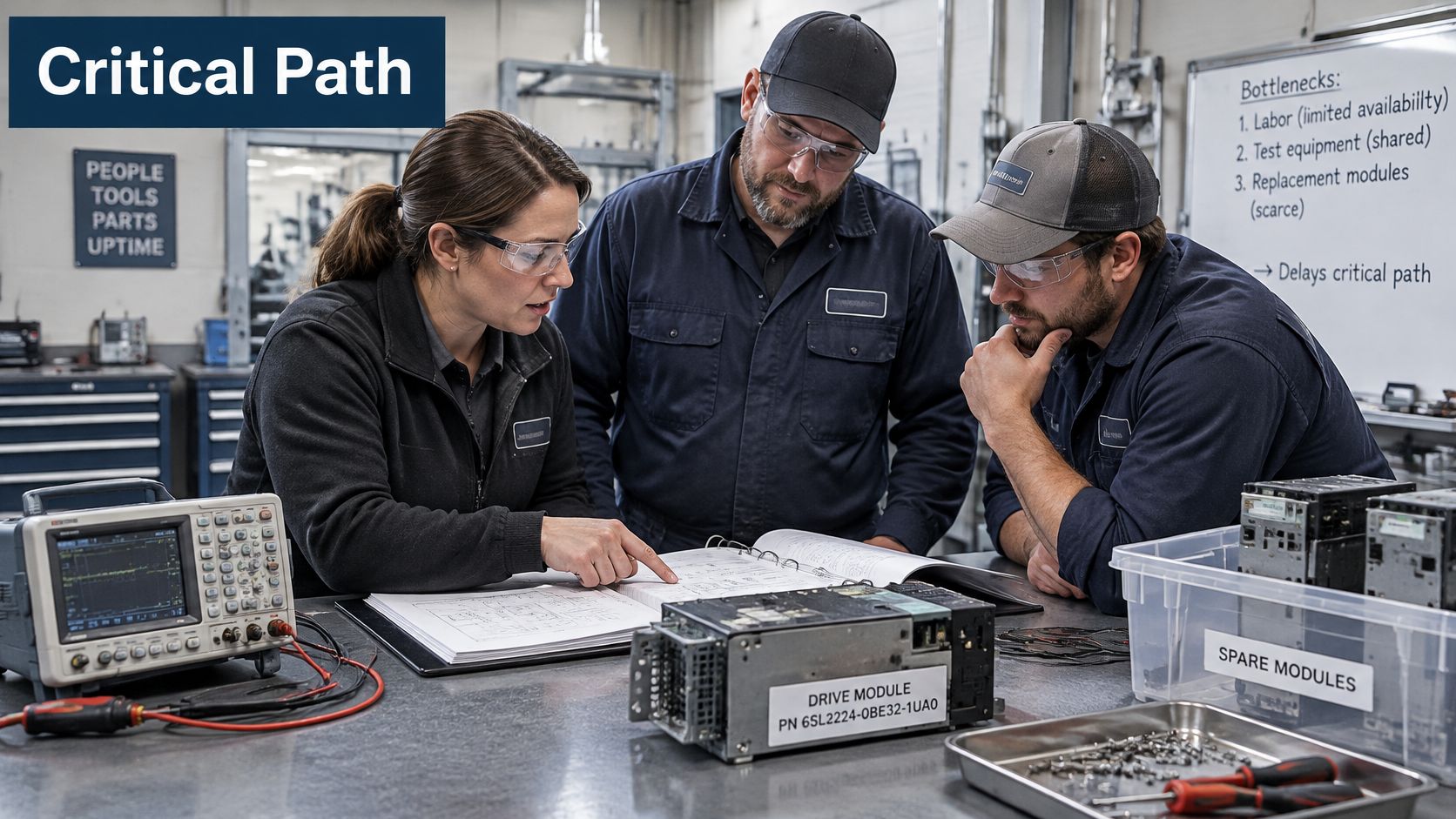
Labor, test equipment, and unavailable replacement modules stall the critical path even when the drawings are correct. A pack that says inspect and repair as necessary leaves the hardest decisions until access is scarce and the restart deadline is close.
The turnaround-management analysis from BCG notes that turnaround work can consume up to 50% of a plant's annual maintenance budget, while only about 32% of turnarounds achieve the combined definition of on-time completion, budget compliance, and completion of planned work. Pack development is therefore a cost-control exercise as well as a technical one.
Build a separate pack for each drive system
Give each drive and its auxiliaries an identifiable record. Include the asset tag, model and serial details, power topology, motor information, drawings, alarm history, and the current configuration reference.
The task sequence should cover:
- Incoming inspection and safe access: Identify the equipment, isolation boundaries, DC-bus verification points, and auxiliary supplies.
- Cabinet and cooling assessment: Record contamination, filters, fans, heat exchangers, ducting, and cooling-system condition.
- Power and control diagnostics: Specify capacitor, power-module, and control-board checks, with manufacturer-approved methods and acceptance limits.
- Electrical integrity: Define insulation and termination checks, including what must be disconnected to protect electronics.
- Configuration control: Identify parameter and firmware records, software access, and the approved recovery copy.
- Functional acceptance: Describe controlled re-energization, permissive checks, signal tests, and the operating conditions required for acceptance.
Don't write test healthy as the acceptance criterion. State what will be measured, where the reading goes, and who resolves a failed result.
Match resources to the actual work
Assign electricians authorized for the voltage class and site switching arrangements, drive-trained technicians for internal diagnostics, and commissioning engineers for control integration. A general electrical crew may complete cable work correctly yet lack the access software or experience needed to restore a drive configuration.
Stage appropriately rated meters, an insulation tester, thermal imaging equipment, torque tools, discharge-verification equipment, and the required communications interfaces. Confirm calibration and availability rather than listing tools nobody has reserved.
Order power cells, compatible power modules, capacitor assemblies, control boards, cooling fans, specialized filters, and proprietary interface components against the approved findings and contingency strategy. Verify part revisions and storage condition; a warehouse label alone doesn't establish readiness.
Before freeze, each pack needs a named owner, material status, and permit status. If a critical component remains unconfirmed, show the alternative disposition and its schedule consequence rather than marking the pack ready.
How to Recondition MV Drives on Site Within the Outage
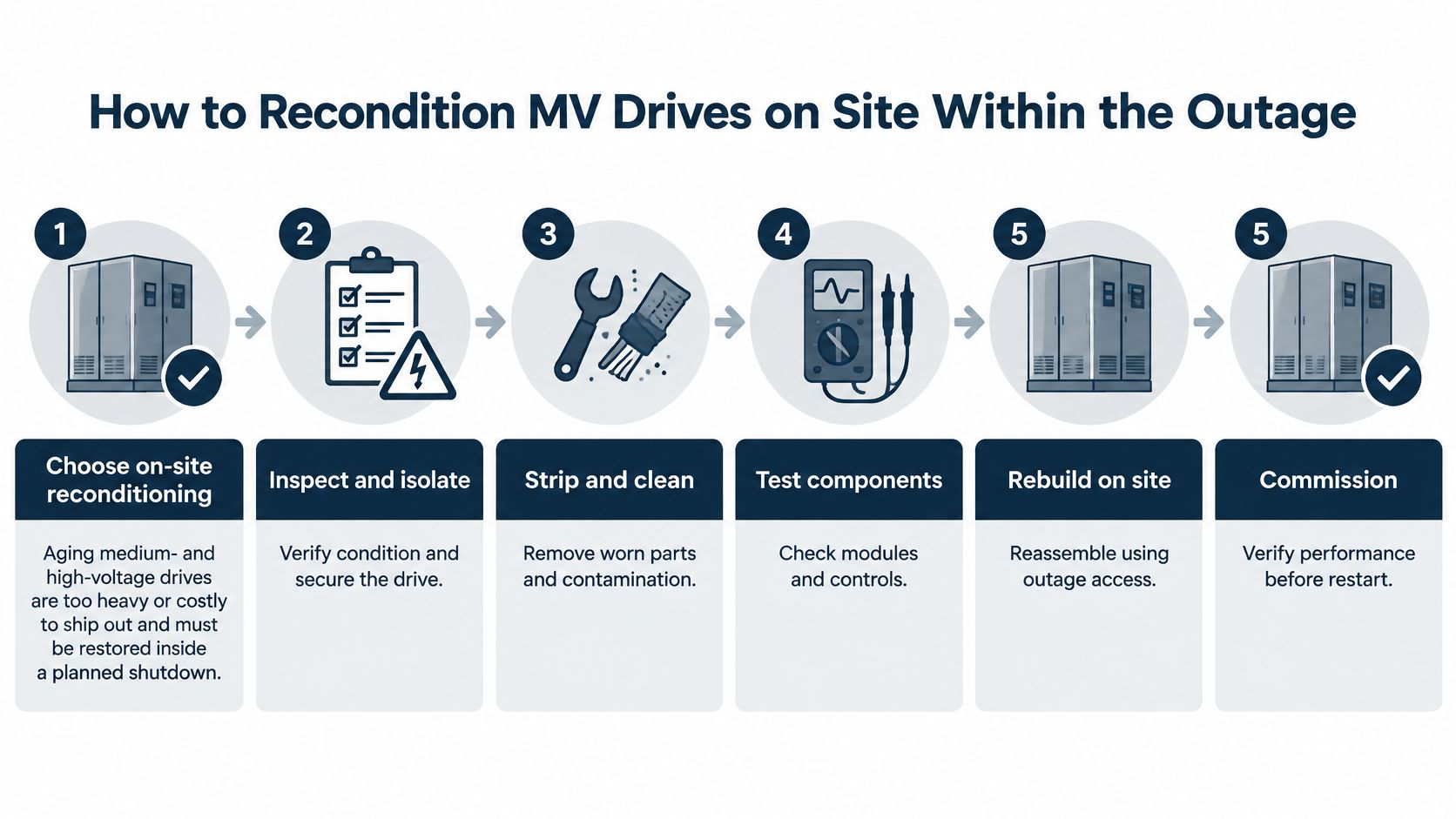
On-site reconditioning suits aging medium- and high-voltage drives when moving the equipment to a workshop is impractical and the plant can provide a controlled work area. It is not just an internal clean under a different label. The team must assess condition, select justified interventions, rebuild correctly, and produce evidence that supports return to service.
Our on-site reconditioning process includes condition assessment, planned shutdown and safe work-area setup, cabinet and cooling-path cleaning, power-cell and critical-component inspection, replacement recommendations, reassembly with insulation and connection checks, controlled power-up, and functional verification.
Preserve the condition evidence
Capture operating thermal images safely before shutdown where access arrangements permit. After isolation and proof of safe access, photograph contamination patterns, discoloration, connector condition, and cooling obstructions before disturbing them.
Record insulation readings using the manufacturer's procedure and a defined circuit boundary. Never apply an insulation tester across connected power electronics unless the manufacturer explicitly permits that test. The baseline must identify what was tested, not merely show a resistance value.
Clean before rebuilding
Remove contamination using methods compatible with the insulation system, boards, coatings, and enclosure design. Use suitable vacuum equipment and approved cleaning materials; don't blow conductive dust deeper into cell assemblies or connectors.
Clean the entire cooling path, including intake restrictions and heat-exchanger surfaces. Cleaning after reassembly creates avoidable access work and can contaminate inspected components again.
Attach photographs and a cleaning record to the asset pack. If moisture or corrosion remains, stop and resolve its significance rather than hiding it behind a completed-cleaning entry.
Inspect beyond appearance
Examine power cells, capacitor assemblies, switching components, gate-drive connections, control boards, fans, and auxiliary supplies. Look for leakage, tracking, thermal damage, damaged connectors, and mechanical deterioration, then use the appropriate diagnostics to confirm condition.
A component can look acceptable and still fail its diagnostic criteria. Write replacement recommendations with the failure mechanism, supporting result, compatibility requirement, and consequence of continued service.
Reassemble the whole electrical boundary
Check cell seating, connector engagement, protective-earth continuity, cable routing, insulation clearances, and connection integrity. Use the specified torque procedure rather than tightening by feel.
Don't restrict reinspection to the parts replaced. Removal and access work can disturb neighboring connections, ducts, barriers, or control wiring.
Schedule protection: Reserve recovery float before restart. Don't allocate every available hour to disassembly and repair.
Power-cell availability can determine whether the drive returns on time. Resolve sourcing during pack development and keep a compatible exchange strategy where justified.
Finish with a turnover bundle containing the original condition record, work performed, replacement details, test results, configuration reference, and unresolved restrictions. The commissioning team should receive an inspected assembly and a clear status, not a verbal assurance that it's ready.
Safety Holds and Quality Gates Before Restart
A drive can pass a workshop test and still trip in production because the installed system has a loose termination, an incorrect parameter set, or an unproven permissive. A missing backup or incomplete modification record blocks recovery when the commissioning engineer needs it.
Restart authority depends on evidence, not confidence. Completing the repair does not authorize energization. Keep safety holds separate from progress milestones.
Establish safe access before internal work
| Gate | Required Evidence | Failure It Prevents |
|---|---|---|
| Lockout and tagout | Identified sources, secured isolations, and verified absence of voltage at defined points | Unexpected energization from the main supply or another source |
| DC-bus discharge | Meter verification using the approved access and test procedure | Shock from stored energy during cabinet entry or re-entry |
| Auxiliary energy control | Checks covering control supplies, UPS feeds, cooling equipment, and other stored energy | Backfeed, unexpected movement, or hazardous pressure |
| Initial condition capture | Safely obtained operating thermal record and pre-cleaning inspection record | Loss of evidence needed to diagnose the original defect |
Follow the manufacturer's discharge requirements. Elapsed time or an extinguished indicator does not establish zero energy. Qualified personnel must use appropriately rated instruments and the site's approved proving procedure.
Where test points require preliminary access, follow the equipment-specific safe-access method. Do not open an exposed high-energy compartment solely to complete a checklist item.
Release the assembly through quality holds
Document the test boundary for insulation and termination checks. Record connection work and torque verification against specified values. A loose power termination may reveal itself as heating only after process load rises.
Save the original parameter set and identify firmware before making changes. Keep the approved operating configuration distinct from temporary diagnostic files, and record any motor-data or control-mode changes.
- Controlled energization: Confirm barriers, covers, cooling availability, protection settings, and work-party clearance. Assign a witness and agree on a stop procedure.
- Functional testing: Prove local and remote commands, speed references, feedback, interlocks, alarms, and trip behavior under approved conditions.
- Handover: Close safety-critical punch items and document accepted noncritical restrictions before operations takes control.
Use a VFD startup checklist to make checks repeatable, while retaining equipment-specific acceptance criteria. Record measured results and obtain the witness signature.
The authorized isolating person signs the isolation evidence. The technician and responsible reviewer sign inspection and test records. The electrical supervisor normally releases energization, subject to the site's switching authority, while commissioning and operations representatives accept functional performance. Name these roles before execution so approval authority is clear at restart.
Review Restart Results Before Signing Off the Outage
A drive can pass its initial restart checks and still show a problem as load rises. Reconcile completed work, accepted deferrals, punch-list status, and initial operating alarms before closing the outage. Confirm each repaired drive against its acceptance conditions; a running signal alone is not acceptance evidence.
Compare actual findings, diagnostic results, rework, and early operating trips with the assumptions used to select the scope. For example, a power termination may heat only after process load rises. Treat that as a follow-up requiring investigation, not as a closed punch item. Keep the original risk ranking alongside the finding and its assigned action.
Measure operating quality, not just availability
The refining maintenance white paper from AspenTech links emergency shutdowns, startups, and malfunctions with higher emissions and energy input. Review restart duration and repeated starts alongside available site energy and emissions measures.
For each critical drive, compare:
- Load and efficiency: Match the pre-shutdown baseline with post-restart operation at comparable conditions.
- Energy intensity: Compare energy per unit of useful production, rather than electricity consumption alone.
- Harmonic and thermal condition: Include measurement location, load, and cooling conditions.
- Control performance: Distinguish process instability, parameter errors, and signal problems from hardware defects.
Digital-twin and IoT monitoring depend on reliable historian timestamps, asset identity, alarm context, and commissioning records. Correct missing tags or inconsistent configuration records before interpreting a trend as deterioration.
Use the review to set the next inspection interval according to observed condition and operating exposure. For preventive maintenance, issue a written report with inspection findings and recommended next actions.
Close each finding with an owner, due date, and defined evidence for completion. Hold a prompt review while the execution team can still resolve discrepancies, then use the results to shape the next shutdown scope.
DUCHENG Industrial provides planned VFD maintenance, on-site reconditioning for aging MV/HV drives, spare-parts compatibility support, and controlled recommissioning. Visit DUCHENG Industrial to discuss your drive list, shutdown constraints, and restart requirements before you freeze the electrical scope.