
Build a reliable predictive maintenance program for VFD fleets. Learn how to set KPIs, integrate IoT sensors, and close the loop from alert to verified repair.
Most advice about a predictive maintenance program starts in the wrong place. Teams buy sensors, wire up dashboards, and call it reliability, then wonder why the next VFD trip still stops the line.
The harder truth is that equipment doesn't fail because a chart existed. It fails because nobody defined who validates the alert, what evidence is enough to act, which repair path applies, and how the intervention gets finished before the drive gives up under load. In harsh environments, that execution gap matters more than the model itself.
Table of Contents
- Why Most Sensor Deployments Fail to Prevent Downtime
- Building the VFD Asset Register and Baseline
- Selecting the Right Condition Indicators and Sensors
- Closing the Loop from Alert to Verified Repair
- Launching a Pilot and Proving the ROI
- Sustaining the Program in Harsh Environments
Why Most Sensor Deployments Fail to Prevent Downtime
A cabinet full of sensors does not equal a working predictive maintenance program. It only means you've started collecting condition data, and condition data without a decision path usually becomes noise.
The practical failure mode is simple. An alarm comes in, an operator sees it, maintenance is busy, production can't stop, and the alert gets parked for “later.” That delay is where a preventable VFD problem turns into a trip, a forced shutdown, or a messy restart under pressure.
Practical rule: if an alert does not lead to a named owner, a repair window, or a documented justification for deferral, it isn't a maintenance action yet.
The alert is only the first step
The useful question isn't whether the cabinet temperature rose or the fault counter ticked up. The useful question is whether the team knows if that signal means inspect now, schedule the next window, derate the drive, or prepare a module swap. Without that decision matrix, alerts compete with production priorities and lose.
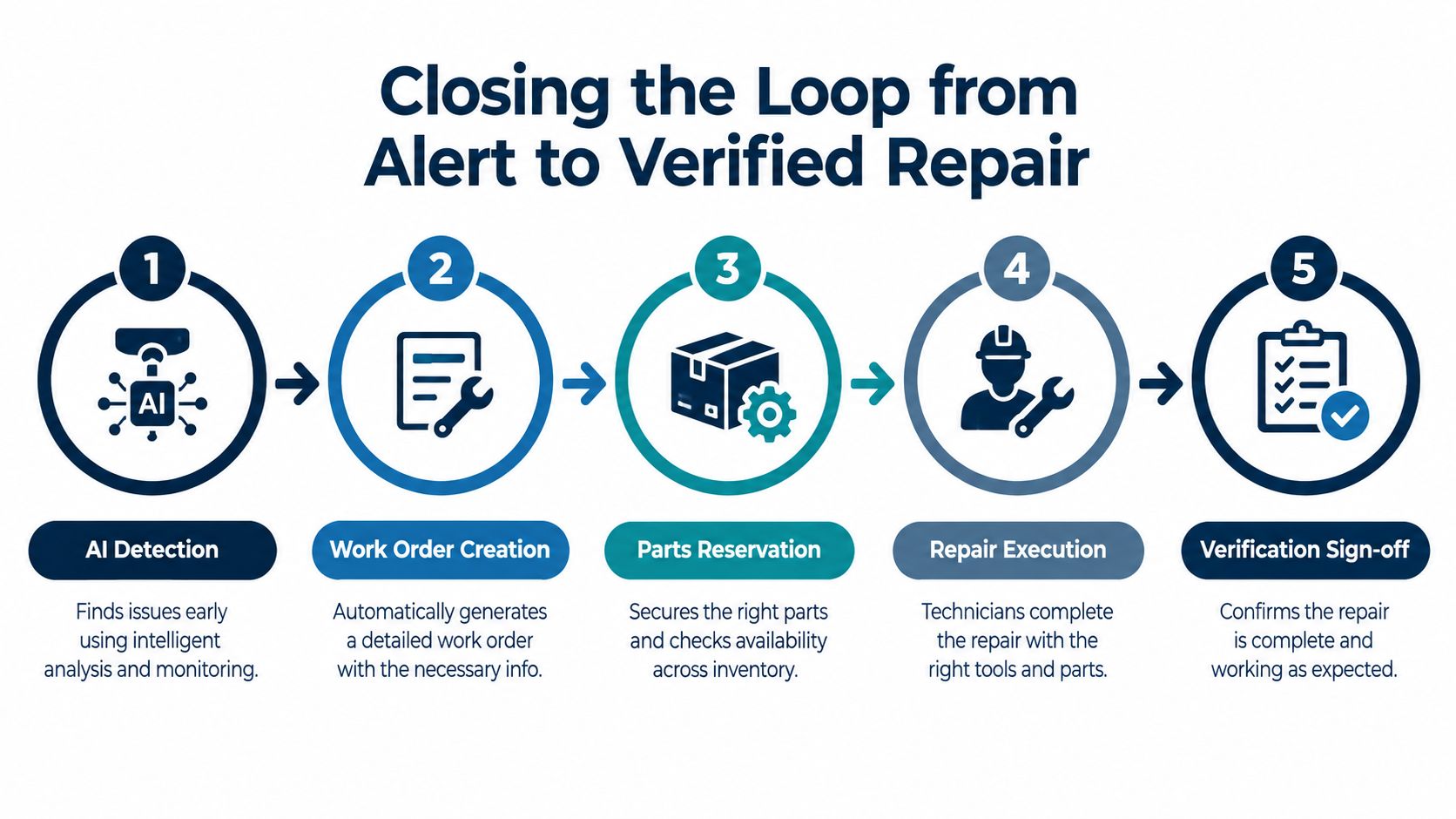
That's why the closed loop matters more than the analytics stack. A mature program links detection to work order creation, parts readiness, repair execution, and verification after restart. The workflow has to survive shift handoffs, weekend staffing, and mixed-brand fleets where fault names and parameter layouts aren't consistent.
The 2025 maintenance survey in the brief is a useful warning sign. It found that 27% of facilities actively used predictive maintenance, down from 30% the year before, while fewer than 35% spent most of their maintenance time on preventive work despite 71% calling it foundational. Those numbers point to a familiar reality, monitoring technology alone doesn't guarantee operational discipline. Survey summary on predictive maintenance adoption and workflow gaps
What actually breaks the chain
Three things usually break the chain between alert and repair.
- No response ownership. Nobody is clearly responsible for validating the signal and moving it into the CMMS.
- No intervention rules. The team doesn't know when to inspect, derate, shut down, or keep running under observation.
- No verification step. The repair happens, but the evidence that the problem is gone never gets fed back into the program.
Production pressure is not the enemy. Unclear escalation rules are.
For VFDs in harsh sites, the margin for hesitation is thin. Heat, contamination, vibration, and aging components don't wait for a convenient window. A program works only when the organization is ready to act on a prediction with the same seriousness it gives a real failure.
Building the VFD Asset Register and Baseline
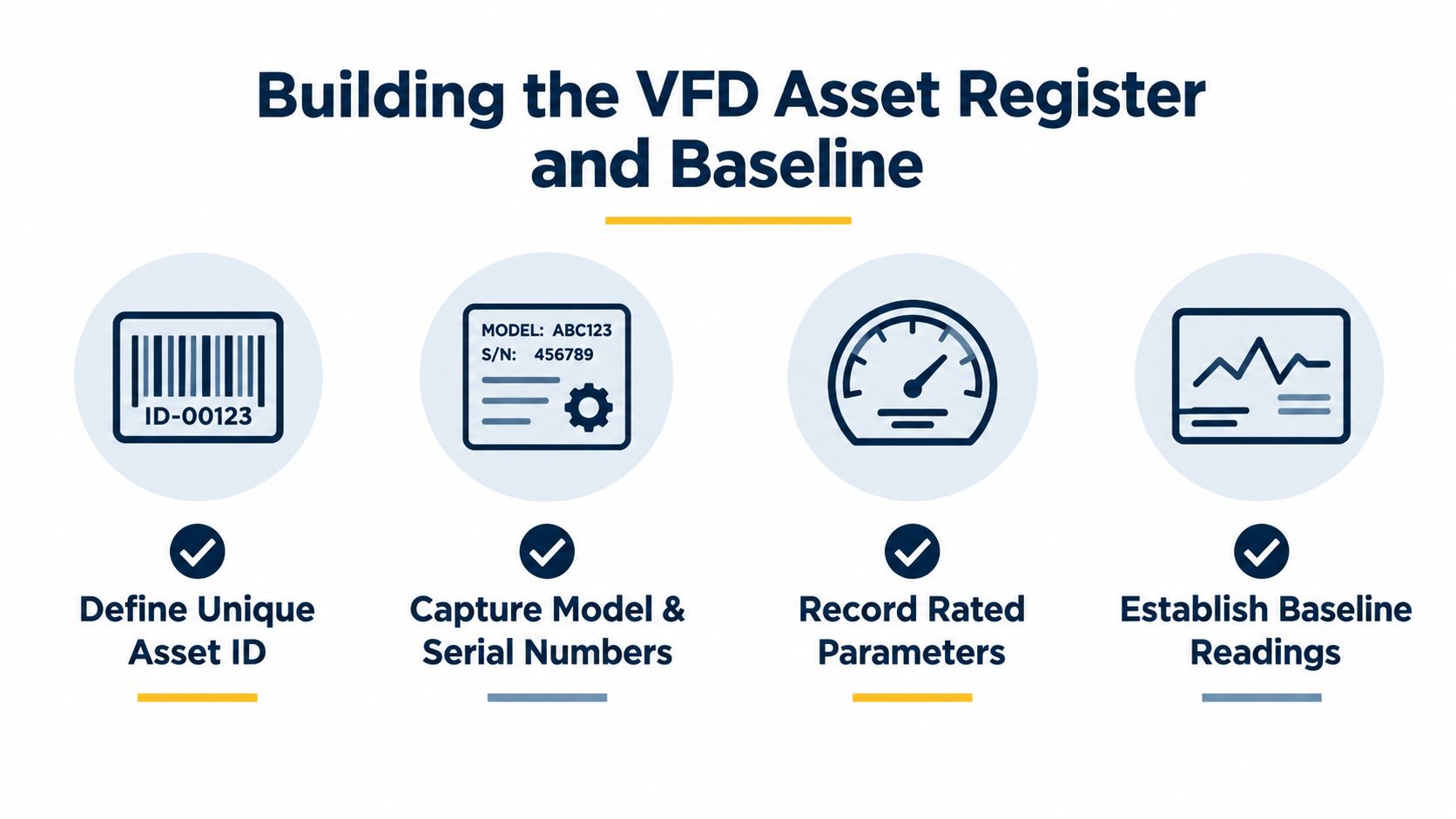
A useful baseline starts with identity, not sensors. If the asset register is weak, every later alarm becomes harder to trust because no one can tie the signal to the exact drive, motor, duty cycle, or environment that produced it.
Build the register around the failure context
Start with a unique asset ID, then capture the drive model, firmware version, motor details, load profile, duty cycle, fault history, and environmental conditions. Those fields matter because two drives with the same frame size can age very differently if one lives in a cool electrical room and the other sits above a dusty process line. Mixed-brand fleets make this even more important, because parameter structures and fault codes don't always line up cleanly.
For aging equipment, incomplete history is normal. Don't stall the program waiting for perfect records. Build the register from what you can verify now, then enrich it as you inspect cabinets, review service notes, and trace recurring trips back to their operating context.
A clean register also makes it easier to normalize naming across the plant. If one site calls a component by a local nickname and another uses a different tag convention, alerts become hard to trend. The point is not bureaucracy, it's traceability.
Capture normal operation before you chase abnormality
The baseline should be taken during stable operation, not during a startup surge or a messy recipe change. For VFDs, the most useful baseline includes input and output voltage balance, current balance, DC-bus voltage and ripple, heatsink and cabinet temperature, cooling-fan status, insulation and grounding observations, harmonic or power-quality indicators, fault-code frequency, starts and stops, and cumulative operating hours.
Those data points tell you how the drive behaves when it's healthy. Once you have them, trend movement matters more than a single threshold crossing. A gradual change in cabinet heat or current balance often says more than one isolated alarm.
Baseline rule: if you can't describe what stable looks like, you can't prove that the drive is drifting.
The baseline also needs a quality check. If a sensor drifts, communication drops, firmware changes, or the production recipe changes, the program can create false confidence or false alarm fatigue. Good registers don't just store data, they preserve the operating context needed to judge whether a deviation is real.
Selecting the Right Condition Indicators and Sensors
Not every signal deserves a sensor, and not every sensor deserves trust. The best predictive maintenance program is selective, it tracks the signatures that precede VFD trouble and ignores the rest.
Follow the failure modes that matter
For VFD fleets, the most useful indicators are the ones tied to heat, power quality, contamination, and wear. Thermal stress shows up before insulation damage or component drift. Capacitor aging and cooling degradation often show up in DC-bus ripple, temperature behavior, or repeated nuisance trips. Contamination in the cabinet can push a drive from stable to unstable long before a visible failure.
Harmonic stress belongs in the conversation too, especially where the electrical environment is already noisy. You don't need to turn every cabinet into a laboratory, but you do need enough signal quality to see whether the drive is being pushed into a corner by its surroundings. In harsh sites, the sensor package has to survive the same conditions the drive does.
| Critical VFD Condition Indicators | Failure Mode Detected | Monitoring Method |
|---|---|---|
| Cabinet and heatsink temperature | Cooling degradation, thermal stress | Temperature trend monitoring |
| DC-bus ripple | Capacitor aging, power-stage stress | Electrical trend capture |
| Input and output current balance | Load imbalance, developing electrical fault | Current trend analysis |
| Fault-code frequency | Recurring latent defects, unstable operation | Event history review |
| Cooling-fan status | Airflow loss, overheating risk | Status and alarm monitoring |
| Insulation and grounding observations | Contamination, leakage, grounding weakness | Inspection plus condition checks |
Use trends, not one-off thresholds
Single alarms are blunt instruments. Trend deviations are better because they show whether a machine is drifting or just having a noisy day. That distinction matters in cabinets exposed to salinity, conductive dust, or repeated thermal cycling, where raw readings can bounce around without indicating real deterioration.
Historian quality matters as much as sensor quality. If the data stream drops, the timestamps are off, or the sampling is inconsistent, the program can't separate meaningful change from garbage input. That's why the monitoring architecture has to be tested under real site conditions, not only in a clean commissioning room.
The sensor layer should support action, not just visibility. If a trend suggests fan degradation, contamination, or capacitor stress, the team needs enough confidence to move from observation to intervention without waiting for the drive to fail first. For a deeper look at practical sensor selection, the guide to predictive maintenance sensors is a useful companion.
Closing the Loop from Alert to Verified Repair
A prediction has value only after someone acts on it and proves the fix worked. Otherwise, the program becomes a notification service for future downtime.
Define the escalation path before the first alert
Every alert needs a class, an owner, and a decision rule. Some signals justify inspection only. Some justify a planned shutdown. Some justify a controlled module swap if spares are ready and the risk of waiting is higher than the risk of intervention. Safety-critical decisions still need human override authority, because no software should overrule a live operational hazard.
If the same alert can trigger three different responses depending on who's on shift, the program is too vague to trust.
A good matrix also includes evidence thresholds. For example, a recurring temperature rise plus fan degradation may justify one response, while a lone temperature spike might only trigger recheck and observation. That logic keeps technicians from chasing ghosts while still catching the deterioration that would otherwise become a trip.
Tie the workflow to the CMMS
The alert should create or trigger a work order, not a conversation thread. Once the work order exists, parts reservation, technician assignment, and shutdown planning become visible to everyone who needs them. That's especially important when spare parts have long lead times or when a replacement drive has to be checked for compatibility before it lands on site.
The feedback loop matters too. After repair, the team should record what failed, what was replaced, what was cleaned, what was reconditioned, and whether the drive returned to stable operation. That post-repair verification is what improves the next alert's threshold and reduces repeat noise.
Operational rule: every alert should leave behind a traceable outcome, even if the outcome is “defer with justification.”
DUCHENG Industrial's self-built IoT platform is one example of this kind of workflow support. It collects key VFD parameters in real time, analyzes lifecycle condition, and uses trend models to warn of deteriorating IGBTs, power units, and capacitor banks. For teams that need structured field execution rather than just monitoring, that kind of data arrangement can fit into the same closed-loop logic as the rest of the maintenance process.
<iframe width="100%" style="aspect-ratio: 16 / 9;" src="https://www.youtube.com/embed/PngqgzJaSz8" frameborder="0" allow="autoplay; encrypted-media" allowfullscreen></iframe>Launching a Pilot and Proving the ROI
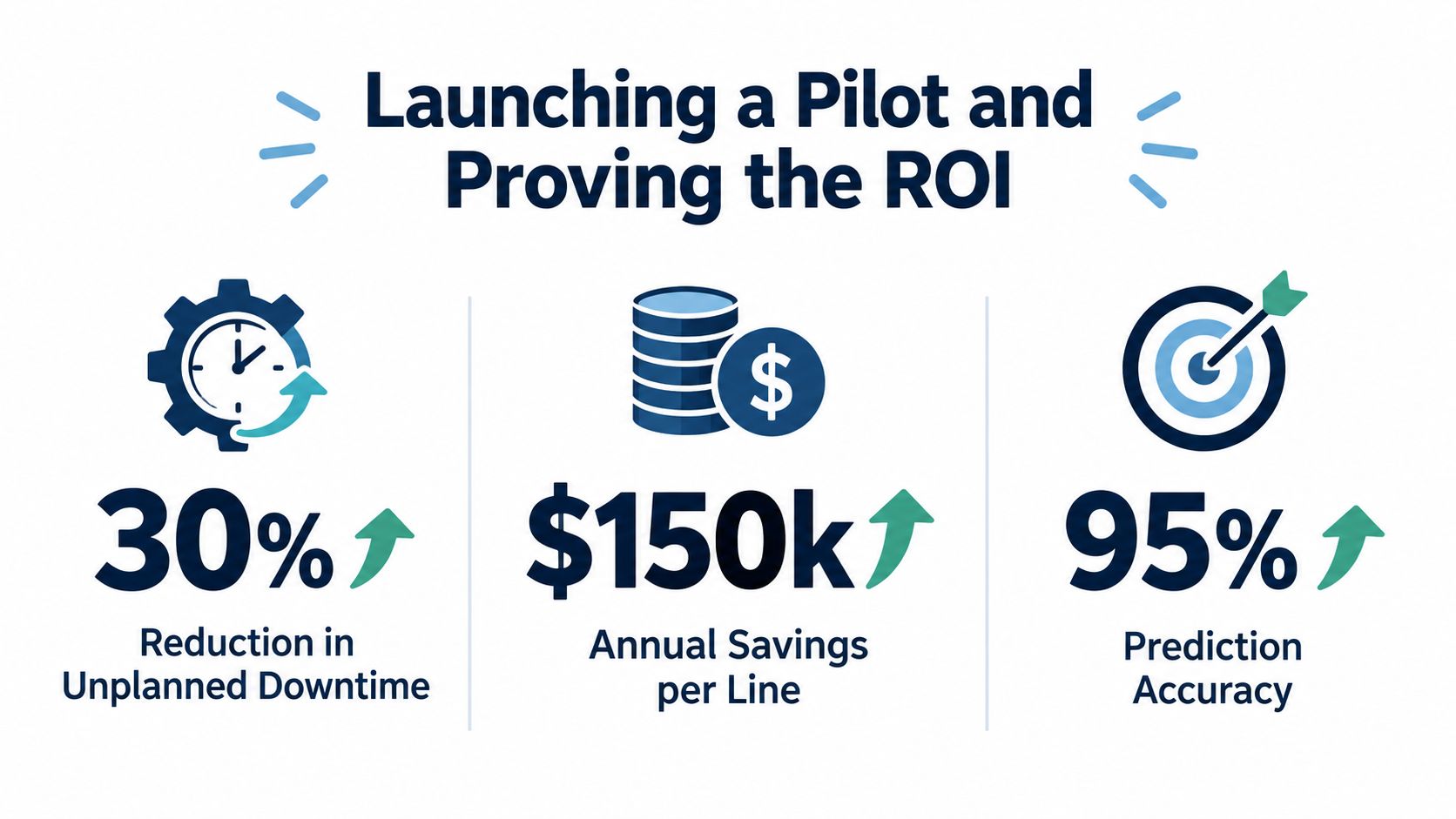
A pilot should prove that the workflow holds up under pressure, not that the dashboard looks active. Start with critical VFDs that affect production, have a real failure history, or are hard to repair during a normal shutdown. Then test whether the team can detect, validate, and fix problems before they turn into interruptions. For architecture and data integration considerations, see the guide to industrial IoT predictive maintenance [https://ducheng-industrial.com/blog/industrial-iot-predictive-maintenance].
Choose KPIs that reflect execution, not vanity
The best pilot metrics are simple and hard to fake.
- Alert-to-work-order time. How fast the alert becomes a real maintenance task.
- Prediction-to-failure lead time. How much time the team gained before the issue became a trip.
- Avoided downtime. Whether the intervention prevented a stoppage that would have happened otherwise.
- Repeat-failure rate. Whether the same problem came back after the repair.
- Verified corrective action rate. Whether alerts resulted in completed, checked repairs.
These KPIs matter because a pilot can look successful on a screen and still fail in the field. If technicians are not trained to read the trends, document the intervention, and confirm the fix, the program only creates busier inboxes. Training has to focus on interpretation and follow-through, not dashboard browsing.
Compare against a real baseline
A pilot has to be measured against documented history, not memory. That means you need a pre-pilot record of emergency callouts, repeat trips, and how often the plant had to recover under pressure. After the pilot starts, compare those same outcomes across the same asset group.
A useful pilot also shows where the process stalls. If alerts arrive but work orders lag, the problem is workflow. If work orders move but repairs are delayed, the problem is parts or staffing. If the repair happens but the fault returns, the issue is usually diagnosis quality or installation discipline.
The first pilot rarely proves everything. It should prove enough to decide whether the plant can execute the loop reliably.
Use the pilot to harden the workflow before scaling. A small, disciplined rollout shows whether the plant is ready for wider adoption, and it gives you evidence to justify more coverage without guessing.
Sustaining the Program in Harsh Environments
At one coastal plant, the monitoring platform kept flagging a recurring cabinet temperature drift on a late-life drive. The data was real, but the first fix missed the root problem because the cabinet still had contamination embedded in corners that the sensor couldn't see. The alarm went quiet for a while, then came back after another heat cycle.
That's the pattern harsh environments create. The digital model can be directionally right while the physical condition inside the cabinet keeps changing faster than the software can infer.
Use field inspections to recalibrate the model
In dirty, humid, or thermally stressed sites, scheduled physical inspection is not a fallback, it's part of the program. Cabinet cleaning, component inspection, fan checks, and controlled reconditioning give the team a way to verify what the model inferred and correct what the sensors could not fully capture. When a drive is too large or too critical to ship easily, on-site reconditioning can reduce transport risk and keep the intervention inside a planned window.
That combination of data and hands-on work is what keeps the program honest. The technician sees contamination, heat discoloration, loose terminations, or degraded airflow. The system provides the trend history that explains why those conditions matter.
Feed repair outcomes back into thresholds
Every completed repair should refine the next alert rule. If a fan replacement solved a rising temperature trend, that outcome should shape how the program treats the same pattern next time. If a cabinet cleaning restored stability, the environment itself becomes part of the maintenance logic, not just an afterthought.
A program that survives harsh service usually does three things well:
- Preserves inspection discipline. Field checks stay on calendar even when the dashboard looks calm.
- Records repair outcomes. The team documents what was found, not just what was planned.
- Updates assumptions. Thresholds and decision rules change as the fleet ages.
The goal isn't to make the model perfect. The goal is to keep it useful as the equipment, environment, and operating pattern change.
Over time, that's what separates a monitoring project from a real predictive maintenance program. The site doesn't just see the future a little earlier. It gets better at acting on what it sees.
DUCHENG Industrial supports VFD fleets with commissioning, troubleshooting, repair, preventive care, on-site reconditioning, and Smart O&M consulting for harsh industrial sites. If you need a practical maintenance workflow that connects condition data to verified repair, visit DUCHENG Industrial and review how their lifecycle drive services fit your plant's operating reality.