
A complete VFD commissioning checklist for 2026. Follow our 8-step guide covering safety, electrical, and parameter verification for a successful VFD startup.
A rushed VFD startup is where small installation mistakes turn into big downtime. The drive looks ready, the panel is closed, and the pressure from production is already there, but one missed interlock, one loose shield, or one bad parameter entry can turn a normal energization into a plant-wide headache. A solid VFD commissioning checklist keeps the work disciplined, phase by phase, so the first run is controlled, the data is trustworthy, and the asset starts its life without avoidable stress. That matters even more in steel, chemical, and coastal environments, where heat, contamination, and corrosion punish weak commissioning discipline fast. The checklist below follows the way field crews work, from documentation to acceptance testing, so you can move quickly without skipping the checks that protect people, equipment, and uptime.
Table of Contents
- 2. Hardware Installation Inspection and Physical Verification
- 2. Hardware Installation Inspection and Physical Verification
- 3. Electrical Power Supply Quality and Parameter Verification
- 4. Control System Wiring, Logic, and Interlock Testing
- 5. VFD Parameter Configuration and Factory Setting Verification
- 6. No-Load and Soft-Start Motor Rotation Testing
- 7. Load Ramp and Performance Acceptance Testing
- 8. Monitoring System Integration, Alarm Response, and Shutdown Procedures
- VFD Commissioning: 8-Point Comparison
- From Checklist to Lifecycle Management
2. Hardware Installation Inspection and Physical Verification
The cabinet can look tidy and still fail under real plant conditions. A drive that passes a visual walkdown but has poor cable routing, loose terminals, weak cooling airflow, or a compromised enclosure seal will usually show its weakness later, often after the line is already under load. I have seen panels that looked correct from the front, while the rear layout created EMC noise and led to nuisance trips long after commissioning was signed off.
Inspect the physical work like it has to survive the worst shift
Start with mechanical alignment and fasteners. Loose hardware brings vibration, and vibration turns into intermittent faults that waste hours once the process is live. Check cable glands, drain paths, seal faces, and every entry point where moisture, dust, or conductive contamination could work its way into the cabinet.
Grounding needs the same level of attention. A commissioning check should confirm grounding resistance below 0.1 ohms at the PE terminal, because that forces a measured result instead of a visual assumption waywardleaders.com VFD commissioning guide. In a steel mill, a weak protective earth can turn nuisance noise into repeated shutdowns. On coastal sites, it can shorten asset life by letting corrosion and leakage currents do their work over time. That kind of finding belongs in the first field pass, not after production starts.
Cooling checks matter just as much. Verify that the fan path is clear, filters are fitted correctly, and heat can leave the enclosure without being trapped by nearby piping, conduit, or wall clearance. In chemical plants and other corrosive areas, a clean airflow path is not a comfort item, it is part of keeping semiconductors and capacitors within their thermal limits.
For detailed field examples, see our commissioning field notes. The value of that review is simple, it helps the crew compare what was installed against what the site demands, especially when DUCHENG Industrial is working across different drive brands and harsh duty environments.
A good field habit is to photograph the key labels and component tags before the panel is closed. Those images help the maintenance team later when a spare has to be ordered, a terminal has to be traced, or a fault call arrives after dust, heat, or vibration has aged the original markings.
2. Hardware Installation Inspection and Physical Verification
A cabinet can look tidy and still fail the field test. Cable routing, terminal tightness, cooling airflow, and enclosure sealing all need to be checked on site, because those details decide whether the drive runs cleanly or overheats under load. I have seen installs that passed a quick visual check from the front, while the rear routing created EMC noise that later showed up as nuisance shutdowns in production.
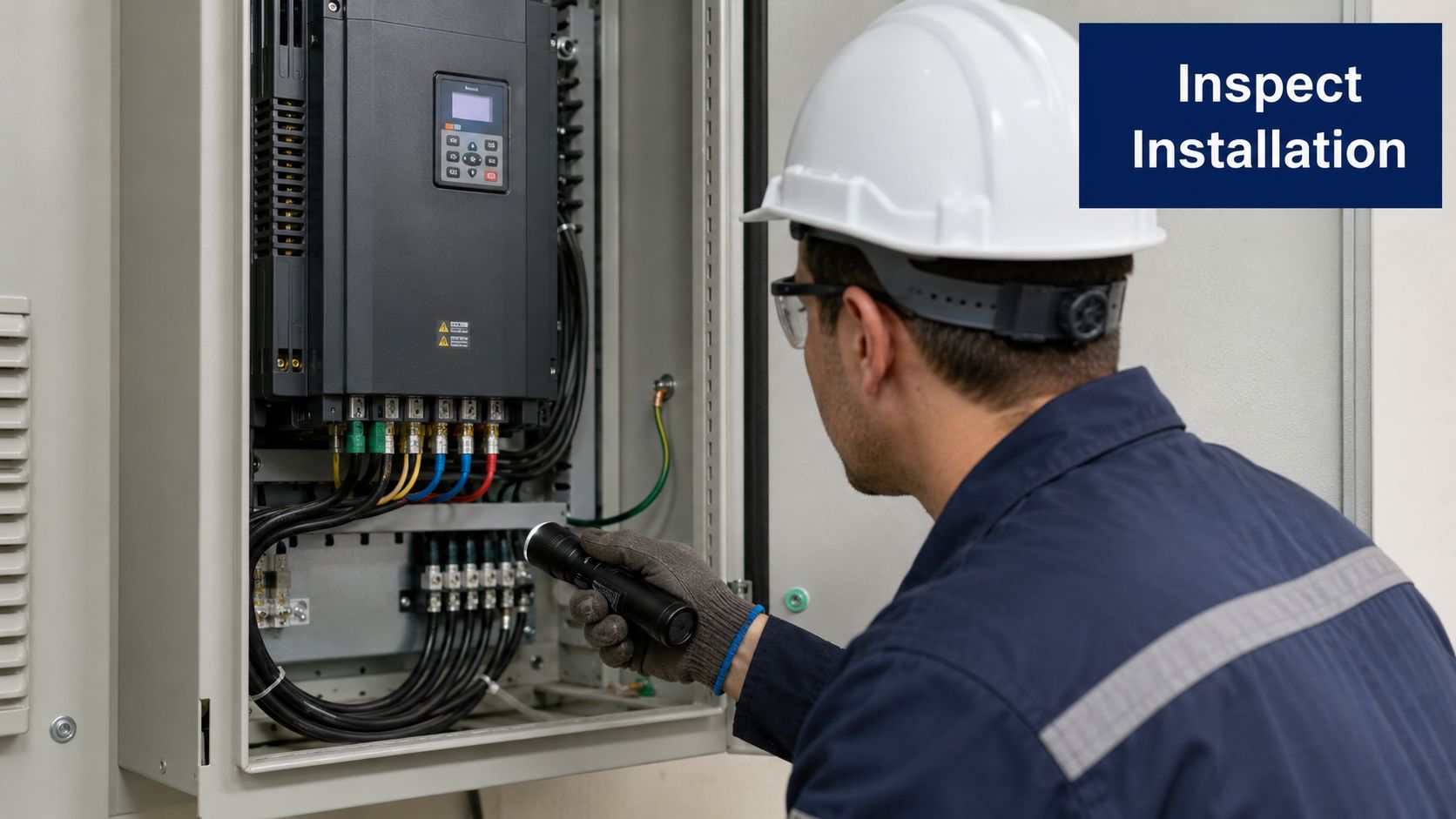
Inspect the physical work like it has to survive the worst shift
Start with mechanical alignment and fasteners. Loose hardware invites vibration, and vibration creates intermittent faults that are hard to trace once the line is running. Then check cable glands, drain holes, seal surfaces, and every entry point where moisture or fine contamination could track into the cabinet.
Grounding deserves special attention. A commissioning guide used in the field calls for grounding resistance below 0.1 ohms at the PE terminal, because that forces a measured result instead of a guess waywardleaders.com VFD commissioning guide. Use thermal imaging where possible to spot uneven cooling airflow, blocked filters, or hotspots around terminals and power components. On a chemical retrofit, that kind of inspection can expose ductwork that looks installed but does not move air the way the drive needs.
Loose terminations do not announce themselves at startup. They usually show up later as heat, drift, or a trip that nobody can reproduce on demand.
This is also the point where a field team should document cable gauges, routing paths, and terminal block assignments with photographs. That record speeds up later troubleshooting and helps when a drive returns for preventive care or on-site reconditioning. DUCHENG Industrial's commissioning field notes are useful here because the value is not just in starting the drive, it is in preserving the evidence you will need when the asset ages.
3. Electrical Power Supply Quality and Parameter Verification
Incoming power is one of the easiest things to overlook and one of the hardest things to fix after the drive is online. A VFD can't correct a weak supply, it can only react to it, and that means phase imbalance, transients, and ugly upstream conditions can appear as drive faults even when the drive itself is healthy. The job here is to establish a clean baseline before the system starts doing real work.
Measure the supply the way the drive will feel it
Use proper power quality equipment, not a basic meter, and verify voltage, frequency stability, and three-phase balance across multiple production cycles. The commissioning guidance in the verified data calls for AC supply imbalance below 3%, which is a practical limit because imbalance above that level can create nuisance trips and confuse fault isolation waywardleaders.com VFD commissioning guide. In medium-voltage work, coordinate with the utility when impedance data is needed, because supply behavior at the point of common coupling can be different from what the plant bus suggests.
A steel mill in Southeast Asia found 8% phase imbalance during commissioning, and an input reactor solved the shutdown problem before the drive was released to operations compressortech2.com commissioning article. That's the kind of issue a rushed startup misses, then spends weeks blaming on the drive, the motor, or the operator. Chemical plants have their own version of this problem when nearby switchgear creates transients that look like ground faults.
Document the supply condition under both no-load and full-load conditions if the plant load profile changes during the day. If the site has variable frequency loads or high inrush events, extended monitoring is worth the time because it shows whether the drive will see stable input when production gets busy. In field service work, that baseline becomes one of the most useful references during Rapid Restore calls, because it tells you whether the fault lives upstream or inside the drive train.
4. Control System Wiring, Logic, and Interlock Testing
Control wiring determines whether commissioning stays controlled or turns into troubleshooting. Start, stop, permissive, and emergency stop circuits should be proven on their own before they are tied into the motor circuit, because a sound power section cannot correct broken logic. In practice, missing permissives and crossed feedback signals show up here, while they are still cheap to fix.
Prove the logic before the motor ever moves
Use a multimeter, PLC simulator, or dry-run test setup to verify each signal path by type. Digital inputs, analog inputs, outputs, and Ethernet or fieldbus paths should all be checked against the control schematic, not just made to work in the moment. An emergency shutdown system in one chemical plant exposed missing permissive logic for a cold-start condition, and correcting it during commissioning prevented a bad production handover.
The same discipline catches more subtle issues too. A speed feedback wiring error in a steel mill was found during control testing before it could create false overspeed trips during acceleration. In a tire manufacturing line, a permissive that blocked emergency stop behavior was corrected during commissioning, which is the kind of logic flaw that hides until an operator really needs the stop circuit to respond.
Make the interlock behavior visible
A simple truth table or timing diagram goes a long way when the machine has to be maintained six months later. It keeps the logic from becoming tribal knowledge. Test each permissive with simulated fault signals, and confirm that the output response matches the intended shutdown path, not just the nominal start sequence.
Good commissioning logic is boring. When the interlocks behave exactly as expected, nobody notices them, and that's the point.
DUCHENG Industrial's production escort style support fits this phase because critical restart windows rarely allow trial and error. The goal is not to admire the wiring. It is to prove that the control system will protect the process and the people when conditions change.
5. VFD Parameter Configuration and Factory Setting Verification
Parameter entry is the point where a drive stops being a generic power converter and becomes a machine-specific asset. The motor nameplate, load type, communication requirements, braking behavior, and protection thresholds all need to align before the first rotation test. If settings are copied from a previous job without engineering review, the plant usually pays for it later in heat buildup, nuisance trips, or unstable acceleration.
Match the drive to the motor, the load, and the environment
Use the manufacturer's software for parameter loading when possible, because offline setup makes it easier to review each field before power is applied. Cross-check the values against the motor nameplate and control schematic, then document any deviation with engineering sign-off. That discipline prevents a common field failure, where a seemingly minor mismatch becomes a trip condition only after the process is already under pressure.
Application context changes the final setting. In a steel mill MV drive, thermal protection thresholds were adjusted for the foundry environment so the drive would not nuisance-trip from ambient conditions. In a chemical plant, communication protocol setup allowed integration with an existing DCS without extra hardware, which avoided a messy workaround. In tire production, adjusting acceleration ramps reduced mechanical stress on the coupling during startup.
A practical commissioning note from the verified data is that many applications use conservative ramp times of 5 to 30 seconds, but the right setting still depends on the load and process response compressortech2.com commissioning article. That is why ramp tuning should never be treated as a generic default. If the load can rotate freely during autotune, use it, but only when the safety plan and mechanical setup allow it.
6. No-Load and Soft-Start Motor Rotation Testing
The first rotation test tells you more than any drawing can. Once the motor is allowed to turn under no-load or light-load conditions, you can confirm rotation direction, acceleration smoothness, and basic motor health signals without putting the process at risk. At that point, field judgment matters more than theory.
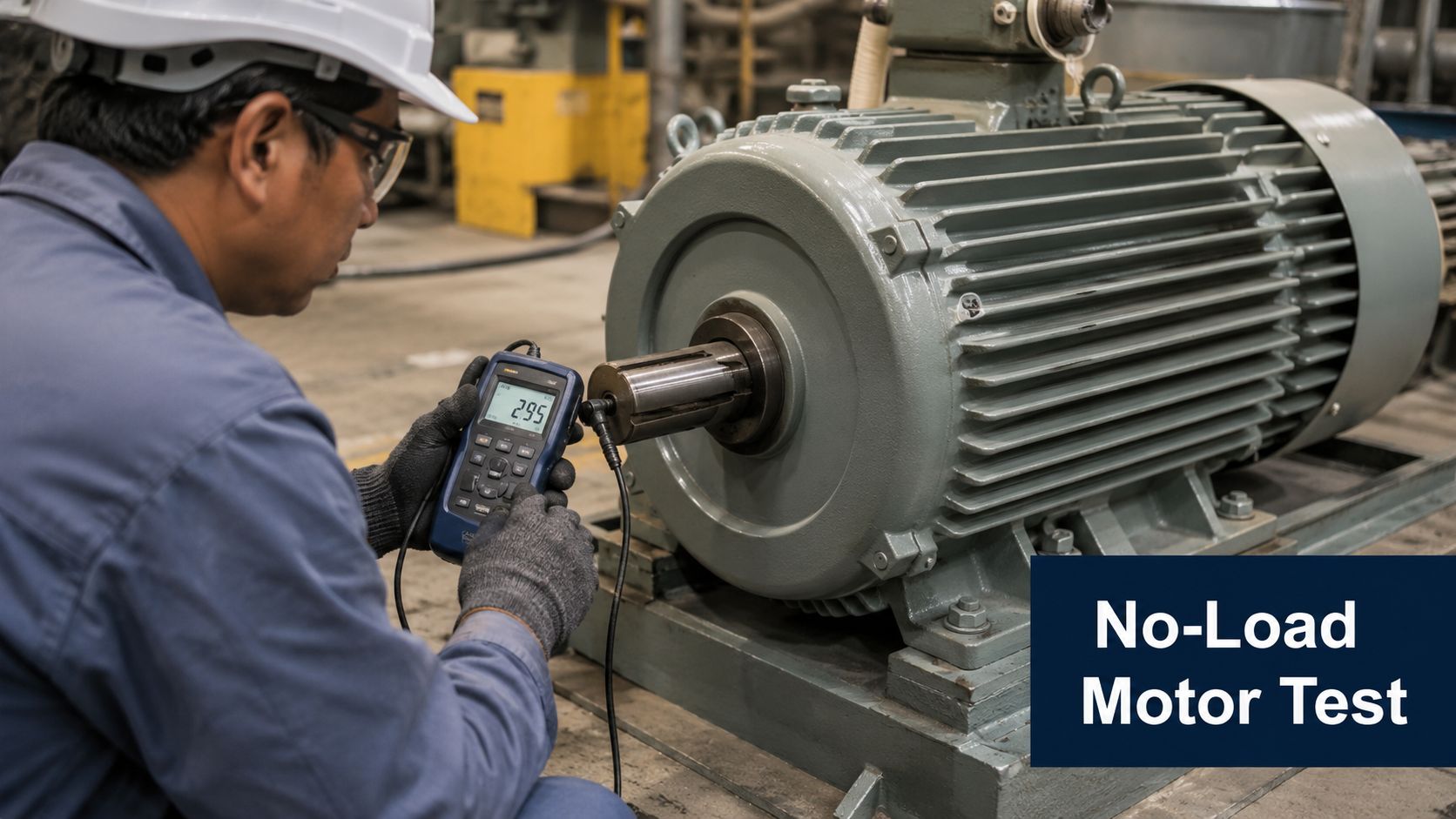
Capture the baseline before the process load is involved
Run the motor initially at reduced speed if the application allows it, then check rotation, noise, vibration, and current behavior. A staged approach, with open-loop running, encoder verification where applicable, and a gradual climb to full speed, helps isolate faults because it keeps too many variables from changing at once. That matters on crowded industrial sites where a bad bearing, a loose coupling, or a wiring error can hide behind a clean start.
This phase also turns commissioning into a lifecycle tool. A clean no-load run creates the reference point for later maintenance, and that baseline is what makes future trend checks meaningful. In a steel mill, for example, motor current signature data gathered during no-load testing later helped reveal bearing degradation before it turned into an outage. DUCHENG's field experience across steel, chemical, and coastal plants points to the same practice, because baseline data is only useful if it comes from a controlled start, not a rushed one. For sites building out that kind of long-term visibility, a digital twin predictive maintenance workflow can help compare today's readings with the original commissioning record.
Watch for mechanical clues that electrical test sheets never reveal. Bearing friction noise, resonance, slow thermal rise, or an awkward stop response can point to alignment or installation issues before the process load is involved. If the no-load run exposes vibration, stop and correct the mechanical condition before you add load.
A clean no-load run is the cheapest predictive maintenance asset you will ever create, because the baseline becomes the comparison point for the rest of the drive's life.
If a protective reaction is being tested, keep it controlled and intentional. Simulated fault response is useful only when everyone knows the shutdown path and the restart conditions. On harsh industrial sites, that discipline saves time later because the commissioning record already shows what normal looked like on day one.
7. Load Ramp and Performance Acceptance Testing
A drive is not commissioned just because it spins. It has to carry real process load without overheating, tripping, or losing speed control, and that only becomes clear under a controlled load ramp. This phase is where acceptance gets earned, not assumed.
Bring the load in gradually and watch the machine speak
Use data logging during the ramp so you can see current draw, temperature rise, and speed stability over time. The verified guidance calls for final test-and-record operation under normal production conditions for 24 to 48 hours before baselining performance waywardleaders.com VFD commissioning guide. That's a strong practice because many problems only show up after the system has been warm and under duty long enough to settle into its real operating pattern.
A hot-rolling drive in a steel mill exposed inadequate cooling during sustained load testing, and the cooling system was upgraded before acceptance. A chemical reactor cooling pump showed efficiency below expectation during full-load testing, which led to a bearing inspection and replacement before the warranty window was wasted. A tire manufacturing press revealed that it needed additional mechanical braking to control speed overshoot during rapid load release.
These examples point to the same rule. A load test should confirm not only that the motor can pull the load, but that the whole system stays thermally and mechanically stable under the actual duty cycle. If ambient conditions are severe, test during the warmest realistic operating window, or you'll accept the drive on a day that doesn't resemble production.
Acceptance criteria should be agreed before the test starts. If the team argues about the limits after the load ramp begins, the data stops being useful.
When the numbers disagree with expectation, don't force the handover. Slow down, inspect the cooling path, check the load coupling, and compare actual power draw against what the process should demand. In field service, that's how you avoid shipping a hidden issue into production.
8. Monitoring System Integration, Alarm Response, and Shutdown Procedures
Commissioning doesn't end when the drive passes load. It ends when the monitoring, alarm, and shutdown behavior has been proven in the same environment where the drive will live. This is the point where a drive becomes part of the plant's maintenance strategy instead of a standalone asset.
Turn the drive into a monitored asset from day one
Set baseline operating ranges for current, temperature, and vibration during commissioning, then use those values to define alarm thresholds with margin. The verified guidance includes a final test-and-record phase under normal conditions before baselining performance, and that baseline is what makes alarms meaningful later waywardleaders.com VFD commissioning guide. Test that alarm messages reach the right people on all shifts, not just the day crew.
A steel mill integrated vibration monitoring into SCADA and detected bearing wear before the projected failure window, which created time for planned maintenance instead of a reactive stop. In a chemical plant, temperature alarm thresholds were tuned to reduce nuisance shutdowns while keeping protection intact. A tire plant used alarm logging to trace recurring trips back to contamination and thermal management issues, which is exactly why the alarm history matters more than the one-time event.
For a broader digital strategy, DUCHENG Industrial's Smart O&M and IoT consulting approach fits naturally, and the company's digital twin predictive maintenance notes are a useful reference for structuring the data flow DUCHENG Industrial digital twin predictive maintenance notes. The important part is not fancy software. It's whether the alarms are readable, the logs are usable, and the shutdown behavior is predictable when the line is under pressure.
If the alarm history can't help you explain a fault to the next shift, the monitoring system isn't finished yet.
A short review cycle after startup helps too. Keep the threshold values, notification routes, and shutdown sequence documented in a place maintenance can reach, whether that's a digital manual, SCADA help screen, or a laminated panel card. The plant will thank you the first time the drive complains at 2 a.m. and the team has to act without guesswork.
VFD Commissioning: 8-Point Comparison
| Item | Implementation complexity | Resource requirements | Expected outcomes | Ideal use cases | Key advantages |
|---|---|---|---|---|---|
| Pre-Commissioning Documentation Review and Safety Verification | Moderate, detailed document cross-checking and safety validation | E&I engineers, manufacturer manuals, checklists, time for verification | Verified documentation, safety baseline, identified compatibility issues | New installs, retrofits, regulatory audits, legacy equipment checks | Prevents installation errors, ensures compliance, establishes baseline records |
| Hardware Installation Inspection and Physical Verification | Medium–High, on-site mechanical and electrical inspections | Skilled technicians, thermal camera, torque tools, access to enclosures | Confirmed mounting, cabling, cooling, EMC and ingress protection | Harsh environments, contractor-installed systems, reconditioning | Detects installation defects early, prevents thermal/EMC problems |
| Electrical Power Supply Quality and Parameter Verification | Medium–High, requires measurement and analysis over time | Power quality analyzer, true RMS instruments, electrical expertise, extended monitoring | Baseline power metrics, identified supply issues, mitigation recommendations | Sites with variable utility quality, remote/industrial locations, recurring nuisance trips | Prevents utility-caused faults, informs filters/transformer/reactor needs |
| Control System Wiring, Logic, and Interlock Testing | High, logic verification and simulated fault testing required | Control engineers, PLC/HMI access, simulators, multimeters | Verified control wiring, correct interlock behavior, safe dry‑run | Safety‑critical processes, complex automation, E‑stop validation | Prevents unsafe motor behavior, avoids control logic–related incidents |
| VFD Parameter Configuration and Factory Setting Verification | Medium, vendor‑specific knowledge and iterative tuning | OEM software, laptop, drive manuals, parameter libraries, tuning time | Optimized drive settings, reduced nuisance trips, correct communications | Multi‑brand drives, performance tuning, DCS/fieldbus integration | Optimizes performance/protection, enables repeatable templates |
| No‑Load and Soft‑Start Motor Rotation Testing | Medium, controlled energization with strict safety controls | Test instruments, vibration/temperature sensors, safety permits | Verified rotation direction, baseline signatures, detected mechanical issues | Initial energization, baseline condition monitoring, safe commissioning | Early detection of mechanical faults, safe validation of protections |
| Load Ramp and Performance Acceptance Testing | High, extended full‑load testing and thermal stabilization | Data loggers, long test windows, process cooperation, instrumentation | Confirmed full‑load performance, thermal stability, acceptance documentation | Final acceptance, warranty verification, mission‑critical production ramps | Validates sustained performance, provides acceptance baseline |
| Monitoring System Integration, Alarm Response, and Shutdown Procedures | High, system integration and alarm tuning with IT/SCADA involvement | Sensors, SCADA/IoT integration, calibration, IT resources, storage | Integrated alarms/logging, automated responses, diagnostic data for analysis | Predictive maintenance programs, fleet monitoring, regulatory reporting | Enables early fault detection, reduces MTTR, supports root‑cause analysis |
From Checklist to Lifecycle Management
A strong VFD commissioning checklist does more than get the first start over the line. It creates the reference point for everything that happens after handover, from predictive maintenance to fault isolation to lifecycle planning. That's why the best commissioning teams treat the process like asset setup, not a paperwork exercise.
The staged checks matter because they separate problems cleanly. Documentation review catches design mismatches before the cabinet is energized. Hardware inspection finds thermal and wiring issues before they become damage. Power quality verification tells you whether the utility side is clean enough to support stable operation. Control testing proves the logic before the motor ever moves. Parameter verification aligns the drive with the actual machine. No-load testing creates a baseline. Load acceptance confirms duty performance. Monitoring integration makes sure the data keeps paying dividends after the startup crew leaves.
Long-term asset management starts to look practical instead of theoretical. The same current, temperature, vibration, and fault records gathered during commissioning become the reference data for future service calls. That helps maintenance managers distinguish between a real drive problem and a supply-side disturbance, and it gives reliability teams the evidence they need to plan work instead of reacting to breakdowns.
In heavy industry, that lifecycle thinking matters because drive failures rarely respect production schedules. Steel, chemicals, coastal utilities, and tire manufacturing all punish weak commissioning in different ways, but the pattern is the same, contamination, heat, poor logic, and weak baselining show up later as downtime. DUCHENG Industrial's multi-brand field service model is built around that reality, because commissioning, repair, reconditioning, and monitoring only work as a system when the early data is trustworthy.
If your team is preparing a new startup, a restart after failure, or a critical production window, use this checklist as the working standard and tighten it to your site conditions before the first energization. For hands-on support with commissioning, diagnostics, reconditioning, or monitoring design, visit DUCHENG Industrial and talk with a team that works on VFD assets from startup through late-life operation.