
Learn what VFD drive repair involves, common faults, on-site vs workshop options, repair vs replace decisions, timelines, costs, and how
A critical pump stops at 2 a.m., the drive display is dark or faulted, and operations wants an answer in minutes, not days. That's the moment where VFD drive repair either becomes a controlled recovery or an expensive repeat failure. The difference isn't luck. It's whether someone resists the reset button long enough to find out why the drive tripped.
Table of Contents
- When Your VFD Trips and Production Stops
- What VFD Repair Really Involves
- Common Faults and How Diagnostics Find Them
- On-Site Versus Workshop Repair Options
- Repair, Recondition, Upgrade, or Replace
- Timelines, Costs, and Spare-Parts Matching
- How to Choose a Qualified Service Provider
- Your VFD Repair Decision Checklist
When Your VFD Trips and Production Stops
The conveyor was running fine on the previous shift. Now it's stopped mid-load, the motor won't restart, and every reset attempt trips again within seconds. Production is asking for an ETA. Someone suggests swapping in a spare drive from stores, someone else wants to just replace the power module and try again.
Both instincts are understandable. Both can make things worse. A rushed restart into an undiagnosed fault can destroy a good replacement module, damage the motor, or hide a root cause that returns on the next shift under full load. If the fault originated outside the drive, in the cabling, motor, or supply, a new drive inherits the same problem.
What the first hour should look like
Slow down for the steps that protect people and evidence, then move fast on diagnosis.
- Record before you reset: Photograph the fault display, save the fault history, and note load, speed, and process conditions at the trip.
- Isolate safely: Lock out, wait for discharge, and verify the DC bus is safe before anyone opens the cabinet.
- Look before you touch: Check for smell, discoloration, fan failure, blocked filters, loose terminals, and contamination.
- Decide with evidence: Follow a structured sequence for the first steps after a trip rather than swapping parts on suspicion.
A fault code tells you what protection operated. It rarely tells you why. Treat it as the start of diagnosis, not the diagnosis.
For maintenance managers, electrical supervisors, and reliability engineers, the stakes in that first hour are threefold. Safety comes first, because a stopped drive still holds stored energy. Downtime cost comes second, and it usually dwarfs the repair bill. Asset health comes third, because the choice you make now, repair, recondition, upgrade, or replace, shapes the next several years of that drive's life. Getting production back matters. Getting it back without planting the next failure matters more.
What VFD Repair Really Involves
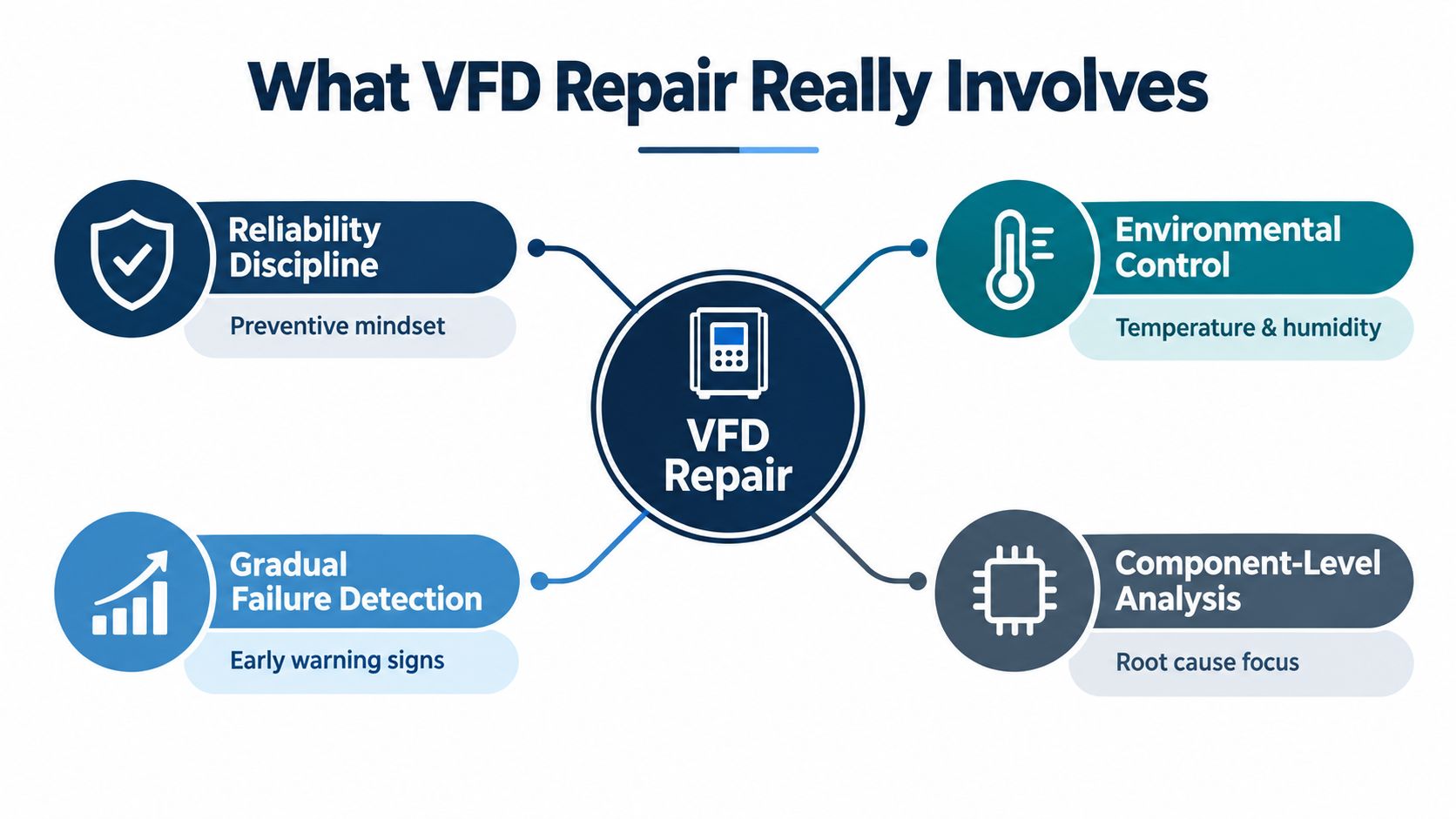
Good VFD drive repair isn't a component swap. It's a reliability and environmental-control discipline, because most failures develop gradually before anything trips. A drive can run apparently normally with a clogged heatsink, a weakening fan, or aging capacitors, right up to the day it doesn't.
Failures that build quietly
Maintenance guidance identifies thermal stress, contamination, cooling-system degradation, loose electrical connections, and capacitor aging as recurring risk factors, and notes that clogged heatsinks and failing fans let a drive operate until sudden failure, as set out in published maintenance guidance on VFD failure mechanisms. The same guidance puts a typical service-life window at about 7 to 10 years for thermally stressed systems, with particular attention to DC-bus capacitors around seven years. Treat those figures as planning indicators, not guarantees. Load profile, ambient temperature, ventilation, humidity, dust, salt, and vibration shift real life in either direction.
That guidance also notes VFDs can reduce energy consumption by approximately 20 to 50% in suitable pump, fan, and conveyor duties, which is why plants keep them. But the drive adds failure mechanisms a direct-on-line starter never had, including motor-side risks from PWM switching. Carrier frequencies above 5 kHz have been associated with bearing damage when shaft-current protection is inadequate.
Multiple generations on one site
Repair programs also have to span hardware generations. Practical industrial AC drives emerged in the late 1950s, solid-state units served very large motors through the 1960s, and mainstream adoption arrived in the 1980s as semiconductors shrank size and cost, a timeline traced in the history of industrial drive technology and maintenance. One plant can therefore hold legacy thyristor drives with discontinued displays alongside microprocessor units with sensorless vector control and industrial communications.
So a proper repair includes fault-history review, visual and thermal inspection, capacitor and fan assessment, connection checks, controlled bench testing, and verification of motor, cabling, grounding, and load before restart. Replace only the failed module and skip the rest, and you've fixed the symptom while leaving the environment that produced it untouched.
Common Faults and How Diagnostics Find Them
Four fault families account for most bench work, and each one punishes shortcuts.
IGBT faults are system events
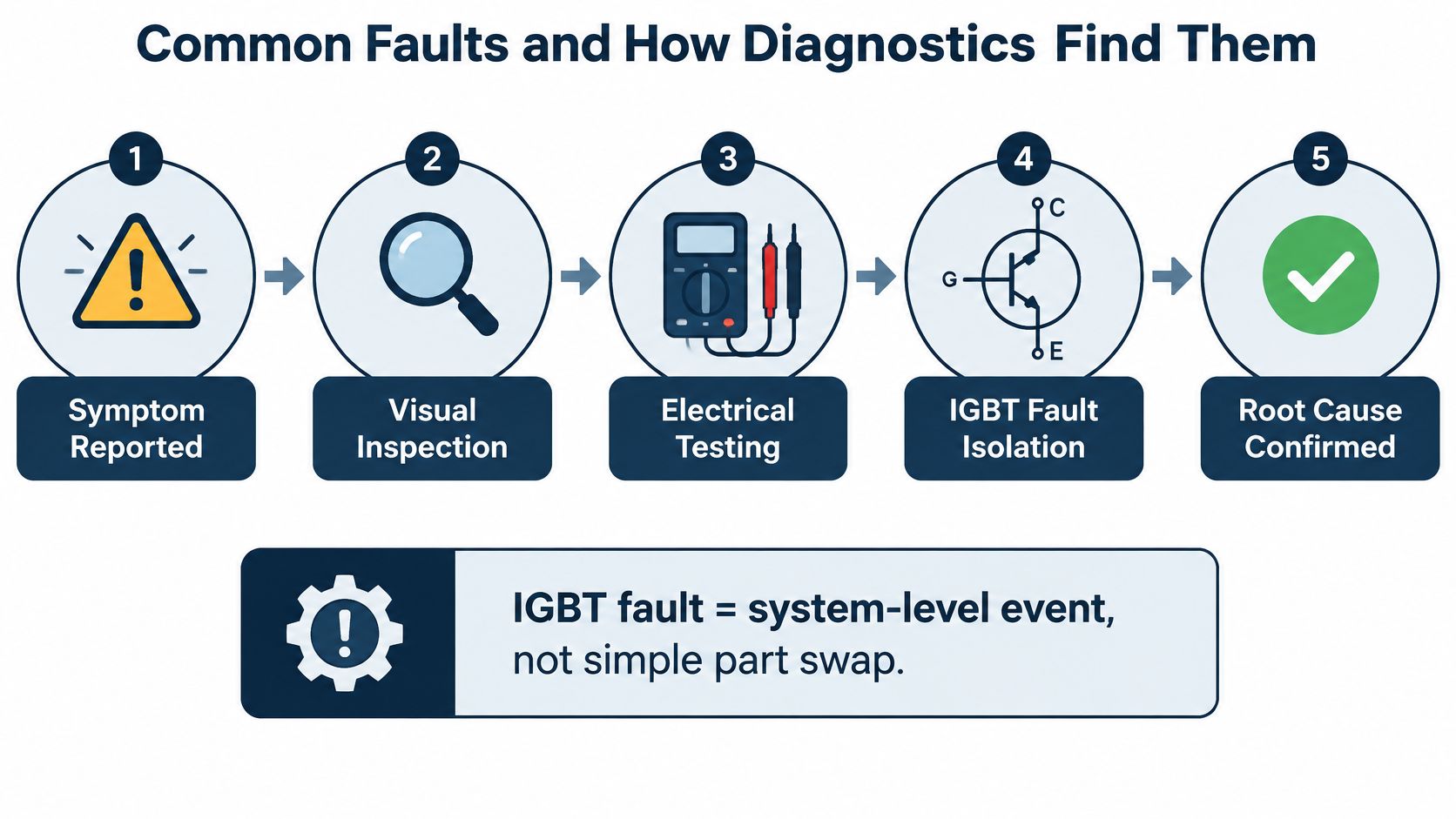
An IGBT fault is a system-level event, not a simple semiconductor replacement. After lockout and verified DC-bus discharge, technicians check gate-to-emitter isolation, compare diode-mode readings across collector-emitter paths, inspect gate resistors and protection components, and verify the gate-drive waveform, including turn-off bias and dead time, before applying load, following the method described in guidance on IGBT testing and failure analysis.
Skip that and a good replacement device can fail immediately. If the driver delivers wrong amplitude, insufficient dead time, or asymmetric commands, you get shoot-through, excessive current, localized junction heating, and a second dead module. The repaired stage should be energized first from a current-limited source, with no-load waveforms checked before the motor is connected. Thermal interface, heatsink contact, mounting torque, and thermal-camera inspection under controlled load complete the picture. Acceptance isn't diode-test symmetry. It's stable gate behavior, normal idle current, balanced phase switching, and controlled thermal rise.
DC-link capacitors fail by feedback
Capacitance loss and rising ESR increase bus-ripple current and push extra electrical and thermal stress onto the inverter switches. Visual checks for bulging or leakage help, but they aren't enough. Measure capacitance and ESR where possible, and evaluate DC-bus ripple on a powered drive, as detailed in documentation on DC-link capacitor condition and reforming.
The failure feeds itself. Higher ripple heats the capacitor, heating accelerates degradation, and the worsening ripple triggers overvoltage trips, fuse operation, or secondary IGBT damage. So diagnosis must also chase the initiating cause, supply imbalance, blown bank fuses, undersized DC-link chokes, cabinet temperature, airflow, and contamination. Drives stored unpowered for more than approximately one year may need controlled capacitor reforming before service, because full voltage applied abruptly to aged electrolytics can cause excessive inrush or dielectric damage.
Cooling failures and loose connections round out the list, and they're often the upstream cause of the first two. Interpret the trip against a reference for common VFD fault codes, but confirm with measurement. Codes point. Instruments prove.
On-Site Versus Workshop Repair Options
Once diagnosis says the drive itself needs work, the next call is where the work happens. Neither path is automatically better.
When the workshop wins
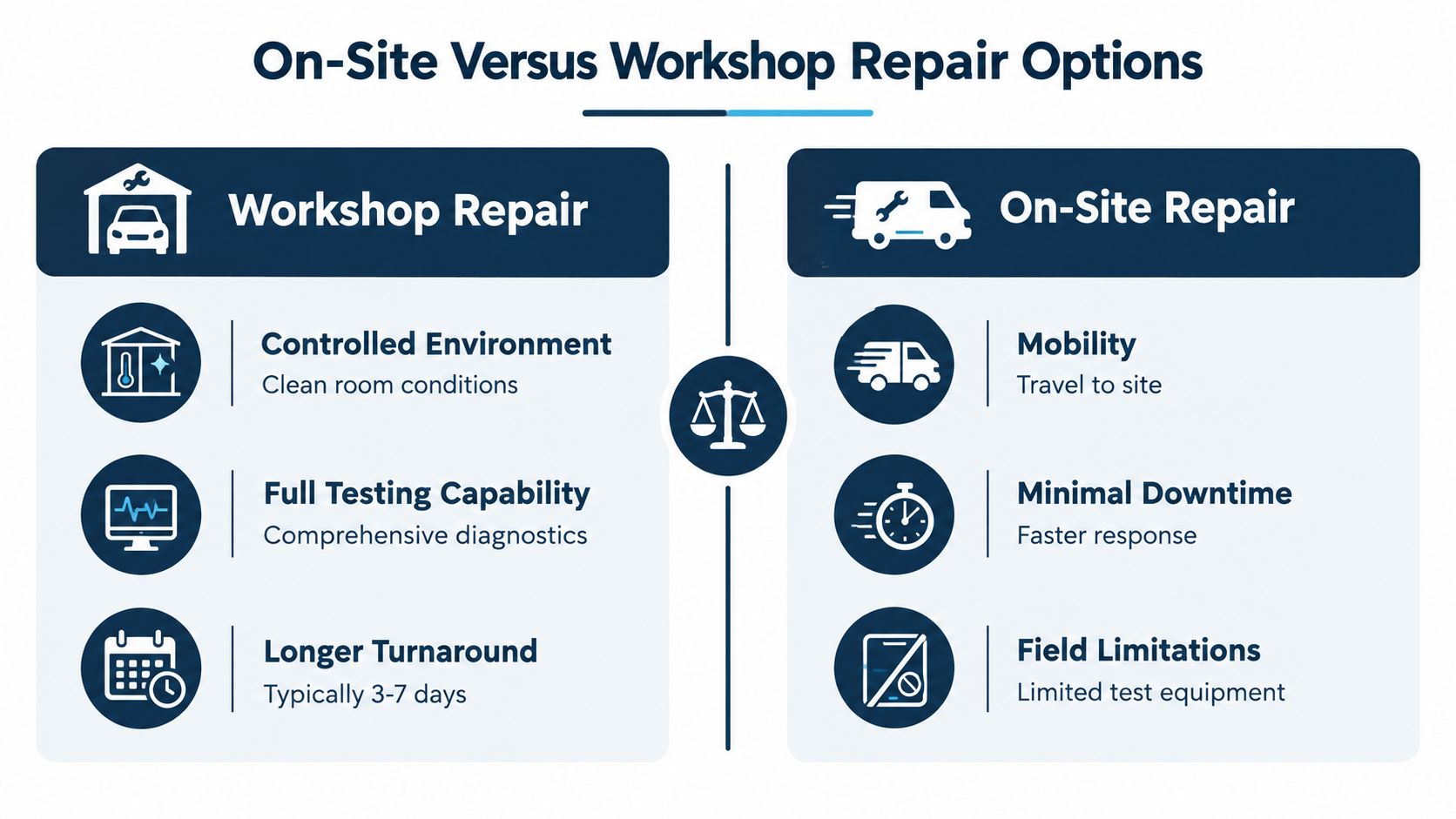
Workshop repair gives you a controlled environment: full disassembly, cleaning, bench diagnostics, component-level repair, parameter recovery, reassembly, and functional or load testing before the unit returns. That's the right setting for board-level faults, contamination deep inside the unit, damaged traces, or any job needing staged energization and thermal verification. If the drive can be removed and shipped safely, and a spare or bypass keeps production running, the workshop usually delivers the most thorough result.
The trade-off is time and handling. Removal, transport, repair, return, reinstallation, and recommissioning all add up, and every move risks connector damage, lost parameters, or wiring errors on refit. Photograph terminal wiring and export the full parameter set before disconnecting anything.
When the work must come to the drive
On-site repair flips the trade-off. A field team diagnoses in place, replaces what's needed, and restarts under controlled procedures without the drive ever leaving its cabinet. That matters most for medium- and high-voltage drives, where transport, lifting, moisture exposure, and long lead times make shipping a project in itself. In those cases, full on-site reconditioning inside a planned shutdown window, cleaning, component renewal, connection work, and testing in place, can restore a large drive without the transport risk.
- Choose workshop repair when: the fault needs deep bench work, the unit is shippable, and production can run without it.
- Choose on-site work when: the drive is large or integrated, downtime cost dominates, or shipping risk outweighs bench advantages.
- Either way, require: documented diagnosis, controlled restart, and verification under load, not just a powered-up display.
Practical rule: ship the drive when the bench adds diagnostic depth you can't get in the field. Keep it in place when moving it adds more risk than the bench removes.
Repair, Recondition, Upgrade, or Replace
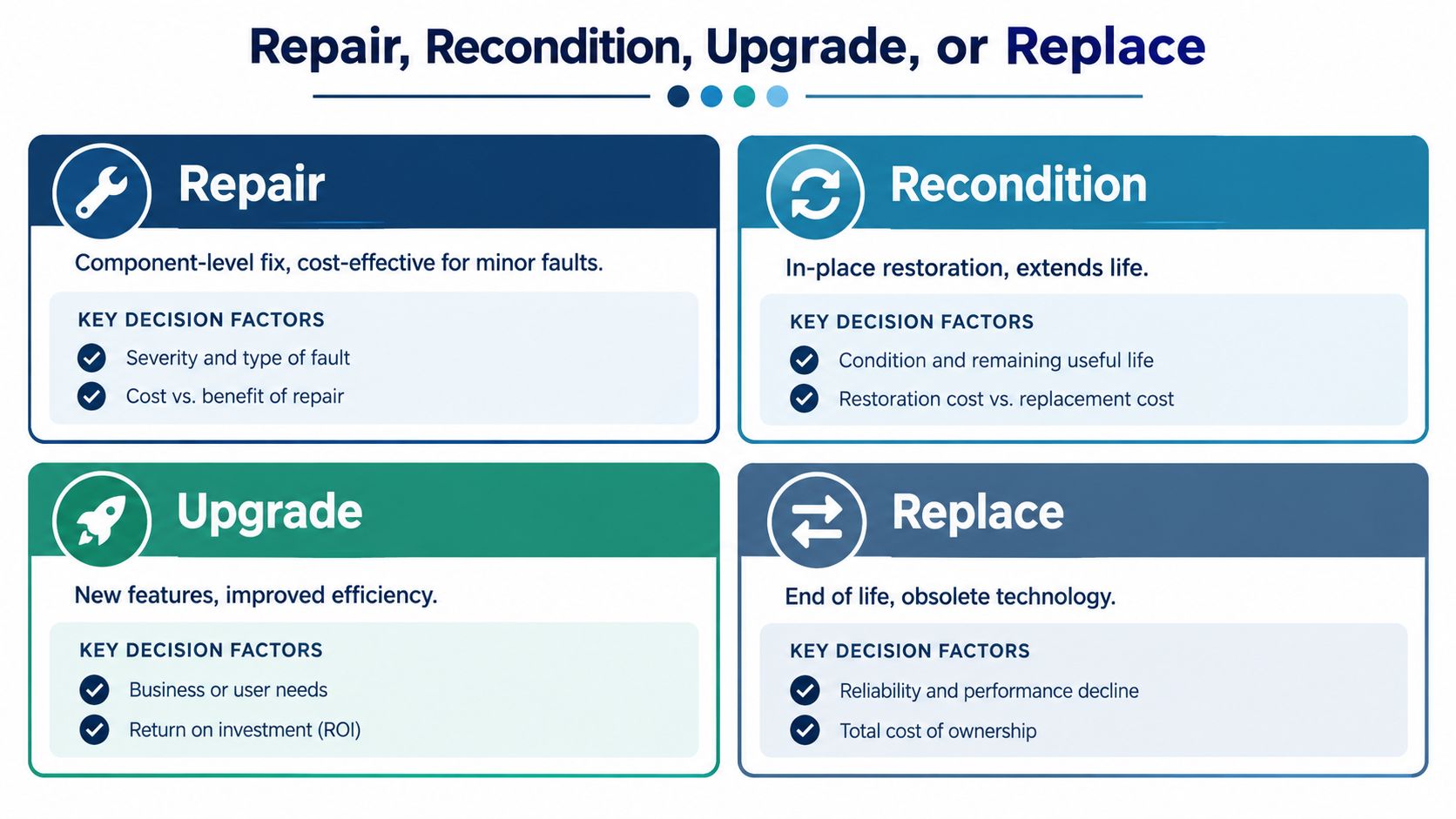
Most VFD drive repair content lists fault codes and stops there. The harder question, and the one that decides your budget, is which of four paths a failed drive should take.
Aging isn't uniform
A drive doesn't wear out all at once. Power semiconductors can remain serviceable far longer than electrolytic capacitors and cooling fans when thermal conditions are controlled. That's why age alone is a poor decision rule, a point developed in analysis of repair versus replacement decisions for variable speed drives. An old drive with a healthy power stage, clean boards, and available parts may be an excellent overhaul candidate. A younger drive cooked by years of blocked airflow may not be.
Run the decision gate
Work through these inputs with test evidence in hand, not impressions.
- Condition by subsystem: Test capacitors, fans, power stage, gate drive, control boards, and cooling path separately. One failed subsystem argues for repair. Several degraded ones argue for reconditioning or replacement.
- Parts and support: Confirm availability of boards, modules, displays, and firmware support. Obsolete boards or unsupported software can make a cheap repair uneconomic.
- Fault history: A first failure after long service differs from the third trip this year. Repeat failures under unchanged environmental stress won't be cured by another component.
- Criticality and downtime cost: On steel, tire, chemical, and utility sites, production interruption cost dominates purchase price, so the fastest reliable path often wins.
- Compatibility: Check enclosure fit, motor compatibility, parameter migration, and whether a replacement changes EMC or harmonic behavior in your installation.
Repair fixes an isolated fault at component level. Recondition when the platform is sound but wear items and contamination need systematic renewal, often in place for MV units. Upgrade when serviceable subsystems can be kept while controls or functions are renewed. Replace when obsolescence, repeated failures, or multi-subsystem damage make further spending indefensible. Document the gate decision. That record justifies the spend and informs the next failure.
Timelines, Costs, and Spare-Parts Matching
Timelines vary widely, and anyone quoting a fixed turnaround before diagnosis is guessing. Fault type, parts availability, and whether work happens on site or in a workshop drive the schedule. Cost follows the same logic, with one addition: downtime itself is usually the largest line item, even though it never appears on the repair invoice.
Typical VFD Repair Scenarios
| Fault Type | Typical Approach | Key Cost Drivers |
|---|---|---|
| Cooling fan or filter failure | On-site renewal, cleaning, thermal check | Access, parts, shutdown window |
| DC-link capacitor degradation | Bank replacement, rectifier and precharge checks | Capacitor rating, labor, reforming needs |
| IGBT or gate-drive failure | Workshop bench repair, staged energization | Module cost, driver repair, load testing |
| Control board fault | Component-level repair or exchange unit | Board availability, parameter recovery |
| Contamination or heat aging | Reconditioning in place or in workshop | Extent of cleaning, wear-item renewal |
Where parts matching goes wrong
Spare-parts matching is where repeat outages are born. Gate-drive voltages, protection thresholds, module pinouts, and switching frequencies aren't interchangeable across brands or even across generations of one platform. A module that fits mechanically can still be electrically wrong.
Insist on identification, sourcing, compatibility review, and pre-dispatch verification of any exchange unit. For capacitors, verify polarity, capacitance class, ripple-current rating, voltage rating, balancing components, busbar torque, and precharge operation after fitting. And never accept a capacitor-only repair that skips the rectifier, precharge circuit, bus impedance, and inverter stage. That's not a saving. It's a deferred second outage, usually at a worse time.
Plan the money the same way. A thorough diagnosis, correct parts, and full verification cost more than a quick swap, but they're cheaper than doing the job twice with production stopped both times.
How to Choose a Qualified Service Provider
You're not buying a component. You're buying a diagnostic method and the discipline to follow it under time pressure. Vet providers on evidence, not promises.
What to look for
- Documented diagnostic methodology: They isolate faults with measurements before recommending repair or restart, and they put findings in writing.
- Multi-brand, multi-voltage capability: Low-, medium-, and high-voltage competence matters because your site almost certainly runs mixed generations.
- Field experience in harsh environments: High salinity, conductive dust, and heat change how drives fail, and a provider who's worked in those conditions diagnoses faster.
- Transparent credentials: Manufacturer authorizations, partner status, and client project records should be presented openly, not claimed vaguely.
- Regional response: Local service locations shorten response time and reduce transport risk for large drives.
DUCHENG Industrial, for example, provides multi-brand VFD repair, on-site MV reconditioning, and spare-parts verification across China and Southeast Asia, which illustrates the service profile to compare against. Whatever provider you shortlist, test them against the same list.
How to engage them
Request a documented diagnosis before approving work. Ask how they bench-test, how they verify gate drive and DC-link condition, and what loaded testing they perform before handover. Confirm how they source and verify spare parts, how parameters are backed up and restored, and what records you'll receive. A provider who welcomes those questions is telling you something. So is one who doesn't.
Set the engagement up during calm periods, not during a breakdown. Agreed contacts, site access, drive inventories, and parameter backups arranged in advance turn an emergency into a procedure.
Your VFD Repair Decision Checklist
When the next drive trips, work this sequence in order.
- Protect and record: Lock out, verify discharge, save fault history and parameters before resetting.
- Diagnose to root cause: Test power stage, gate drive, capacitors, cooling, connections, motor, and cabling. Don't let a fault code substitute for measurement.
- Choose the setting: Workshop for deep bench work on shippable units, on-site reconditioning when size or downtime makes shipping the bigger risk.
- Run the four-way gate: Repair, recondition, upgrade, or replace, based on subsystem condition, parts availability, fault history, criticality, and compatibility.
- Verify parts and restart: Confirm compatibility before dispatch, energize in stages, and prove performance under controlled load.
The thread through all of it is simple. Test evidence beats a generic service-life number. Aging isn't uniform, environments differ, and a controlled overhaul can preserve valuable installed functionality when the motor, cabinet, and control architecture remain serviceable. Equally, honest test results sometimes say replacement is the cheaper machine, and hearing that early saves real money.
Keep records from every event, fault data, measurements, parts fitted, and gate decisions. That history is what turns the next breakdown from a debate into a decision you can make in minutes, with confidence, at 2 a.m.
If a drive trip has production stopped, or an aging MV unit needs reconditioning without the risk of shipping it, DUCHENG Industrial offers structured on-site diagnosis, workshop deep repair, and documented repair-versus-replace assessments across China and Southeast Asia. Visit the site to start a service request, review lifecycle support options, or reach the 24-hour emergency contacts for China and Thailand.