
Explore VFD repair services, from rapid on-site triage to deep workshop repair and MV on-site reconditioning, with practical selection guidance for plant teams.
At 2 a.m., a 480 V drive trips on a ground-fault code, the centrifugal pump drops out, and a downstream process skid begins coasting to a stop. The reliability engineer has minutes to decide whether to call the OEM hotline, send an on-site technician, or remove the drive and ship it to a repair workshop. Each option carries a different risk. A fast restart might recover production but leave the cause untouched, while a deeper repair may protect the asset but miss the available maintenance window.
That's why VFD repair services shouldn't be treated as a single transaction. The right response depends on the failure class, asset criticality, available spares, safety conditions, and how long the process can tolerate an outage. A drive that has lost communication with a controller calls for a different service tier than one with a shorted DC bus, recurring overcurrent trips, or contamination inside the power section.
Table of Contents
- The Moment a Drive Trips and the Clock Starts
- What VFD Repair Services Actually Cover
- On-Site Rapid Triage vs Workshop Deep Repair
- MV On-Site Reconditioning for Large Drives
- When Repair Beats Replacement in 2026
- Spare Parts, Exchange Units, and Compatibility
- How to Choose a VFD Repair Services Provider
- Turning Repairs Into a Reliability Program
The Moment a Drive Trips and the Clock Starts
The first mistake is treating the trip code as a diagnosis. A code tells you what the drive detected, not necessarily what caused the event. A ground-fault indication may involve the motor, motor leads, output stage, insulation, or a transient that has already passed. Resetting the drive without isolating those possibilities can turn a recoverable incident into a damaged power module.
The first response should protect people and preserve evidence. Operators should record the fault history, operating state, motor speed, load condition, recent maintenance, and any unusual sound, smell, heat, or vibration. Technicians then verify the isolation boundary, inspect the cabinet, check for contamination and loose connections, and test the motor circuit before attempting a controlled restart.
Practical rule: A restart is a diagnostic step only when the team knows what it is testing and what conditions will trigger an immediate stop.
The decision tree usually has three branches:
- Rapid on-site triage when the asset is critical, the fault appears contained, and a safe restart or limited component change may restore operation.
- Workshop repair when the drive shows power-stage damage, recurring faults, contamination ingress, or evidence that it needs controlled bench testing.
- Replacement or engineered renewal when the unit is repeatedly failing, unsupported, physically damaged, or no longer suited to the application.
The economics are broader than the repair invoice. A stopped pump may interrupt a batch, force a downstream skid into a defined restart sequence, require process coordination, and consume a maintenance window that was never planned. Conversely, rushing a drive back into service without checking line quality, load inertia, parameters, and thermal history can create a second trip soon after the first.
A structured service provider therefore begins with triage and ends with a return-to-service decision. The plant shouldn't ask only, “Can you repair this drive?” It should ask, “Which intervention gives this asset the safest and most predictable path back to production?”
What VFD Repair Services Actually Cover
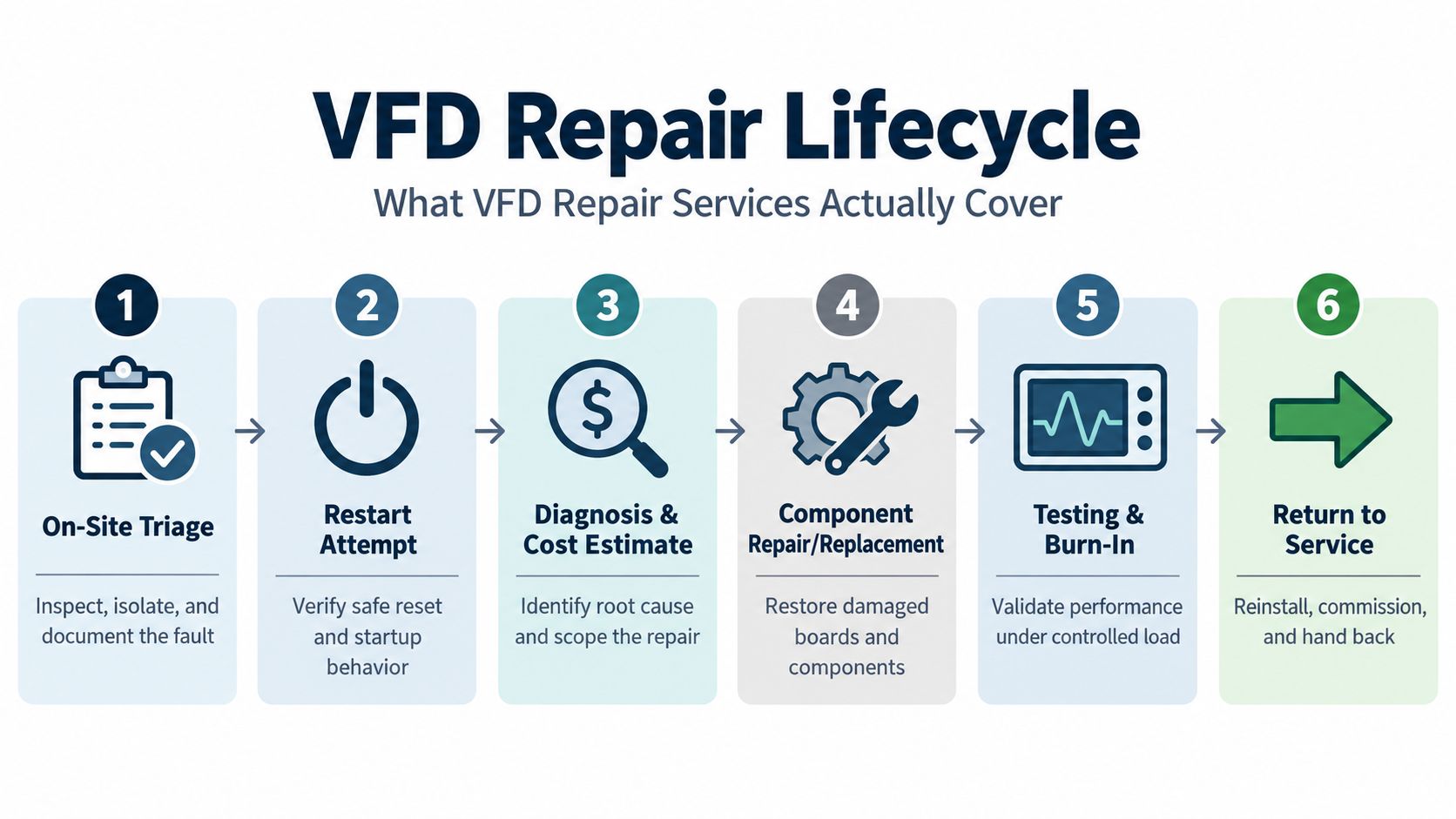
A complete VFD repair service has several distinct stages. The scope may begin with an emergency phone assessment and end with a tested unit, updated records, and support during restart. Providers that describe every job as “repair” make it difficult for plant teams to compare risk, turnaround, and accountability.
The service stages
On-site triage establishes whether the drive can be safely inspected, reset, isolated from the process, or restarted. The technician reviews fault history, wiring, environmental conditions, motor data, and visible damage. This stage is often the fastest route to a controlled recovery, but it may not reveal intermittent or thermal faults.
Component-level diagnosis moves beyond the display code. Technicians test the DC bus, rectifier, IGBTs or diodes, gate-driver circuits, control boards, cooling system, and relevant I/O. They also look upstream and downstream, because overvoltage, overload, harmonics, poor installation, and motor-side faults can damage a healthy replacement drive.
Workshop deep repair allows full de-energization, disassembly, board-level work, power-module replacement, capacitor inspection, firmware staging, and controlled functional testing. The workshop environment is better suited to faults that need repeated testing or cannot be safely reproduced in a live plant.
MV on-site reconditioning serves large drives that are difficult, hazardous, or uneconomical to crate and transport. The work can include subsystem renewal, fiber-optic and gate-driver work, control-board handling, insulation checks, and controlled recommissioning while the cabinet remains installed.
The support layer
Spare-parts identification and exchange-unit management are separate capabilities, not administrative extras. The provider must match the drive's exact hardware revision, firmware environment, power rating, control architecture, and application requirements before dispatching a board or replacement unit.
After repair, witness testing gives the plant evidence that the unit performs as expected. Depending on the drive and service scope, this can include insulation checks, control verification, simulated commands, no-load operation, load testing, thermal observation, and a documented fault report. Return-to-service support then covers parameter confirmation, motor rotation, permissive checks, communications, and controlled loading.
Break-fix work is normally transactional. A contracted reliability program adds response obligations, maintenance windows, asset records, escalation rules, and service-level expectations. Those arrangements carry more planning and reporting, but they also make it easier to decide when a drive should be repaired, monitored, reconditioned, or replaced.
On-Site Rapid Triage vs Workshop Deep Repair
On-site and workshop repair solve different problems. On-site work prioritizes time to controlled recovery. Workshop work prioritizes diagnostic depth and repeat-failure prevention. Neither is automatically superior.
On-site triage is appropriate when the drive remains mechanically and electrically suitable for inspection, the fault is limited, and the plant has a safe path to test operation. Typical tasks include reviewing fault logs, checking parameters, inspecting fans and airflow, verifying control wiring, checking the capacitor bank, testing I/O, and replacing a known failed module from verified stock. Communication loss, a failed fan, a control interface issue, or a soft fault may be resolved without removing the cabinet.
Workshop repair becomes more valuable when the drive has a recurring overcurrent problem, a DC-link short, suspected IGBT damage, board contamination, water ingress, or a fault that cannot be reproduced reliably in the field. Technicians can remove and inspect assemblies, rework gate-driver boards, renew bus connections, stage firmware, and apply thermal or load stress in a controlled setting.
| Criterion | On-Site Rapid Triage | Workshop Deep Repair |
|---|---|---|
| Primary objective | Restore safe operation quickly | Isolate and correct deeper failure causes |
| Best fit | Soft faults, fans, I/O, communication loss | Power-stage damage, recurring trips, contamination |
| Plant disruption | Usually limited to a planned access window | Includes removal, transport, and reinstallation |
| Diagnostic depth | Constrained by site tools and operating conditions | Full disassembly and bench testing |
| Main risk | A restart may mask the root cause | Longer outage if no exchange unit is available |
| Evidence required | Fault history and field inspection | Detailed test report and component findings |
A plant with no standby drive may choose on-site triage first, then remove the unit if the fault returns. A critical asset with a known power-stage failure should usually skip repeated reset attempts and move directly to controlled removal or a qualified field reconditioning plan. The decision should account for asset criticality, downtime tolerance, contamination exposure, and the likelihood that the first intervention will identify the cause.
A useful on-site versus workshop repair framework helps teams make that choice before the next outage, not while production is already stopped. The practical trade-off is simple: on-site service buys hours, while workshop service usually buys confidence.
MV On-Site Reconditioning for Large Drives
Medium- and high-voltage drives create a different service problem. A large cabinet may be bolted into a process line, connected to a critical motor, and surrounded by lifting, access, and isolation constraints. Removing it can require specialized handling and a shutdown plan that the process cannot easily provide.
On-site reconditioning starts with a site assessment. The service team confirms the single-line arrangement, isolation points, discharge requirements, cabinet condition, available working space, environmental hazards, test access, and restart sequence. For a cement kiln drive or a large induced-draft fan, the plan also has to coordinate with operations, electrical safety, mechanical teams, and the process owner.
The reconditioning sequence
The crew first isolates and secures the equipment under the plant's approved high-voltage procedures. Large DC bus capacitors require a controlled discharge sequence, verification of zero energy, and documented access authorization. This is not a scaled-up low-voltage repair. It requires disciplined two-person working practices, appropriate test equipment, and clear boundaries between energized and de-energized systems.
Technicians may then replace gate-driver assemblies, fiber-optic boards, cooling components, control boards, or other serviceable subsystems. Fiber connectors and interfaces need careful cleaning and inspection because contamination can create intermittent control faults that are difficult to find after the cabinet is closed. Control-board firmware or configuration work must be staged against the existing system architecture, not treated as a generic software update.
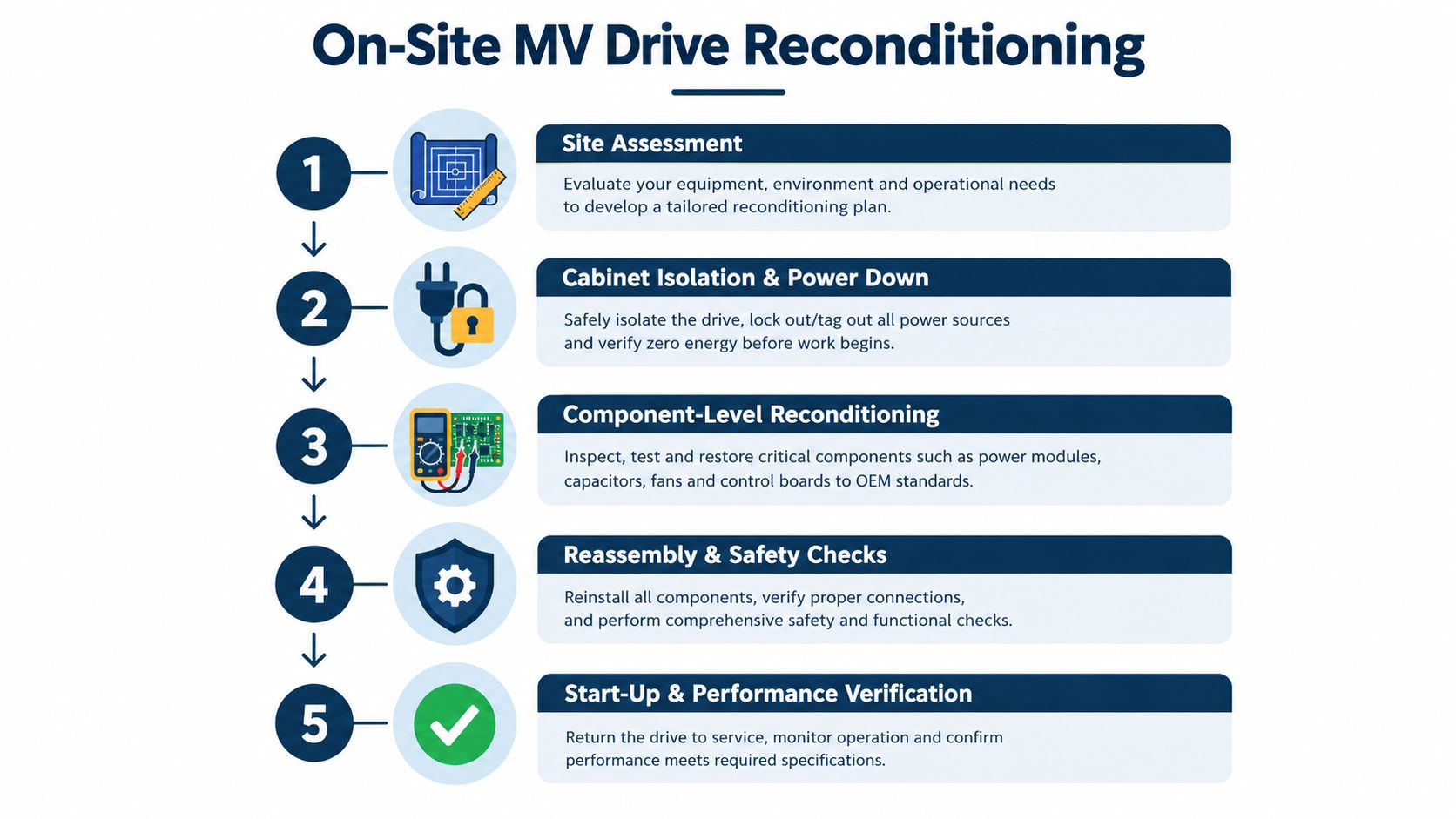
After reassembly, the team performs safety checks and electrical verification appropriate to the drive design. Hi-pot and partial-discharge testing may be part of the post-repair scope, followed by control checks, permissive validation, motor checks, and a staged increase in operating load.
The benefit is logistical as much as technical. The cabinet stays in place, transport damage is avoided, and the repair can align with a defined outage window. The cost is a larger on-site crew, more extensive test equipment, stricter safety controls, and a longer work package than a simple low-voltage module change.
A short technical demonstration can help teams understand the sequence and constraints of on-site drive reconditioning.
<iframe width="100%" style="aspect-ratio: 16 / 9;" src="https://www.youtube.com/embed/Ggkou2vehHY" frameborder="0" allow="autoplay; encrypted-media" allowfullscreen></iframe>When Repair Beats Replacement in 2026
The repair-versus-replace decision has changed because replacement availability and legacy support can be as important as component price. A market analysis describes extended lead times, tariff-driven equipment cost pressure, and OEM discontinuations as reasons replacement may be harder to execute, while repair providers increasingly combine component diagnostics, load testing, and warranty support. The relevant question is therefore not “What does repair cost?” It's “Which option returns the process to dependable operation with less schedule and integration risk?”
A repair often makes sense when the failure is isolated, the cabinet and cooling system remain sound, the required parts can be verified, and the existing parameters and mechanical footprint are valuable. It may also be the safer route when a replacement would require new wiring, control integration, commissioning, operator retraining, or a longer shutdown. For older drives, a repair evaluation can reveal whether targeted renewal of capacitors, power modules, fans, or control assemblies is enough to extend useful service.
Replacement deserves priority when the same failure keeps returning, the control architecture is obsolete, the enclosure has suffered extensive water or corrosive contamination, or the drive is undersized for the load. A repair that restores operation without addressing those conditions only postpones the decision.
| Decision Factor | Repair Wins | Replace Wins |
|---|---|---|
| Failure pattern | Isolated, identifiable component fault | Repeated failure of the same subsystem |
| Support position | Verified parts and compatible revisions are available | Control boards or critical parts are obsolete |
| Site condition | Cabinet, motor interface, and cooling path are serviceable | Fire, severe water ingress, or corrosive damage is extensive |
| Shutdown exposure | Replacement would extend the outage or require major integration | A planned modernization already exists |
| Lifecycle value | The drive fits the application and can be tested after repair | The asset no longer meets process, safety, or efficiency needs |
The U.S. VFD market is projected to grow from US$4.5 billion in 2026 to US$6.2 billion by 2033, at a 4.7% CAGR, according to Persistence Market Research's U.S. variable frequency drive market forecast. That expanding installed base means more assets will enter mid-life and late-life service decisions. Plants should use that reality to build an assessment process, not assume that a new shipment is always the lowest-risk answer.
Spare Parts, Exchange Units, and Compatibility
A replacement board can look correct and still fail in service. Hardware revisions, firmware dependencies, parameter structures, sensor interfaces, and communication arrangements all matter. Installing the wrong revision may produce intermittent trips, unexplained communication loss, or a no-fault-found return that sends the unit through the same cycle again.
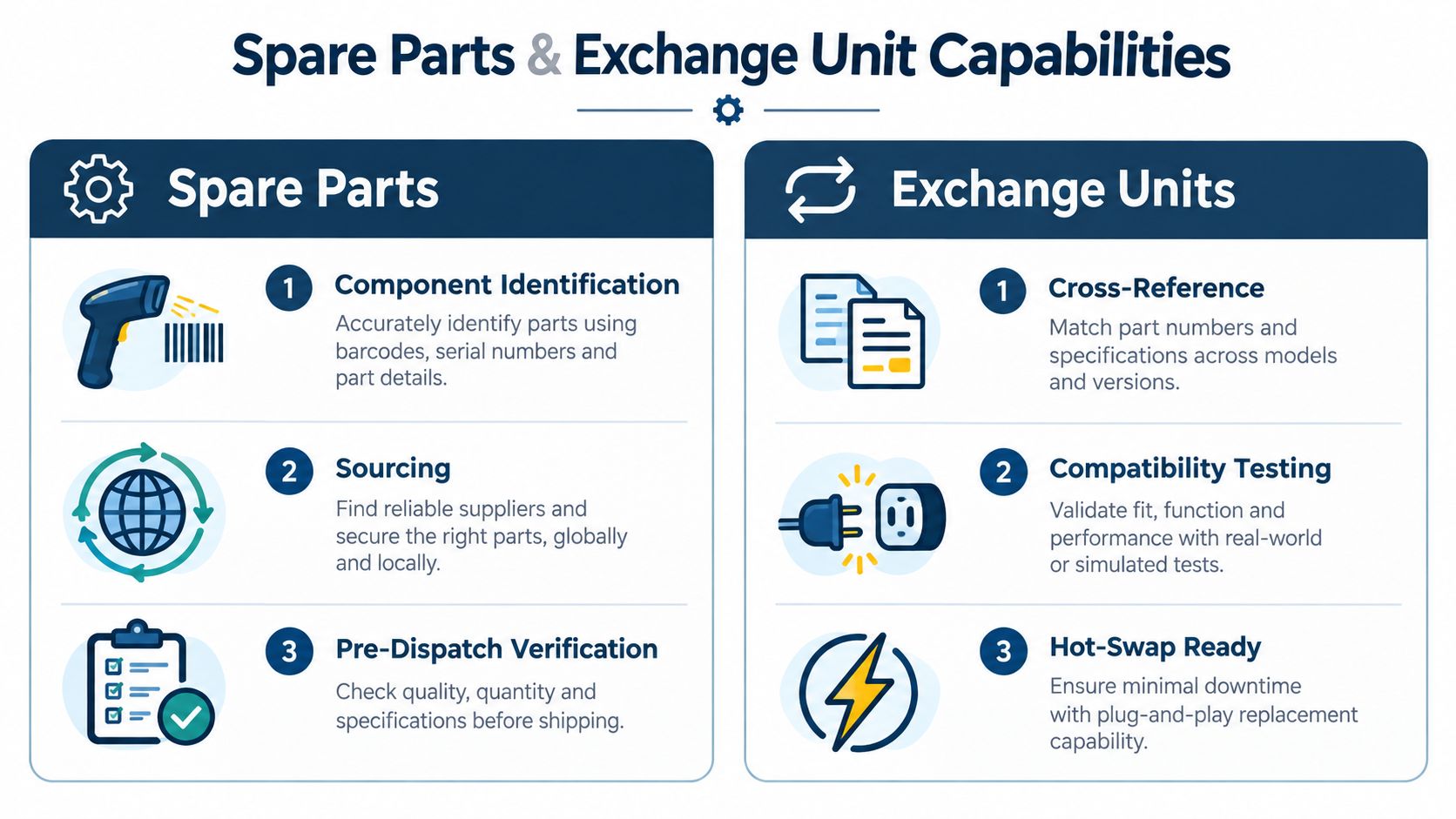
The parts process should begin before anyone quotes a component. The technician records the drive nameplate, serial information, installed board markings, fault history, cabinet photographs, firmware details, and application data. The provider then cross-references those details against the drive architecture and confirms whether a newer revision is a direct substitute, requires parameter conversion, or needs additional hardware.
Three part categories
- New components offer predictable provenance and a clear support path, but availability and compatibility still need verification.
- Refurbished components can restore legacy equipment when new parts are unavailable, provided the provider documents inspection, replacement work, and test results.
- Exchange units reduce removal-to-return time, but only if the substitute has been cross-referenced and bench-checked against the plant's application.
Pre-dispatch verification should include more than a visual inspection. A serious workflow tests power supplies, control signals, communications, display or keypad operation, protection behavior, and relevant firmware or configuration. For a power module, the provider should verify the associated gate-driver and protection circuits rather than treating the module as an isolated commodity.
The plant should also control what happens to the removed part. Tag it with the asset number, failure symptom, date, and operating position. That record allows the reliability team to identify repeated board failures, contamination patterns, and application-specific stress instead of treating each exchange as an unrelated event.
A broader industrial asset management process gives those parts decisions a proper home. Without accurate records, even a technically competent repair provider may receive incomplete information and send back a part that is electrically functional but wrong for the installed system.
How to Choose a VFD Repair Services Provider
A provider's brochure rarely tells you whether the team can handle the fault that stopped your plant. Ask questions that expose the actual service boundary, test capability, response structure, and responsibility after installation.
Technical capability
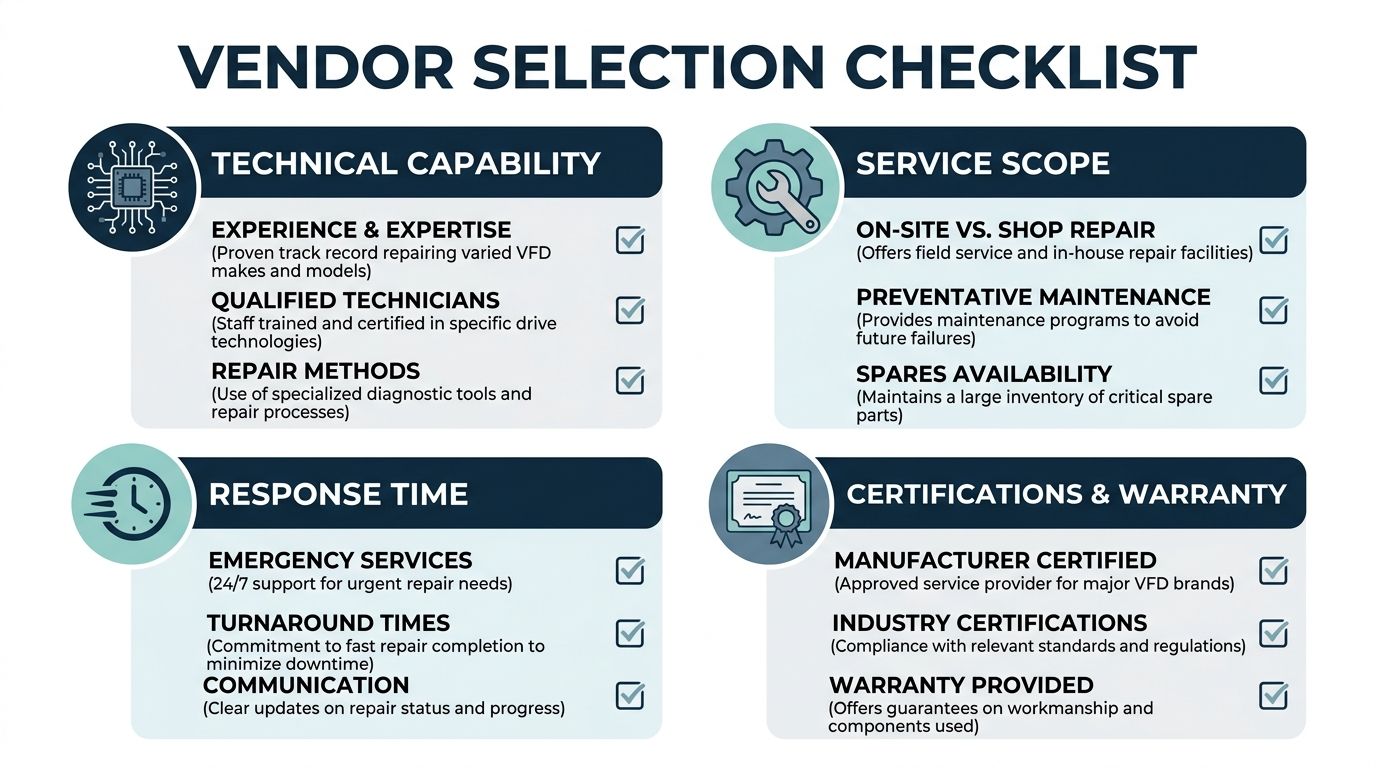
Start with the voltage range and failure classes. Can the provider work on your low-voltage assets and your medium-voltage systems, or will it subcontract the difficult work? Does the workshop perform component-level diagnostics, or does it only replace complete boards? Ask whether technicians can examine power quality, motor insulation, load behavior, cooling conditions, and parameter settings before declaring the drive defective.
You should also ask to see the test method. A bench that verifies control logic isn't equivalent to a facility that can apply representative load and monitor thermal behavior. For MV work, ask about high-voltage safety procedures, test equipment, fiber handling, insulation verification, and the conditions required for an on-site repair.
Response structure
Put the response model in writing:
- Emergency access: Who answers outside normal plant hours, and what information must the control room provide?
- Triage commitment: How quickly can a qualified technician review the fault and determine the next safe action?
- Exchange availability: Which drive families and power ranges are supported with compatible exchange units?
- Workshop pathway: What happens if the on-site attempt fails, and how quickly can removal, transport, and diagnosis begin?
A response promise without escalation rules isn't a service level. It's a hope.
Commercial and verification questions
Ask whether pricing uses fixed repair tiers, time and materials, or a quoted diagnostic stage followed by approval. Confirm what the warranty covers, how exclusions are handled, and whether the report identifies root cause or only lists replaced parts. Consequential downtime liability is often limited, so procurement should understand that boundary before an outage occurs.
Before signing, audit the workshop if practical. Request a sample anonymized repair report, call references involving similar failure classes, and ask the provider to explain a case where it recommended replacement instead of repair. DUCHENG Industrial offers multi-brand commissioning, troubleshooting, workshop repair, preventive care, MV on-site reconditioning, spare-parts support, and emergency contacts for China and Thailand. Those capabilities should still be evaluated against your own voltage classes, site hazards, response needs, and documentation standards.
Turning Repairs Into a Reliability Program
A repair program becomes a reliability program when every intervention improves the next decision. The plant shouldn't record only the part that failed. It should capture the operating condition, environmental exposure, protection settings, motor-side findings, fault sequence, corrective action, test evidence, and recommendation for follow-up.
The strongest programs use a consistent failure-mode vocabulary across the fleet. A fan blockage, capacitor deterioration, gate-driver fault, communication interruption, and motor insulation issue should not all appear in the database as “VFD failure.” Different causes require different preventive actions.
Build the decision loop
- Tag every event. Link the fault to the asset, process duty, load, environment, and repair action.
- Review repeat patterns. Look for recurring faults by drive family, cabinet location, duty cycle, contamination exposure, and maintenance history.
- Schedule post-repair checks. Confirm parameters, cooling, communications, motor behavior, and load response after return to service.
- Set an escalation rule. Define when repeated repairs, unavailable parts, or worsening cabinet condition moves the asset into replacement planning.
- Protect the next outage window. Pre-identify exchange units, critical boards, lifting requirements, test equipment, and access permits.
Preventive maintenance matters because field data supports the idea that many drive problems can be managed before full failure. In one industry compilation covering hundreds of drives, 20% required replacement parts, 47% had problems that did not require parts, and 33% had no problems after a formal preventive-maintenance process was introduced, as reported in variable frequency drive preventive-maintenance statistics. The useful lesson is not that every plant will reproduce those figures. It's that inspection, cleaning, testing, and targeted intervention can prevent a blanket replacement response.
Environmental control belongs in the same loop. Dust, moisture, oil mist, and airborne particles restrict cooling, while increased internal temperature accelerates capacitor aging. The engineering guidance in this VFD troubleshooting flowchart cites the commonly used rule that each 10°C increase above rated internal temperature can roughly halve capacitor life.
A mature service plan combines rapid restore for emergencies, deep repair for complex faults, on-site MV work where transport creates risk, and parts control that prevents compatibility mistakes. It then measures what plant leaders need: fewer unplanned trips, shorter restoration time, clearer replacement timing, and maintenance spending that can be defended.
DUCHENG Industrial supports multi-brand VFD commissioning, troubleshooting, workshop repair, preventive maintenance, spare-parts verification, and on-site reconditioning for medium- and high-voltage drives. Visit DUCHENG Industrial to discuss a staged service plan for your critical drive assets, upcoming shutdown, or next unexpected trip.