
Learn what a 200 breaker box rating means, how much load it really carries, its key parts, and when a professional should check it before any upgrade.
A 200 breaker box is a panel whose main breaker and busbar are rated for 200 amps, the maximum current the service can carry, and most homes draw far less than that at any one moment.
That ceiling is easy to misread as a usage figure. A 2026 analysis by the American Council for an Energy-Efficient Economy measured homes with 200-amp panels and found an average one-minute peak load of approximately 65 amps. The number on the door is the most the equipment is listed to pass. It isn't a snapshot of what the house, shop, or plant is pulling right now, and it doesn't prove the conductors, meter, or utility arrangement can support that full rating.
Plant supervisors hit the same trap. A feeder panel stamped 200 amps can sit well under that mark for years, then look "full" the week a new drive, heater, or charger is added. The useful question is whether the calculated load, the measured demand, and the markings on the equipment all agree.
Table of Contents
- What a 200 Amp Breaker Box Really Means
- Parts Inside the Enclosure and What They Do
- Typical Loads a 200 Amp Panel Can Carry
- Signs a Professional Should Check the Panel
- How to Size the Breaker and Wire Safely
- Upgrade Only When the Calculated Load Requires It
What a 200 Amp Breaker Box Really Means
A 200 breaker box, more precisely a 200-amp panelboard or service panel, is equipment whose main breaker and bus are listed to carry 200 amps. That figure is a supply limit. It isn't the load the building is drawing, and it isn't permission for every branch circuit to run at 200 amps.
In the United States these panels became common from the 1990s onward as houses added central air conditioning, electric water heating, and larger appliances. The same ACEEE analysis reported that most homes built today use 200-amp electrical services, while some newer homes use services rated at 400 amps. It also found that 200-amp panels averaged 5.05 unused breaker spaces, compared with 2.55 spaces in 100-amp panels. In practical terms that's room for about two to three additional two-pole breakers, the kind that feed 240-volt equipment such as heat pumps, EV chargers, or electric resistance appliances.
Empty spaces aren't spare amps. A panel can have open slots and still fail a load calculation if the service conductors or the calculated demand are already tight.
What the nameplate is actually saying
At 240 volts, 200 amps is about 48 kilovolt-amperes of capacity at the rated ceiling. That's a limit on how much the service may supply, not a meter reading of what the home or plant draws. Allowable loading still depends on a code-compliant load calculation, conductor ratings, overcurrent protection, and the panel's short-circuit rating.
| Label on the panel | What it describes | What it does not tell you |
|---|---|---|
| Main breaker rating (200 A) | Maximum current the main breaker carries before tripping | How much load is actually running |
| Busbar or panel rating (200 A) | Maximum continuous current the busbar and enclosure are listed to carry | Whether the service conductors can handle that current |
| Short-circuit rating (kA RMS) | Largest fault current the panel can safely interrupt | Normal operating current or household demand |
| Service conductor size | Current the incoming service wires can safely carry | Breaker size alone |
| Number of spaces | How many breakers physically fit in the panel | Available capacity for new loads |
Practical rule: Read the main breaker handle and the nameplate before you treat any 200 breaker box as having spare capacity. If those two markings don't match the service conductors, the smaller rating is the one that governs.
A maintenance lead who only counts open slots will green-light a new 240-volt load that the calculation can't support. Match each line on the door to the row above, then decide whether you need a load study, not a new enclosure.
Parts Inside the Enclosure and What They Do
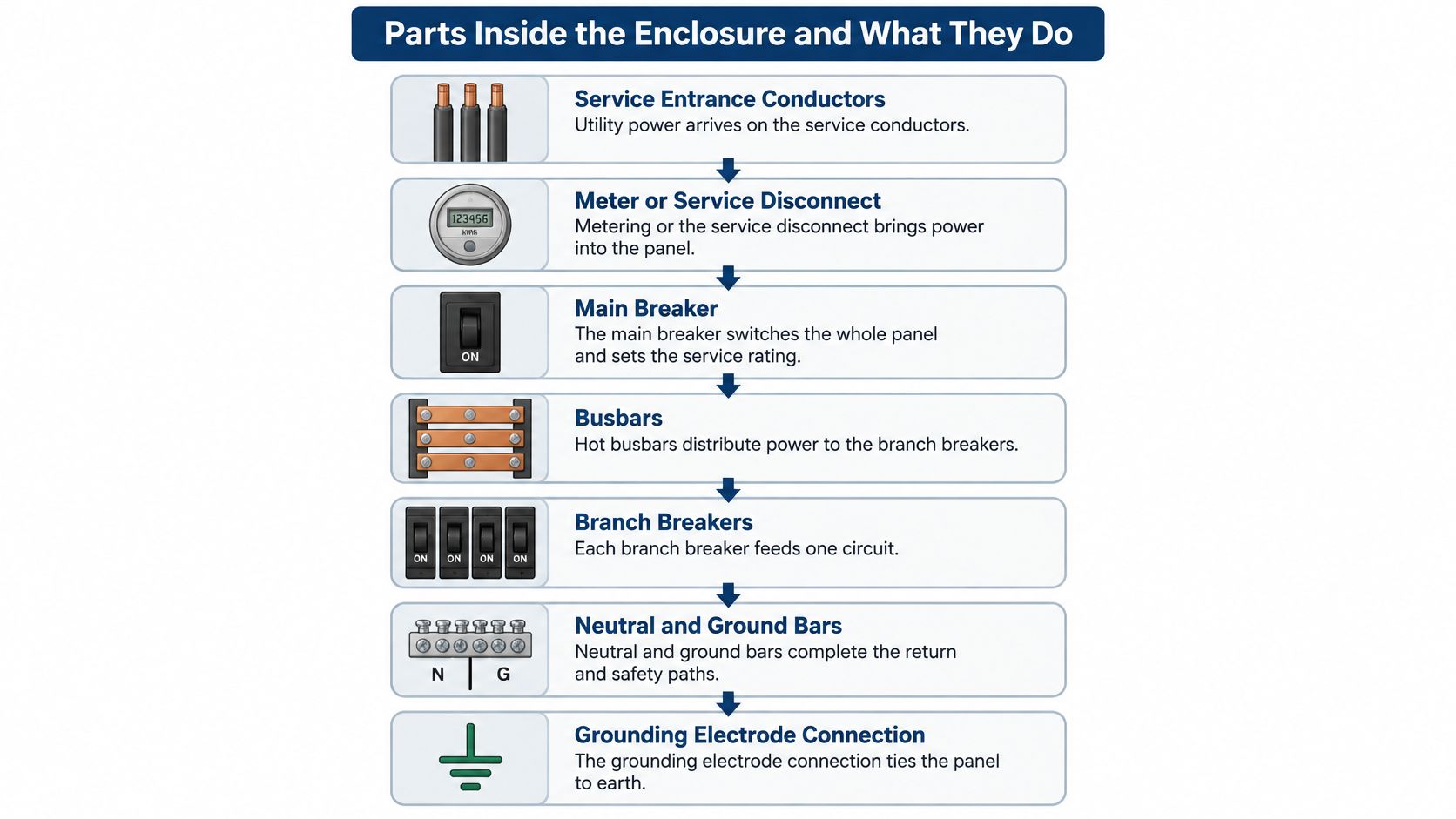
Power enters on the service entrance conductors, passes the meter or service disconnect, and lands on the main breaker. That breaker can shut the whole panel off, and its rating is what people usually mean when they say the service is 200 amps. From the main breaker, current moves onto the hot busbars, which feed each branch breaker. A branch breaker then protects one circuit on the way out to a load.
UL guidance on panelboards, written against UL 67 and the National Electrical Code, defines a panelboard's current rating as the maximum continuous current that can pass through its main terminals. A separate marking gives the short-circuit current rating in RMS symmetrical amperes. Those are two different jobs. One limits normal current. The other says how large a fault the gear can interrupt.
Return path, cover, and the rating that isn't the headline
Neutral current returns on the neutral bar. Equipment grounding conductors land on the ground bar, which ties to the grounding electrode. At the service equipment those systems are bonded once. In a subpanel fed from that service, neutral and ground stay on separate bars so fault current doesn't ride the neutral all the way back through the building.
For panelboards rated 200 amps or smaller, UL guidance says branch-circuit overcurrent protection must follow NEC Section 408.36(A). The same guidance gives a residential example: a panel marked 200 ampere maximum, see main circuit rating, may use an enclosure with six inches of wire-bending space suitable for 2/0 AWG conductors, but that 200-amp marking has to be identified as applying to single-phase, three-wire residential service equipment. A plant feeder with a different voltage or phase count doesn't inherit that example.
The dead-front cover and the enclosure keep live parts from casual contact. They don't add ampacity.
If you can point from the incoming conductors, through the main breaker, along a busbar, and out one branch breaker, you can describe the panel to an electrician without guessing.
Before anyone lands a new breaker, match the main breaker, busbar, conductors, voltage, phase, available fault current, and the enclosure listing. Verify the nameplate, the interrupting rating, the service conductors, and the utility or service-disconnect arrangement. The headline number alone doesn't establish that match.
Typical Loads a 200 Amp Panel Can Carry
Breaker size is the protection on a circuit. It isn't the current that circuit draws every minute it's on. Planning a 200 breaker box starts with the two-pole loads, because those eat both spaces and a large share of the service.
| Equipment | Typical breaker size | Typical use pattern |
|---|---|---|
| Level 2 EV charger | 40-60 A | Continuous load, sized at 125 percent of rated current |
| Electric range or cooktop | 40-50 A | Intermittent, with cooking peaks |
| Electric water heater | 30 A | Intermittent, heating cycles |
| Heat pump or central air unit | 30-60 A | Set by the model and compressor size |
| Electric clothes dryer | 30 A | Intermittent, while running |
Continuous loads change the math
A load that can run for three hours or more is treated as continuous. A Level 2 charger is the usual example. If the charger is set to draw 40 amps, the branch circuit is sized at 125 percent, so the breaker and conductors are chosen for 50 amps, not 40. The car still draws 40. The extra is headroom the code requires so terminations don't sit at their limit for hours.
An electric range, a water heater, and a dryer cycle. Their breakers can add up to well over 100 amps on paper while the simultaneous draw stays much lower, because the elements aren't all on for the same minute. Adding nameplates is how people talk themselves into an upgrade they may not need, or into a panel that looks fine until two long-running loads overlap.
A short overlap example
Say a house already runs a heat pump on a 40-amp breaker and the owner wants a charger set at 48 amps. The charger circuit is sized at 125 percent, so you're looking at a 60-amp two-pole breaker for that circuit alone. Nameplates suggest 40 plus 48, or 88 amps, before lights, refrigeration, and the water heater. Those 88 amps are not what the service sees every evening. The heat pump cycles. The charger can be scheduled or limited. The water heater can be held off while the car charges. The calculation still has to cover the worst credible overlap, but the worst credible overlap isn't "every breaker at its handle rating at once."
List every planned 240-volt load, note whether it is continuous, add the breaker spaces each two-pole device needs, and compare that list with the spaces and ampacity you still have. If the list is tight, the next step is a load calculation or load management, not an automatic service change.
Signs a Professional Should Check the Panel
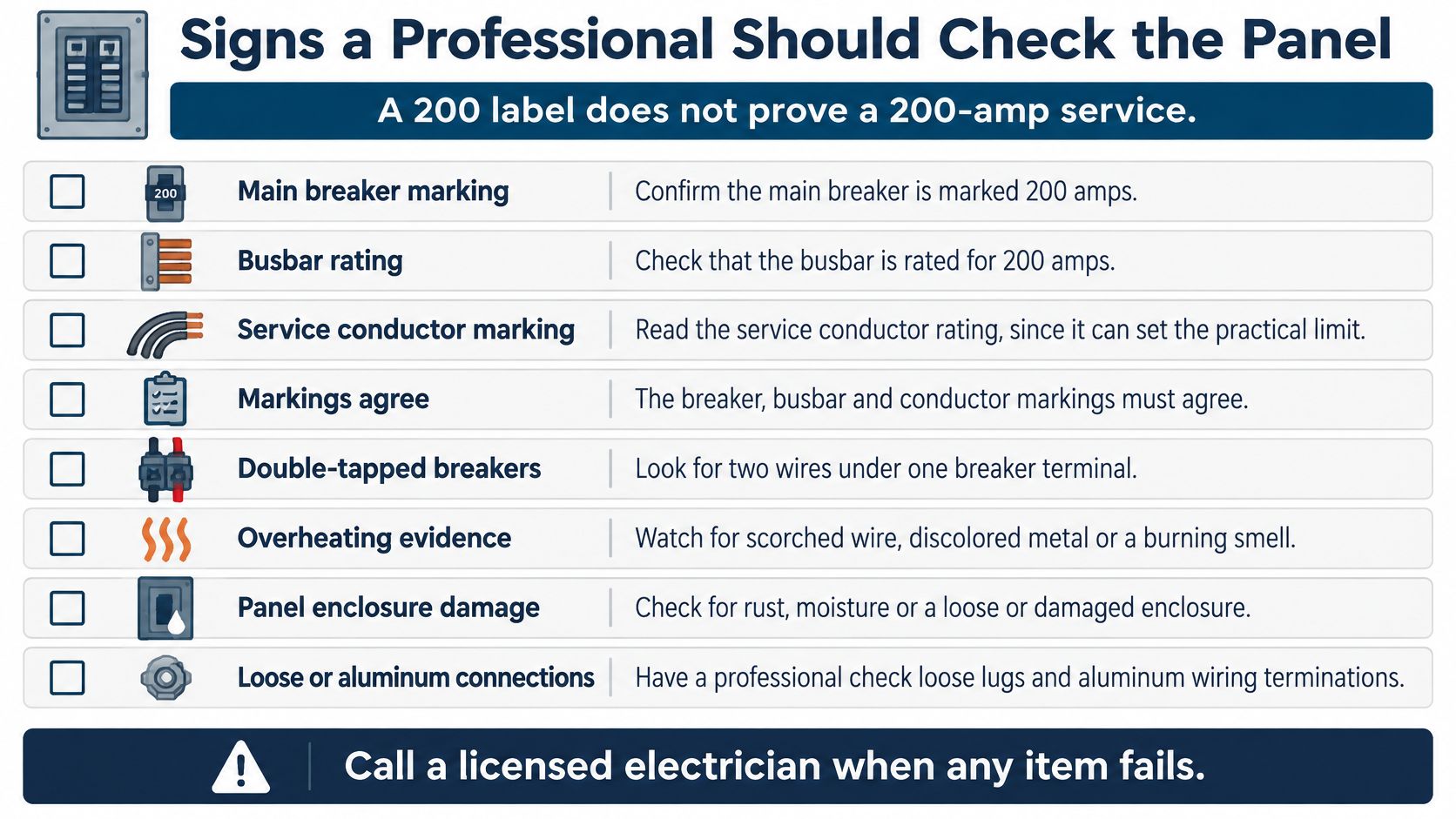
A 200 stamped on the door doesn't prove you have a 200-amp service. The main breaker, the busbar, and the service conductors each have their own rating. When those markings disagree, the conductors set the lower practical limit. You can have a 200-amp breaker in an enclosure fed by cable that was never sized for that current.
What you can record before anyone opens the cover
Stand in front of the dead-front and write down what you can see without removing it:
- Panel nameplate and rating: Note the ampere rating, voltage, phase, and short-circuit rating if they're printed.
- Main breaker size: Read the handle. A 200-amp enclosure with a 150-amp main is a 150-amp disconnect.
- Service conductor marking: If the cable jacket is visible, record the size and material. Don't guess from breaker size.
- Spaces in use: Count full-size breakers and any tandems the labeling allows.
- Permits and inspections: Look for a sticker, a date, or a utility approval that matches the equipment now installed.
- An existing load calculation: If a prior electrician left one, keep it with the photos.
Warning signs belong to a licensed electrician, not a Saturday project. Warm or discolored breakers, a burning smell, buzzing that isn't the ordinary transformer hum, scorch marks, two conductors under one breaker terminal, and a main that trips again after a reset all mean stop adding load. A panel with no visible rating at all is the same category. So is rust, moisture, or a cover that doesn't seat.
For a service request, photograph the nameplate straight on so the rating reads clearly, capture any fault display before anyone resets it, and take one wider shot of the whole installation and its surroundings. That set lets an evaluator see both the label and the context. Heat at a lug that looks only slightly discolored often shows up more clearly with infrared thermography for electrical equipment than with a glance.
This short walk-through shows how a technician reads a residential panel without treating the door label as proof.
<iframe width="100%" style="aspect-ratio: 16 / 9;" src="https://www.youtube.com/embed/HhooOkrxI2Y" frameborder="0" allow="autoplay; encrypted-media" allowfullscreen></iframe>A licensed electrician should confirm the load calculation and any utility requirement before a breaker is added or a conductor is changed. Photos prepare that visit. They don't replace it.
How to Size the Breaker and Wire Safely
Conductor selection for a 200 breaker box follows the installation method, the temperature rating, the adjustment factors, and the governing code. A generic wire chart skips all four. UL's panelboard marking and application guide notes that panelboard construction commonly uses 60°C ampacities for conductors from No. 14 through 1 AWG and 75°C ampacities for 1/0 AWG and larger, and that panel markings identify which sizes and temperature ratings the lugs accept.
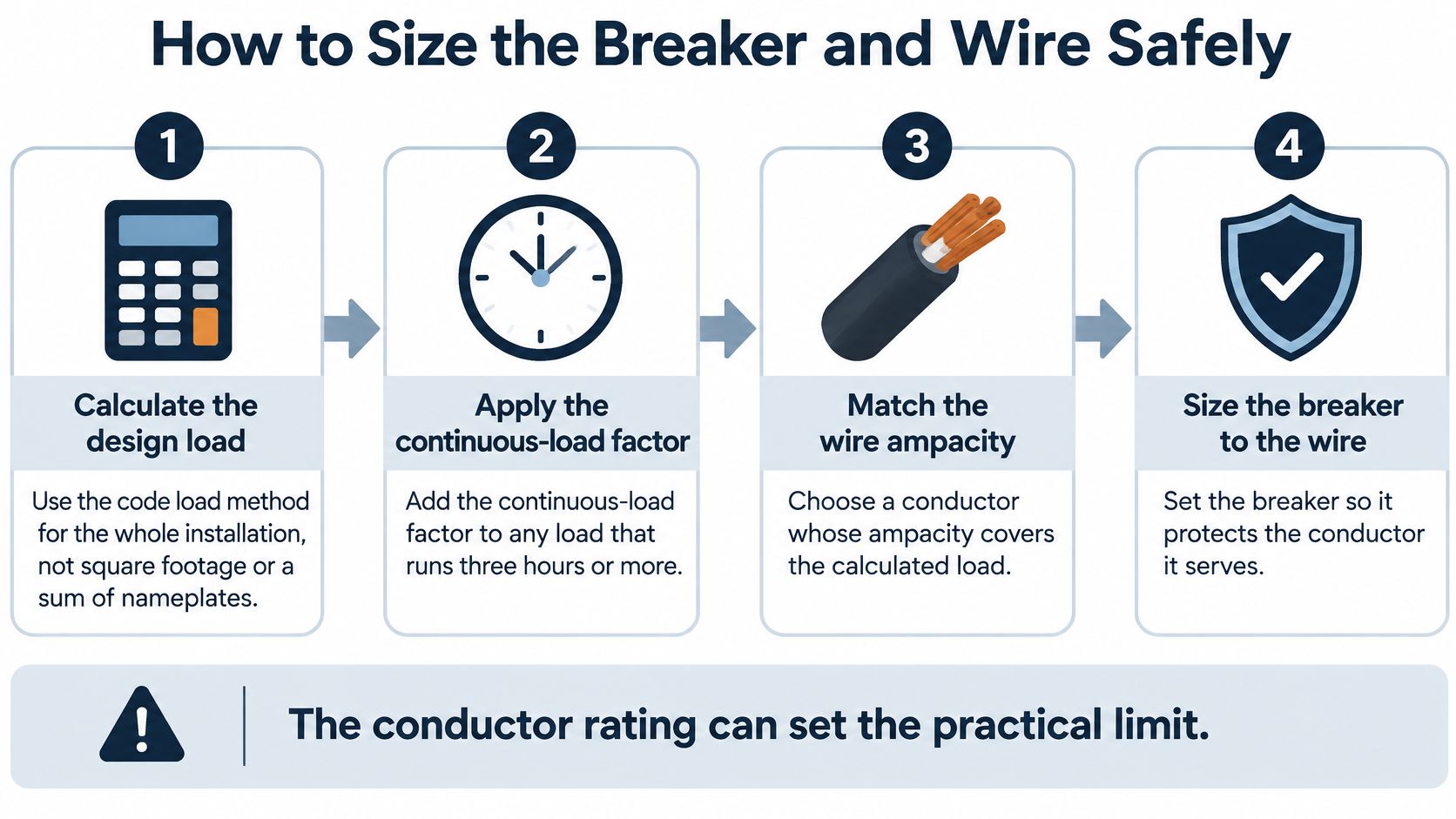
The 200 on the main breaker is a ceiling, not a demand figure. What the panel carries in practice depends on conductors sized to the calculated load, and that calculation starts with the code method, not a cable catalog. For U.S. dwelling services, NEC Table 310.12 lists reduced service-conductor sizes for a 200-amp rating: 2/0 copper or 4/0 aluminum. Don't carry that dwelling rule over to an industrial feeder until you've confirmed the installation is eligible. A nonresidential 200 A feeder may need larger conductors once insulation type, ambient temperature, conduit fill, grouping, voltage drop, continuous load, and termination limits are applied.
The sequence, and the mistake at each step
- Calculate the design load with the code method for the whole installation, not with square footage and not by adding appliance nameplates. The common error is treating every breaker handle as simultaneous demand. How an electrical load center is arranged doesn't change that math.
- Apply the continuous-load factor to anything that can run three hours or more, including an EV charger. NEC 210.19(A) and 215.2(A) call for conductors and overcurrent devices sized at 125 percent of the continuous load. Skipping that factor leaves terminations at their thermal limit for a full shift.
- Choose the conductor by ampacity at the terminal temperature rating. Use 60°C values from No. 14 through 1 AWG unless the equipment is marked otherwise, and 75°C values for 1/0 and larger when the lugs allow it. Picking a 90°C column from a cable table, then landing that conductor on a 75°C lug, overstates the ampacity.
- Derate for ambient temperature, conduit fill, and grouping. A conductor that is fine in open air can be too small in a hot, crowded raceway. People skip this on short industrial runs and then wonder why the insulation discolors.
- Check voltage drop over the actual length. The breaker doesn't see a sag at the far end of a long feeder. Motors and drives do.
- Confirm the lugs accept the material and the size. Aluminum landed in a copper-only lug, or a conductor that doesn't fit the barrel, is a loose connection waiting on heat.
- Match the breaker's interrupting rating to the available fault current. A breaker that is the right ampere size can still be the wrong device if its kA rating is below the fault the utility can deliver.
The breaker protects conductors against overcurrent. It doesn't compensate for undersized wire, excessive voltage drop, poor terminations, or heat built up inside a dirty cabinet. If the conductor is the weak item, the conductor sets the limit, and the breaker has to be chosen to protect that conductor.
Upgrade Only When the Calculated Load Requires It
A 2025 Lawrence Berkeley National Laboratory analysis of roughly 37,000 single-family homes found that the median home with a 100-amp panel used less than 50 percent of its capacity, and that the vast majority didn't exceed 100 amps. Solar PV and EV charging were the main new drivers of panel-capacity concern. Section 1 set up the ceiling-versus-usage distinction. This data shows how wide that gap usually runs.
A 200-amp dwelling service stands on four things: a load calculation that supports the rating, a busbar marked at least 200 amps, service conductors sized to match, and a main breaker that generally sets the service-disconnect rating. When the breaker marking and the service-cable marking disagree, the conductors determine the lower practical service rating. Looking for a "200" on the cover doesn't settle conflicting ratings, missing inspection records, or a utility that hasn't approved the arrangement. Condition, fault rating, neutral and ground configuration, and utility authorization can matter more than the number on the door.
Five ways to stay inside the service you have
Try these before you price a new service, in roughly this order:
- Verify the service conductors before assuming the breaker marking is your ceiling; an undersized cable, not the load, may be the limiting factor.
- Install load management that reduces charger output while another large load is on.
- Use managed electric heating so resistance or heat-pump stages don't all call at once.
- Add a subpanel when the problem is physical space for one large circuit, and the calculation still fits.
- Lower a circuit setting, such as a smaller charger current, when the calculation is only slightly over.
The calculation, not the evening, makes the call. Take a service whose measured peak sits near the low end of a 200-amp rating. Add a 48-amp charger, and because charging runs for hours the demand calculation counts it at 125 percent, or 60 amps. If the recalculated total stays under the service rating, the panel keeps its job, and holding the charger inside that rating is a controls decision, not a new mast and meter. If the total crosses the rating, the number on the door finally becomes a real limit, and the upgrade earns its cost through math instead of marketing.
| Path | When it fits | Next action |
|---|---|---|
| Verify and maintain | Markings agree and calculation fits | Keep the panel and schedule periodic inspection |
| Manage load | Calculation is tight but workable | Apply a charger limit, scheduling, or managed heating |
| Upgrade service | Calculated load exceeds service or conductors are undersized | Plan the upgrade with an electrician and the utility |
Write down three checks before you call: the main-breaker rating, the service-conductor size and material, and whether you have a current load calculation. If any one is missing or the three don't agree, you're not ready to add a large load or to buy a larger panel. Ask a licensed electrician for the calculation, and involve the utility before any service change. Replacing the enclosure alone doesn't upgrade conductors, metering, or the available fault current.
If your facility's next capacity question sits beside aging drives rather than a residential panel, DUCHENG Industrial supports the drive side of that work, from on-site fault recovery and planned maintenance to workshop repair and on-site reconditioning of medium- and high-voltage systems. Bring the equipment details and the panel markings with the request so the scope matches your gear. Visit DUCHENG Industrial to start a service request.