
AC drive vs DC drive compared on efficiency, torque, maintenance and retrofit risk, with a practical selection guide for plant engineers.
“Replace the DC drive with AC” is easy advice to give when you don't own the shutdown. For an existing production line, the harder question is whether conversion removes more risk than it introduces. A healthy DC motor with suitable controls may be a better asset than a rushed AC replacement with unresolved cooling, feedback and braking requirements.
The AC drive vs DC drive decision starts with the load, then the installed equipment, then the maintenance and conversion plan. Purchase price comes after those checks, not before them.
Table of Contents
- AC Drive vs DC Drive at a Glance
- Energy Use and Efficiency in Real Plants
- Torque, Speed Range and Regeneration by Load Type
- Maintenance Demands of Each Drive Type
- Retrofit, Refurbish or Replace by Situation
- Confirm Your Drive Choice Before You Order
AC Drive vs DC Drive at a Glance
For most new industrial installations, an AC drive is the default. Keeping a DC drive makes sense when the existing motor is serviceable and its operating characteristics suit the process, particularly across demanding low-speed duties.
Treat the following comparison as general tendencies, not guaranteed performance. A properly engineered vector-controlled AC system can narrow the traditional low-speed gap considerably.
AC and DC drive differences at a glance
| Criterion | AC drive | DC drive |
|---|---|---|
| Motor design | Squirrel-cage induction or brushless synchronous motor | Conventional DC motor with brushes and commutator |
| Speed control | Variable frequency and voltage regulated electronically | Armature voltage and field excitation regulated by a converter |
| Low-speed torque | Achievable with vector control and a properly engineered drive | Strong and direct, a traditional DC strength |
| Regeneration | Active front end returns energy; a braking resistor dissipates it instead | Four-quadrant operation feasible with a suitable converter |
| Typical role today | Default for new installations and many retrofits | Retained in legacy lines and specific heavy-duty or wide-range applications |
The drive is only part of this comparison. Replacing a converter while retaining a motor is a different engineering project from replacing the motor, converter, feedback and mechanical interfaces together.
How the technology changed
The IEEE overview of DC motors traces practical DC designs to the 1830s, their variable-speed dominance for more than a century, static-converter development in the 1930s, and the decisive semiconductor-enabled AC transition during the 1960s and 1970s. Early DC systems made speed and torque control practical without the complex electronic conversion that AC motors would later require.
Mercury-arc static converters replaced rotating motor-generator equipment in selected installations. They improved conversion performance but were expensive, so adoption wasn't universal. Semiconductor power electronics eventually made comparable AC control practical for induction motors in steel mills, hoists, conveyors and process lines.
That history explains the installed base. A legacy DC package isn't necessarily an engineering mistake waiting to be corrected. It may be a well-matched system whose maintenance burden, supportability or remaining life has changed.
Compare complete systems
An AC proposal should identify the motor and control method, not just the drive family. Likewise, a DC proposal should establish whether the existing motor, field supply and feedback remain suitable.
Decision rule: Choose the system that meets the duty with the lowest manageable lifecycle risk, not the technology with the newest label.
For maintenance managers, that means separating several questions. Can the process benefit from reduced speed? Can the proposed package sustain its torque duty? Can the team maintain it, and can the plant recover if it fails? Those answers matter more than a broad claim that one motor technology is always better.
Energy Use and Efficiency in Real Plants
Reducing speed saves the most energy when the load itself requires much less power at lower speed. The U.S. Department of Energy's variable-frequency-drive measurement guide explains that, under ideal affinity-law conditions, a centrifugal pump or fan at 75% speed requires about 42% of full-load power, or approximately 49% including losses.
That isn't a universal motor rule. It describes suitable variable-torque applications, not a loaded conveyor or a process that must maintain substantial torque regardless of speed.
Replace restriction with useful speed control
A fan controlled by a damper still spends energy moving air against a restriction. A pump controlled by throttling or bypass may similarly consume power that doesn't contribute usefully to production. Speed control can reduce that waste when the process permits lower flow.
Before approving savings, establish the actual operating profile:
- Demand profile: Log flow, pressure and process demand alongside electrical input.
- Existing control: Identify throttling, damping, bypass and unnecessary full-speed operation.
- Minimum operating point: Check static head, minimum flow, cooling and process stability.
- Comparable output: Compare energy at equivalent production conditions, not before and after a shutdown.
A constant-load application offers a different result. The converter adds losses, so installing a VFD doesn't automatically improve overall efficiency. Oversizing also deserves scrutiny because lightly loaded operation can weaken the expected return.
Typical efficiency values in AC drive systems
| Element or case | Typical value | What it means for the decision |
|---|---|---|
| Frequency converter (VFD) | High conversion efficiency at its intended loading | The speed-control saving must outweigh converter losses |
| Industrial AC motor | Set by motor size, rated speed and operating point | Use the proposed motor's efficiency curve |
| Complete AC drive system | Combined converter and motor efficiency | Compare system input with useful shaft output |
| Pump or fan at reduced speed | Substantially reduced demand under suitable affinity-law conditions | Replacing throttling can produce meaningful savings |
| Drive operating at very low output | Reduced conversion efficiency | Check prolonged light-load operation rather than assuming nameplate efficiency |
Measure the existing DC baseline
These are AC-system considerations, not evidence that every AC package uses less electricity than every DC package. Measure the existing converter and motor together, including auxiliaries, then compare them with the proposed installation under matching duty.
Include transformer losses, harmonic mitigation, cabinet cooling and braking operation in the assessment. A favorable motor efficiency figure can conceal a less favorable complete installation.
Use a documented variable-speed-drive energy savings assessment to establish the baseline and verification method. Commission against that baseline, then repeat measurements after operating conditions or control settings change.
Torque, Speed Range and Regeneration by Load Type
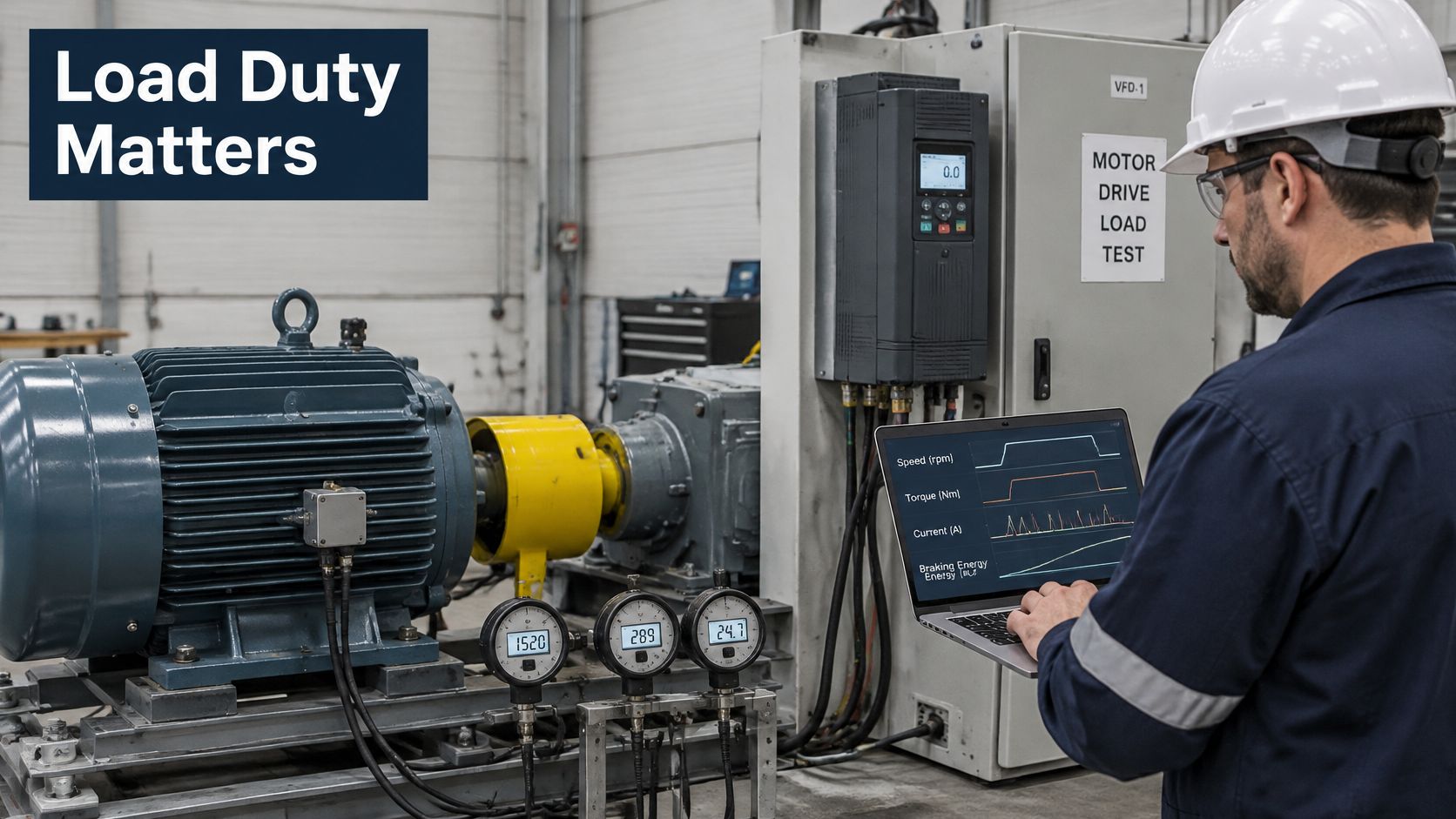
Start with a duty record, not a horsepower match. A drive that accelerates an unloaded machine successfully may still fail when the process demands sustained torque at crawl speed or repeated braking.
Capture speed reference, actual speed, current and process load together. The relationship between them tells the engineer more than an isolated peak-current reading.
What must the motor actually deliver?
How much starting torque is required, and for how long? Distinguish breakaway torque from acceleration torque and continuous running torque. A brief peak rating doesn't establish that the drive can sustain a difficult start.
How slowly must the machine run under load? Modern vector control can provide torque performance comparable to many legacy DC systems, but motor cooling and feedback still need engineering. Don't assume a shaft-mounted fan provides sufficient cooling during prolonged low-speed operation.
How much inertia must be accelerated and stopped? Record acceleration time, deceleration time, reversal frequency and overload duration. Include the driven machine, gearbox and product load rather than considering the motor alone.
What accuracy and electrical constraints apply? Establish feedback requirements, acceptable speed deviation, supply conditions and harmonic limits. Sensorless control shouldn't be accepted by default where the process requires dependable operation close to standstill.
Where does braking energy go?
A regenerative active-front-end AC drive can return energy to the supply. A conventional diode-front-end VFD generally cannot, so braking energy needs a resistor or another suitable dissipation arrangement. A braking resistor provides braking, not energy recovery.
A serviceable DC system remains attractive for frequent motoring and regenerative braking in either direction. However, retaining DC still requires confirmation that the converter supports the required operating quadrants.
A published paper-machine retrofit comparison reports approximately 98% power factor for a diode-rectifier PWM AC drive versus about 90% for a DC drive at rated speed, with DC power factor declining at lower speed, but finds no significant intrinsic efficiency difference between the systems. Power factor isn't the same measurement as energy-conversion efficiency, and that application comparison isn't a universal guarantee.
Specify the stopping duty as carefully as the running duty. An undersized braking arrangement can make an otherwise suitable drive package unusable.
Match the application to its dominant requirement:
- Steel mills: Evaluate overloads, coordinated line control and reversal duty before disturbing an established DC installation.
- Hoists and cranes: Prioritize controlled lowering, regeneration, feedback and independent mechanical-brake coordination.
- Conveyors: Check loaded restart torque and acceleration against belt and gearbox limits.
- Test stands: Establish bidirectional torque control and repeated regenerative duty.
- Centrifugal pumps and fans: Favor AC speed control when process demand permits meaningful speed reduction.
Maintenance Demands of Each Drive Type
AC means less mechanical commutation maintenance, not no maintenance. Removing brushes doesn't remove cabinet heat, contamination, loose connections or aging electronic components.
The ABB technical guide to variable-speed drives gives typical converter efficiency of 97–99%, motor efficiency of 82–97%, and complete-system efficiency generally above 80%. Efficient equipment still produces heat that the cooling system must remove reliably.
Separate motor work from converter work
A squirrel-cage AC motor removes brush inspection, brush replacement, commutator resurfacing and carbon-dust management. A conventional DC motor retains those tasks, so maintenance records should include brush condition, uneven wear, commutator condition and signs of abnormal sparking.
Both systems still need attention to bearings, cooling, connections and insulation. Converter maintenance adds fan condition, heat-sink cleanliness, capacitor condition and thermal checks.
Repeated trips may originate in cabinet conditions rather than the motor. Record drive faults separately from motor repairs, including load state, cabinet temperature, cooling condition and what changed before the fault appeared. Otherwise, a recurring overtemperature trip can become a misleading history of supposedly unreliable electronics.
At Hangzhou Iron & Steel, repeated failures in a group of ABB drives aged 7–12 years decreased from 2–3 times per month to about once every six months after a two-month maintenance contract. That is a specific maintenance outcome, not a promised result for every installation.
Start with a schedule, then adjust it
The following is a practical starting schedule, not a substitute for manufacturer instructions or site risk assessment:
- Monthly: Inspect ventilation paths, filters, dust accumulation and cooling-fan operation; shorten the interval where contamination builds rapidly.
- Quarterly: Review capacitor condition and electrical connections using approved inspection methods; perform intrusive work only under safe isolation.
- Yearly: Back up parameters, review fault trends and perform suitable motor and cable insulation tests with the drive disconnected as required.
Don't apply an insulation tester through connected power electronics. Follow the equipment instructions for isolation, discharge verification, test voltage and reconnection.
Use the variable-frequency-drive maintenance guide to turn these tasks into an asset-specific job plan. Steel dust, tire-plant carbon black and chemical contamination require different cleaning and inspection decisions. Set intervals from condition records and operating duty, not from an unchanged calendar template.
Retrofit, Refurbish or Replace by Situation
Choose the intervention that keeps production risk lowest over the asset's remaining service life. A newer AC system can still be the wrong choice if conversion work, commissioning risk or the outage required outweighs the benefit.
Assess the motor's condition, failure history, duty, speed range, regeneration needs, available support and production criticality together. The Control Design guide to choosing AC or DC drives describes this installation-led approach, including retaining a serviceable motor while renewing its controls.
Conversion includes more than a motor and drive
An AC conversion may require a different motor frame, shaft arrangement, coupling or mounting adaptation. Check alignment access and confirm the replacement motor will preserve maintenance clearance.
Cooling requirements may change. Feedback signals, encoder supply, signal interfaces and control-system scaling may also need revision. Review existing cables for insulation suitability, routing and compatibility with the proposed converter output.
The electrical scope can include harmonic mitigation, braking hardware, protection coordination and cabinet ventilation. Commissioning must verify rotation, feedback polarity, limits, interlocks, stopping behavior and process response.
Price this work explicitly. The drive purchase is only one cost among outage hours, engineering, spare stock, operator training and recovery from an unsuccessful restart.
Retrofit path by installation situation
| Situation | Likely path | Why |
|---|---|---|
| Serviceable DC motor and wide low-speed range needed | Keep the DC motor and upgrade controls | Preserves proven operating behavior and avoids immediate frame and cooling changes |
| Variable-torque pump or fan with long run hours | Convert to AC drive after validating the operating profile | Can reduce reliance on restrictive flow control |
| Recurring brush or commutator failures, motor otherwise sound | Refurbish now, then plan conversion | Provides a controlled bridge if the root cause is repairable |
| Aging drive electronics, motor healthy | Replace or upgrade the drive and feedback | Retains useful motor life while addressing control-system risk |
| Heavy MV drive that is difficult to ship | Recondition on site in a planned shutdown | Avoids transport risk and extended removal and reinstallation work |
Refurbishment only makes sense when the asset remains suitable for the duty. If the commutator is beyond economical recovery, insulation condition is unacceptable or replacement parts cannot support production needs, continued repair may not be a credible path.
Healthy equipment can also be replaced too soon. Drive-only renewal, feedback replacement and staged conversion can preserve useful service life while addressing the specific risk.
Establish the sequence before committing the outage
For an aging drive system, DUCHENG first assesses which parts can be maintained and refurbished before recommending whole-unit replacement. That can provide a maintainable interim option where appropriate, rather than forcing an emergency technology change.
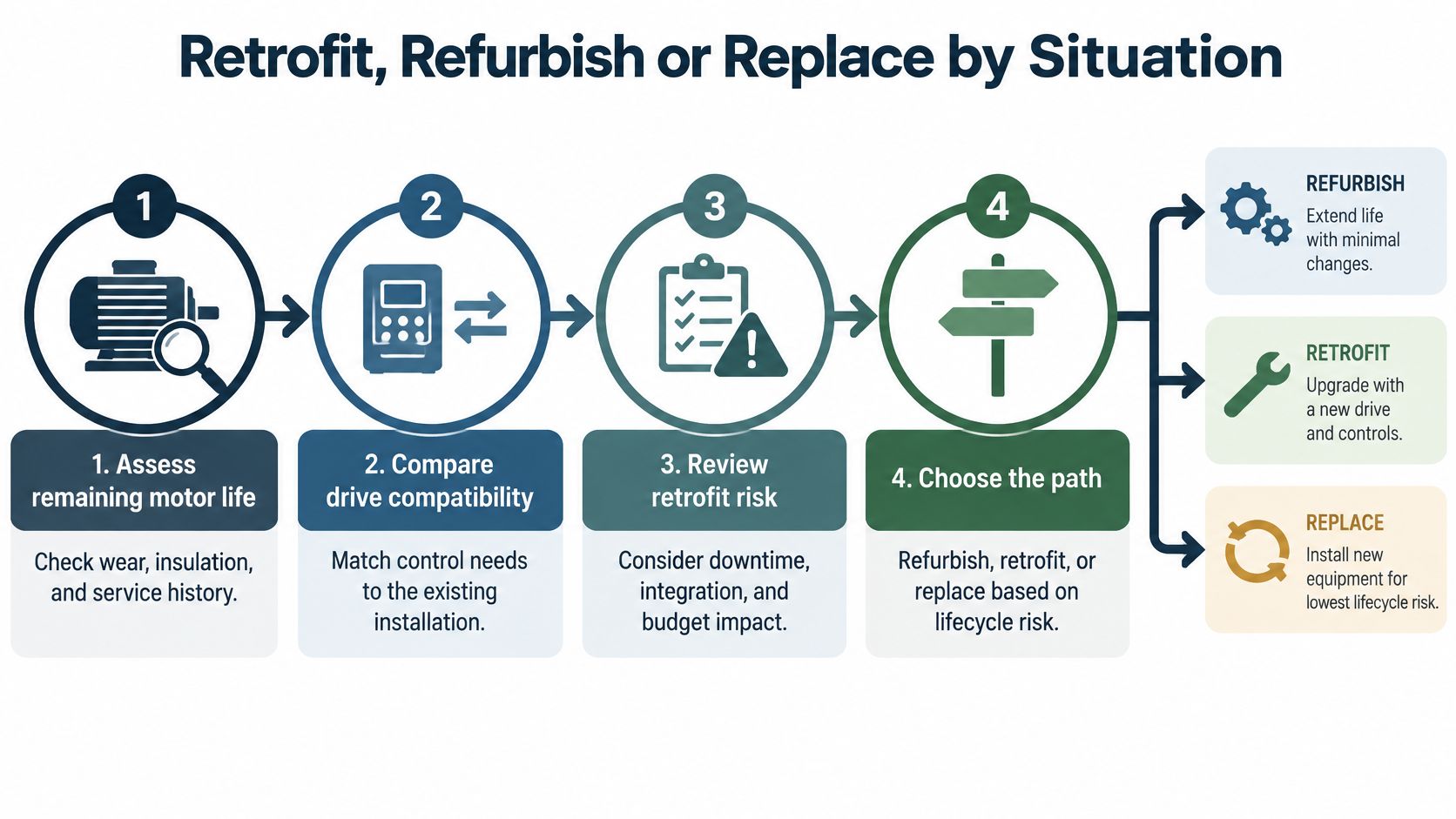
DUCHENG's on-site reconditioning service is intended for aging medium- and high-voltage drives that are difficult to ship. The work is carried out within a planned shutdown. DUCHENG Industrial (Thailand) Co., Ltd. reconditioned medium-voltage drives with nearly ten years of service fully on site at a tire manufacturer in Rayong, Thailand.
A planned shutdown needs an acceptance test, not just an installation completion date.
Agree who approves restart, which operating conditions must be demonstrated and what records maintenance receives. Where practical, preserve previous parameters, drawings and recoverable equipment until the replacement passes its agreed tests.
Confirm Your Drive Choice Before You Order
Before releasing a purchase order, turn the selected drive into a complete, reviewable specification. Use the duty analysis and retrofit assessment above as the basis; the remaining task is to make the selection measurable and confirm how it will be accepted.
- Confirm the sizing basis: Check that the selected drive rating and configuration match the confirmed motor and application requirements. Document any assumptions that still need engineering approval.
- Approve the specification: Record the selected equipment, required interfaces and acceptance criteria in the procurement documents. Make unresolved items explicit before ordering.
- Submit a diagnosis request if the existing drive has a fault: Include its brand, exact model code, rated power and voltage, fault code exactly as displayed, when the fault occurs, operating environment and a nameplate photo. An engineer reviews each service request.
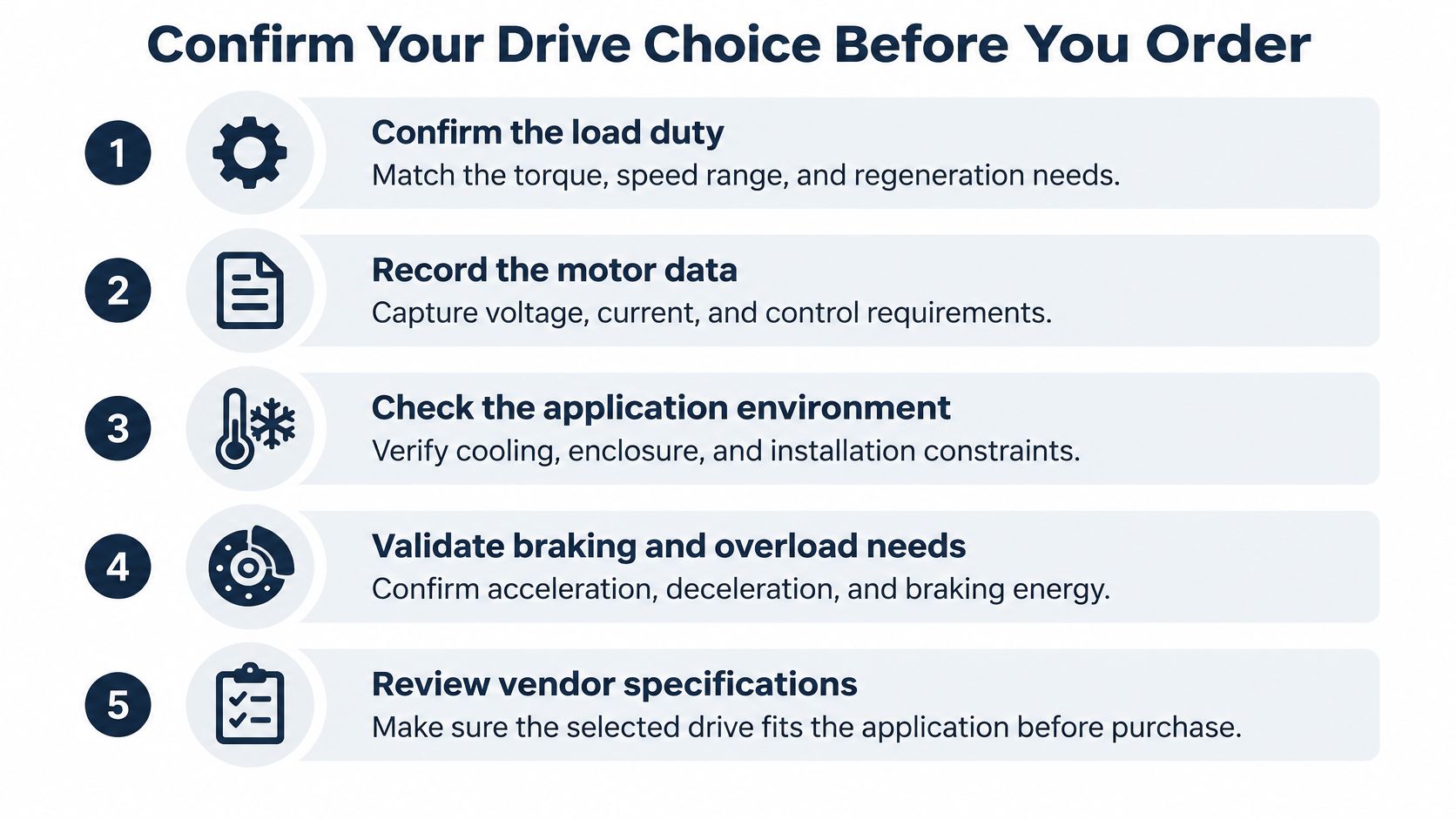
VFD Master supports engineering pre-selection for low-, medium- and high-voltage projects, with real-time sizing, a copyable summary and print/PDF export. Use the results to document a candidate selection, then confirm the specification against the actual installation before ordering.
Choose the provisional path, keep, refurbish or convert, and arrange an engineering review before shutdown planning begins.
DUCHENG Industrial provides multi-brand drive commissioning, preventive maintenance, troubleshooting, workshop repair and on-site reconditioning, with upgrade assessments that check what can be renewed before whole-unit replacement. Visit DUCHENG Industrial with your drive details and fault history to arrange an engineering review before committing to an AC conversion or another DC refurbishment.