
Learn what a dual function breaker does, where it fits in plant electrics, and how to choose, test, and install one for safety and code compliance.
You get the call an hour into second shift. A junction box smells hot, a receptacle circuit keeps dropping out, and someone mentions a tingle at a washdown station. The standard breaker never tripped, and now you're deciding whether you're looking at one fault or two different hazards on the same branch circuit.
Table of Contents
- Why Plant Teams Are Paying Attention to Dual Function Breakers
- How a Dual Function Breaker Protects Two Different Hazards
- How GFCI and AFCI Standards Evolved into One Device
- Dual Function Breaker Versus Separate GFCI and AFCI Devices
- Matching the Right Protection to Each Plant Location
- Installation, Testing, and Preventive Maintenance Habits
- Common Misconceptions That Lead to Misdiagnosis
- Putting It Together on the Plant Floor
Why Plant Teams Are Paying Attention to Dual Function Breakers
A supervisor walks the line after that call and finds a familiar pattern. Inside a junction box, an aged conductor has been arcing against a loose terminal. The insulation is darkened, but the load current never rose enough for a conventional breaker to react quickly. Down the same wall, a wet station gives a worker a tingle when a hand touches a metal frame.
Neither event looks dramatic on an ammeter. That's the problem. A conventional thermal-magnetic breaker watches mainly for overload and short circuit. It isn't designed to recognize a low energy arc that's heating insulation, and it isn't designed to spot a small amount of current leaving the intended path and returning through ground, water, equipment, or a person.
One Near-Miss, Two Different Failure Paths
Treat those as separate stories that happen to share a circuit. The arcing conductor is a fire risk hiding inside the wiring system. The tingle is a shock risk at the point where people touch equipment. A crew can fix the loose terminal and still miss the leakage path, or dry the station and still leave damaged insulation energized.
A Dual Function Breaker matters here because it puts both watch functions in one panel mounted device. It retains overload and short circuit protection, and it adds electronics that look for hazardous arcing and for ground leakage. For a maintenance supervisor, that changes the conversation from, did the breaker hold, to, what kind of trip did we get and what should the crew inspect first.
A trip isn't just an interruption. It's diagnostic information, if your team records which protection operated and what the circuit was doing at the time.
That's why plant teams shouldn't file this device under residential convenience. In offices inside a plant, welfare areas, labs, break rooms, and light branch circuits, you've got aging cords, portable tools, moisture, and people working close to receptacles. You've also got limited panel space and a need for clear reset and test records. One device that can address both hazards, when the circuit is suitable, gives you a cleaner panel and a simpler maintenance decision.
The catch is suitability. Noisy loads, shared neutrals, and circuits fed through power electronics can complicate selection. You need to understand what each channel senses before you trust it with a real plant load.
How a Dual Function Breaker Protects Two Different Hazards
Think of current like water in a closed loop of pipe. What leaves the panel on the hot conductor should come back on the neutral. The GFCI channel is constantly comparing outgoing and returning current. If some current finds another route to ground, the loop doesn't balance.
The AFCI channel watches a different problem. It isn't counting missing water. It's listening for the sputter in the flow. A loose connection or damaged conductor can arc in a series path, or conductors can arc to each other in a parallel fault. Those arcs create messy, high frequency current signatures that a normal load shouldn't produce in the same pattern.
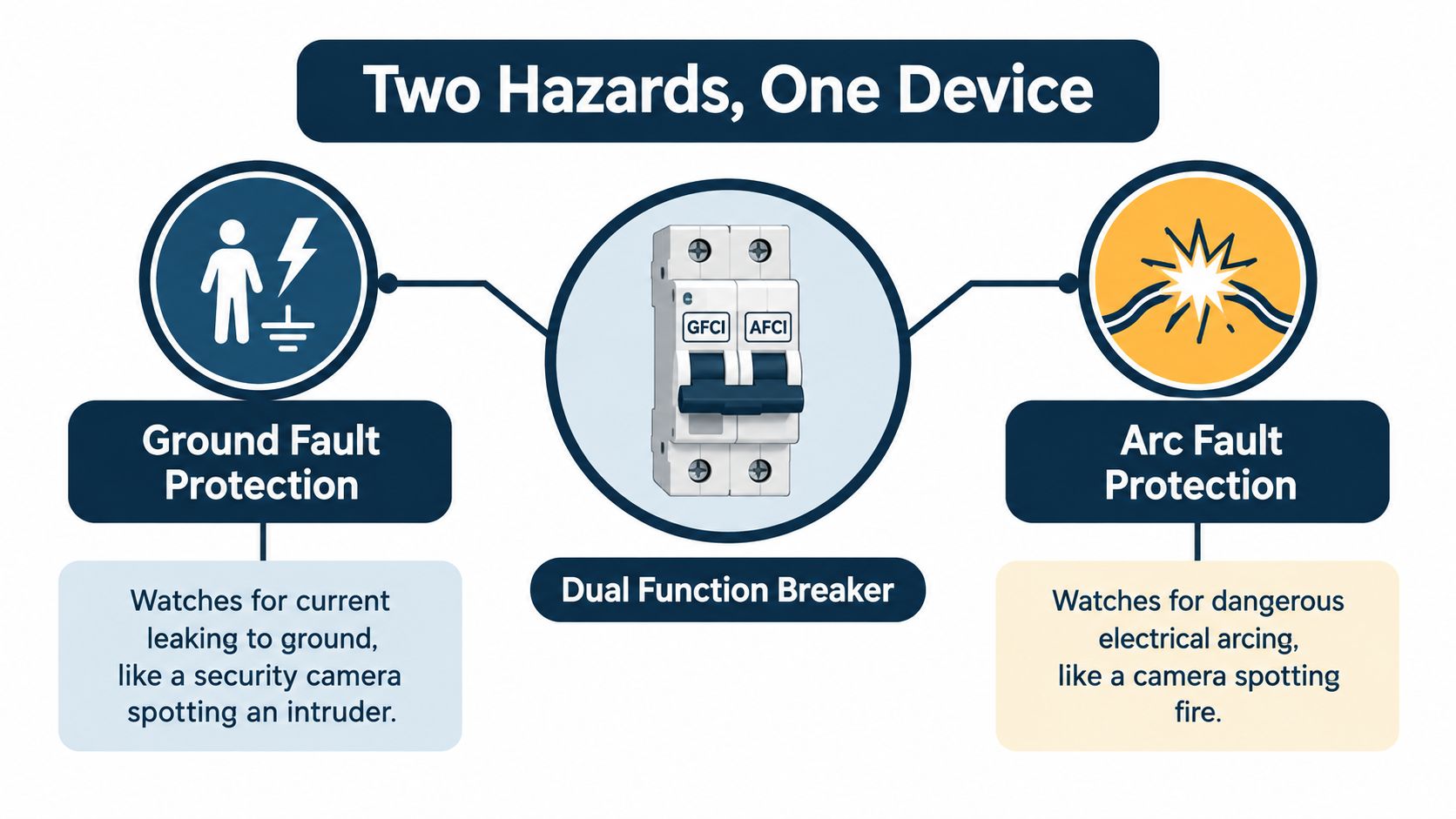
What Each Channel Actually Trips On
For personnel protection, the CPSC describes a typical 6 mA ground current threshold and an AFCI requirement to trip when eight half cycles of arcing occur within a 0.5 second window in its technical description of combination AFCI and GFCI protection. You don't need to memorize the waveform math to use the device well. You do need to remember the boundary. Ground fault means current is leaking out of the loop. Arc fault means current is behaving like it's jumping a gap.
- Ground fault trip: Look first for moisture, damaged portable equipment, a conductor touching a grounded enclosure, or a neutral problem that's creating imbalance.
- Arc fault trip: Look first for loose terminals, pinched cords, cracked insulation, and connections that heat under load.
- Overload or short circuit trip: Look first for excessive load, a direct fault, or a failed connected device.
A standard breaker can miss the first two because neither fault must draw high current. An arc can sit below the magnetic trip level while it cooks insulation. Leakage through a person can be dangerous long before it looks like an overload. That's the gap a Dual Function Breaker fills, and it's why crews who manage mixed office and process support circuits also study how combination arc fault protection differs from simple overcurrent protection.
Treat the enclosure as two diagnostic systems sharing one handle. If your team resets first and asks questions later, you'll lose the best clue the device gives you.
How GFCI and AFCI Standards Evolved into One Device
These two protections didn't start together. They followed different hazards into the code, decades apart, and that history explains why older panels often have one protection but not the other.
GFCI protection entered the U.S. National Electrical Code in 1968, initially for underwater swimming pool lighting, and later expanded to other wet or conductive locations, according to CPSC meeting material on AFCI and GFCI history. The logic was direct. Water, conductive surfaces, and people in close contact with equipment create a shock path that overcurrent protection can't see.
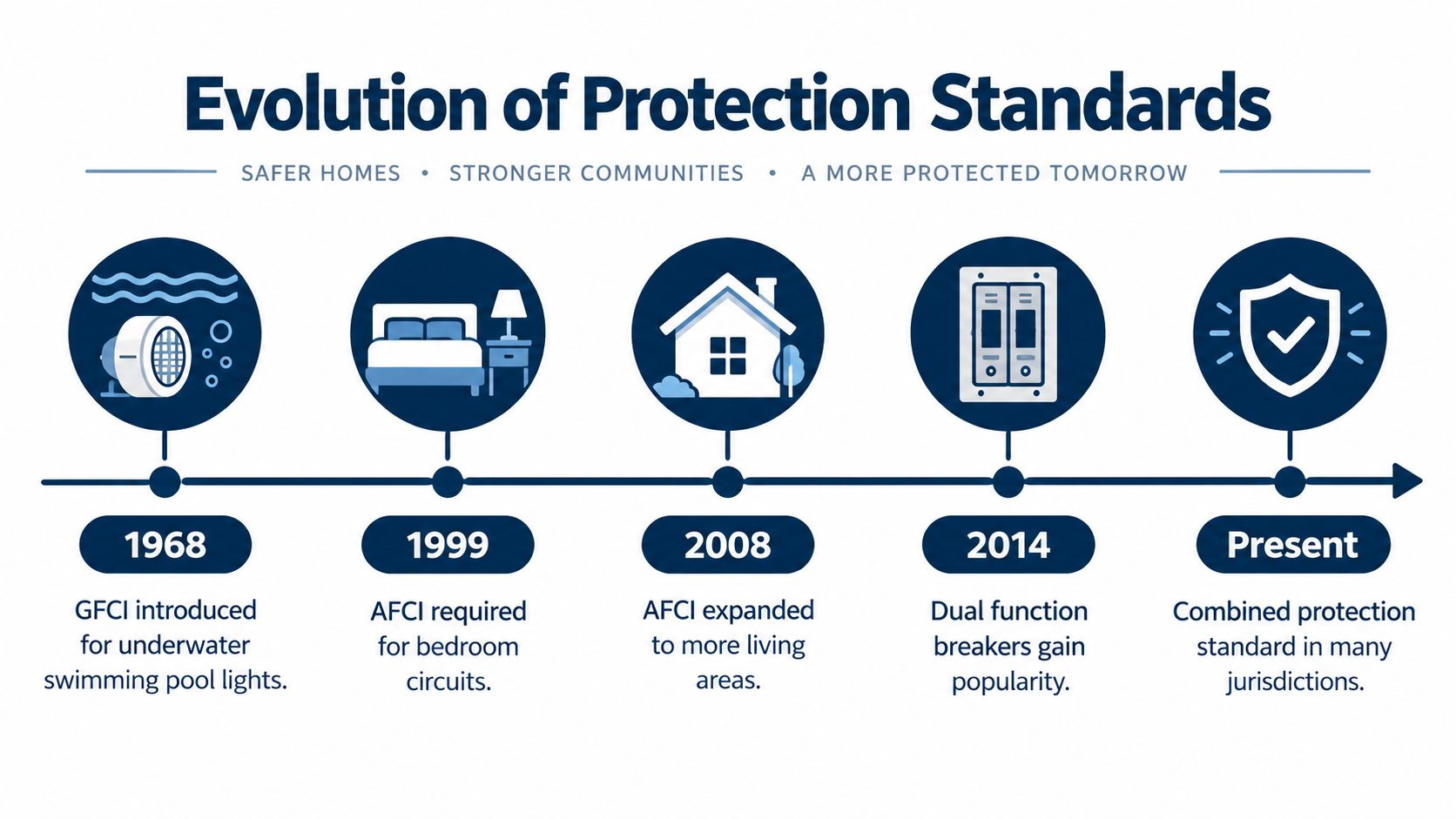
The Slower Path for Arc Fault Protection
Arcing was harder to define in a testable way. A normal motor, dimmer, or switching supply also distorts current, so a sensor that trips on every irregularity would be unusable. A NEMA working group with UL participation completed a draft AFCI standard in December 1996. Products were commercially available by January 1997.
The 1999 NEC became the first edition to require AFCIs, initially for dwelling unit bedroom branch circuits, effective January 1, 2002. Later editions expanded coverage to living areas in 2008 and to kitchens and laundry areas in 2014. As those areas overlapped with places that already needed GFCI protection, panel design got awkward. You could coordinate separate devices, or you could use one breaker built to satisfy both objectives where applicable.
For plant supervisors, the residential timeline still matters because many non process spaces inside industrial buildings behave like those listed areas. Break rooms, crew welfare rooms, offices, and laundry or kitchenette spaces combine receptacles, water, portable appliances, and aging branch wiring. The code history pushed protection into exactly those mixed risk locations.
Practical rule: Don't ask only whether a circuit is old or new. Ask whether its location combines shock exposure, cord damage, and hidden wiring. That's where the combined device earns its panel space.
Combined protection didn't appear because one hazard replaced the other. It appeared because real rooms started requiring both at once.
Dual Function Breaker Versus Separate GFCI and AFCI Devices
You can protect a suitable branch circuit with one Dual Function Breaker, or you can coordinate separate arc fault and ground fault devices. Both approaches can work. The right choice depends on panel condition, what's already installed downstream, and how clearly your crew needs to troubleshoot at 2 a.m.
One combined breaker gives you one handle, one test point at the panel, and one device record. That's tidy for a new circuit or a panel rebuild. Separate protection can be smarter when compliant GFCI protection already exists at the first receptacle and you only need to add arc fault protection, or when only one hazard drives the requirement for that location.
Side by Side for Maintenance Decisions
| Criterion | Dual Function Breaker | Separate GFCI + AFCI |
|---|---|---|
| Panel space | One breaker position for both panel level functions | May need a breaker plus a downstream receptacle device |
| Troubleshooting | One location, but crews must identify which channel tripped | Fault location can be clearer when devices are physically separate |
| Reset routine | One handle and one test procedure to train | Reset may happen at the panel, at a receptacle, or both |
| Retrofit fit | Cleanest when you're already replacing the breaker | Better when existing downstream protection is sound and documented |
| Circuit needs only one function | Adds a function you may not need | Lets you match protection to the actual hazard |
| Records | One asset entry, install date, and test log | Multiple devices to track on the same circuit |
Nuisance tripping doesn't automatically favor either option. A shared neutral, leakage from connected equipment, or electrical noise can trouble separate devices too. What changes is coordination. With separate devices, a GFCI receptacle may trip while the AFCI breaker holds, which points the crew downstream. With a combined breaker, you're relying on the manufacturer's trip indication and your isolation steps to separate leakage from arcing.
Cost per circuit shouldn't be judged on the breaker shelf price alone. Count panel labor, receptacle work, downtime for testing, spare stocking, and the time a supervisor spends explaining two reset locations to different shifts. In a crowded retrofit panel, preserving a spare space may matter more than device price. In a simple existing installation, replacing everything for neatness can waste a shutdown window.
Choose the combined device when both protections are needed on the same branch circuit and the wiring method suits it. Choose separate devices when the circuit needs only one function, when existing downstream protection is already correct, or when physical separation makes fault finding materially faster for your team.
Matching the Right Protection to Each Plant Location
Start with people, water, and wiring condition, not with the breaker catalog. Walk the area and ask three plain questions. Can a person become the path to ground here. Can cords or branch wiring get damaged, pinched, wet, heated, or loosened over time. Does the load produce electrical noise that could confuse sensing electronics.
Wet process support areas, outdoor receptacles, break room sinks, wash stations, and maintenance bays put personnel protection first. Current doesn't need to be large to hurt someone when skin is wet and contact is solid. That's the zone where the ground fault channel earns priority, and where crews should be strict about damaged extension cords and portable tools.

Where Arcing Risk Deserves Equal Weight
Lighting and receptacle circuits in plant offices, control room support spaces, dormitory or crew welfare areas, and older administrative wings often hide a different pattern. Furniture pushes against cords. Space heaters and chargers cycle receptacles. Connections loosen after years of thermal movement. Nobody sees the early arc because it's behind a desk, above a ceiling, or inside a box.
Use a simple mapping before you order hardware.
- Wet location, low cord damage risk: Prioritize personnel ground fault protection and inspect receptacles and enclosures often.
- Dry location, aging flexible cords: Prioritize arc fault protection and a cord inspection routine crews follow.
- Kitchenette, laundry, welfare area: Evaluate a Dual Function Breaker because water, appliances, and branch wiring risks overlap.
- Noisy or drive influenced circuit: Stop and evaluate load compatibility before selecting any electronic breaker.
That last category catches plant teams out. A VFD supplied circuit and other switching power electronics can create high frequency noise and leakage behavior that everyday branch loads don't. Don't assume a breaker intended for ordinary branch circuits belongs directly in that environment without checking the drive manufacturer's guidance, grounding arrangement, filtering, and the breaker's stated compatibility. In many plants, the cleaner answer is to keep drive power circuits under the protection scheme designed for the drive system, and use dual function protection on suitable receptacle and lighting branch circuits nearby.
Don't let a protection upgrade create a new troubleshooting problem. If the load signature is unusual, prove compatibility on paper before the panel cover comes off.
Also check the circuit topology. A multiwire branch circuit with a shared neutral needs a device arrangement designed for that wiring. Putting a single pole electronic breaker on it and hoping for the best usually ends with repeated trips and a crew that stops trusting the protection.
Installation, Testing, and Preventive Maintenance Habits
Good installation is mostly unglamorous discipline. De-energize and verify, confirm the breaker matches the panel and circuit rating, and identify the correct hot and neutral conductors before you land anything. Route the load neutral through the breaker where the design requires it, land the neutral pigtail on the panel neutral bar if it's that style, and torque line and load terminals to the manufacturer's specification.
Neutral mistakes cause a large share of confusing start ups. A shared or misrouted neutral can create apparent imbalance and repeated ground fault trips, a risk described alongside conductor routing and load compatibility checks in CPSC technical material on AFCI fire technology. The same material supports monthly testing of AFCI and GFCI functions according to manufacturer instructions, so build that test into the job plan instead of treating it as optional paperwork.
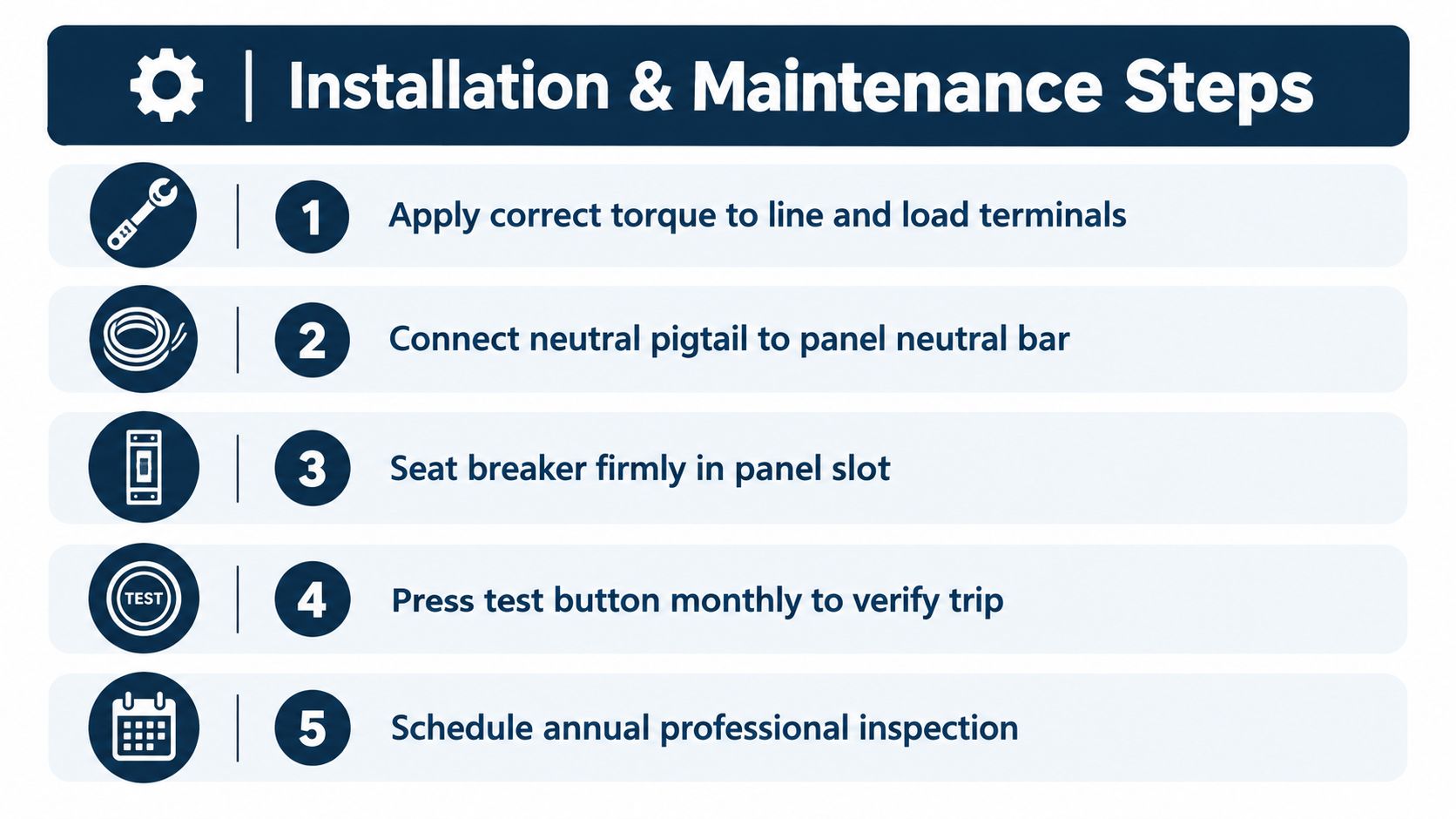
A Test Routine Supervisors Can Audit
- Seat and inspect: Confirm the breaker is fully seated, conductors aren't nicked, and no stray strands sit outside the terminal.
- Energize with loads controlled: Start with downstream loads disconnected or switched off, then add them in groups so a problem load reveals itself.
- Use the built in test button: Follow the manufacturer's sequence and confirm the handle moves to the trip indication.
- Reset deliberately: Move the handle fully off, then on, according to the device instructions. A half hearted reset creates false failure calls.
- Record the result: Log date, circuit, tester name, pass or fail, and any load that was connected during a trip.
That rhythm fits naturally beside wider panel and drive routines, including the inspection discipline in a structured motor control center maintenance program. The point isn't bureaucracy. After an incident, a dated pass, a recorded trip cause, and a replacement record show whether protection was verified or merely assumed.
If a breaker fails its built in test, do not keep resetting it. Remove it from service through your qualified electrical process and replace it. Protection electronics can fail, and monthly functional tests are how you catch that failure before a person or a fire tests the device for real.
Common Misconceptions That Lead to Misdiagnosis
The most expensive misconception is treating every milliamp number as the same kind of protection. An AFCI device may include ground fault sensing around a commonly cited 30 mA level for equipment or pre arcing detection, while Class A GFCI personnel protection responds at approximately 4 to 6 mA, a distinction explained in manufacturer guidance on dual function test and protection behavior. Those levels aren't interchangeable, and the higher sensing level doesn't substitute for personnel protection.
That one misunderstanding drives bad purchases. A supervisor sees ground fault mentioned on an arc fault device and assumes shock protection is covered. It may not be. Read the device marking for the actual functions, and specify Dual Function Breaker in plain words when you need both AFCI and personnel level GFCI performance in one breaker.
Testers, Shared Neutrals, and Repeated Trips
The second trap is tester confidence. The built in button is the valid field test for the breaker's protective electronics. A handheld tester that fails to trip an AFCI doesn't necessarily prove the breaker is defective, because plug in testers can't always reproduce the waveform and conditions the breaker is designed to evaluate. Use handheld tools for wiring checks, then judge the protective function by the manufacturer's test.
- Handle sits in trip position: Don't force it on. Isolate loads, inspect for moisture and damage, then reset once through the proper sequence.
- Trips instantly with no load: Suspect wiring, neutral routing, or a fault in the branch circuit before condemning connected equipment.
- Trips only with one appliance: Remove that load from service and test it separately. Don't move it to another circuit and call the problem solved.
- Passes one function, fails another: Treat the device as failed for service. Half protection isn't the protection you specified.
The third trap is calling the device residential only. Application depends on circuit type, location, load compatibility, and the authority having jurisdiction, not on whether the building has a production line. Plant offices and welfare spaces are still branch circuit environments with people, cords, and water.
When trips repeat, escalate in order. Preserve the trip indication, unplug portable loads, check neutrals, inspect boxes, and bring in a qualified person if the cause stays hidden. Replacing a breaker before you isolate the circuit teaches the crew to distrust every future trip.
Putting It Together on the Plant Floor
Start this week with an inventory, not a purchase order. Open your panel schedules and mark circuits that serve wet areas, kitchenettes, laundry points, offices, welfare rooms, and outdoor receptacles. Flag the ones with aging cords, frequent portable tool use, unknown neutral arrangements, or a history of unexplained trips.
For each flagged circuit, make a short decision note. Does it need personnel protection, arc fault protection, or both. Is existing downstream protection documented and tested. Is the load electrically noisy. Is the neutral dedicated or shared. Those five answers will sort most circuits faster than a catalog search.
Your First Register
Create one row per installed Dual Function Breaker with panel, circuit number, area served, install date, device rating, monthly test result, and trip history. Add a column for load changes, because a new heater, charger bank, or cleaning machine can change the behavior of a circuit that ran for years.
Brief every shift on one rule. Nobody resets a repeated trip without recording what was connected and telling the supervisor. That single habit turns nuisance calls into usable evidence, and it protects the next crew from energizing a damaged cord that someone forgot to mention.
A compliant device on the shelf does nothing. A correctly selected breaker, installed on a suitable circuit, tested monthly, and backed by a register your team trusts becomes a working safety control. That's the standard to aim for on the plant floor.
If your plant is sorting through nuisance trips, drive related electrical noise, or aging branch circuit protection alongside VFD reliability work, DUCHENG Industrial can support structured on site diagnosis, commissioning, preventive care, and component level drive repair across your operation. Visit the site to discuss your equipment, request service support, and build a maintenance record that helps your team act before the next unplanned stop.