
Learn how to choose the right electrical maintenance contractor for industrial facilities. Covers services, vetting, emergency response, and contract tips.
At 2:00 a.m., a critical pump stops because its drive has tripped. The shift electrician reaches the cabinet, finds an unfamiliar fault code, and discovers that nobody has confirmed whether the unit can be restarted safely, repaired on site, or should be removed. Production is waiting, the maintenance supervisor is calling everyone on the escalation list, and the contractor who quoted the lowest hourly rate suddenly looks very expensive.
That's the moment many plants decide they need a real electrical maintenance contractor. The mistake is waiting until the outage to choose one. Multi-brand drive experience, medium-voltage capability, documented safety controls, and a credible emergency response plan must be verified while the plant is running. Hourly price matters, but it comes after competence, availability, and decision quality.
Table of Contents
- The 2 A.M. Drive Trip That Changes Everything
- What an Electrical Maintenance Contractor Actually Does
- Core Services That Define a Serious Industrial Contractor
- Vetting Checklist for Industrial Electrical Maintenance
- When to Repair, Recondition, or Replace Drive Assets
- Procurement and Contract Considerations
- Your Shortlist in One Page
The 2 A.M. Drive Trip That Changes Everything
The drive belongs to a critical pump. It may be part of a cooling loop, a process-water system, or another service that can't wait for the morning shift. The electrician checks incoming power, reviews the keypad, and calls the usual service number. The person who answers can reset low-voltage equipment, but hasn't worked on this drive family and can't confirm whether the fault points to a replaceable control component, a damaged power section, or an upstream problem.
A weak contractor treats the event as a callout. A serious contractor treats it as an incident within the asset's lifecycle. The first response includes controlled isolation, fault-history capture, visual inspection, power-quality checks, and a restart decision based on evidence rather than pressure. If the drive can't be returned safely, the contractor should explain the recovery path, identify compatible spares, and separate temporary restoration from a permanent repair.
Practical rule: Never sign an emergency agreement with a contractor whose technical limits you haven't tested during normal operating hours.
The broader trade gives buyers plenty of choice, but choice doesn't guarantee industrial capability. U.S. electrical contracting establishments number about 75,000, with combined annual revenue of more than $170 billion, while industry forecasts cited in market reporting put the U.S. market at $283.74 billion by 2028, up from $225 billion in 2022. Those figures describe a large market, not proof that a particular firm can work on your drive fleet. Industry market context should make you more demanding, not less.
Maintenance already represents a core part of contractor work. The 2024 Profile study found that an average of 36% of electrical contractor revenue came from maintenance, service, and repair, compared with 37% from new construction and 28% from modernization and retrofit. It also found that 55% of total sample revenue on average came from commercial, industrial, institutional, and public projects in 2022. The 2024 electrical contractor profile confirms that maintenance is a major business line, but you still need to establish whether a bidder's maintenance work matches your voltage levels, brands, and operating risks.
At 2:00 a.m., plant leadership usually wants one answer: when will the pump run again? Before that question arrives, ask a harder one: who has earned the right to answer it?
What an Electrical Maintenance Contractor Actually Does
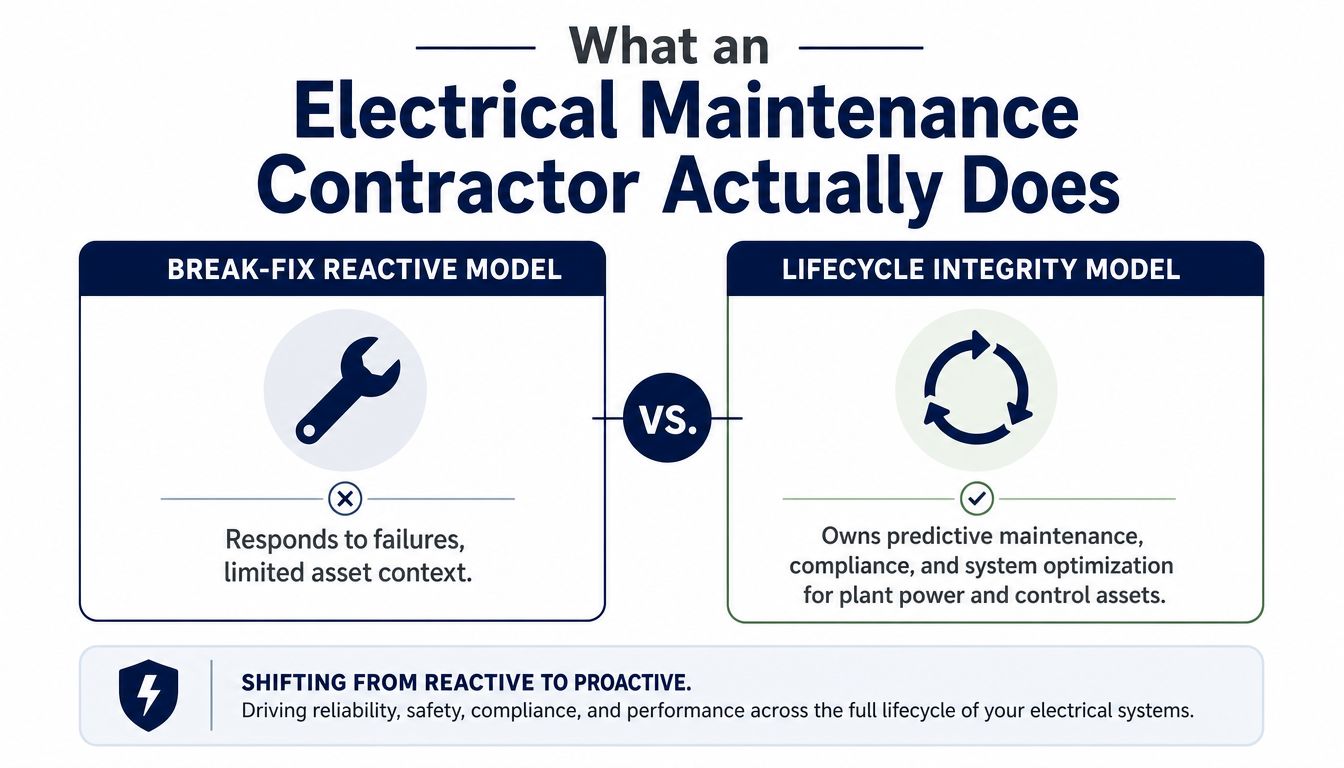
An electrical maintenance contractor should own the lifecycle integrity of plant power and control assets. That includes planned inspections, predictive diagnostics, fault response, repair decisions, commissioning support, compliance records, and recommendations for renewal. The contractor isn't merely a technician dispatched after failure, and it isn't an installer who happens to accept service calls.
Three terms need clear separation:
- Maintenance preserves asset condition through inspections, testing, cleaning, thermal checks, condition monitoring, and planned intervention.
- Repair restores a failed component or subsystem, such as a fan, capacitor bank, control board, or power module.
- Reconditioning goes deeper. It involves controlled disassembly, cleaning, component assessment, replacement of aging parts, functional testing, and a documented return-to-service baseline.
A general electrical installer may be excellent at construction and panel work without having the diagnostic depth required for a multi-brand drive fleet. An OEM service arm may know its own products well but offer limited coverage when your plant contains equipment from several manufacturers. Your contractor must be accountable for the installed system, not just the products it sells.
The operating model to expect
A lifecycle contractor connects field work to plant decisions. After a service visit, you should receive usable records, not a vague invoice stating “checked drive.” The record should identify the asset, observed condition, measured values, fault history, work performed, parts installed, test results, and remaining risks.
That information belongs in your maintenance system and should support decisions about shutdown scope, spare-parts stocking, and capital replacement. Predictive maintenance uses real-time condition monitoring and analytics to estimate remaining useful life and plan intervention before failure, a method IEEE sources describe for improving reliability and resource use while reducing emergency repairs. IEEE research on predictive maintenance provides the technical basis for expecting more than reactive troubleshooting from a modern contractor.
A contractor becomes valuable when it can explain not only what failed, but why it failed, what evidence supports the fix, and what should happen next. That is the difference between closing a work order and managing asset integrity.
Core Services That Define a Serious Industrial Contractor
A credible industrial contractor should cover the asset lifecycle from commissioning through late-life operation. Don't accept a service portfolio that lists only emergency troubleshooting and routine electrical inspections. Plants need a coordinated program covering power quality, protection, rotating equipment, drives, backup systems, and the records that connect them.
| Service Category | Asset Lifecycle Stage | Expected Deliverable |
|---|---|---|
| Commissioning and acceptance testing | Start-up and handover | Test records, settings verification, punch-list closure, and baseline measurements |
| Thermography and condition surveys | Operating life | Heat-pattern findings, priority ranking, and corrective recommendations |
| Partial-discharge surveys | MV operating life | Survey results, risk interpretation, and follow-up actions |
| Protective-relay verification | Commissioning and periodic maintenance | Confirmed settings, injection-test records, and approved test sheets |
| Motor and generator testing | Commissioning, operation, and overhaul | Insulation and winding assessment, trend data, and repair advice |
| Switchgear maintenance | Preventive and corrective maintenance | Inspection records, mechanism checks, contact assessment, and test results |
| VFD and soft-starter servicing | Operating life and shutdowns | Fault diagnosis, cooling-system checks, component findings, and restart validation |
| UPS and battery health checks | Backup-power operation | Battery condition records, alarm review, and replacement planning |
| Drive and motor reconditioning | Late-life operation | Scope of work, replaced components, functional test results, and return-to-service baseline |
Voltage coverage is a capability test
Low-voltage competence isn't enough for heavy industry. Medium-voltage switchgear, transformers, MV drive cells, and associated protection systems require appropriate authorization, test equipment, switching procedures, and experienced personnel. Ask the bidder to describe the exact boundary between work it performs directly and work it subcontracts.
A serious contractor should be able to discuss insulation diagnostics, phasing, relay testing, load testing, safe switching, and the controls used before equipment is re-energized. If the answer is “we can bring someone in,” ask who that person is, how quickly they can arrive, and who remains accountable for the result.
Documentation is part of the service
Test sheets, infrared findings, relay settings, single-line updates, failure-mode records, and commissioning documents aren't administrative extras. They create the evidence needed to identify recurring failures and plan shutdown work. They also help demonstrate that energized electrical work is controlled under recognized safety expectations.
The contractor should quote these deliverables in the scope. If reports, updated drawings, and CMMS-ready records appear only as optional add-ons, the program is probably built around labor hours rather than reliability outcomes. Require one integrated scope that shows how commissioning, preventive maintenance, corrective repair, and reconditioning information will remain connected.
Vetting Checklist for Industrial Electrical Maintenance
Treat vendor qualification as an audit. A polished presentation proves very little. You need evidence that the contractor can work safely and competently on the equipment your plant operates.
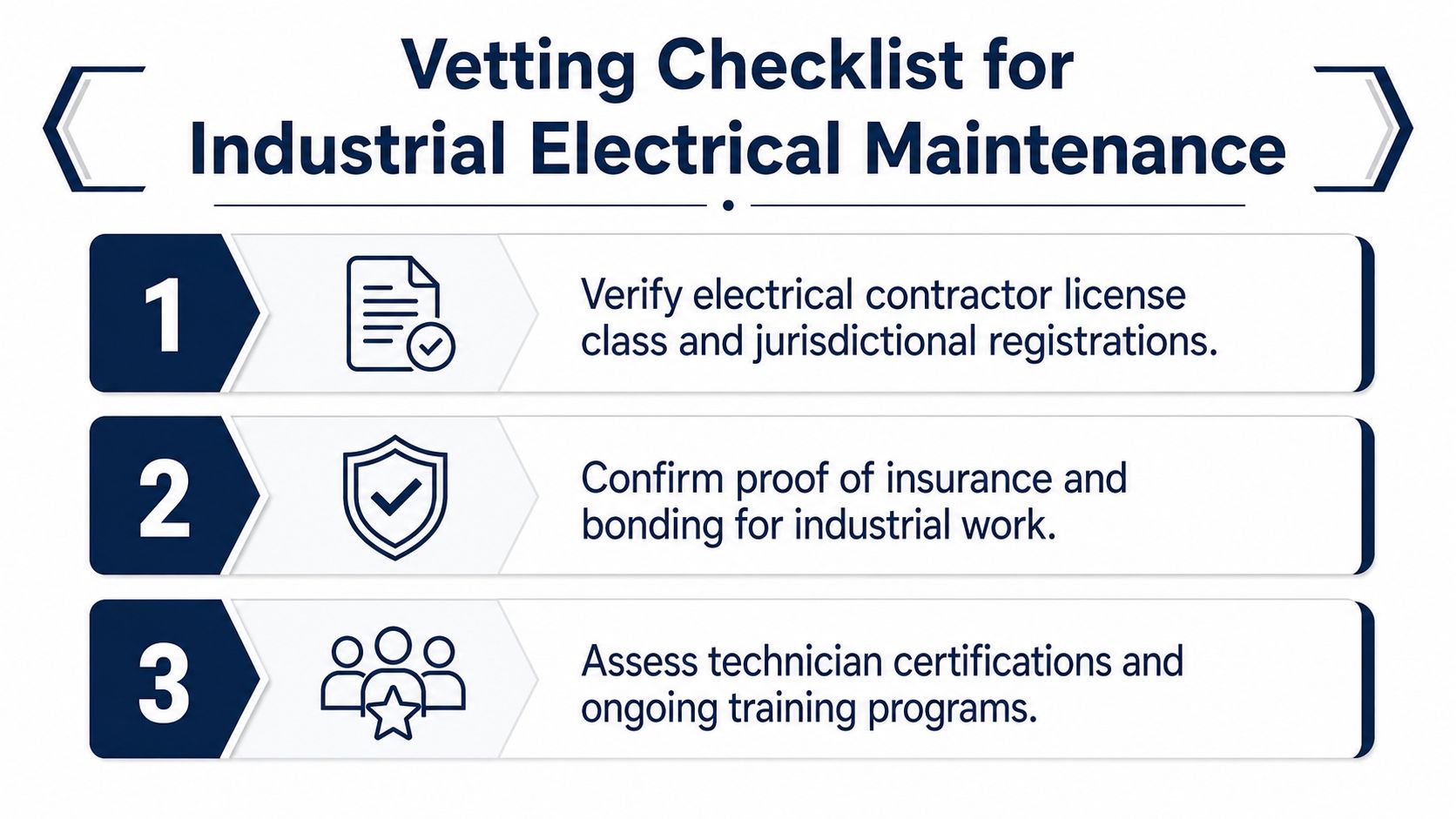
Start with legal and insurance requirements. Request the electrical contractor license class, jurisdictional registrations, proof of insurance, bonding documentation, and evidence that the firm's scope includes industrial work. Don't assume commercial project experience transfers automatically to a plant with MV equipment, rotating machinery, process interlocks, and production-critical shutdowns.
Test the people and the installed base
Ask how many technicians are currently qualified for your voltage class and whether those technicians are employees, subcontractors, or shared resources. Then ask for current training records relevant to your installed drive brands, protection equipment, switching procedures, and arc-flash controls.
For multi-brand drives, marketing language is not evidence. Request a project list covering the previous 24 months, with drive make, model, voltage, power rating, work type, and customer reference where disclosure is permitted. A bidder that can't identify comparable work should not receive responsibility for your fleet.
Use the same process described in this industrial electrical maintenance services guide as a prompt for your own questions, but judge every contractor against your actual asset register. The important test is not whether a company mentions commissioning, repair, and preventive maintenance. It's whether it can show the methods, records, and personnel behind those words.
Verify MV field capability
Ask for a site visit or workshop walkthrough. Look for suitable insulation diagnostic equipment, phasing instruments, load-testing arrangements, controlled switching documentation, calibrated meters, and a clear process for protecting sensitive electronics during testing.
Then run a scenario. Give the bidder a tripped MV drive, incomplete fault history, a production deadline, and a known switching boundary. Ask what the first hour looks like, who authorizes isolation, what measurements are taken, and what evidence is required before restart. You're testing judgment, not theatrical confidence.
Emergency response deserves the same scrutiny. Ask for the last three after-hours MV callouts, the time the call was received, the time a qualified person began remote triage, and the time the truck rolled. A contractor that refuses to share any operational evidence may still be capable, but it hasn't earned a high-risk contract.
Safety records should include TRIR, EMR, incident history, and a written JSA process you can read. OSHA's electrical-contractor guidance emphasizes the hazards of shock and electrocution and the need for controls such as arc-flash labeling, incident-energy analysis, PPE selection, and qualified-person training. OSHA electrical contractor guidance gives you the safety baseline. Your contract should turn that baseline into site-specific procedures and records.
<iframe width="100%" style="aspect-ratio: 16 / 9;" src="https://www.youtube.com/embed/lYfJxanVq1A" frameborder="0" allow="autoplay; encrypted-media" allowfullscreen></iframe>When to Repair, Recondition, or Replace Drive Assets
A tripped VFD doesn't automatically justify a replacement quote. That reflex often converts a diagnosable subsystem failure into an unnecessary capital purchase, especially when the platform remains supported and the cabinet hasn't suffered severe environmental damage.
Start with evidence. Review the fault history, DC-bus behavior, input and output measurements, cooling condition, capacitor health, fan operation, control-board status, IGBT condition, contamination, and the history of previous failures. A single replaceable failure is a repair candidate. A drive with broad thermal degradation, repeated main-circuit failures, or severe moisture intrusion may be a replacement candidate.
The cost comparison matters, but don't reduce it to purchase price. Include removal, shipping, engineering changes, control integration, commissioning, spare-parts exposure, production risk, and the time required to qualify a replacement. As a practical internal rule, if a repair or reconditioning scope remains below roughly 40% to 50% of a new unit's price and the platform is viable, reconditioning deserves serious consideration. That is a decision rule, not a guaranteed outcome, and the contractor must support it with test evidence.
Use the asset's actual condition
Reconditioning makes sense when the drive's enclosure, power architecture, control platform, and application remain suitable. The work should include cleaning, inspection, replacement of degraded consumables and known weak components, component-level testing, thermal review, functional testing, and a witnessed performance baseline.
On-site work can be especially valuable for large MV drives. Transport adds handling risk, scheduling delays, and uncertainty about what happens between removal and return. A contractor capable of controlled on-site reconditioning can restore service during a planned shutdown without treating the entire drive as disposable.
Replacement is the right decision when the platform is obsolete, critical parts are no longer available, failures repeatedly involve the main power section, contamination has damaged insulation or boards beyond reliable restoration, or the application has outgrown the drive's technical capability. Don't let a low repair price keep an unsafe or unsupported asset in service.
| Criterion | Repair | Recondition | Replace |
|---|---|---|---|
| Primary condition | Localized component or subsystem failure | Aging platform with recoverable structure | Obsolete, repeatedly failing, or severely damaged platform |
| Evidence required | Fault isolation and component test | Full inspection, component assessment, and functional baseline | Lifecycle, compatibility, risk, and integration assessment |
| Best fit | Fast restoration of a defined fault | Extension of useful life during planned work | Long-term renewal or technical change |
| Main risk | Hidden secondary damage | Poor scope or weak post-work testing | Integration delays, new commissioning risk, and higher capital cost |
Use this VFD maintenance guidance to build the inspection questions into your contractor scope. The contractor should present repair, reconditioning, and replacement as competing evidence-based paths, not steer every failure toward the most expensive invoice.
Procurement and Contract Considerations
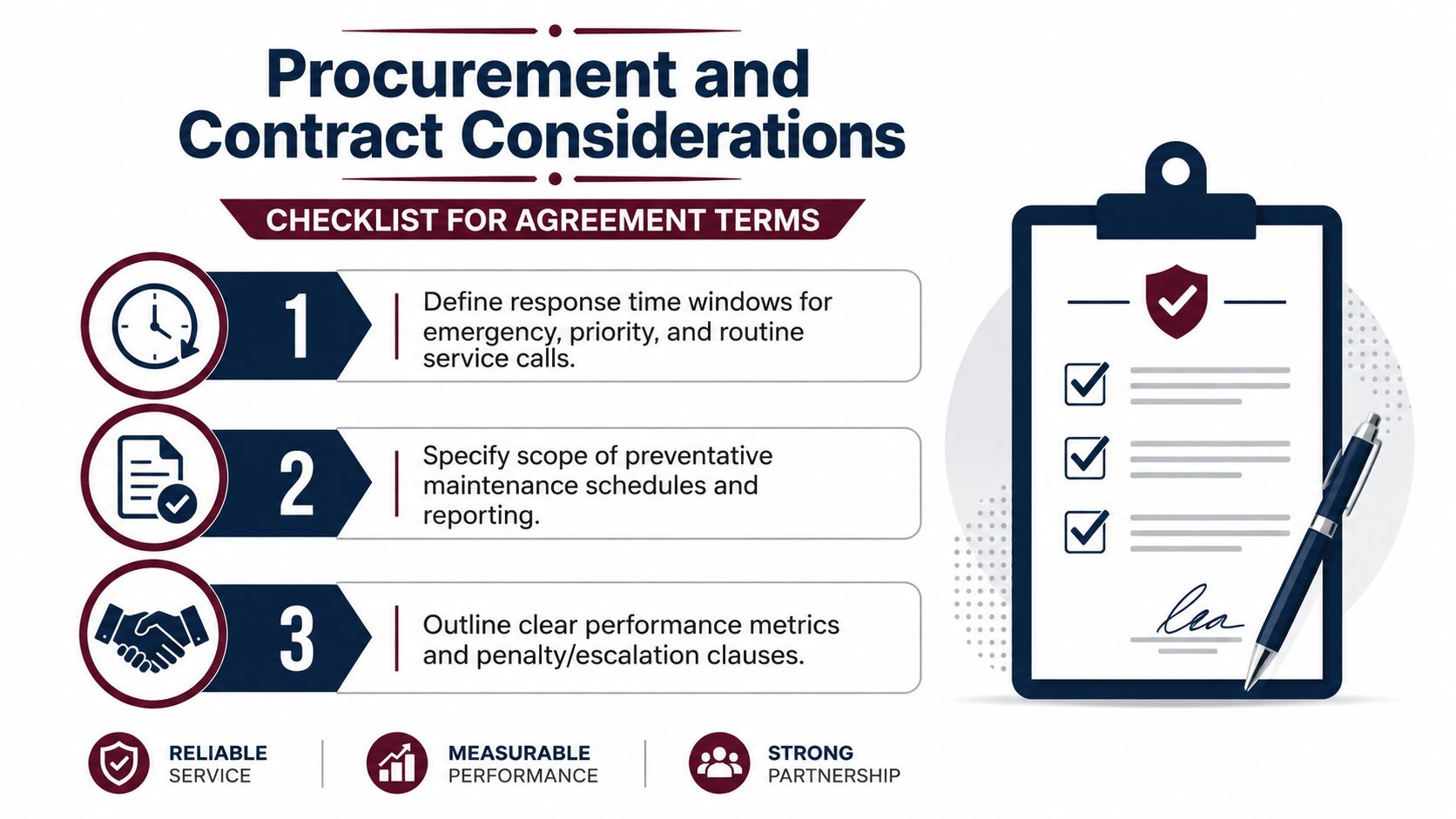
A quote describes proposed work. A contract defines accountability. If the agreement doesn't state response windows, documentation, escalation, parts ownership, and performance measures, both sides will interpret the promise differently after the first serious outage.
Set service levels by consequence. A tripped MV line serving a critical process shouldn't share the same response commitment as a non-critical alarm. Define remote triage, qualified-person availability, on-site arrival, escalation, and recovery communication separately. Name the responsible roles and deputies, not just a shared mailbox or generic call center.
Put parts and records in writing
Spare-parts terms create disputes when nobody defines ownership. The agreement should state:
- Stocking responsibility: Identify which parts the contractor holds and which remain plant-owned.
- Obsolescence risk: State who carries the cost if a model becomes unavailable.
- Consignment rules: Define access, replenishment, inspection, and inventory records.
- Markup limits: Set a ceiling or transparent pricing method for emergency and routine parts.
- Compatibility checks: Require verification before dispatching an exchange unit or substitute component.
Documentation must be a paid deliverable, not a favor. Require test reports, updated single-line diagrams where changes occur, commissioning records, asset history updates, fault analysis, and CMMS-ready files. If a contractor can restore equipment but leaves no usable record, the plant pays for the same learning repeatedly.
Measure the relationship, not just the callout
Tie payment and renewal to objective measures such as report turnaround, preventive-maintenance completion, data quality, response performance, repeat-failure review, and closure of agreed corrective actions. Use performance credits where missed commitments create measurable operational burden. Reserve audit rights for safety files, training records, calibration documents, and subcontractor controls.
The exit clause should work without an argument about whether the service “felt” poor. Define termination triggers around missed response commitments, unresolved safety findings, repeated documentation failures, unauthorized subcontracting, or persistent inability to provide qualified personnel. A clean exit protects both parties because it makes expectations visible before the contract starts.
Your Shortlist in One Page
Take these questions into the vendor meeting and require written answers:
- Can you prove industrial licensing, insurance, bonding, and safety performance for work at our voltage levels?
- Which technicians will serve our site, and what current training and authorization do they hold?
- Show us comparable multi-brand drive projects, including model, rating, voltage, fault, and work performed.
- Can you perform MV diagnosis, switching support, testing, and reconditioning on site? Walk us through a tripped-drive scenario.
- What happens during an after-hours emergency, from the first call through qualified-person arrival and escalation?
- Will you provide repair, reconditioning, and replacement options with evidence, lifecycle implications, and parts availability?
- Who owns spare parts, obsolete inventory, consignment stock, and compatibility risk?
- Which reports, test records, drawings, and CMMS updates are included in the base scope?
- What response, documentation, safety, and repeat-failure metrics control payment and renewal?
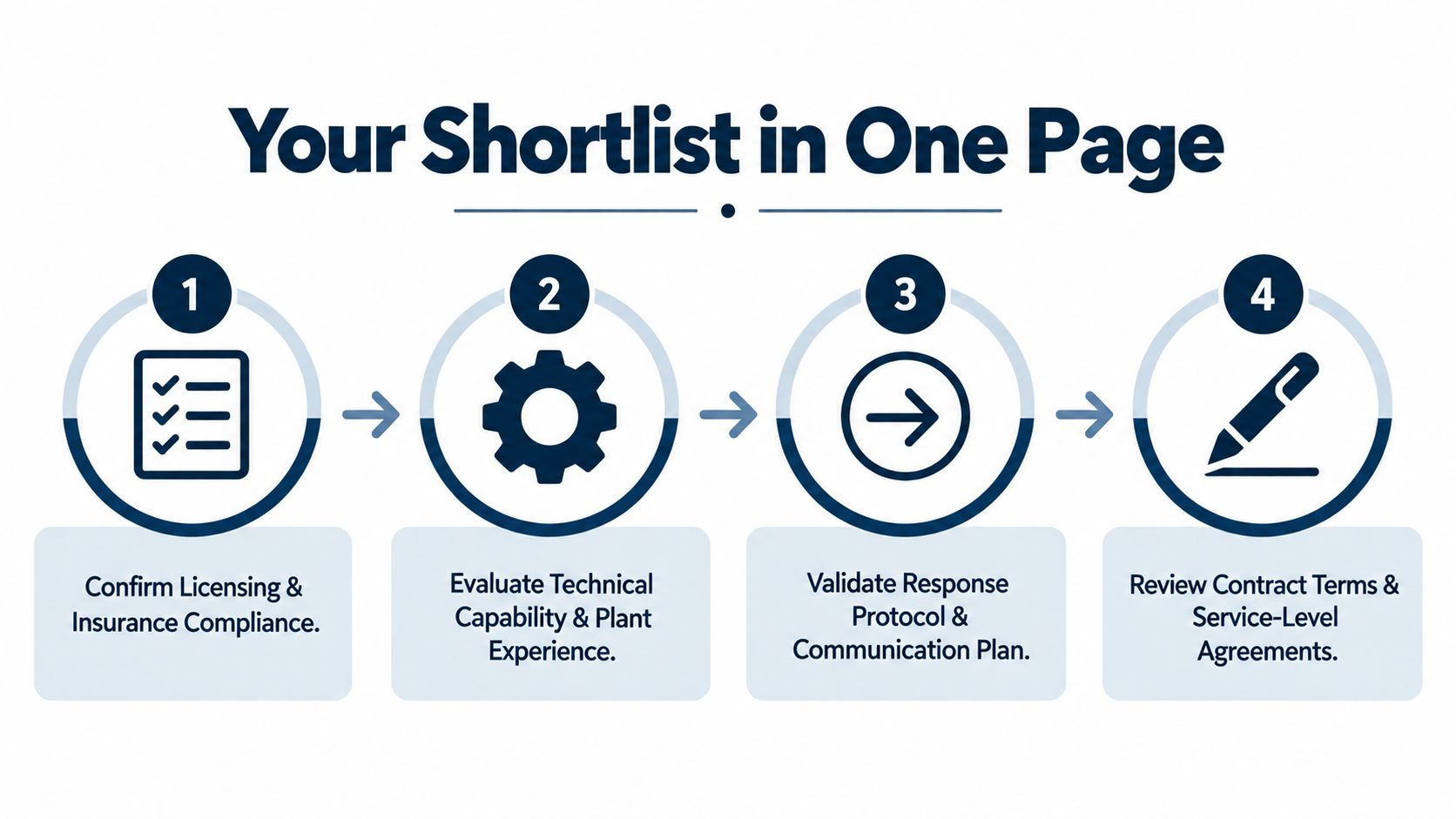
Score two or three finalists against the same questions. Don't compare one vendor's polished presentation with another vendor's hourly rate. Compare evidence, qualified resources, MV capability, response commitments, lifecycle judgment, and contract protections.
One red flag should eliminate a candidate immediately: refusal to disclose relevant VFD work or MV switching experience. You're not asking for confidential customer data. You're asking for enough evidence to decide whether the contractor can safely manage the assets that keep your plant operating.
DUCHENG Industrial provides multi-brand VFD commissioning, troubleshooting, repair, preventive maintenance, and on-site reconditioning for low-, medium-, and high-voltage drive systems, with 24-hour emergency repair contacts available for China and Thailand. If you're evaluating an electrical maintenance contractor for drive lifecycle support, visit DUCHENG Industrial to review its service scope and start a conversation about your installed base, MV requirements, and response needs.