
Learn how to build an electrical preventive maintenance plan for VFDs and motors. Master checklists, thermal mitigation, and shutdown procedures.
A production line is running at full load when a variable frequency drive trips. The motor stops, the process backs up, and the electrical team starts working through alarms while operations asks the only question that matters in the moment: when can the line run again? In a harsh plant environment, the trip may have started with dust on a heatsink, a cooling fan losing capacity, a loose power connection, moisture, or insulation aging that went unnoticed between scheduled inspections.
That pattern is why electrical preventive maintenance has to be more than a calendar reminder. A practical program connects asset criticality, failure modes, operating conditions, inspection findings, and safe intervention. It gives technicians enough structure to find deterioration early without wasting limited shutdown time on equipment that presents little operational risk.
Table of Contents
- The Business Case for Structured Maintenance
- Designing a Risk-Based Inspection Strategy
- Layered Checklists for Drives and Motors
- Moving Beyond Static Thermal Inspections
- Executing Safe Shutdown and Reconditioning Procedures
- Tracking KPIs and Justifying the Budget
The Business Case for Structured Maintenance
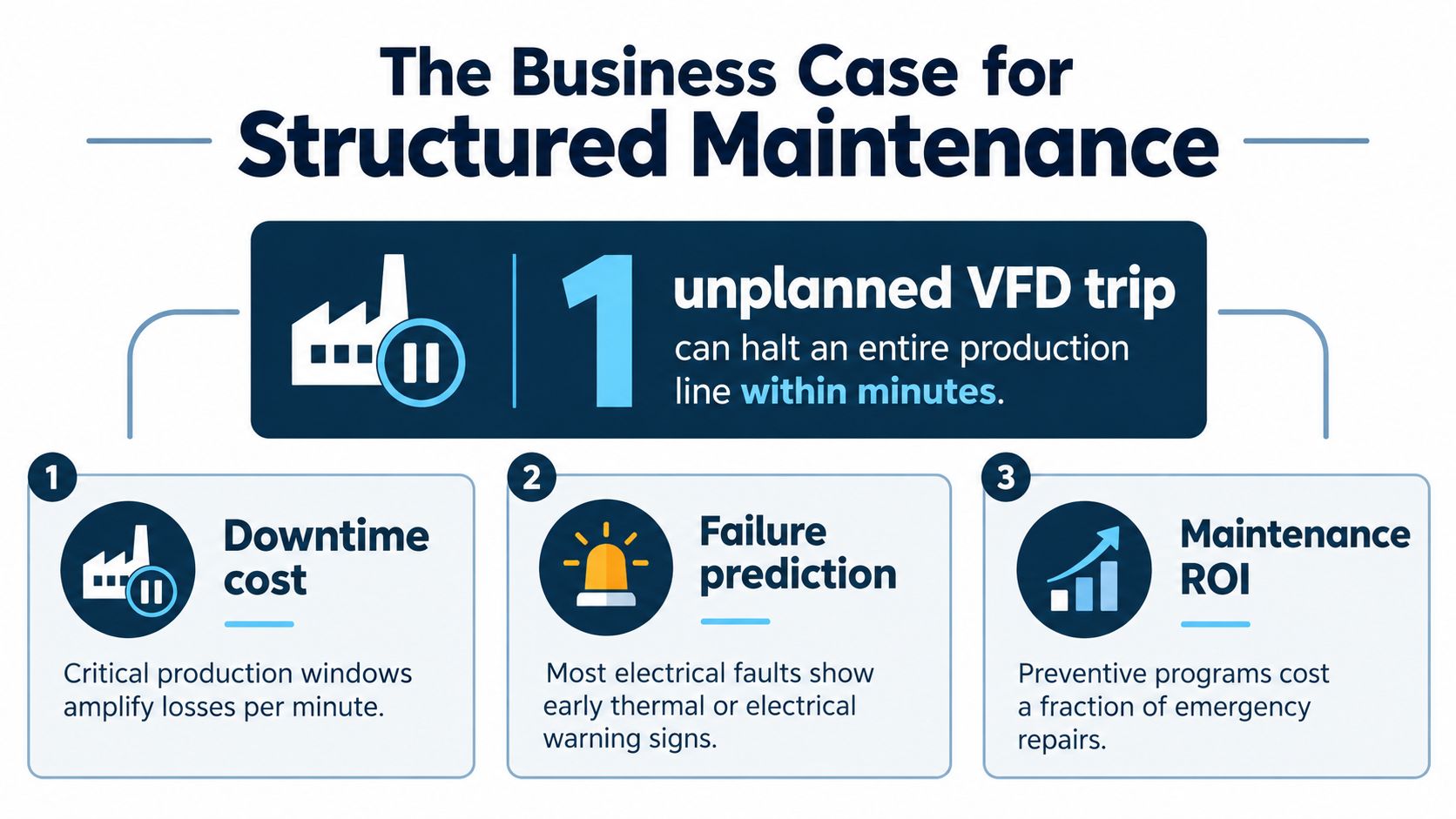
A VFD trip during a production run can stop far more than the drive. The motor drops out, connected equipment may remain unavailable, and operators may need to stabilize the process before technicians can work safely. In a harsh industrial environment, dust, heat, moisture, vibration, cooling-fan wear, loose power connections, and insulation aging can turn a small defect into a production interruption.
The business case for electrical preventive maintenance rests on controlling those failure paths before they become urgent work. A 2021 TEGG/LINC electrical maintenance whitepaper reports that facilities without preventive maintenance experience failure rates three to five times higher than facilities with structured programs. Its examples cover major electrical assets, including switchgear, transformers, motor control centers, and distribution panels (industrial electrical maintenance data). Treat that figure as a benchmark, not a guarantee. The practical question is which failures your site can detect early and which ones can stop production, affect quality, or create a safety exposure.
Maintenance became a formal control
Formal electrical maintenance standards developed over time. NFPA began its preventive maintenance work on June 27, 1968, when it formed a committee to develop texts for maintaining electrical systems and equipment in industrial applications. The stated purpose was to reduce loss of life and property. That work produced a recommended practice in 1973, later revisions and adoption as NFPA 70B, and eventual elevation to a standard effective January 16, 2023, after final elevation on December 27, 2022 (NFPA 70B history and development).
For plant managers, the history shows how maintenance moved from informal care to a defined safety and reliability control. Inspection, cleaning, tightening, testing, and condition-based intervention support equipment such as switchgear, MCCs, transformers, VFDs, and motors. The program should also account for operating conditions. A drive in a hot, dusty enclosure does not face the same deterioration rate as a lightly loaded unit in a clean electrical room.
Practical rule: Present the program as a way to reduce known failure mechanisms on assets that control production and safety, not as a list of technician tasks.
Put the evidence into the budget conversation
A strong funding request links each maintenance action to a plant consequence. Thermography can reveal abnormal heating before a connection or component fails. Checking a VFD fan and airflow path can identify cooling loss before heat causes a load-related trip. Insulation testing can expose motor deterioration while the motor is still available for planned work.
Independent risk-engineering guidance reports that electrical equipment failure rates are three times higher when components are excluded from a scheduled preventive maintenance program, and that more than two-thirds of electrical system failures can be prevented by routine preventive maintenance (electrical maintenance risk guidance). Use these figures with work orders, VFD trip history, failed-part records, inspection findings, and downtime logs. Published benchmarks establish context. Site evidence determines where the next maintenance dollar will reduce the most risk.
Designing a Risk-Based Inspection Strategy
A blanket schedule looks orderly, but it often misallocates effort. A lightly loaded spare motor and a VFD driving a bottleneck process shouldn't automatically receive identical inspections just because they're in the same calendar month. The first should be managed appropriately. The second deserves a deeper failure analysis and stronger condition visibility.
Start with the asset and its consequence
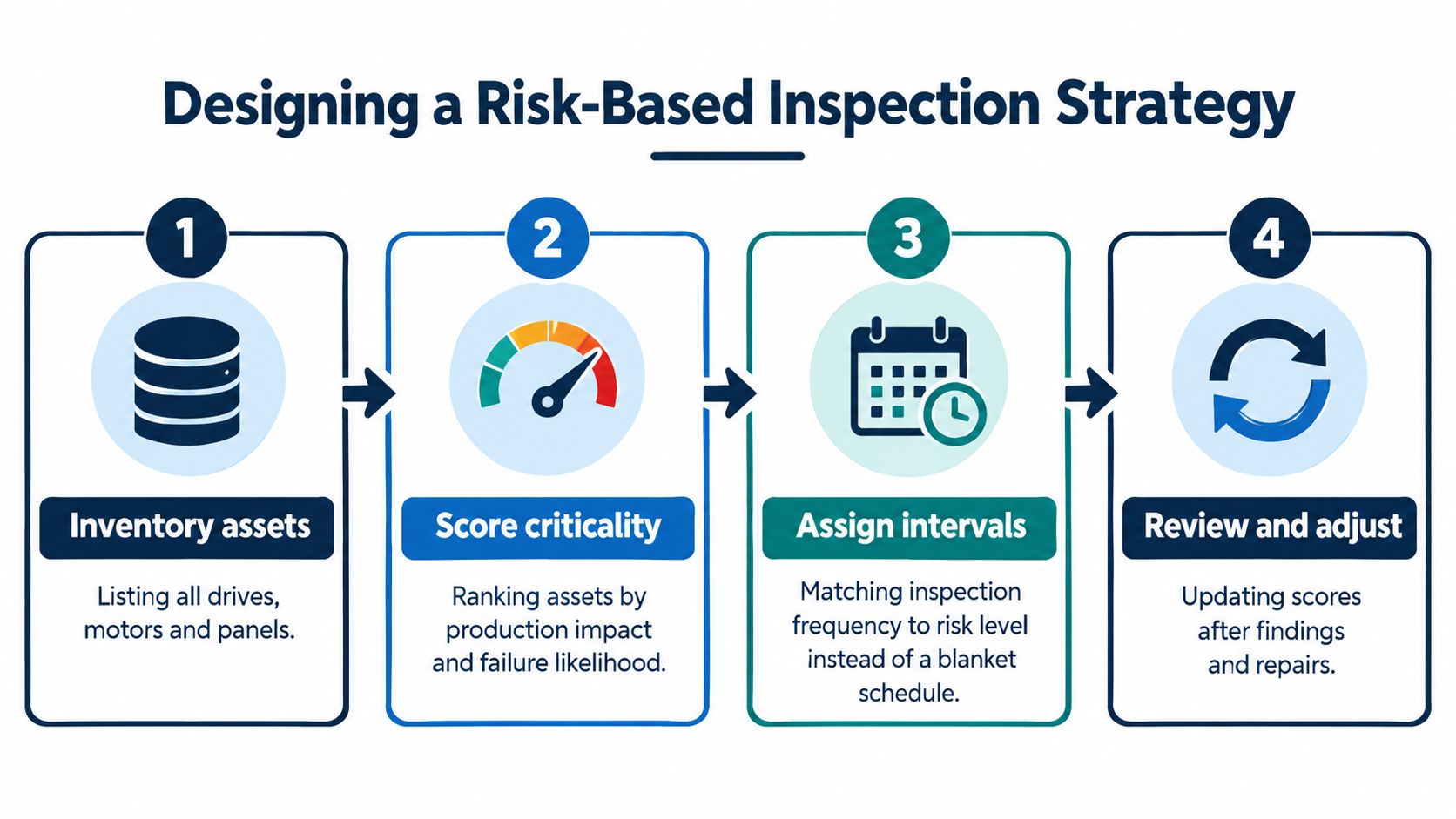
Build an inventory that links each drive to its motor, process duty, enclosure, power source, control role, and available spare. Include auxiliaries that can create a drive trip, such as cooling fans, filters, braking components, and upstream protection. If the records don't show the complete connection between the drive and the process, the maintenance team can't reliably prioritize work.
Then score criticality using operational consequence and failure likelihood. Consider whether a failure stops a bottleneck, creates a safety exposure, damages product, affects environmental controls, or can be bypassed. Add the site's actual history. A repeated trip on an apparently moderate-duty drive may deserve a higher priority than a larger asset with stable condition and a practical standby.
Match intervals to failure modes
Industry guidance recommends building preventive maintenance around equipment failure modes and their statistical time-to-failure distributions, rather than relying on fixed calendar intervals alone (failure-mode-based preventive maintenance guidance). For a VFD, likely mechanisms include contamination, inadequate cooling, loose or discolored connections, capacitor deterioration, power-module stress, and control or feedback faults. For a motor, the relevant mechanisms may include bearing wear, winding degradation, vibration, moisture ingress, and insulation aging.
The interval should follow the way the failure develops. A condition that changes rapidly under production load may need frequent visual or operational observation. A slowly developing dielectric problem may call for periodic electrical testing and trend comparison. A critical asset may need both, because no single inspection method sees every degradation path.
Define thresholds before findings arrive
A technician should know what requires cleaning, what requires a planned repair, and what requires immediate escalation. Establish baseline values and acceptable trends for thermal observations, winding resistance, insulation condition, vibration, alarm frequency, and drive loading where those measurements are available. Record the test method and operating state, because a reading without context is difficult to interpret.
Review the ranking after significant findings, repairs, process changes, or repeated trips. Risk-based maintenance isn't a one-time scoring exercise. It becomes useful when the work history changes the next inspection decision.
Layered Checklists for Drives and Motors
A VFD and motor need checks at different speeds and depths. In a dusty, humid, corrosive, or carbon-black plant, a missed airflow restriction can turn into overheating during the next production run. Fast inspections expose visible threats early. Deeper tests show whether a condition is stable, worsening, or beyond an acceptable boundary.
Weekly checks catch environmental damage
For drives exposed to harsh conditions, inspect the enclosure and every feature that supports heat removal. Look for condensation, corrosion, dust or carbon deposits on filters and heatsinks, unusual fan noise, blocked airflow, terminal discoloration, and cabinet doors or seals that no longer maintain the intended enclosure condition. Review the drive display and fault history for intermittent alarms. A drive that has not tripped can still be deteriorating.
Compare each observation with the previous record. A gradual increase in contamination or new fan noise may matter more than a single pass or fail result. Photograph consistent points inside and around the cabinet so technicians can identify change across inspections. Record the operating load and recent environmental conditions when they affect the finding.
Quarterly tests need operating context
Quarterly work should include thermography under a representative load, rather than scanning an idle or lightly loaded cabinet. Inspect power connections, input and output terminals, protective devices, bus areas, and cooling paths. A hot connection, uneven phase pattern, or abnormal component temperature requires investigation before the next high-demand production period.
For the DC bus, check ripple and related electrical condition with appropriate procedures and qualified personnel. The task becomes diagnostic when the technician compares the result with a baseline and checks for evidence of capacitor or power-module stress. A recurring deviation deserves a work order, even if the drive remains in service.
Annual testing screens deeper aging
Where the equipment design, isolation procedure, and manufacturer requirements permit it, annual work should include insulation resistance and polarization index testing for the motor and connected circuit. These tests screen insulation integrity and can expose aging before it becomes a forced outage. Biannual capacitor ESR or capacitance testing adds a separate check on VFD capacitor condition.
A 2021 electrical maintenance whitepaper recommends component-specific VFD actions including weekly visual checks, quarterly thermography and DC bus ripple checks, biannual capacitor ESR or capacitance testing, and annual insulation resistance plus polarization index testing. Use that cadence as a structured reference, then adjust it for asset criticality, environment, duty cycle, manufacturer requirements, and measured condition.
For a field reference covering inspection, cleaning, connection checks, testing, and documentation, pair your site procedure with this industrial preventive maintenance checklist. The site procedure should define who performs each task, what evidence gets recorded, and which findings trigger escalation.
A checklist does not replace isolation, qualification, or engineering judgment. Each technician must understand residual energy, test voltage, motor-drive compatibility, and the consequences of applying a test to connected electronics. When conditions change, revise the checklist and its frequency rather than preserving a calendar routine that no longer matches the risk.
<iframe width="100%" style="aspect-ratio: 16 / 9;" src="https://www.youtube.com/embed/KFVh8YPwQSg" frameborder="0" allow="autoplay; encrypted-media" allowfullscreen></iframe>Moving Beyond Static Thermal Inspections
A drive can pass its scheduled thermal inspection and still fail during the next production run. Annual thermography remains useful, but it covers less than 1% of operational time, so it may miss intermittent heating, marginal connections, or overload conditions that appear only under specific duty cycles.
Timing determines what the inspection can reveal. A VFD may stay within its normal temperature range during a planned visit, then overheat after ambient temperature rises, production demand changes, a fan filter loads, or contamination restricts airflow. Motors can show acceptable condition on a quiet shift while developing vibration or thermal stress during a high-load process state.
Use inspections when risk is highest
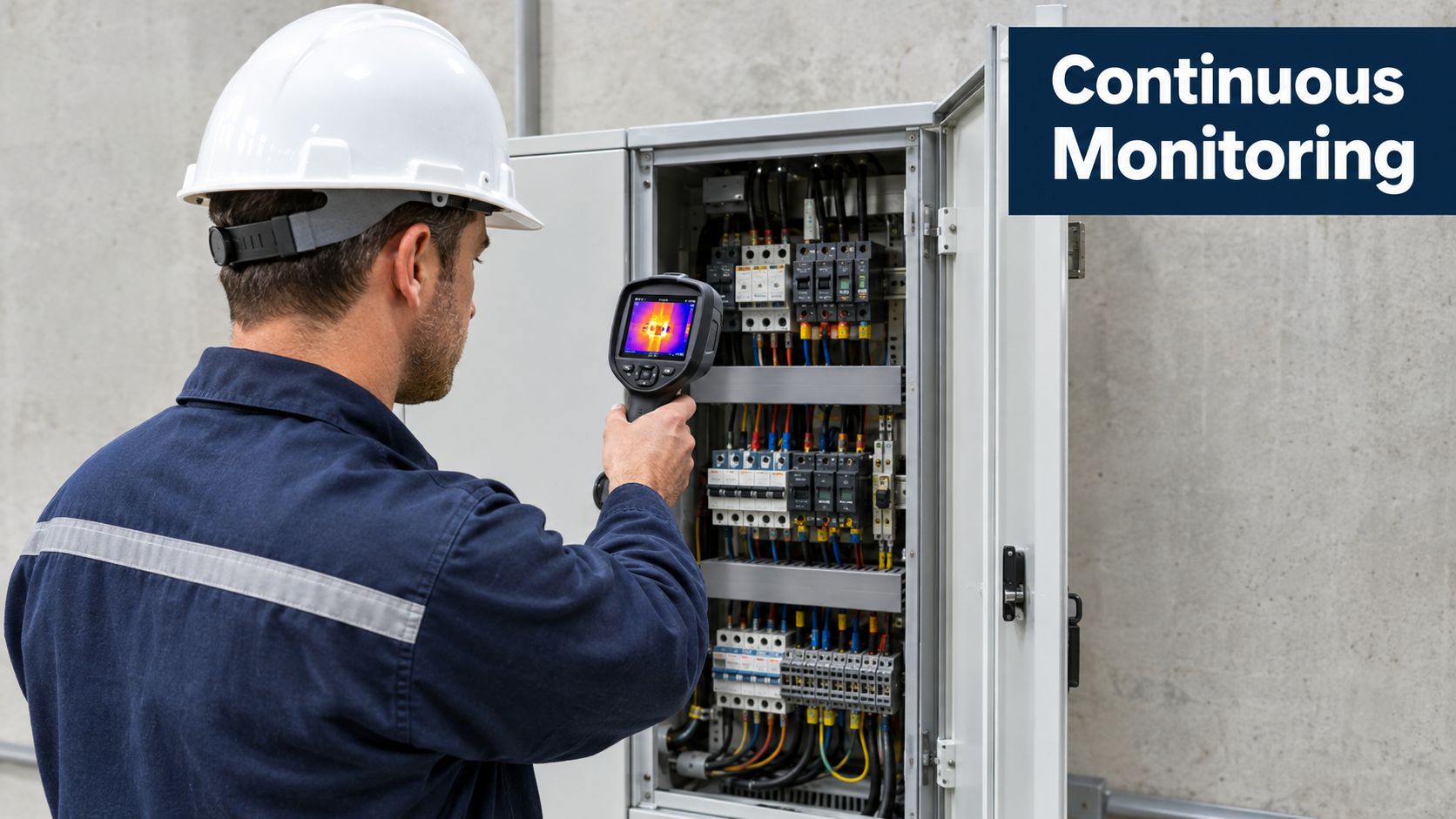
Schedule targeted thermal inspections during representative or heavy loading periods, provided access and operating procedures permit safe work. Record the load state, ambient conditions, recent process changes, alarm history, and established equipment baseline. A thermal image can show a temperature difference, but this context determines whether the difference indicates a developing fault or normal operating variation.
Harsh environments require the same condition focus between formal inspections. Carbon black, salt, conductive dust, and moisture can change cabinet behavior quickly. Cleaning frequency, enclosure condition, filter loading, and cooling performance should respond to measured site conditions rather than an inherited maintenance template.
A thermal camera shows a condition at a moment. A useful maintenance program explains why that condition appeared and whether it is getting worse.
Add condition signals to the decision
Condition-based maintenance can begin without a full monitoring project. Start with the highest-criticality drives and collect signals the team can act on, including temperature, fan status, alarm recurrence, load profile, DC bus behavior, and inspection findings. Combine these observations with work-order history to separate normal variation from a developing failure mode.
For VFDs, the pattern matters as much as the reading. Repeated overtemperature alarms may point to blocked airflow, degraded fans, or a cabinet exposed to conditions beyond its design assumptions. DC bus changes, recurring overcurrent events, and load-dependent trips deserve correlation with process state and motor behavior before technicians adjust thresholds or replace components.
Predictive systems and edge analytics can tailor intervals to load profiles and failure history. They cannot compensate for an incomplete asset register, inconsistent measurements, or work orders that omit operating conditions. Use technology to prioritize field attention, while technicians maintain repeatable inspection methods and clear escalation rules.
A 2026 survey reported predictive maintenance adoption rising from 9% to 18% year over year in the United States, the United Kingdom, and Germany, while proactive approaches fell from 55% to 45%. The figures support a balanced program. Routine inspections provide coverage, while live condition data directs attention to assets and operating states with the greatest failure risk.
Executing Safe Shutdown and Reconditioning Procedures
A planned shutdown can remove production pressure, but it doesn't remove electrical danger. The team still has to establish the work boundary, isolate every energy source, verify absence of voltage, control stored energy, and confirm that the equipment is safe to open and test. Drives can retain hazardous energy after isolation, so the site procedure must define discharge time, verification points, and authorized test methods.
Plan the window around risk
Freeze the work scope before the shutdown. Identify the assets, drawings, test instruments, technicians, permits, replacement parts, cleaning materials, and restart authorities. Confirm that the parts match the installed drive configuration, motor duty, control arrangement, and revision requirements. A physically similar component isn't automatically a compatible component.
During the outage, record the as-found condition before cleaning or disturbing connections. Check for dust deposits, salt or chemical residue, moisture, hot spots, fan deterioration, damaged insulation, loose hardware, and evidence of repeated alarm conditions. This record gives the team a defensible basis for deciding whether the asset needs routine service, targeted repair, workshop work, or replacement assessment.
Decide between field work and workshop repair
On-site maintenance makes sense when the work involves inspection, cleaning, connection checks, fan or filter service, controlled testing, and repairs that can be completed safely with the available equipment. Workshop repair becomes more appropriate when the drive needs disassembly, bench diagnostics, component-level repair, or functional testing that the plant can't perform reliably in place.
For medium- and high-voltage drives, transport can add handling exposure, logistics complexity, and downtime. Full on-site reconditioning may be the more practical path when the work can be executed within the planned outage and the site can support the required safety controls, test equipment, and specialist personnel. The decision should be based on equipment size, fault condition, access, test capability, schedule, and the consequences of a failed restart.
Restart in controlled stages
Before energization, restore barriers, covers, guards, cooling paths, cables, terminals, interlocks, and communication connections. Verify that temporary grounds, test leads, tools, and foreign material have been removed. Confirm that protection settings, motor data, control references, and permissives match the approved configuration.
Bring the system back in stages. Energize and observe the drive before applying process load, then run the motor under controlled conditions while checking current balance, direction, vibration, temperature, alarms, and process response. Keep the restart owner clear. If an alarm appears, stop and diagnose it rather than repeatedly cycling the drive in the hope that the condition clears.
A service provider such as DUCHENG Industrial can support planned shutdown maintenance, drive troubleshooting, component repair, spare-part compatibility review, and on-site reconditioning for medium- and high-voltage systems. Whatever support model you use, require a documented diagnostic path and a clear handover record before returning the asset to operations.
Tracking KPIs and Justifying the Budget
A maintenance department can complete every scheduled task and still fail to improve reliability if the work isn't connected to equipment outcomes. Checklist completion measures activity. Plant leaders need evidence that the activity changes failure exposure, restart performance, and production stability.
Measure reliability, not paperwork alone
Track the indicators that explain whether electrical preventive maintenance is working:
- Unplanned downtime: Record the duration, process impact, initiating fault, and recovery actions for each electrical interruption.
- Mean time between failures: Trend repeat failures by drive, motor, process area, and failure mode instead of averaging unrelated assets together.
- Repeat trips: Separate nuisance alarms, environmental faults, control issues, thermal events, and component failures so the team can target the cause.
- Condition trend closure: Count findings that received an engineering decision, planned repair, escalation, or documented accept-as-is rationale.
- Schedule compliance with context: Record missed tasks, but also capture why they were missed and whether the risk ranking changed.
- Post-maintenance performance: Confirm that the asset remained stable after restart and that the original symptom didn't return.
Use these measures to tell a clear story. If a drive receives fan service and contamination removal, then later operates through demanding production periods without recurring thermal alarms, that outcome is more meaningful than the completed work order by itself.
Build a defensible spending priority
Budget pressure is normal. A recent industrial study identifies budget limits, outdated planning methods, and insufficient resources as reasons electrical preventive maintenance is often only partially implemented (industrial study on EPM implementation). The answer isn't to create the largest possible task list. It is to direct money and labor toward assets that govern throughput, safety, and recovery time.
Use the asset criticality ranking, failure history, CMMS records, bills of material, spare availability, and planned downtime calendar. Correct inaccurate equipment records before buying parts. Verify that the proposed spare matches the actual installed configuration. A low-cost inspection that finds a recurring failure mode may deserve priority over an expensive upgrade with no clear risk reduction.
Make records useful at the next decision
Each record should answer four questions: what was inspected, under what operating conditions, what changed, and what action followed. Attach measurements, photographs, alarm histories, component identifiers, and test limitations where relevant. The next technician should be able to compare the result with a known baseline without reconstructing the entire job from memory.
For sites that need structured field support, electrical reliability services can be evaluated alongside internal capability, including diagnostic work, planned maintenance, repair, reconditioning, and restart support. The selection should follow the asset risk and the work scope, not a generic preference for outsourcing or insourcing.
DUCHENG Industrial supports industrial facilities with multi-brand VFD commissioning, preventive maintenance, troubleshooting, repair, spare-part compatibility checks, and on-site reconditioning for medium- and high-voltage drives. If your plant is dealing with recurring trips, harsh-environment contamination, or a shutdown window that can't tolerate a failed restart, visit DUCHENG Industrial to discuss a condition-aware maintenance plan.