
Learn to select high voltage motors for reliability and efficiency. This guide covers key specs, common failures, and maintenance tips.
Motor systems consumed 13,462 TWh of electricity worldwide in 2023, equal to 53% of global electricity consumption, according to the IEA 4E Motor Systems Energy and Sustainability Analysis. High voltage motors represent only part of that total, but they sit inside the largest electrical loads in industrial plants, where one failed machine can stop a process line, compressor train, pump system, or mill.
Buying the right motor therefore takes more than comparing voltage, power, efficiency, and delivery date. The difficult decisions appear later, in service: whether the insulation is deteriorating, whether repeated starts are overheating the winding, whether a drive is compatible with the motor's thermal limits, and whether a multi-ton machine can be shipped without adding unacceptable downtime and transport risk.
The practical approach is to treat the motor, its drive, its driven equipment, and its maintenance history as one lifecycle system.
Table of Contents
- Why High Voltage Motors Deserve Special Attention
- Defining High Voltage Motors and What Efficiency Really Means
- Insulation Health and Partial Discharge Diagnostics
- Starting Behavior, Thermal Stress, and Mechanical Checks
- Repair, Recondition, or Replace on Site
- Regulatory Efficiency Rules and What They Actually Cover
- Reliability Metrics and the Case for Lifecycle Service
Why High Voltage Motors Deserve Special Attention
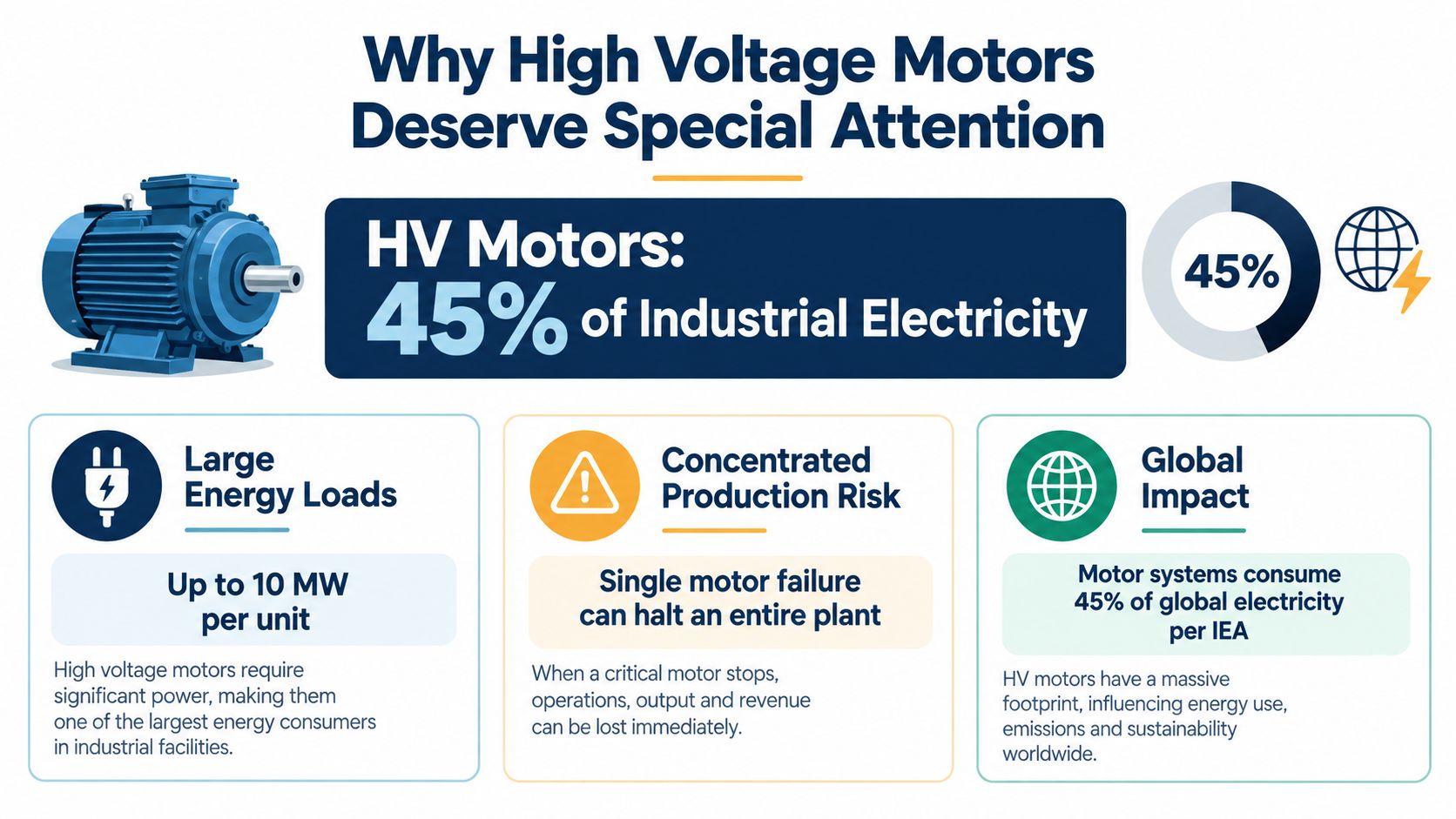
Motor-system electricity use increased by 26% between 2015 and 2023, adding 2,756 TWh, while total global electricity demand grew by 24% over the same period, according to the IEA 4E analysis. Industry accounted for 72% of motor-system electricity consumption, so large industrial drives sit at the intersection of energy management and production reliability.
The installed population creates an even sharper distinction. Historical IEA-related analysis reported that motors rated above 375 kW represented only 0.03% of the global motor stock, yet consumed approximately 23% of all motor power and more than 10% of total global electricity. The published industry analysis uses this relationship to show why motor count alone gives a poor indication of operational risk.
A plant can contain hundreds of small motors and only a few large machines. Those larger units may carry most of the electrical load and process consequence. A high voltage motor driving a cooling-water pump or compressor can appear electrically healthy while remaining operationally critical, because its trip removes the only practical route for continued production.
Start with consequence, not equipment count
Set maintenance priority by answering four questions:
- What does the motor drive? Identify whether it serves a bottleneck, a redundant service, or a noncritical auxiliary.
- What happens after a trip? Record the controlled shutdown sequence, restart dependencies, and likely production interruption.
- How often does it start? Starting frequency changes thermal and mechanical duty, even when the running load looks acceptable.
- What evidence exists? Review insulation tests, vibration, bearing temperatures, operating current, and drive fault history. Age alone is weak evidence.
High voltage motors commonly run pumps, compressors, fans, mills, conveyors, and extruders. Their service condition depends on insulation, cooling, alignment, starting behavior, and drive compatibility. A nameplate confirms the design point. It does not show whether contamination has restricted airflow, a coupling has shifted out of alignment, or a drive is applying damaging output conditions.
Starting stress and shipping constraints also belong in the priority decision. A motor that starts repeatedly may need a different inspection interval from one with a steady load. A multi-ton replacement may require transport planning, lifting capacity, and outage coordination that make a repair or field reconditioning more attractive. VFD lifecycle service can change that repair-versus-replace calculation by adding drive checks, fault-history review, and motor-drive compatibility testing before failure forces the decision.
Practical rule: Weight asset criticality by power and process consequence, not by the number of motors in the plant.
That rule should shape the spare-parts strategy. A small inventory of correctly identified bearings, cooling components, sensors, and compatible drive parts may protect a critical large motor more effectively than a broad stock of generic items. Protect the machines that concentrate the greatest energy and production exposure rather than treating every motor identically.
Defining High Voltage Motors and What Efficiency Really Means
The classification covers three-phase, fixed-speed cage induction motors rated above 1 kV and up to 11 kV, with rated powers from 200 kW to 2,000 kW, under IEC 60034-30-3, as described in the IEC product preview for the standard. The phrase high voltage motor still has no single boundary across every electrical standard.
That scope affects procurement. A low-voltage efficiency table cannot replace the applicable high-voltage classification, test method, and operating conditions. Construction may look familiar, yet insulation coordination, cooling, switching behavior, test arrangements, and connection to the plant distribution system can change the service result. Those differences also affect how the motor responds to starting stress and whether a replacement can be shipped, lifted, and installed within the outage window.
Read efficiency as a loss budget
Indicative minimum efficiencies from an industry supplementary specification based on IEC 60034-1 and IEC 60034-2-1 include the following:
| Power and pole count | Indicative minimum efficiency |
|---|---|
| 300 kW, two-pole | Approximately 95.4% |
| 300 kW, four-pole | Approximately 95.5% |
| 400 to 500 kW, two-pole | Approximately 96.0% |
| 400 to 500 kW, four-pole | Approximately 96.0% |
| 400 to 500 kW, six-pole | At least 94.7% |
A few percentage points become continuous heat and energy loss. As a worked example, a 500 kW motor operating 8,000 hours annually at 96% efficiency has about 20.8 kW of losses. At 95% efficiency, losses reach about 26.3 kW, creating roughly 43.8 MWh of additional annual energy loss. This calculation follows the stated rated power, operating hours, and efficiency assumptions.
Field measurements need context. Check actual loading, cooling performance, bearing condition, voltage balance, and VFD output quality before blaming process conditions. Confirm that acceptance testing used the rated voltage, frequency, load, and applicable method. Off-design operation can make measured efficiency differ from the nameplate without proving winding or core degradation.
Efficiency is therefore a whole-system result. Include cable and drive losses, harmonics, cooling auxiliaries, speed control, operating-point stability, and the cost of an unexpected trip. A strong nameplate value may still produce a poor lifecycle decision if the motor runs far from its intended load, its insulation is already deteriorating, or its VFD is nearing an unsupported late-life condition. In that case, drive lifecycle testing and repair planning can change the repair-versus-replace decision before shipping a replacement becomes the limiting factor.
Insulation Health and Partial Discharge Diagnostics
Stator insulation is often the first reliability boundary that deserves serious attention. Electrical stress, heat, moisture, contamination, vibration, and loosened bracing can create defects that grow long before a motor trips. Partial discharge is particularly useful because it can reveal activity in weak regions of the insulation system, but it only becomes valuable when the plant trends results under a repeatable test configuration.
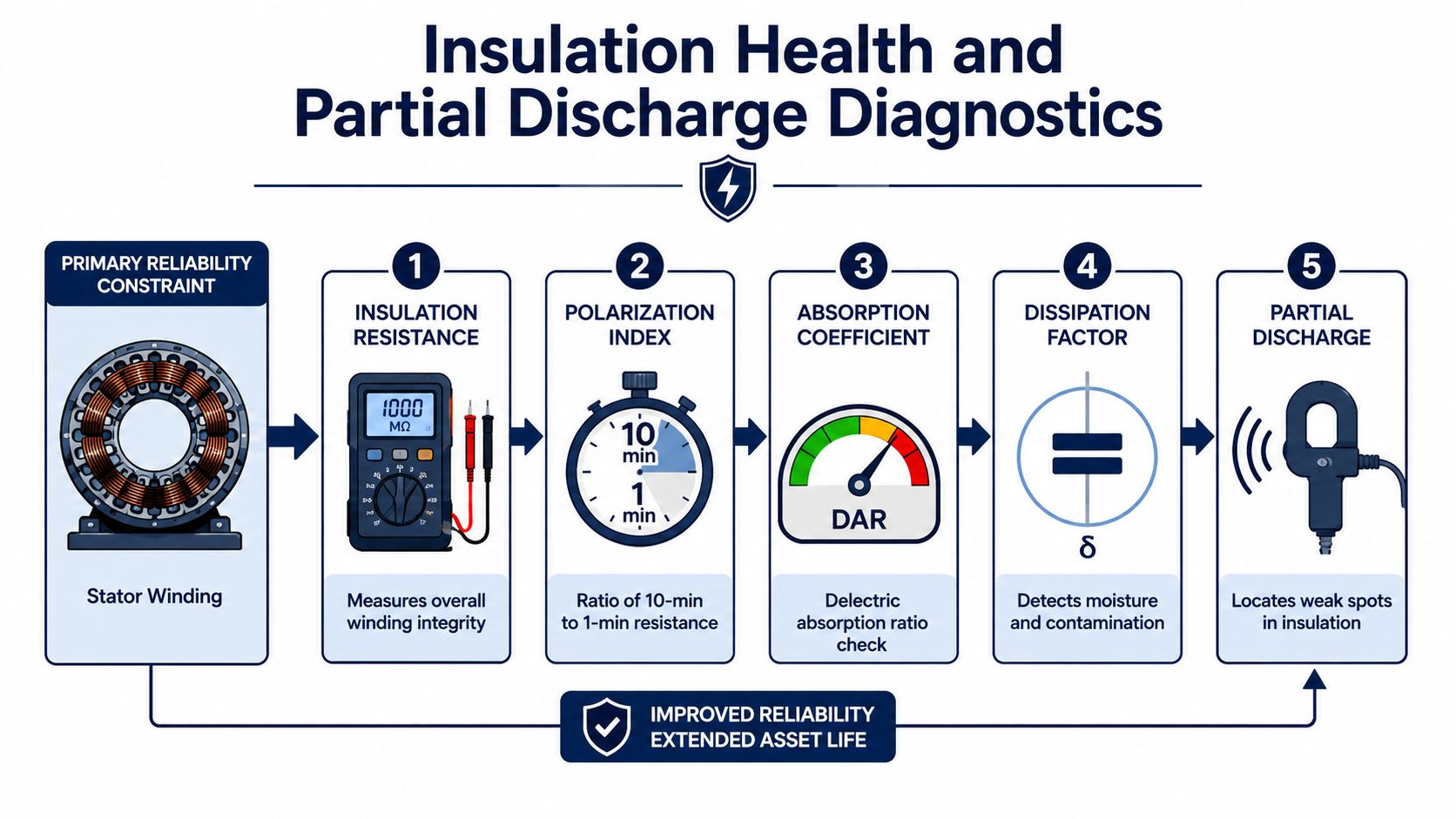
A useful offline program combines several measurements rather than treating partial discharge as a standalone verdict:
- Insulation resistance: Establishes a broad view of winding insulation integrity.
- Polarization index: Compares resistance behavior over time and helps identify contamination or moisture effects.
- Absorption coefficient: Adds another view of dielectric absorption behavior.
- Dissipation factor, or tan delta: Helps expose dielectric losses associated with moisture, contamination, and insulation aging.
- Partial discharge: Locates and characterizes weak activity in the insulation system.
Thresholds only work with consistent testing
Published guidance cited in a long-term study classifies partial-discharge levels above 30 nC as critical, requiring rapid action. A more recent study of 11 kV motors used phase-voltage measurements at 6.35 kV and treated readings below 10,000 pC as acceptable, 10,000 to 30,000 pC as cautionary, and above 30,000 pC as defective, according to the ELMA 2021 study.
Those thresholds aren't interchangeable. Nanocoulombs and picocoulombs describe different scales, and the result also depends on test voltage, sensors, coupling arrangements, noise rejection, and measurement procedure. Keep the test configuration consistent, record environmental conditions, and compare the trend with tan delta, insulation resistance, visual inspection, and ultraviolet evidence where available.
Do not turn one PD number into an automatic replacement decision. First locate the activity, confirm the measurement setup, and determine whether the defect is local and repairable.
The value of condition-based repair is clear in the reported intervention from the same study. Targeted insulation reinforcement reduced measured partial discharge from 77,000 pC to 9,500 pC, an 87.7% reduction, showing that a localized intervention can restore the insulation condition without automatically requiring a complete winding replacement.
Learn more about medium-voltage motor maintenance and diagnostics.
Schedule these tests during planned shutdowns, not after a protection trip. Inspect slot-end stress regions, contamination, loosened bracing, corona protection, and signs of thermal distress. The most useful report does not label the motor good or bad. It explains what changed, where the activity is concentrated, how quickly it is moving, and what action preserves the remaining service life.
<iframe width="100%" style="aspect-ratio: 16 / 9;" src="https://www.youtube.com/embed/Wo6JnpRYvJU" frameborder="0" allow="autoplay; encrypted-media" allowfullscreen></iframe>Starting Behavior, Thermal Stress, and Mechanical Checks
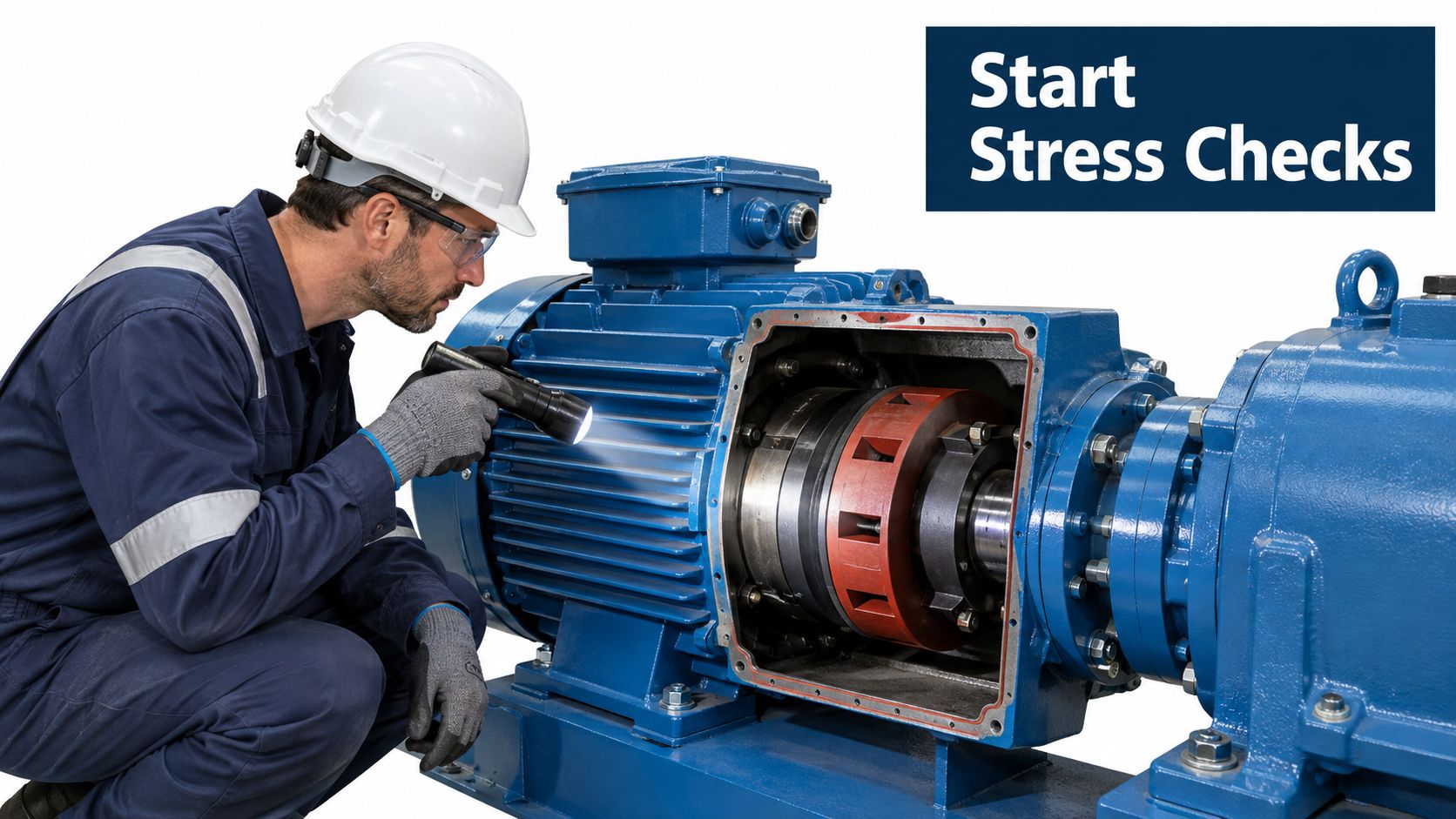
A motor can pass an insulation test and still be at risk during starting. Repeated unsuccessful starts impose thermal stress on windings and mechanical stress on couplings, bearings, shafts, and driven equipment. The protection system may prevent immediate damage, but every failed attempt should be treated as evidence that the starting sequence needs investigation.
The starting method must match the motor, driven load, plant distribution, and drive configuration. Review the starting current profile, acceleration behavior, voltage recovery, protection settings, and restart permissives. A controlled start isn't just an electrical preference. It's a way to prevent a stalled or slow-accelerating machine from spending too long in a high-current, high-slip condition.
Commissioning checks that matter later
Before commissioning or restarting after major work, establish a usable baseline:
- Starting current and acceleration: Capture the start profile and compare acceleration against the expected load behavior.
- Phase voltage balance: Check all phases under relevant operating conditions. Imbalance creates uneven heating and torque.
- Alignment: Verify motor-to-driven-equipment alignment after installation, transport, bearing work, and coupling changes.
- Vibration: Record baseline readings at the motor and driven equipment, then trend changes rather than waiting for an alarm.
- Bearing temperature: Observe temperature rise and stabilization, not just a single spot reading.
- Coupling condition: Inspect fit, lubrication where applicable, flexible elements, guards, and signs of torsional or axial distress.
Large motors often serve process equipment where a single trip has a disproportionate consequence. A compressor train, cooling-water pump, induced-draft fan, or rolling mill may not return to stable operation through an uncontrolled restart. The restart procedure should define who confirms process readiness, who verifies electrical conditions, and what evidence permits another start attempt.
A second start should be a controlled decision, not an automatic response to the first failed start.
Review the drive fault code, motor current, mechanical resistance, process pressure, valve position, and thermal state before trying again. If the cause isn't understood, repeated cycling can turn a correctable control or mechanical problem into winding, bearing, or coupling damage.
Repair, Recondition, or Replace on Site
An aging high voltage motor rarely presents a simple repair-or-replace choice. The practical decision depends on condition, logistics, remaining service life, spare-parts availability, downtime exposure, and whether the associated drive can continue to support the motor safely.
Shipping is often underestimated. A large medium-voltage motor or drive may require specialist lifting, protective packing, transport coordination, disconnection work, and recommissioning after return. If the machine is heavy, difficult to access, or tied to a narrow shutdown window, workshop repair can create more schedule risk than the technical repair itself.
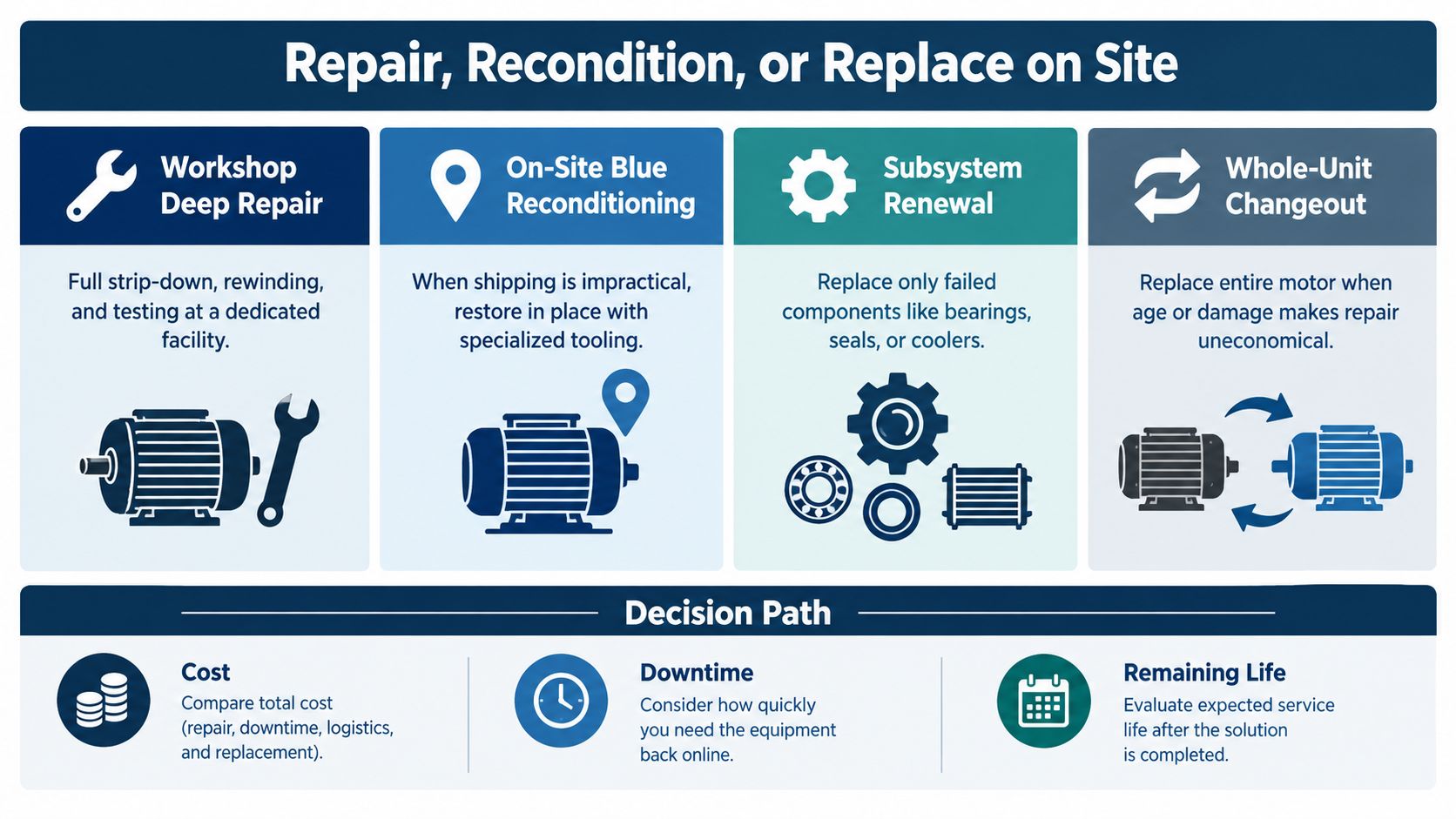
Compare the intervention against the failure evidence
| Option | Best fit | Main trade-off |
|---|---|---|
| Workshop deep repair | The motor needs a full strip-down, rewinding, specialist balancing, or extensive bench testing | Transport and removal can extend downtime and introduce handling risk |
| On-site blue reconditioning | Shipping is impractical and the work can be completed with specialized field tooling | Site conditions, access, cleanliness, and test capability must be controlled |
| Subsystem renewal | Bearings, seals, coolers, sensors, or drive components are the main weakness | It won't solve a fundamentally damaged core or insulation system |
| Whole-unit changeout | Age, damage, unavailable parts, or lifecycle cost make repair uneconomical | Procurement, installation, commissioning, and compatibility work can dominate the schedule |
The decision should start with evidence. High partial discharge, declining insulation resistance, worsening tan delta, bearing wear, vibration growth, repeated failed starts, and drive faults each point toward a different intervention. A motor with localized insulation activity may be a repair candidate. A motor with widespread winding damage and obsolete support equipment may justify replacement.
Include the drive in the same calculation
A motor replacement doesn't automatically solve the system problem if the VFD is also late in life, poorly matched, or unable to produce acceptable output quality. Conversely, renewing serviceable drive subsystems, improving cooling, replacing failed power components, or correcting control issues may extend useful operation without a whole-unit changeout.
The assessment should document:
- Condition: PD trend, insulation trajectory, vibration, bearings, cooling, and mechanical integrity.
- Compatibility: Motor voltage, current, speed range, acceleration profile, cable arrangement, and drive output quality.
- Logistics: Removal route, lifting, transport, workshop capacity, site access, and return commissioning.
- Economics: Repair scope, replacement scope, downtime exposure, spare-parts risk, and expected remaining life.
- Evidence: Test records, fault history, photographs, measurements, and post-work functional results.
Review practical approaches to industrial motor repair.
The right answer may be a staged renewal. Repair the serviceable subsystem during a planned shutdown, improve monitoring, verify the drive, and reserve whole-unit replacement for evidence that the core asset can no longer deliver reliable service. That approach is particularly useful when the motor itself remains structurally sound but its connected drive or auxiliaries are creating avoidable trips.
Regulatory Efficiency Rules and What They Actually Cover
Efficiency rules are easy to overgeneralize. A new procurement requirement for a defined low-voltage motor category doesn't automatically create an obligation to replace an existing high voltage motor that continues to operate safely and reliably.
The policy situation is moving, but coverage depends on jurisdiction, voltage, motor topology, application, test method, and whether the asset is new or already installed. The IEA State of Energy Policy 2026 overview reports that 15 countries changed minimum energy-performance standards in 2025, with several raising requirements to IE3. The same source notes movement toward IE4 for certain 75 to 200 kW motors in the EU and major trading partners.
Those developments don't establish a universal rule for every high voltage machine. A plant team must first determine whether its motor falls inside the regulated category at all. The voltage class and topology may place it outside a rule written for general-purpose low-voltage equipment.
Check the scope before planning replacement
Current industry coverage of the U.S. 2027 DOE rule describes application to specific three-phase motors rated from 1 to 750 horsepower and 600 volts or less. It also identifies exemptions for categories including synchronous, liquid-cooled, submersible, and inverter-only motors. The rule's scope therefore doesn't automatically extend to a high voltage induction motor because both machines are used in industrial service.
Use a written applicability review:
- Jurisdiction: Which national or regional rule governs the purchase or modification?
- Voltage: Does the requirement cover the motor's rated voltage?
- Topology: Is the machine induction, synchronous, liquid-cooled, submersible, or inverter-only?
- Duty: Does the application match the covered service category?
- Status: Is the motor new, rewound, repaired, derated, or already installed?
- Evidence: What test records support the selected efficiency and repair decision?
A higher efficiency class can matter for a new procurement without creating a clear mandate to replace a functioning high voltage motor already in service.
Maintenance teams should also ask how grandfathering applies and whether rewinding changes the regulatory status. Keep the technical file complete, including nameplate data, test method, operating duty, repair scope, and the reason for selecting repair, reconditioning, or replacement. That record supports both compliance discussions and lifecycle decisions.
Reliability Metrics and the Case for Lifecycle Service
Nameplate efficiency is only one part of the reliability picture. A plant that wants fewer forced outages should trend the measurements that reveal deterioration before protection trips: mean time between failures, partial-discharge movement, vibration trend slope, insulation resistance trajectory, bearing temperature, starting behavior, and energy consumption at actual operating load.
Each metric answers a different maintenance question. MTBF shows whether interventions are reducing repeat failures. PD trending shows whether insulation activity is stable or accelerating. Vibration and bearing-temperature trends expose mechanical deterioration. Load-based energy data can reveal changing efficiency, process drift, cooling problems, or drive-related losses that a visual inspection won't find.
Turn shutdown work into a decision process
Preventive care is most effective when it produces an action, not just a report. During a planned shutdown, clean contamination, inspect cooling paths, verify connections, test insulation, review drive condition, inspect the coupling, and compare results with prior records. If the evidence indicates localized deterioration, plan a targeted repair. If the evidence points to systemic aging or unavailable parts, prepare a controlled replacement rather than waiting for a forced outage.
Controlled restart procedures matter just as much. Confirm process readiness, verify the motor and drive state, review the cause of any previous trip, and limit repeated start attempts until the thermal and mechanical conditions are understood. Structured on-site triage can prevent a manageable fault from becoming winding damage or a longer production interruption.
The lifecycle view also changes the VFD calculation. A motor may remain serviceable while its drive needs preventive care, component-level repair, cooling renewal, spare-parts verification, or on-site reconditioning. In other cases, a modern drive may improve controllability but add new requirements for cable suitability, harmonics, insulation stress, and thermal assessment. Compare the complete operating profile and failure consequence instead of treating replacement as an automatic upgrade.
For high voltage motors, condition-based decisions supported by repeatable trends consistently provide a stronger basis than one-shot nameplate comparisons. The objective isn't to keep an old asset running indefinitely. It's to know whether the next intervention should preserve, renew, or replace the asset, and to complete that work before the process discovers the answer for you.
DUCHENG Industrial provides commissioning support, troubleshooting, preventive maintenance, workshop repair, spare-parts assistance, and on-site reconditioning for medium- and high-voltage drive systems connected to industrial motors. If your team is evaluating insulation risk, VFD lifecycle work, or a repair-versus-replace decision, visit DUCHENG Industrial to discuss a condition-based service plan.