
Hire the right industrial electrical contractor for commissioning, MV work, and hazardous environments. Learn scope, hiring criteria, and contract essentials.
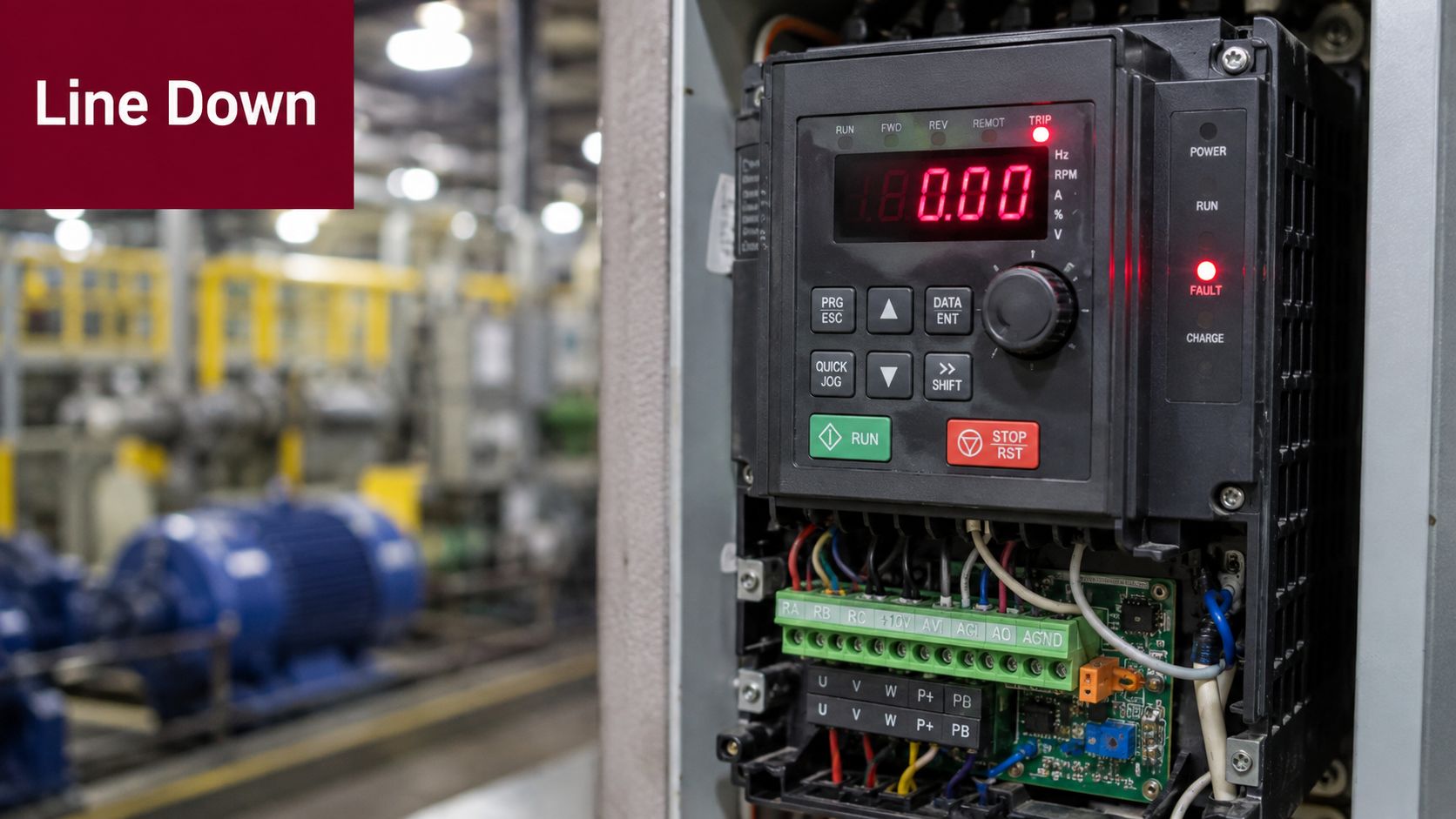
A critical variable frequency drive trips halfway through a high-output shift. The operator sees a fault code, resets it, and watches the same alarm return. Production stops, the maintenance electrician is available, but the unit is a multi-brand medium-voltage drive with stored energy, complex protection logic, and no clear evidence that the fault is inside the drive at all.
That's where the difference between a general electrical contractor and a specialist industrial electrical contractor becomes operationally important. The issue isn't whether someone can terminate cable or replace a component. It's whether the contractor can isolate the fault safely, interpret drive and motor data, control the restart, and leave the asset in a condition that won't produce another trip during the next shift.
Table of Contents
- When a Drive Trip Stops the Line
- The Real Scope of Industrial Electrical Contracting
- Hiring Criteria for Commissioning and Medium-Voltage Work
- Reactive Repair Versus Lifecycle Service Providers
- How the Skills Gap Changes Project Risk
- Writing Contracts That Protect Uptime and Accountability
- The Shift to Embedded Monitoring and Modernization
When a Drive Trip Stops the Line
The first hour after a drive trip usually exposes the strength of a plant's contractor strategy. A generalist may begin by checking visible wiring, cycling power, or replacing a suspected fuse. Those actions can appear decisive, but they can also erase useful diagnostic evidence, repeat a protection event, or place equipment back in service without proving why it failed.
A specialist starts differently. The team confirms the operating state, reviews the fault history, checks the motor and load conditions, verifies isolation, and separates the possible causes into the drive, motor, cabling, control system, and process. That sequence matters because a drive can report a symptom rather than the original cause. A current imbalance, overtemperature event, communication loss, or earth fault may originate outside the converter itself.
Why the restart decision matters
A controlled restart isn't the same as pressing reset. Before authorizing energization, the contractor should establish what was isolated, what was tested, which protective functions operated, and what conditions must be watched during acceleration and loading. The restart plan should identify who has authority to stop the sequence and what readings will confirm stable operation.
Practical rule: Never accept “it reset” as a fault diagnosis. Accept a documented explanation of what was tested and why the restart is safe.
Multi-brand capability is valuable because plants rarely operate a uniform fleet. Older low-voltage units, newer medium-voltage systems, bypass arrangements, PLC interfaces, and motor protection devices may all behave differently. A contractor that knows only one manufacturer's menu structure can lose time or misinterpret a normal interlock as a component failure.
Plant teams can also use a structured variable frequency drive troubleshooting guide to prepare information before the specialist arrives. Record the exact alarm, recent process changes, motor behavior, cabinet condition, and any work performed immediately before the trip. Good evidence shortens the diagnostic path.
The hiring decision is therefore a decision about downtime exposure, safety risk, and equipment life. Headcount alone won't tell you whether a contractor can recover a complex drive. Method, experience across equipment types, and disciplined restart control will.
The Real Scope of Industrial Electrical Contracting
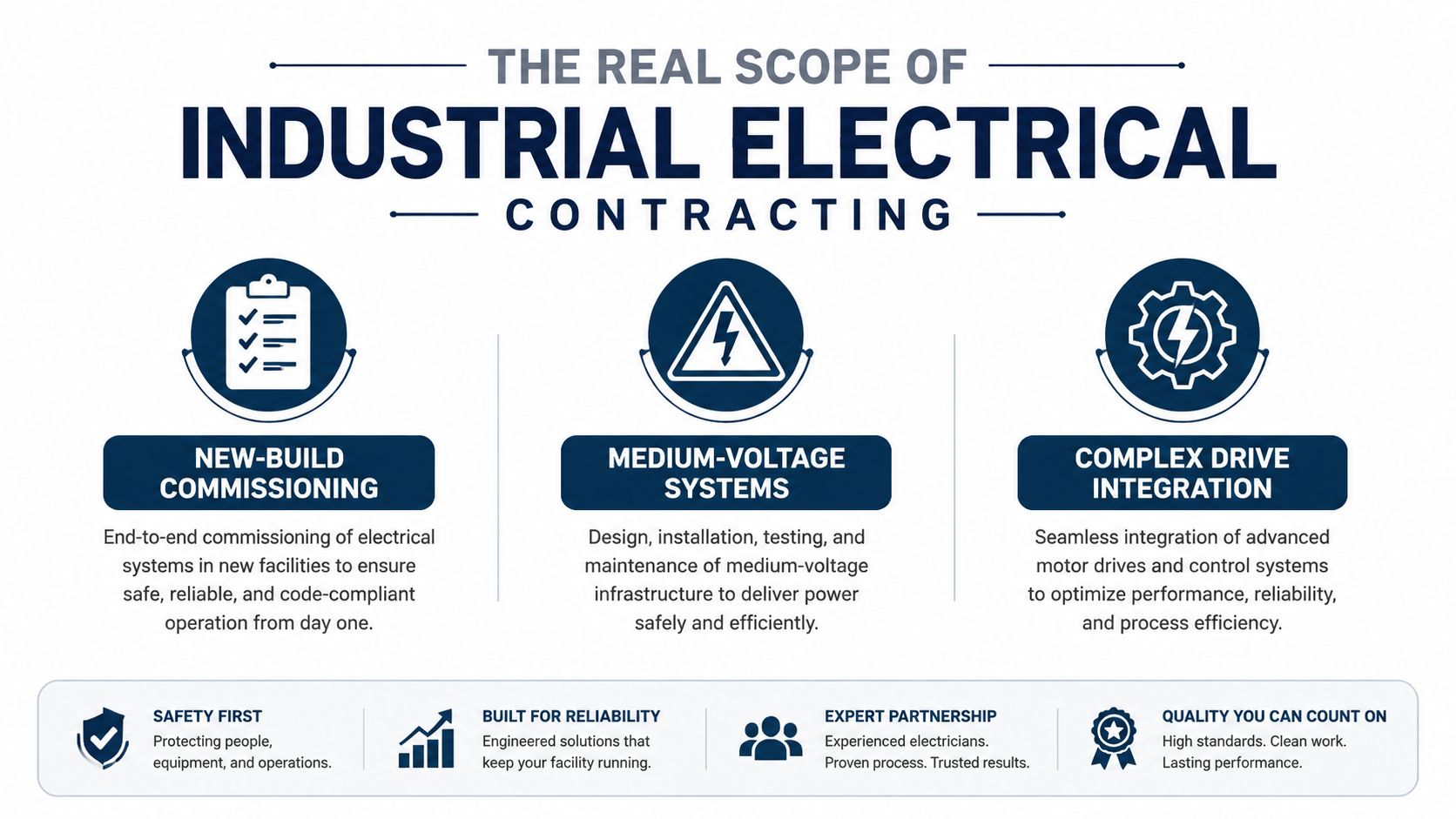
An industrial electrical contractor does far more than install feeders, pull cable, and terminate panels. The work extends from design support and new-build commissioning to medium-voltage testing, hazardous-area execution, motor control, instrumentation interfaces, drive integration, shutdown maintenance, fault recovery, workshop repair, and modernization.
The market's scale reflects how this work is connected to industrial infrastructure. In the United States, the electrical contracting industry includes about 75,000 establishments and generates more than $170 billion in annual revenue, according to industry data on electrical contractors. The same reference notes a projection that global construction volume will grow by 85% to $15.5 trillion by 2030, with the United States, India, and China expected to account for 57% of global growth. Those figures describe the wider construction economy, but they also help explain why industrial electrical capability remains important around factories, utilities, and process plants.
Installation is only the beginning
A project contractor may deliver a system successfully and still lack the capability to support it through years of operation. Industrial service requires a different operating model. The contractor must understand how contamination, thermal stress, vibration, aging components, process changes, and repeated starts affect equipment after handover.
The European sector illustrates the breadth of the profession. It comprises about 2.7 million professionals across 420,000 companies and generates more than €300 billion in turnover, as reported in the EuropeOn sector report. The report also states that merit shop contractors account for roughly 81% of the U.S. electrical contracting market, representing an estimated $232 billion in annual industry revenue and employing nearly three-quarters of the workforce. These figures show a mature, labor-intensive ecosystem, not a narrow specialist trade.
In practice, industrial scope usually includes:
- New-build commissioning: Verify drawings, terminations, protection settings, interlocks, rotation, control logic, and operating sequences before production accepts the system.
- Medium-voltage work: Test, inspect, isolate, troubleshoot, and recondition equipment where transport, access, and energized-system risk require careful planning.
- Drive integration: Coordinate the drive with the motor, PLC, bypass equipment, process controls, protection system, and communications network.
- Lifecycle maintenance: Address cooling paths, fans, terminals, contamination, parameter backups, aging components, and shutdown findings before they become production failures.
- Recovery and repair: Diagnose the complete fault chain, perform component-level repair where appropriate, and verify the finished unit under controlled conditions.
Commercial and residential work often has a defined installation endpoint. Industrial contracting has a service-life responsibility. The right provider understands the equipment's original commissioning records, recurring alarms, spare-part history, operating environment, and upgrade options. That continuity is what turns an installation into a maintainable asset.
Hiring Criteria for Commissioning and Medium-Voltage Work
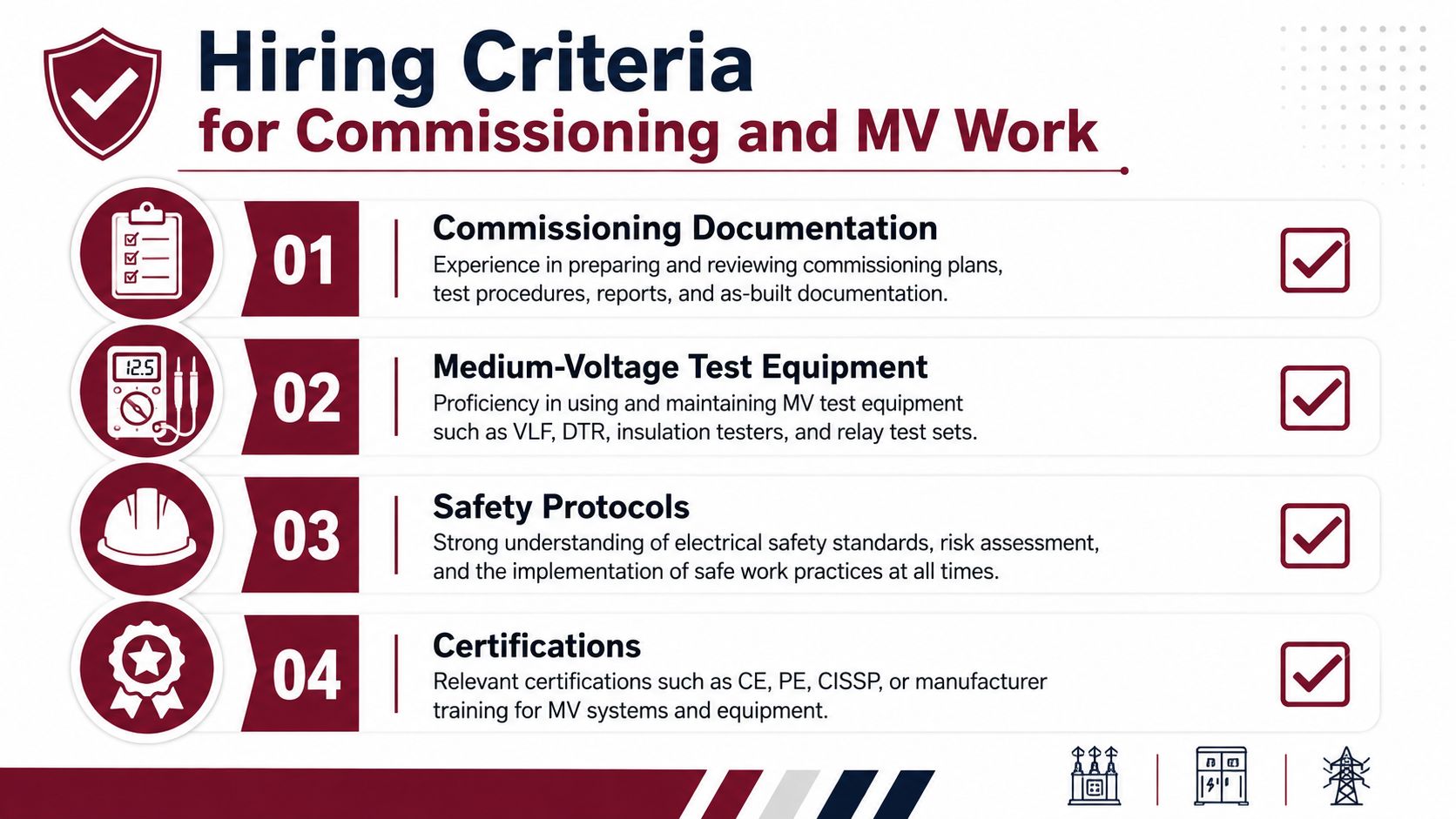
A polished proposal can conceal weak field capability. Before awarding work, require evidence that the contractor can manage commissioning, medium voltage, hazardous areas, and large drives under actual plant conditions. Installation skill alone does not show whether the team can diagnose a recurring trip or recondition equipment during a shutdown.
Start with commissioning readiness
Request the actual commissioning workflow, not a promise to “support startup.” The contractor should show how it reviews drawings, verifies terminations, checks protective and control circuits, confirms parameters, tests interlocks, coordinates with operations, and records the handover. Use this VFD commissioning checklist to structure the request and identify missing steps.
Startup coverage must continue through the first operating sequence. Production escort support means the team remains available after energization, observes the equipment under load, responds to alarms, and identifies who can authorize a controlled stop. Confirm the named personnel, shift coverage, escalation route, and records required before production accepts the system.
Require a defined fault method. It should identify the source, apply suitable diagnostic techniques, isolate the problem to the unit or component level, and replace only damaged or defective items, consistent with the standard fault-diagnosis requirements. Put those steps in the evaluation criteria and scope of work.
Test medium-voltage depth
For large drives, ask whether the contractor can perform on-site reconditioning when transport is impractical. The response should define the work boundary, isolation requirements, test equipment, replacement decisions, functional tests, and documentation. A contractor limited to removal and off-site repair may add transport risk, scheduling exposure, and outage time.
Ask for comparable site experience, including contamination and environmental conditions. High salinity can attack exposed and internal electrical surfaces. Carbon-black contamination can enter cooling paths and affect insulation, thermal performance, and cleanliness. The contractor should explain its inspection, cleaning, testing, and serviceability decisions.
Use a prequalification checklist:
- Hazardous-area competence: Verify qualifications, work controls, equipment-selection knowledge, and permit discipline for classified locations.
- Multi-brand drive experience: Ask which low-, medium-, and high-voltage systems the field team has diagnosed, rather than which products the company has sold.
- Test-equipment readiness: Confirm that meters, insulation-testing equipment, protection-test equipment, and drive-specific diagnostic aids are available and calibrated.
- Handover quality: Require parameter backups, test records, alarm histories, as-left settings, useful photographs, and an open-items register.
A disciplined contractor also states its limits. Refusing an uncontrolled reset or unsupported component substitution protects the equipment and gives the plant a clearer basis for approving the next action.
Reactive Repair Versus Lifecycle Service Providers
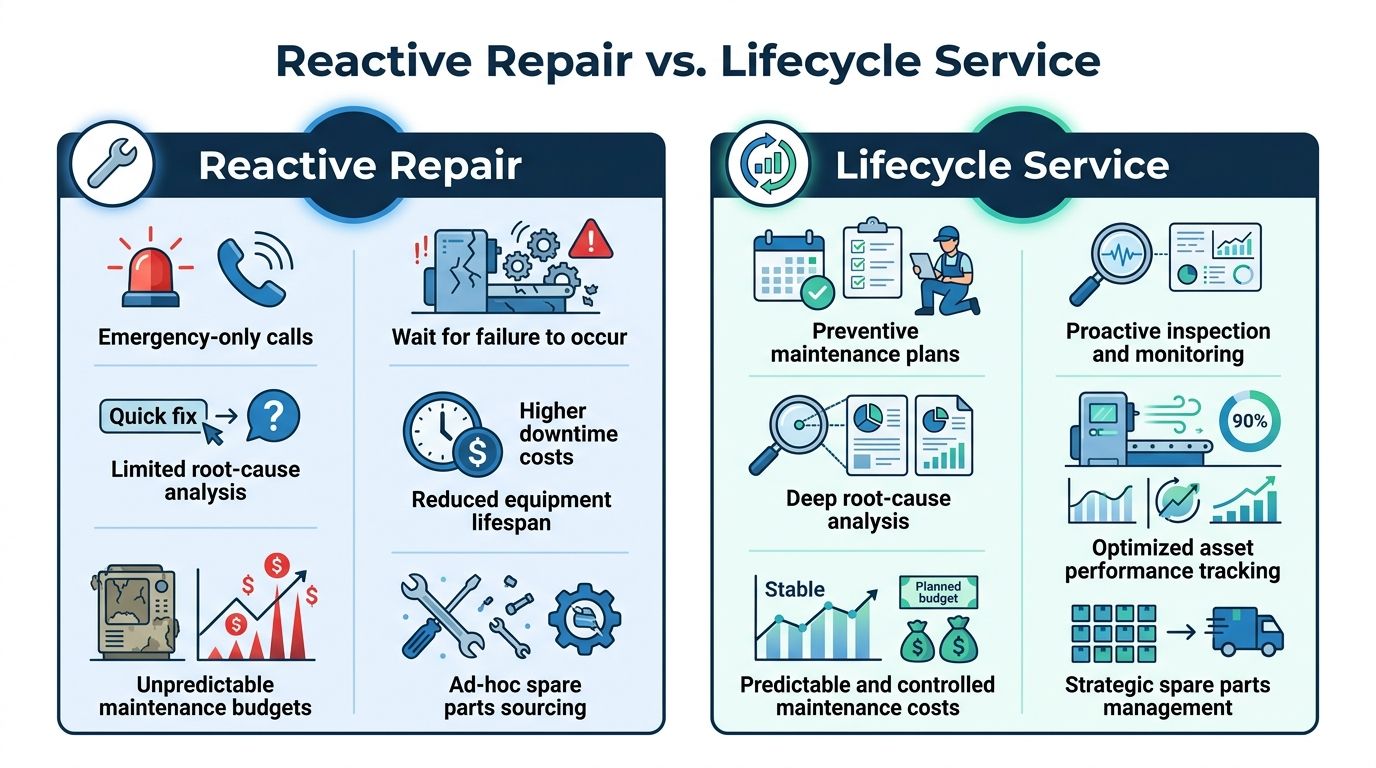
A drive trips during production, the line stops, and the first available contractor is asked to restore operation. That response has a place. The contractor must mobilize, make the equipment safe, identify the immediate fault, and return the asset to service when conditions allow. The risk begins when emergency attendance becomes the entire maintenance strategy.
A reactive contractor usually receives limited history, arrives after the event, identifies the most visible symptom, and works toward the fastest available restoration. That approach may suit a minor fault. It is less reliable for a complex drive, an intermittent trip, an uncertain replacement part, or equipment with repeated failures. Speed without structured diagnosis can leave the initiating condition untouched.
A lifecycle service provider works from a continuing asset record. Commissioning data, parameter files, fault histories, inspection findings, and repair reports support each later decision. Planned shutdown inspections expose developing problems, while repair findings shape future maintenance. The same provider can assess whether a subsystem is repairable, whether on-site reconditioning is practical, or whether replacement is justified.
What the two models demand
| Reactive repair | Lifecycle service |
|---|---|
| Emergency-only calls | Planned maintenance during shutdowns |
| Limited historical context | Asset records and recurring-fault review |
| Replace the suspected part | Isolate the failed subsystem before replacement |
| Workshop shipment by default | On-site reconditioning where transport is impractical |
| Restart and close the ticket | Verify operation and track follow-up actions |
Cooling and connection details show why the distinction matters. Dust buildup restricts airflow, fan bearing noise can indicate developing failure, and loose terminals create resistive heating that raises overtemperature risk. A maintenance program should set inspection intervals, include deeper cleaning when required, replace worn fans, and preserve parameter backups, consistent with the practices described in industrial drive maintenance guidance.
Preparation before dispatch also affects outage time. The team should identify the exact spare, review compatibility, check whether an exchange unit matches the application, and verify the part before sending it to site. A rapid response with an unusable part still leaves the plant waiting and may distract the investigation from the original fault.
The commercial trade-off is clear. Reactive work may appear cheaper because the plant buys a response only when something fails. Lifecycle service requires planning, records, inspections, and technical review, but those activities create more opportunities to find risk before a production window. For medium-voltage drives, on-site reconditioning may also avoid the transport, handling, and scheduling complications of sending large equipment to a remote workshop.
The video below provides an additional visual reference for comparing emergency response with planned service management.
<iframe width="100%" style="aspect-ratio: 16 / 9;" src="https://www.youtube.com/embed/K7xnNQPOlLk" frameborder="0" allow="autoplay; encrypted-media" allowfullscreen></iframe>A useful provider should explain the failure mechanism, identify the evidence behind that conclusion, and specify the action that will reduce recurrence. That standard separates a documented lifecycle response from a temporary reset or parts replacement.
How the Skills Gap Changes Project Risk
A shutdown can lose hours before anyone identifies the fault. A contractor may have enough electricians on its roster, yet lack a technician who can diagnose a mixed-vendor drive fleet, interpret a medium-voltage protection event, and control a safe restart while production is waiting. Headcount measures availability. It does not prove field competence.
Recent UK industry data gives the problem a concrete shape. Thirty-seven percent of UK electrical-business respondents identified a significant shortage of qualified electricians as the biggest obstacle to growth, according to an industry survey from the Electrical Contractors' Association. Separate industry reporting states that England's electrical workforce fell 26.2% from 2018 to 2024, while demand continued to exceed apprentice starts, as reported in coverage of the apprenticeship shortfall.
Those figures do not predict the length of a particular outage. They do explain why specialist depth affects project risk. An inexperienced technician facing a complex trip may gather the wrong evidence, replace a serviceable component, or restart the equipment without correcting the initiating condition. The plant then carries both the original lost production and the risk of another failure.
Probe the contractor's depth
Ask who will attend before the purchase order is issued. Request role descriptions, drive experience, escalation contacts, and anonymized examples of diagnostic records. The contractor should show how field engineers share knowledge, preserve fault histories, and transfer a problem to a senior specialist when the first technician reaches the limit of their authority.
A capable support model includes:
- Named technical escalation: Identify the person who can review difficult faults during a live event.
- Documented diagnostics: Require fault trees, test records, isolation points, and restart conditions rather than a short “repaired” note.
- Remote preparation: Use a controlled information channel to collect alarm codes, photographs, parameters, drawings, and operating history before dispatch.
- Emergency coverage: Confirm how a 24-hour contact handles triage, safety decisions, parts checks, and handover between shifts.
Ask where the contractor's competence stops. The response should cover energized work, hazardous areas, and medium-voltage isolation, including who holds authority for each decision. A cautious boundary is safer than a vague promise to handle everything.
The practical bottleneck includes the availability of field-ready specialists who can turn evidence into a safe decision. Procurement teams should test that capability before mobilization, not discover its absence during a shutdown.
Writing Contracts That Protect Uptime and Accountability
A scope of work should describe decisions, evidence, and handover, not only tasks. “Troubleshoot and repair the drive” leaves too much room for disagreement about what was tested, what was replaced, and whether the plant received a reliable restart.
Start with the asset boundary. Identify the drive, motor, transformer or incoming supply, bypass equipment, control interfaces, communications, auxiliaries, and process signals included in the contractor's responsibility. State which party controls isolation, permits, switching, production coordination, and final authorization to return the equipment to service.
Put the diagnostic method in writing
The contract should require the contractor to isolate the fault before dismantling or replacing components. It should also require a written record of the original alarm, test results, failed or serviceable items, parameter changes, and conditions for a controlled restart.
For commissioning and shutdown work, define the handover package before mobilization. Include approved procedures, inspection records, test sheets, as-left settings, parameter backups, open actions, and operator briefing requirements. If the contractor can't produce those documents, the plant may inherit an operational system without a usable service history.
Use clear language for repair location. If on-site reconditioning is possible, specify the conditions, tools, test equipment, cleanliness controls, and acceptance tests. If workshop repair is necessary, define packing, transport responsibility, incoming inspection, repair reporting, functional testing, and exchange-unit compatibility.
| Contract element | What to specify | Why it matters |
|---|---|---|
| Response and escalation | Contact route, triage information, escalation authority, and emergency coverage | Prevents uncertainty during a live outage |
| Diagnostic procedure | Isolation sequence, evidence collection, testing, fault confirmation, and restart approval | Reduces misdiagnosis and uncontrolled resets |
| Commissioning handover | Test records, parameters, interlock results, alarms, and open actions | Gives operations a defensible as-left record |
| Medium-voltage reconditioning | On-site or workshop boundary, test equipment, cleanliness controls, and acceptance criteria | Controls transport exposure and repair quality |
| Spare parts | Identification, compatibility review, pre-dispatch verification, and return process | Avoids sending an unsuitable part to site |
| Multi-brand capability | Required drive families, auxiliaries, and escalation arrangements | Prevents single-vendor experience from limiting diagnosis |
| Hazardous-area work | Qualifications, permits, equipment controls, and documentation | Aligns technical work with site safety requirements |
| Warranty and recurrence | Repair warranty, repeat-fault review, exclusions, and corrective-action process | Connects payment to accountable outcomes |
Make acceptance measurable
Avoid making “production restored” the only acceptance criterion. A unit may run briefly while still carrying unresolved thermal, insulation, communication, or mechanical risk. Require the contractor to define what stable operation means for the application, what readings must be captured, and what follow-up inspection is required.
Payment milestones can also reflect the work sequence. Separate mobilization, diagnosis, repair, testing, commissioning support, and final documentation. That structure discourages premature closure and gives the plant an advantage when records or tests are incomplete.
Finally, write the escalation path for disagreements. If the contractor recommends replacement, require the evidence behind that recommendation and an assessment of repairable subsystems. A good contract preserves technical options while keeping safety and accountability clear.
The Shift to Embedded Monitoring and Modernization
A drive can keep running while its condition worsens. By the time a trip stops production, the plant may already be carrying thermal stress, insulation weakness, contaminated cabinets, or a recurring mechanical fault. Industrial drive service therefore has to cover more than repair. The practical questions are how deterioration will be detected, how signals will be verified, and whether the asset should be maintained, reconditioned, modernized, or replaced.
Recent drive developments support that approach. Embedded electrical signature analysis is being introduced in modernized drives to support predictive maintenance across motors, pumps, fans, mixers, and conveyors. Academic review evidence discussed in reporting on embedded drive monitoring indicates that digital-twin-based motor monitoring can improve fault-detection accuracy by up to 25% and reduce downtime by 15% to 30%.
Those results do not justify applying one monitoring package across every legacy fleet. Mixed-vendor plants may have separate communication paths, incomplete maintenance records, older control systems, and drives that were never designed to exchange data within a modern architecture. Start with an asset review. Identify available signals, select equipment that merits added sensing, define how readings will be validated, and assign responsibility for responding to alerts.
Modernization needs a service plan
A lifecycle contractor should connect the upgrade assessment with a data-integration plan, condition-monitoring method, and staged renewal of serviceable subsystems. Monitoring has value when it supports a defined maintenance decision, such as scheduling a fan replacement, investigating a motor signature, cleaning a contaminated cabinet, or planning an orderly drive upgrade.
For legacy equipment, embedded monitoring may not be the right first step. A disciplined inspection routine, parameter backup, thermal review, terminal inspection, and reliable fault history can establish the baseline for later integration. Extra alarms without an assigned response only increase workload.
The industrial electrical contractor of the future needs safe field execution and enough systems knowledge to connect findings with maintenance decisions. Select a provider for long-term reliability partnership, not a series of emergency callouts.
DUCHENG Industrial provides multi-brand VFD commissioning, structured troubleshooting, preventive care, workshop repair, and on-site reconditioning for medium- and high-voltage drives across China and Southeast Asia. For help defining a lifecycle service scope, preparing a shutdown plan, or assessing a mixed-vendor drive fleet, visit DUCHENG Industrial.