
Explore industrial equipment maintenance services like preventive, predictive, and corrective strategies to optimize uptime.
A production line rarely announces that it's about to stop. A drive trips during a run, the operator sees a fault code, and the maintenance team starts working backward from the only fact that matters in the moment: production has stopped. The repair bill may be manageable, but the exposure includes lost output, rushed decisions, safety pressure, unavailable parts, and the possibility of restarting with the original fault still present.
That's why industrial equipment maintenance services have moved beyond periodic cleaning and emergency repair. A reliable program connects condition monitoring, skilled diagnosis, controlled intervention, spare-parts planning, and lifecycle decisions. The practical question isn't whether a plant should maintain its equipment. It's how to choose the right intervention, in the right place, before a manageable defect becomes a forced outage.
Table of Contents
- The Reality of Unplanned Downtime
- Core Categories of Maintenance Services
- On-Site Reconditioning Versus Workshop Repair
- Evaluating Service Provider Capabilities
- The Digital Shift in Maintenance Workflows
- Strategic Asset Lifecycle Management
The Reality of Unplanned Downtime
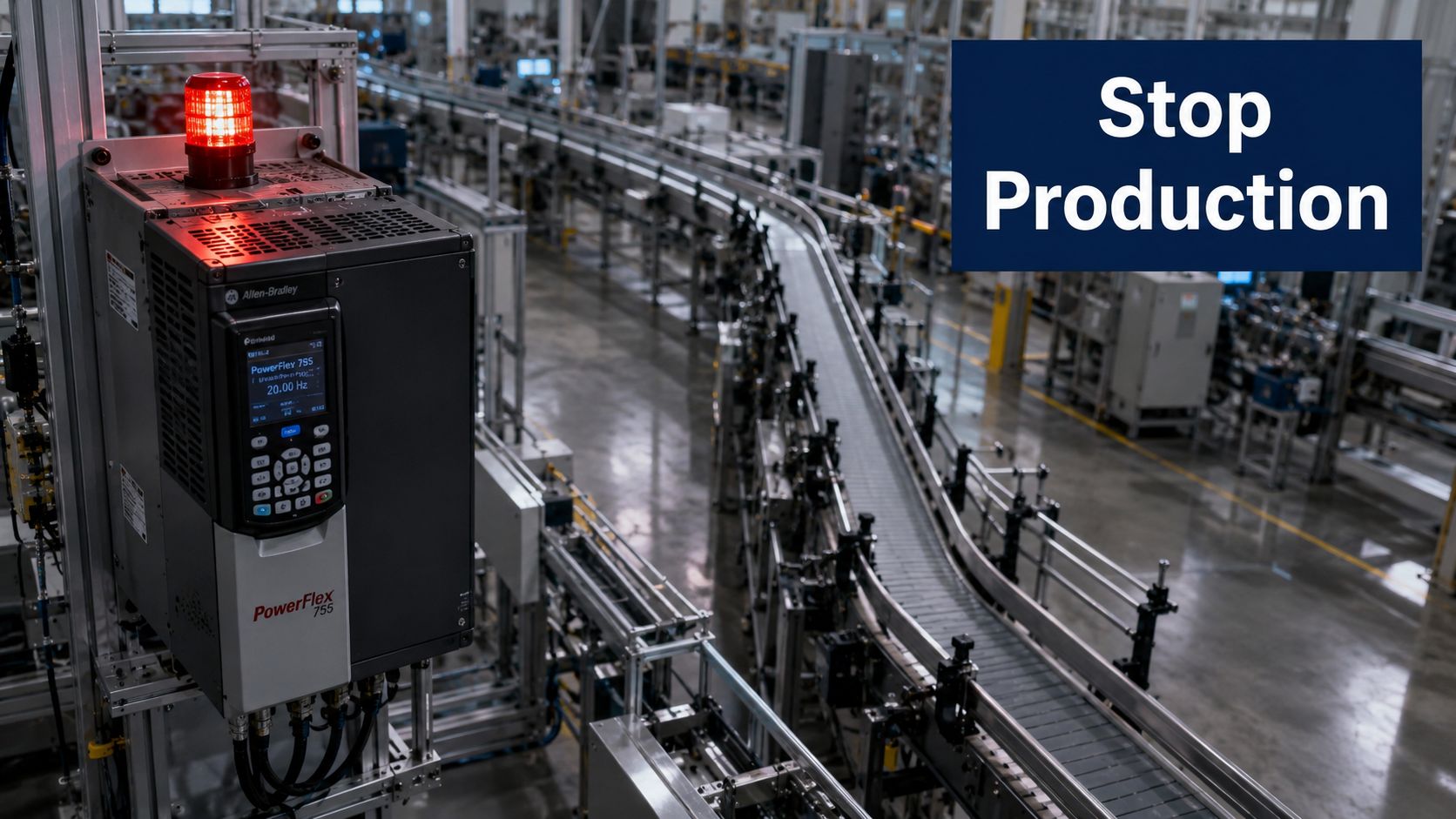
A production line can stop before the crew sees a clear warning. A variable frequency drive may trip after heat has accumulated inside the cabinet, conductive dust has restricted airflow, or a cooling fan, capacitor, connection, or power module has degraded. The trip is immediate. The cause may have been developing for weeks or months.
The first response is often improvised. An electrician checks incoming power, an automation engineer reviews fault history, and a technician looks for visible cabinet damage. Operations wants a restart estimate while procurement searches for a compatible replacement. A quick restoration has value, but returning the drive to service without identifying the initiating condition can leave the same failure waiting in the enclosure.
The cost extends beyond the repair
A failed drive creates several problems at once:
- Production disruption: The affected machine may stop, while upstream and downstream processes lose their operating sequence.
- Safety exposure: Emergency troubleshooting creates time pressure, unfamiliar work conditions, and a need for strict isolation and verification.
- Quality risk: A rushed restart can cause unstable speed control, process variation, or rejected material.
- Resource strain: Maintenance personnel may abandon planned work for the emergency, allowing other risks to accumulate.
- Parts uncertainty: A replacement unit may not match the motor, application, firmware, communications, or control configuration.
The scale of the service category reflects the operational burden of equipment failure. One market estimate valued industrial maintenance services at USD 54.47 billion in 2024, with projections reaching USD 73.72 billion by 2029 and USD 97.66 billion by 2034. Asia-Pacific represented 36.40% of the market in 2024, according to the industrial maintenance services market estimate. Another estimate placed the 2024 market at USD 141.55 billion and projected USD 199.45 billion by 2033. The differing estimates use different market definitions, but both point to sustained demand as industrial facilities expand and modernize.
Reliability starts before the trip
A maintenance team should treat the drive as part of a system. The motor, load, ventilation, cabinet environment, control logic, incoming supply, braking arrangement, and operating profile all affect failure risk. Inspection should therefore cover both the physical asset and the conditions around it before anyone recommends repair, replacement, or continued operation.
The location of the work also affects the decision. On-site reconditioning can reduce removal time and preserve application-specific configuration, but it may expose technicians to restricted access, contamination, limited test equipment, and pressure to return the line to service. Workshop repair provides better control for cleaning, component testing, calibration, and final verification, yet removing the unit can extend downtime and introduce transport or rewiring risks. Digital monitoring helps identify changing temperature, current, alarm, and vibration patterns, but those signals only create value when technicians can inspect, recondition, test, and document the equipment in the field or workshop.
Practical rule: A fast restart is valuable only when the team understands why the equipment stopped and has controlled the conditions that could make it stop again.
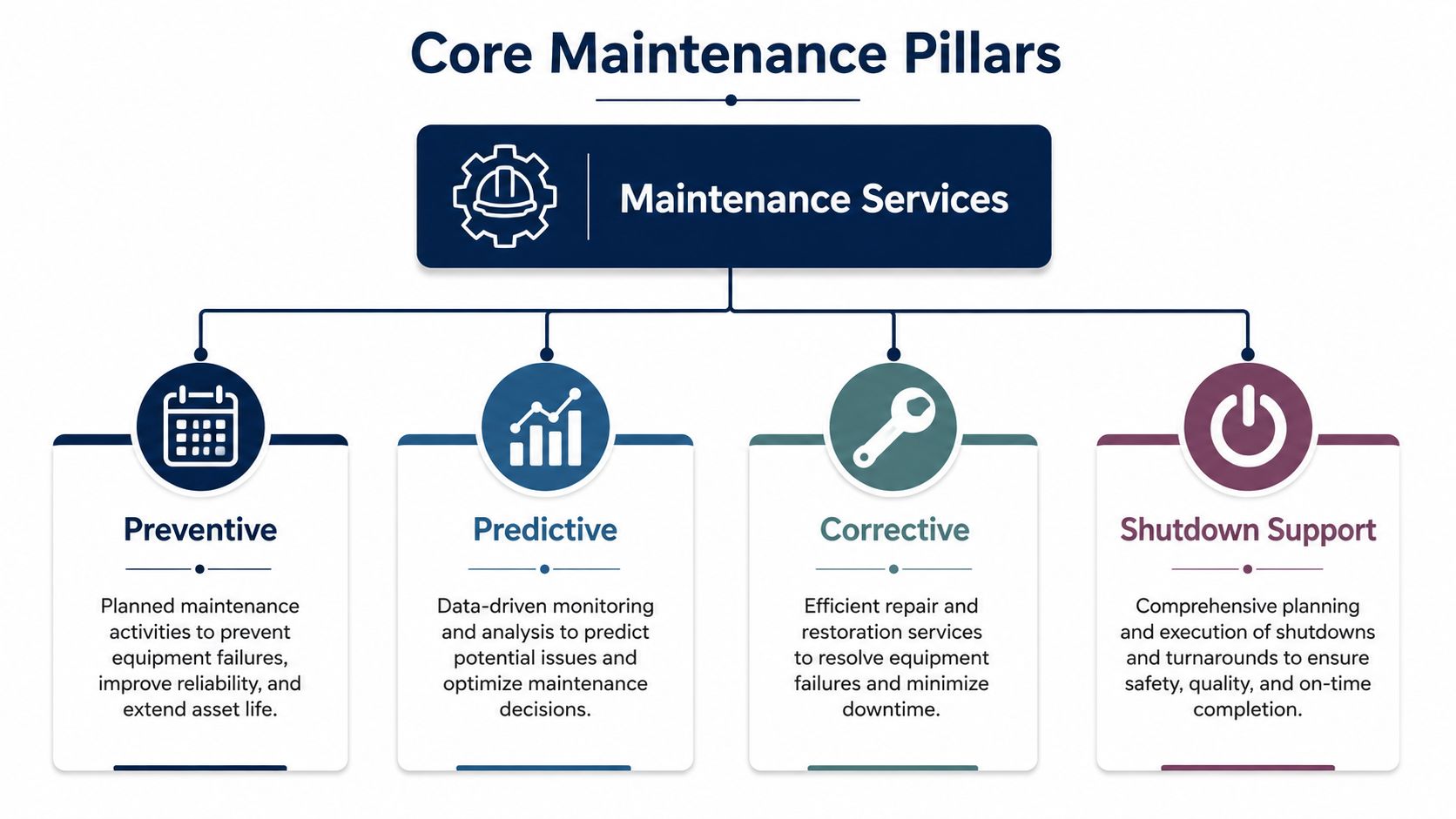
Lifecycle maintenance gives the plant a way to manage that risk. Preventive inspections address known deterioration mechanisms. Predictive monitoring identifies changing conditions. Corrective repair restores function after a defect is found. Shutdown support creates the time and access needed for deeper work safely. Together, these services connect digital evidence with physical execution, protecting uptime, people, and asset value.
Core Categories of Maintenance Services
Industrial equipment maintenance services work best when each maintenance mode has a defined purpose. No single approach is suitable for every drive, motor, control cabinet, or production process. A critical asset may need regular physical cleaning, continuous condition monitoring, corrective expertise, and planned shutdown assistance at different points in its lifecycle.
Preventive maintenance
Preventive maintenance uses scheduled inspections and service tasks to control predictable deterioration. In VFD systems, that can include cabinet cleaning, filter inspection, fan checks, torque verification, thermal inspection, connection examination, and review of alarm history. The work is particularly important in plants exposed to conductive dust, high salinity, vibration, heat, or unstable environmental conditions.
A preventive schedule shouldn't be copied blindly from a generic calendar. The technician should consider loading, enclosure design, ambient conditions, duty cycle, access limitations, and the consequences of failure. A maintenance plan that looks complete on paper can still fail if it ignores the actual contamination and thermal conditions around the equipment. A practical VFD maintenance schedule should connect inspection frequency to asset criticality and observed condition.
Predictive maintenance
Predictive maintenance uses measured condition data to identify deterioration before functional failure. Relevant signals can include temperature, vibration, insulation condition, current behavior, fault frequency, cooling performance, and process response. The value doesn't come from collecting data alone. Someone must define alert thresholds, validate the diagnosis, plan the intervention, and confirm the result after repair.
Predictive maintenance can reduce overall maintenance costs by 20% to 30% and cut unplanned downtime costs by 15% to 25% through early fault detection, according to the predictive maintenance statistics summary. Those results depend on execution. A sensor that raises an alert without a work process, parts plan, or qualified responder merely creates another unattended notification.
Corrective maintenance
Corrective maintenance restores an asset after a defect has been identified. It may involve replacing a cooling fan, repairing a power section, correcting a control issue, resolving an insulation problem, or rebuilding a drive in a workshop. Corrective work becomes more effective when the provider records the fault chain, test results, removed parts, configuration data, and restart conditions.
The distinction between planned and emergency corrective work matters. Planned correction allows isolation, parts preparation, risk review, and testing. Emergency correction compresses all of those activities into a live production crisis, so the organization needs clear escalation procedures and controlled restart steps.
Shutdown support
Shutdown support concentrates skilled labor and inspection effort inside a limited outage window. Teams may clean and inspect multiple drives, verify spare units, test control interfaces, renew aging subsystems, and support commissioning before the line returns to service.
Use the shutdown to remove known risk, not to create new uncertainty. Every intervention should have a defined scope, isolation plan, test method, acceptance criteria, and rollback decision. The strongest programs combine preventive care with predictive findings, so the team spends shutdown time on assets that need it most rather than treating every unit identically.
<iframe width="100%" style="aspect-ratio: 16 / 9;" src="https://www.youtube.com/embed/S3rf9aa6Ca0" frameborder="0" allow="autoplay; encrypted-media" allowfullscreen></iframe>On-Site Reconditioning Versus Workshop Repair
The decision to repair a failed drive on-site or send it to a workshop is operational, not merely technical. A workshop may offer a controlled environment, deeper disassembly, specialized test equipment, and access to component-level repair. On-site reconditioning may protect a narrow shutdown window, avoid transport risk, and keep a large or high-voltage asset in the plant where its configuration and connections are known.
When on-site work is the safer choice
On-site reconditioning is often appropriate when the asset is large, difficult to remove, or connected to a process that can't tolerate an extended outage. Medium-voltage drives can involve substantial lifting, specialized transport, environmental protection, and reconnection work. Each movement creates an opportunity for mechanical impact, moisture exposure, connection damage, or configuration loss.
The plant also retains valuable context. Technicians can inspect the installed cabinet, cable terminations, cooling path, grounding, surrounding equipment, and operating environment while performing the work. That context helps distinguish an internal drive defect from an external cause such as poor ventilation, contamination, load stress, or an upstream electrical problem.
When the workshop earns its place
Workshop repair is preferable when the unit needs full disassembly, bench diagnostics, extensive component replacement, or controlled functional testing that can't be performed safely or efficiently in the plant. It also makes sense when the shutdown window is long enough to accommodate removal and return, or when the repair requires equipment and environmental controls that aren't available on-site.
The risk is logistical. The plant must confirm packaging, lifting, transport, insurance, receiving, repair scope, return testing, and reinstallation. A workshop repair can be technically excellent and still fail operationally if the unit returns late, arrives with incomplete records, or lacks the correct configuration for the application.
A decision based on risk, not habit
Use these questions before selecting the repair route:
- Asset size and voltage: Can the unit be removed without introducing unacceptable lifting or transport risk?
- Outage duration: Is the available shutdown long enough for disconnection, shipping, repair, testing, and reinstallation?
- Failure depth: Does the evidence point to a replaceable field issue, or is full bench disassembly required?
- Site conditions: Can technicians work safely with the available isolation, access, cleanliness, and test arrangements?
- Configuration control: Are firmware, parameters, schematics, protection settings, and application records available?
- Return-to-service risk: Which option provides the stronger post-repair test and controlled restart process?
Condition monitoring can raise equipment availability from 92.4% to 97.8% and increase MTBF by 28.5% across equipment categories, according to the condition-based monitoring case report. The lesson isn't that one repair location always wins. Better condition information gives the plant more time to choose intelligently, prepare parts, and align the intervention with the shutdown rather than reacting after damage has spread.
Evaluating Service Provider Capabilities
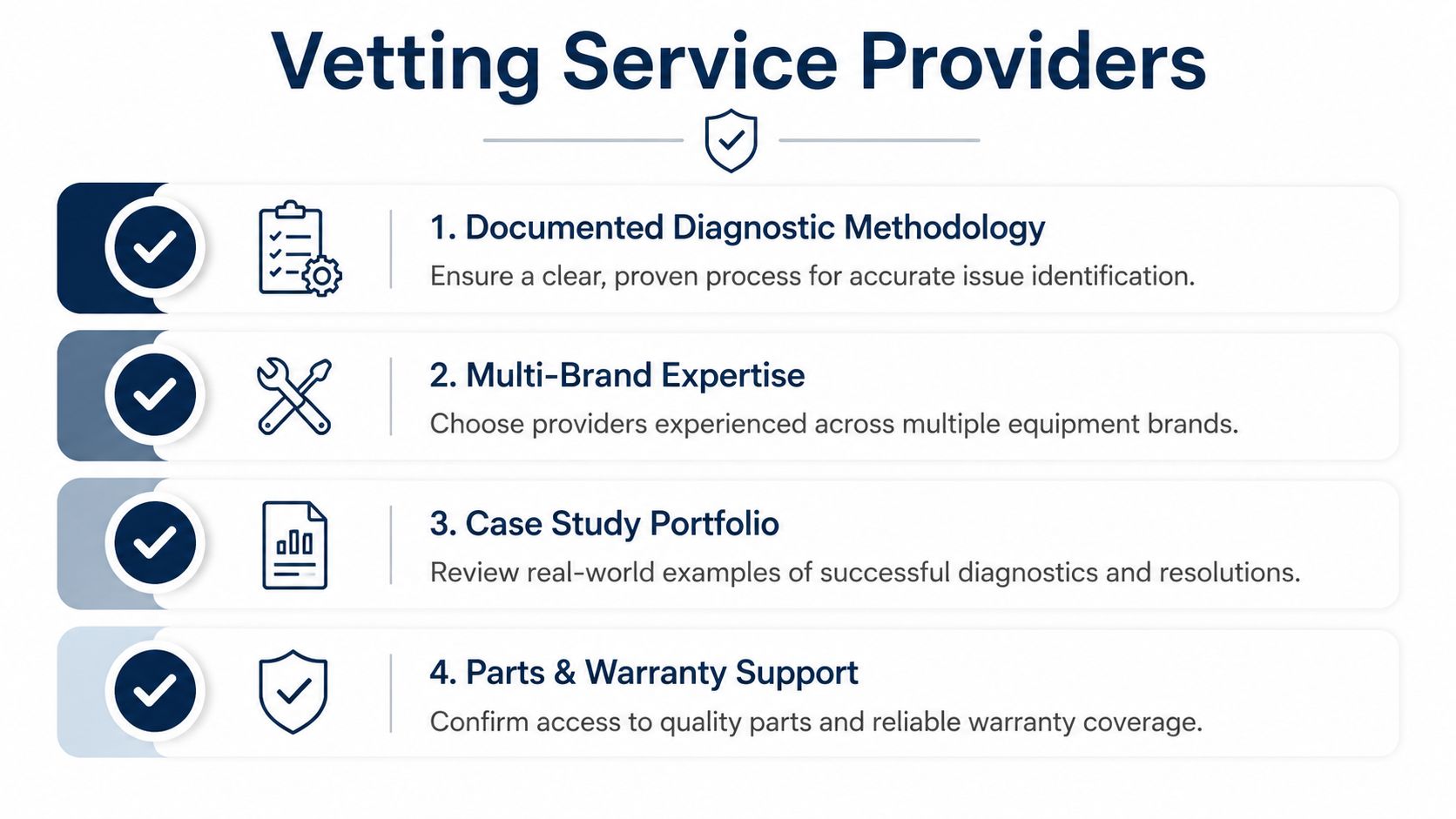
A maintenance provider should be assessed by how it makes decisions under pressure, not by how polished its capability statement looks. Plant managers need evidence that the provider can isolate faults, protect people, preserve configuration data, and support the equipment after the repair is complete.
Start with diagnostic discipline
Ask the provider to show how it moves from a fault indication to a repair decision. A documented methodology should cover safe isolation, visual inspection, alarm and event review, electrical testing, environmental assessment, configuration capture, root-cause analysis, and post-repair verification.
The provider shouldn't recommend a restart merely because the fault can be cleared. It should identify the evidence supporting the restart, define the limits of operation, and state what conditions would require the equipment to be removed from service. That distinction separates troubleshooting from controlled recovery.
Test multi-brand competence
Plants often contain drives from different generations and manufacturers. A provider with multi-brand capability can evaluate the application rather than forcing every problem into one product-specific process. Ask whether technicians understand low-, medium-, and high-voltage systems, auxiliary equipment, motor interfaces, communications, protection, and control integration.
Multi-brand expertise also helps during replacement decisions. The technically correct answer may be a repair, a compatible exchange unit, a subsystem upgrade, or a full changeout. The provider should explain the trade-off and identify compatibility risks before equipment arrives at the site.
Examine execution records
Request anonymized work reports, test sheets, photographs, parts records, and restart documentation. A useful report should show what the technician found, what changed, which tests were performed, and what follow-up actions remain open.
Look for evidence of production escort capability during commissioning and restarts. A provider that stays available through controlled energization, parameter verification, motor testing, and monitored production response can help prevent a successful repair from becoming an unstable restart.
Check the practical support system
Service quality depends on logistics as much as technical skill. Verify how the provider handles:
- Parts verification: Compatibility, revision, voltage class, application fit, and pre-dispatch inspection should be checked before shipment.
- Warranty boundaries: The proposal should distinguish workmanship coverage, component coverage, exclusions, and required operating conditions.
- Regional response: Confirm where technicians and support resources are located, especially for facilities operating across multiple countries.
- Harsh environments: Ask how the team handles salinity, carbon-black contamination, heat, dust, vibration, and restricted access.
- Digital records: Work orders, fault histories, test results, and asset documentation should remain available to the plant.
Ask for the failure story, not just the service list. The strongest provider can explain how it identified the initiating condition, controlled the repair, and prevented a repeat event.
The Digital Shift in Maintenance Workflows
Digital maintenance fails when it stops at detection. A dashboard may show rising temperature or recurring trips, but production reliability improves only when a qualified person receives the information, validates it, prepares the work, and executes the physical intervention safely.
More than two-thirds of maintenance teams expect to adopt AI by the end of 2026, although budget and skill barriers remain significant, according to the maintenance trends roundup. That expectation reflects a real shift, but it shouldn't encourage plants to buy analytics before they can maintain clean asset records, consistent tags, usable alarm histories, and disciplined work-order closure.
Build from the maintenance decision backward
Start by identifying the decision the data should improve. Examples include:
- Should a drive remain in service until the next shutdown?
- Does a temperature rise indicate cabinet contamination, cooling failure, or increased process load?
- Is a recurring trip caused by the drive, motor, cable, control logic, or operating sequence?
- Does the plant need a spare unit, a component kit, or a full replacement assessment?
Once the decision is clear, select the minimum useful data. The system should capture the asset identity, operating context, alert history, technician findings, repair action, and post-repair result. Without those links, teams collect signals but can't learn from completed work.
Connect mobile work to physical execution
Mobile workflows help technicians access drawings, procedures, photographs, previous reports, and parts information at the equipment. They also make it easier to record readings, attach evidence, escalate abnormal conditions, and close the loop between a remote alert and field action.
That workflow must support electrical safety. A mobile screen doesn't replace isolation, absence-of-voltage verification, arc-flash controls, or the site's permit process. Digital tools should reduce searching and documentation delays while keeping the technician's decision within the approved safety system.
Treat AI as an aid to judgment
AI can help classify alarms, identify patterns, prioritize work, summarize records, and surface similar historical events. It shouldn't authorize a restart or override a technician's inspection. The model is only as useful as the data and failure history behind it, and industrial environments often contain missing, inconsistent, or poorly labeled records.
A practical digital program can begin with a small number of critical assets, establish trustworthy baselines, and connect alerts to actual work instructions. A digital twin and predictive maintenance approach becomes useful when it supports decisions such as inspection timing, spare verification, repair selection, and shutdown planning.
The bridge between sensing and action is Smart O&M, which combines monitoring architecture, data arrangements, human review, field execution, and learning after the job. Plants with limited technician capacity need that bridge most. More alerts won't solve a labor shortage if nobody owns the response.
Strategic Asset Lifecycle Management
A drive can be old without being unserviceable. Replacing the complete unit may seem simpler, yet the decision must account for serviceable subsystems, application requirements, spare availability, supportability, energy performance, safety, and the risk of introducing a new configuration into an established process.
Start with the asset history. Record recurring faults, thermal observations, contamination, repair findings, component age, operating load, firmware and parameter data, and the performance of related equipment. This record gives reliability and capital teams a sound basis for choosing repair, on-site reconditioning, workshop repair, upgrade, or replacement.
Renew the part that limits reliability
Subsystem renewal can preserve value when the cabinet, enclosure, control architecture, motor interface, and application remain suitable. Depending on the findings, work may focus on cooling components, power modules, capacitors, control boards, connections, insulation, protection, or environmental controls. The goal is not to keep every old unit operating indefinitely. It is to replace the subsystem limiting reliability when that approach is safer and more economical than changing the entire unit.
Repair location also affects the lifecycle decision. On-site reconditioning reduces transport exposure and can shorten the return to service, but technicians must work within site access, safety, testing, and spare constraints. Workshop repair provides controlled conditions for deeper inspection, cleaning, component replacement, and verification, while adding removal, logistics, and turnaround time. Select the location based on failure depth, production risk, equipment size, and the quality of testing required.
An upgrade or replacement assessment should examine future support. A repair that resolves today's fault but leaves the plant unable to source critical parts creates another lifecycle problem. Spare-parts identification, compatibility review, exchange-unit verification, and controlled storage reduce that exposure.
Make maintenance data useful for capital planning
Maintenance records should answer more than whether a job was completed. They should show whether the asset is becoming more stable, whether failures recur, whether repair depth is increasing, and whether the surrounding system is creating avoidable stress. Those findings help leaders prioritize capital expenditure by operational risk rather than age alone.
Industrial maintenance demand continues to support asset-life extension, uptime protection, reliability work, and structured lifecycle decisions across manufacturing. The market projection cited earlier reinforces the scale of that requirement without changing how an individual plant should evaluate an asset.
Maintenance is a portfolio of choices. Use preventive care for known degradation, digital monitoring to improve inspection timing, corrective expertise to restore function, on-site reconditioning when transport creates unacceptable exposure, and workshop repair when controlled deep work is justified. Connect each alert to a qualified field action and record the outcome. The strongest program protects production now while giving the plant better evidence for future investment.
DUCHENG Industrial provides multi-brand VFD commissioning, troubleshooting, preventive care, workshop repair, on-site Blue Reconditioning, spare-parts verification, and Smart O&M support for industrial facilities in China and Southeast Asia. If your plant needs a practical assessment of repair location, shutdown scope, or lifecycle renewal options, visit DUCHENG Industrial to discuss the equipment and operating conditions with its service team.