
Learn how industrial IoT solutions turn VFD drive signals into maintenance decisions. Covers architecture layers, signals to monitor, and integration risks.
The usual advice on industrial IoT solutions is to connect more equipment, collect more data, and let predictive analytics find the failures. For a plant full of aging variable frequency drives, that's the wrong starting point. A warning has value only when someone knows what to inspect, what evidence to preserve, and who may authorize the restart.
Start with the maintenance response, then build the data path that supports it. A modest monitoring system tied to disciplined electrical work can be more useful than a complex dashboard that leaves the night-shift supervisor guessing.
Table of Contents
- The Six Layers of an Industrial IoT Solution
- How Far Manufacturing Has Connected
- Drive Signals That Should Trigger Work
- Connecting Legacy Drives Without Opening the Loop
- What to Do When the Drive Data Is Incomplete
- How Three Plants Would Use the Same Stack
- Start With One Drive Lineup and a Response Path
The Six Layers of an Industrial IoT Solution
An industrial IoT solution is the complete route from a machine reading to a maintenance decision. Sensors are only part of it. The route also includes communications, storage, interpretation, and a person responsible for acting.
Industrial connectivity grew out of existing automation rather than replacing it. The industrial internet of things overview traces that progression through programmable control, industrial networking, computing, and interoperable communications. For an electrical supervisor, the practical conclusion is straightforward: integrate useful legacy equipment before considering wholesale replacement.
Locate the drive in the architecture
A VFD can expose useful internal information without another cabinet full of instrumentation. Start with its supported status words, fault history, current, operating hours, and thermal indications. Add external measurements only where they answer a maintenance question the drive can't answer itself.
Industrial IoT layers for a VFD fleet
| Layer | Job | Typical components | VFD example |
|---|---|---|---|
| Field | Sense and report | Drive, motor sensors, cabinet probes | Fault code, current, hours, heatsink temperature |
| Edge | Buffer and filter | Industrial gateway, local store | Hold acquired tags through noise or a short link drop |
| OT network | Keep control safe | Segmented PLC and drive network | No write path from the monitoring VLAN |
| Broker | Move agreed data | OPC UA server, read-only broker, historian | Copy status and alarms, not control setpoints |
| Analytics | Judge the trend | Rules, trends, load context | Separate a load swing from rising temperature |
| Work | Act on the alert | Maintenance management system, on-call procedure, spare check | Inspection, controlled restart, repair, or parts |
The edge layer deserves careful attention. Local storage can preserve readings already acquired when the upstream connection fails, but it can't reconstruct readings lost between the drive and gateway. Record communication quality alongside the measurement so a flat trend doesn't masquerade as stable operation.
The broker also needs a defined purpose. Export the agreed tags with their units, timestamps, asset identities, and quality flags. Copying every accessible register increases mapping and troubleshooting work without necessarily improving diagnosis.
Buy the missing layer, not another complete stack
Your plant may already have controllers, a historian, network infrastructure, and a maintenance management system. Check their actual capabilities before buying overlapping functions. An existing historian with dependable event capture may be more useful than a new visualization package with incomplete fault records.
Practical rule: Trace a real alarm all the way to a work order before approving the architecture.
Mark each layer as operational, missing, or unverified. Then shortlist technology against those gaps, not against the length of a platform's feature list.
How Far Manufacturing Has Connected
Manufacturer technology use in the 2025 survey
| Technology | Share using it | What it contributes |
|---|---|---|
| Cloud computing | 57% | Scale and remote access to stored tags |
| Data analytics | 57% | Turn trends into a maintenance judgement |
| Industrial IoT solutions | 46% | Connect equipment into that data path |
| 5G | 42% | Coverage where cable is impractical |
Shares come from Deloitte's 2025 Smart Manufacturing Survey, fielded in August and September 2024. For a drive fleet, the useful question is whether a reported percentage turns into reliable capture at the cabinet, a clear threshold, and a named person who acts on the alert. A separate survey described in the industrial IoT adoption overview asked 600 IoT decision-makers and implementers across global regions, and 85% reported difficulty developing IoT because of connectivity problems in deployment areas.
The manufacturing adoption figures are summarized visually below.
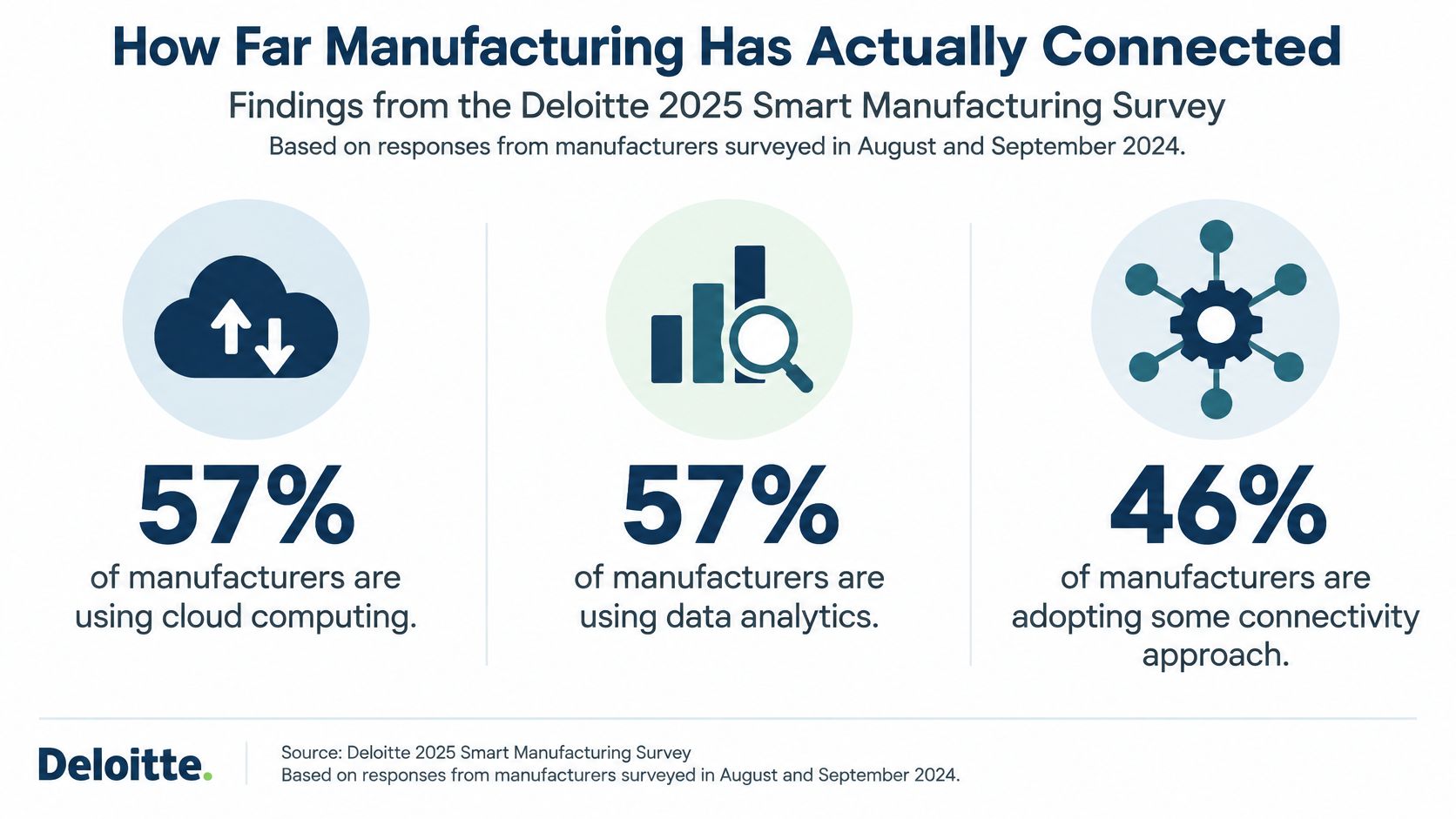
The figures describe installed capability. Equipment connectivity produces readings, analytics supports interpretation, and remote storage makes records accessible across sites. Wireless is a transport choice. The gap that matters is between a connected drive and a written response to its alert.
Test the drive room, not the office
An office network test says little about a gateway mounted near switching equipment. A gateway that passes on a quiet office bench can still drop frames when a contactor opens or a drive starts. Check the proposed installation with the cabinet doors closed, production running, and the surrounding equipment operating normally. Inspect cable routing, shielding, grounding arrangements, antenna placement where applicable, and environmental protection.
Contaminated or saline areas also demand suitable enclosures and maintainable connections. Don't treat every missing packet as a software problem. A damaged connector, poor installation, or unsuitable cabinet location needs physical correction.
A useful acceptance test includes an intentional upstream disconnection. Confirm that the gateway retains acquired events, reports its disconnected state, and forwards records with their original timestamps after communications return.
Roll out by consequence
Prioritize drives that constrain production or repeatedly require fault investigation. A bottleneck lineup gives the maintenance team a concrete reason to check whether data arrives reliably and whether the resulting work is useful.
- Choose a consequence: Identify the production loss or recovery difficulty that justifies monitoring.
- Test resilience: Verify buffering, stale-data indication, and reconnection behavior under operating conditions.
- Assign alarm ownership: Name the person who receives each alarm class and the escalation route when they're unavailable.
Don't wait for plant-wide wireless coverage or a common cloud environment before starting. A bounded installation with an accepted communications test is a better foundation than a large rollout whose missing records become apparent only after a trip.
Drive Signals That Should Trigger Work
Condition monitoring needs an evidence standard. A 2025 NIST systematic review screened 465 peer-reviewed studies published from 2001 to 2023, retained 42 that met its evaluation criteria, and noted fewer rigorous evaluations in manufacturing than in energy and transportation. A published model therefore isn't sufficient reason to trust an alert on your particular drive fleet.
Define the maintenance decision before installing the measurement. If nobody can explain what a rising signal would cause the electrical team to do, defer that tag and resolve the decision first.
Use signals to narrow the inspection
VFD signals and the maintenance action they support
| Signal | Possible meaning | First action |
|---|---|---|
| Heatsink or cabinet temperature | Blocked airflow, failed fan, or high ambient | Inspect filters, fans, and ambient before a restart |
| DC-link ripple | Capacitor aging or supply disturbance | Compare with load and plan a bench or shutdown test |
| Output-current imbalance | Cabling, motor, or output-stage trouble | Isolate drive versus motor before parts are ordered |
| Cooling-fan status and runtime | Fan wear ahead of a thermal trip | Schedule fan replacement at a safe planned stop |
| Leakage or insulation indication | Contamination or insulation aging | Stop and test; don't clear and run |
| Repeated fault-code sequence | Recurring electrical or process stress | Pull parameter backup and fault history before reset |
| Operating hours and energy | Late-life wear and loading pattern | Rank the unit for shutdown work or replacement review |
Temperature needs context. Compare the cabinet and heatsink trends with ambient conditions and load before blaming the power stage. A clogged intake and a failed cooling fan can produce similar thermal symptoms but require different parts and work preparation.
DC-link ripple requires an appropriate measurement path. A slowly polled bus-voltage register may not capture the waveform needed for diagnosis. If the drive doesn't expose a suitable diagnostic value, plan a qualified shutdown or bench test rather than presenting a coarse trend as capacitor condition.
Current imbalance is a fault-isolation prompt, not a replacement instruction. Establish whether the reported value represents separate output phases or a calculated aggregate. Qualified personnel should follow the drive's isolation and discharge procedure, and disconnect sensitive electronics before insulation testing where the manufacturer requires it.
Fan runtime supports planning, but it doesn't prove airflow. Confirm fan operation and the condition of filters, ducts, and heat exchangers. Likewise, operating hours describe accumulated service, not a component's remaining life.
Preserve context and prove the response
Keep native fault codes and parameter files intact. Normalize shared fields for cross-brand reporting, but retain the original units, code descriptions, model, and firmware context. A generic label such as overcurrent can conceal different diagnostic paths.
Time-align drive records with controller events, process load, ambient temperature, and maintenance work. Build the baseline across representative recipes, speeds, starts, and environmental conditions before freezing advisory limits. Don't move protective limits merely to silence monitoring alerts.
A useful alert explains what changed, why it matters, and what the technician should verify next.
Judge the program using false alarms, missed faults, warning lead time, downtime, mean time between failures, and maintenance cost per operating hour. After repair, compare the same signal under comparable conditions. If the reading hasn't changed, investigate whether the repair addressed the cause or whether the measurement was misleading.
Connecting Legacy Drives Without Opening the Loop
Only 17% of surveyed industrial organizations reported mature OT-security practices, while 64% described their maturity as foundational, according to the industrial OT-security survey announcement. For a drive project, cybersecurity must protect parameter integrity and safe operation, not just business information.
A read-only dashboard doesn't automatically mean the underlying connection is read-only. The gateway, protocol permissions, network rules, and maintenance access must enforce the boundary.
Use this checklist when agreeing the connection with the electrical and IT owners.
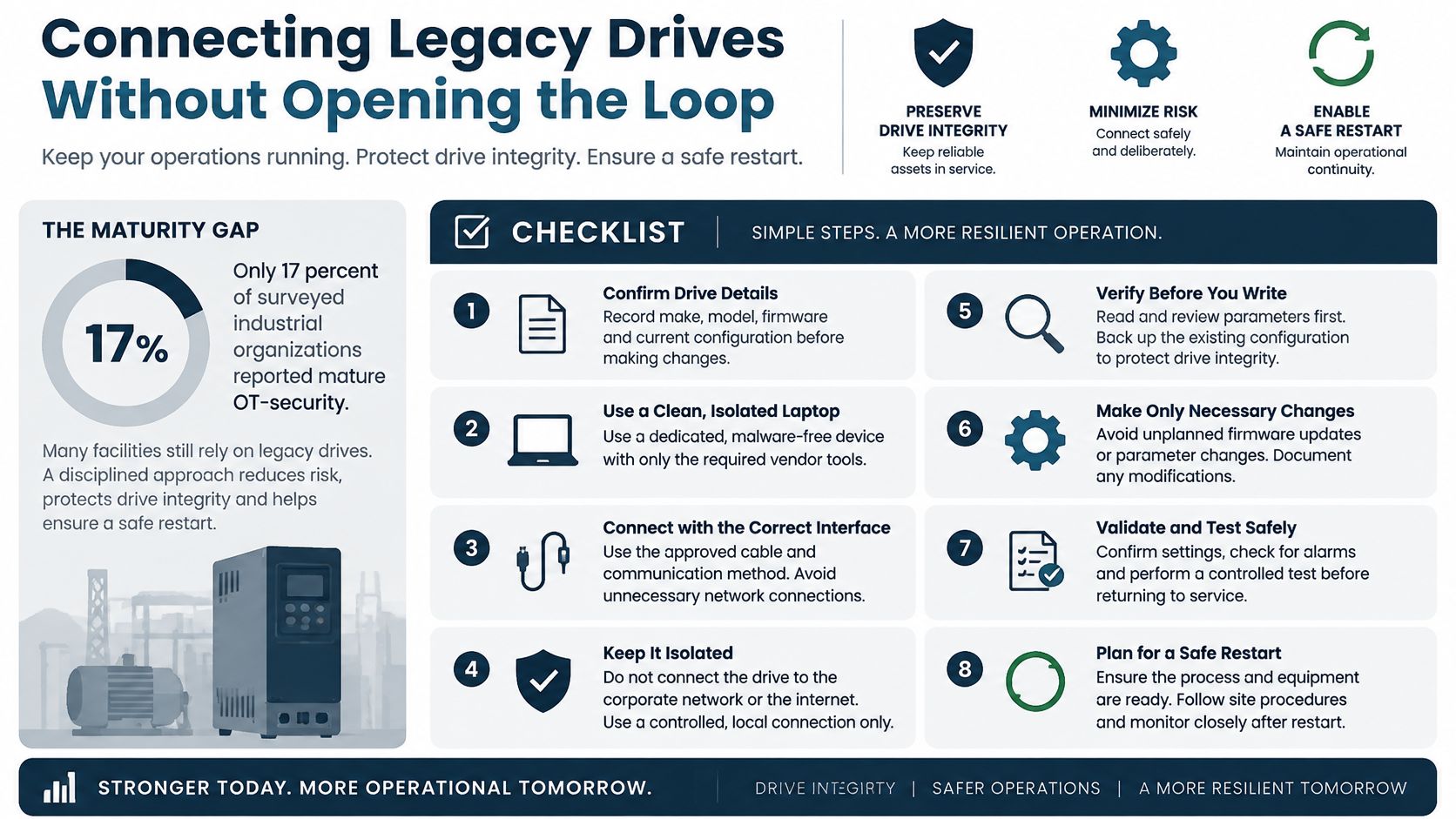
Select the connection before wiring
Record the drive model, communications option, firmware, available tags, and supported access restrictions. Choose native communications where suitable, controller-side tags where the PLC already polls the drive, or a gateway for legacy interfaces. Use a read-only OPC UA server or equivalent broker to expose the approved information.
For serial equipment, distinguish the physical interface from the application protocol. The RS-485 and RTU Modbus connection guide provides background for that discussion. Don't add a polling master to an existing serial control link without checking topology, bus ownership, timing, and equipment support.
Sign off the control boundary
NIST's manufacturing control-system integrity guidance supports monitoring network activity, detecting unauthorized use, controlling software installation, tracking changes, and securing remote access. Translate those controls into an installation checklist both departments can approve.
- Protect the control zone: Keep drives and controllers inside the OT boundary, with explicitly permitted data transfer outward.
- Restrict exported information: Expose agreed measurements and events without making control setpoints reachable from the monitoring side.
- Separate privileges: Trend viewers shouldn't inherit parameter-write or firmware-update authority.
- Control remote maintenance: Require authenticated, logged jump access, approved sessions, and removal of access when work ends.
- Detect changes: Track hardware, software, firmware, and configuration changes against the approved asset record.
- Prepare recovery: Maintain integrity-checked parameter backups, a change approval, and a tested rollback procedure.
Segmentation needs enforced traffic rules. A monitoring VLAN label alone doesn't establish that no write path exists. Test the permissions and document the result without disturbing live control.
For each remote diagnostic session, record asset identity, firmware and parameter versions, user, timestamp, symptoms, changes, and post-change functional-test results. When an aging drive can't be patched until shutdown, assign a remediation owner and compensating controls rather than leaving an unresolved notification in another dashboard.
What to Do When the Drive Data Is Incomplete
At 03:00, a medium-voltage drive trips. The temperature tag is missing, the current trend froze two hours earlier, and the operator reports a normal load. Three accounts, none complete. Treat the disagreement as the condition to investigate. Averaging those accounts into a confident diagnosis hides the underlying problem.
Deloitte's 2025 Smart Manufacturing Survey found cybersecurity is the leading infrastructure-modernization concern for 47% of manufacturing and energy organizations. That finding matters here because an unverified data path can make a healthy drive look unstable and an unstable drive look healthy. Restore or replace the evidence before anyone signs a diagnosis. Another dashboard rarely fixes a missing tag.
Establish what is safe to believe
Verify the signal against the keypad indication, the last good historian value, the data-quality flag, and the controller event. Isolate the fault from cable, motor, auxiliaries, and process load. Assess restart risk where insulation indications, unresolved overtemperature, or repeated trips appear. Select the intervention by comparing workshop repair, on-site reconditioning, subsystem renewal, and replacement. Record measurements, photographs, failed-part identification, and functional-test results so the next decision starts from facts.
Triage when VFD monitoring data is imperfect
| Situation | Verify first | Decision |
|---|---|---|
| Tag missing or stale | Keypad reading and last good value | Restore the link or inspect on site; don't invent the trend |
| Alarm contradicts the load | PLC event, ambient, and process load | Retune the advisory limit only if verified operating conditions explain it |
| Repeated trip on an aging medium-voltage drive | Parameter backup, fault location, and shipping risk | Assess on-site reconditioning within the shutdown window |
| Late-life unit with rising hours | Subsystem condition and spare match | Renew a serviceable failing subsystem before full changeout where justified |
The value of connecting legacy drives comes from the written response behind each alert. A frozen trend with no owner and no next action is another screen to check. Assign the electrical lead to diagnostic acceptance, the reliability or asset owner to the lifecycle decision, and the authorized site role to restart approval. Procurement can confirm availability and compatibility. Safety to energize stays with the site role.
Compare the complete recovery cost
For a large medium-voltage drive, compare removal, lifting, transport, workshop work, reinstallation, and recommissioning with a properly scoped on-site intervention. On-site work avoids transport exposure. It still needs suitable access, isolation, test equipment, parts, and an achievable shutdown scope. Continued operation carries its own cost while the fault remains unresolved.
How Three Plants Would Use the Same Stack
The same architecture supports different decisions because each process carries a different consequence of failure. These are illustrative operating scenarios. The point is to connect a legacy drive fleet to a written maintenance response, not to add another predictive dashboard.
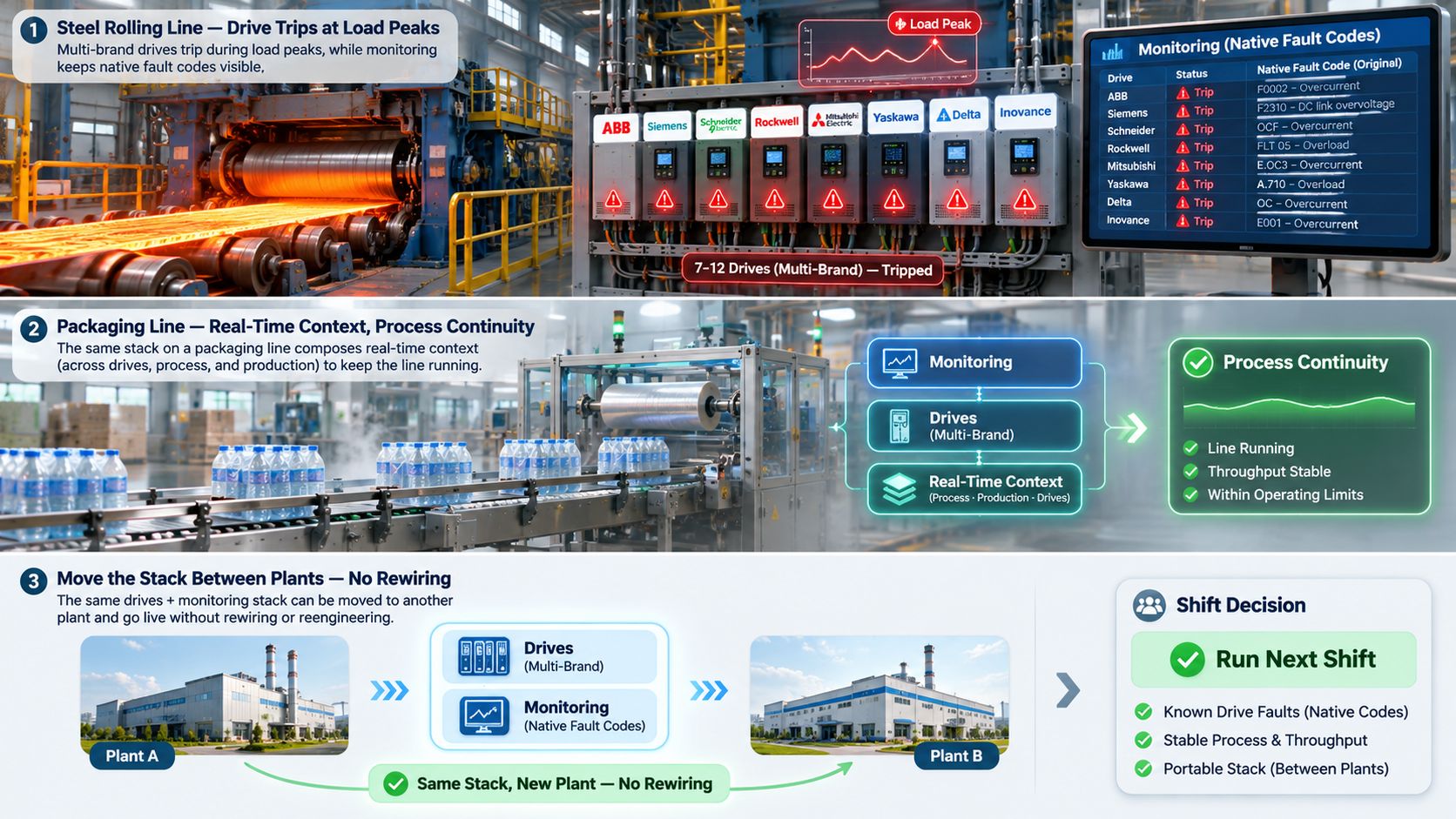
A steel rolling line with thermal trips
A thermal trip lands during a rolling-load peak. The useful field signal is the native thermal fault, preserved with the operating state, so the work layer can turn it into a planned cooling-path inspection. A second reset without inspection wastes the only useful evidence.
There is relevant maintenance evidence at Hangzhou Iron & Steel. Repeated failures in a group of ABB drives aged 7 to 12 years fell from 2 to 3 times per month to about once every six months after a two-month maintenance contract. The result supports disciplined maintenance; it does not prove an IoT algorithm produced the improvement.
A tire line with contaminated cooling paths
On a carbon-black process, conductive dust collects around cabinet cooling equipment. A rising temperature trend at comparable load should prompt the electrical supervisor to prepare a shutdown cleaning and cooling inspection. The analytics layer separates a real thermal change from an ordinary production change, which is the difference between a work order and a nuisance alarm.
The refused action is an immediate drive swap based only on a temperature alarm. Check first whether cleaning restores cooling, then decide if reconditioning is required.
Use the accompanying video as context for the relationship between monitoring and electrical maintenance, rather than as a substitute for an asset-specific procedure.
<iframe width="100%" style="aspect-ratio: 16 / 9;" src="https://www.youtube.com/embed/EDjCUsJh01k" frameborder="0" allow="autoplay; encrypted-media" allowfullscreen></iframe>A utility drive that stays on site
A medium-voltage drive logs an intermittent auxiliary-cooling fault, and removal access is difficult. The edge layer retains the alarm sequence during an upstream network interruption. Remote personnel review that sequence without changing controller or drive settings.
The maintenance owner prepares an on-site inspection and, if conditions warrant, reconditioning within the outage. Shipment follows only a confirmed scope. Restart stays blocked until the cooling fault is resolved.
Match your own bottleneck drive to a maintenance decision, not to a demonstration dashboard.
Start With One Drive Lineup and a Response Path
Choose a bottleneck lineup with a clear production consequence and accessible maintenance records. Keep the initial scope small enough that the electrical team can verify every exported tag and rehearse every alarm response.
Assemble the start pack
- Asset record: Brand, model, voltage class, firmware, communications options, and spare compatibility.
- Signal selection: The relevant thermal, electrical, cooling, fault-history, and service-use indicators.
- Approved data route: A documented read-only export from the control environment.
- Response instructions: Inspection requirements, escalation, work preparation, and restart authority.
- Acceptance baseline: Representative normal operation and a method for checking readings after maintenance.
Use the predictive maintenance program guide to connect that start pack to repeatable maintenance work. Software acceptance should include a simulated alert reaching the correct person with enough information to prepare the job.
Agree the scope before committing
At DUCHENG Industrial, we assess requirements, system architecture, connectivity, cybersecurity, and data arrangements separately for each project before any commitment. Remote monitoring can include condition monitoring, operating-data collection, alarm and trend viewing, and maintenance records, with the exact scope confirmed per project.
We serve clients across China and all of Southeast Asia, connecting that assessment with lifecycle electrical work from commissioning through on-site reconditioning rather than treating monitoring as a fixed package. Once the lineup and response path are written down, send them to service@ducheng-industrial.com for a project-specific discussion.
If the first lineup can't name who inspects, who may restart, and who may change a parameter, don't connect it yet. Resolve those responsibilities before the installation becomes another system that somebody must watch.
DUCHENG Industrial offers multi-brand VFD lifecycle support and project-specific monitoring assessment, linking drive information to diagnosis, maintenance, and controlled recovery. Visit DUCHENG Industrial with your bottleneck lineup, available signals, and proposed response owners to discuss a monitoring scope that supports the electrical work your plant needs.