
Understand low voltage motors, VFD integration, maintenance tasks, and troubleshooting for industrial plant teams seeking practical reliability guidance.
Electric motor systems accounted for 53% of global electricity consumption in 2023, about 13,462 TWh, and within industry they represented 72% of sectoral electricity consumption. When a low voltage motor starts tripping, running hot, or dragging a line down, the problem isn't isolated to one cabinet. It reaches production continuity, energy performance, and the way your team plans maintenance.
A plant usually feels this when a small fault becomes a shutdown. A conveyor stalls on start, a pump overheats after a voltage dip, or a fan keeps tripping until the shift is forced into a workaround. The motor looks like the failure point, but the underlying issue is often the chain around it, the supply, the drive, the load, the cooling, and the restart sequence.
Table of Contents
- Why Low Voltage Motors Matter to Your Plant
- Understanding Low Voltage Motor Fundamentals
- How Low Voltage Motors Interact with VFDs
- Essential Maintenance Tasks for Plant Teams
- Common Failure Modes and Troubleshooting Steps
- Repair, Replacement, and Spare Parts Decisions
Why Low Voltage Motors Matter to Your Plant
The first sign is usually not dramatic. A motor trips during acceleration, a belt line slows, and operators start asking whether it's the motor, the drive, or the load. In practice, that question already points to the right place, because the low voltage motor sits inside a system that can make a minor issue ripple across the entire process.
The hidden business impact of a “small” fault
Electric motor systems are central to industrial power use, so even one unreliable unit can carry more business impact than its frame size suggests. The IEA 4E Electric Motor Systems Annex reports that motor systems accounted for 53% of global electricity consumption in 2023, and 72% of sectoral electricity consumption in industry (IEA 4E Electric Motor Systems Annex). That's why maintenance teams can't treat motor health as a narrow electrical concern.
Shop-floor cost shows up in the spaces between alarms. A unit that runs hot because cooling fins are packed with contamination, or a motor that sees poor terminal voltage under load, can shorten insulation life and push the team into repeat interventions. When that happens, the maintenance plan starts reacting to symptoms instead of protecting throughput.
Practical rule: If a motor fault keeps returning, assume the cause is system-level until you prove otherwise.
Why the motor, drive, and load belong together
Low voltage motors commonly serve pumps, fans, compressors, conveyors, machine tools, and auxiliary equipment. That mix matters because the driven load decides how much torque is needed, how hard the motor starts, and how much heat it builds when conditions drift.
Once a plant team sees the whole chain, the priorities change. Drive compatibility, cooling path, contamination control, and restart procedures stop looking like separate tasks and start looking like one reliability problem. That's the frame I use on site, because it's usually the frame that keeps the next outage from repeating.
Understanding Low Voltage Motor Fundamentals
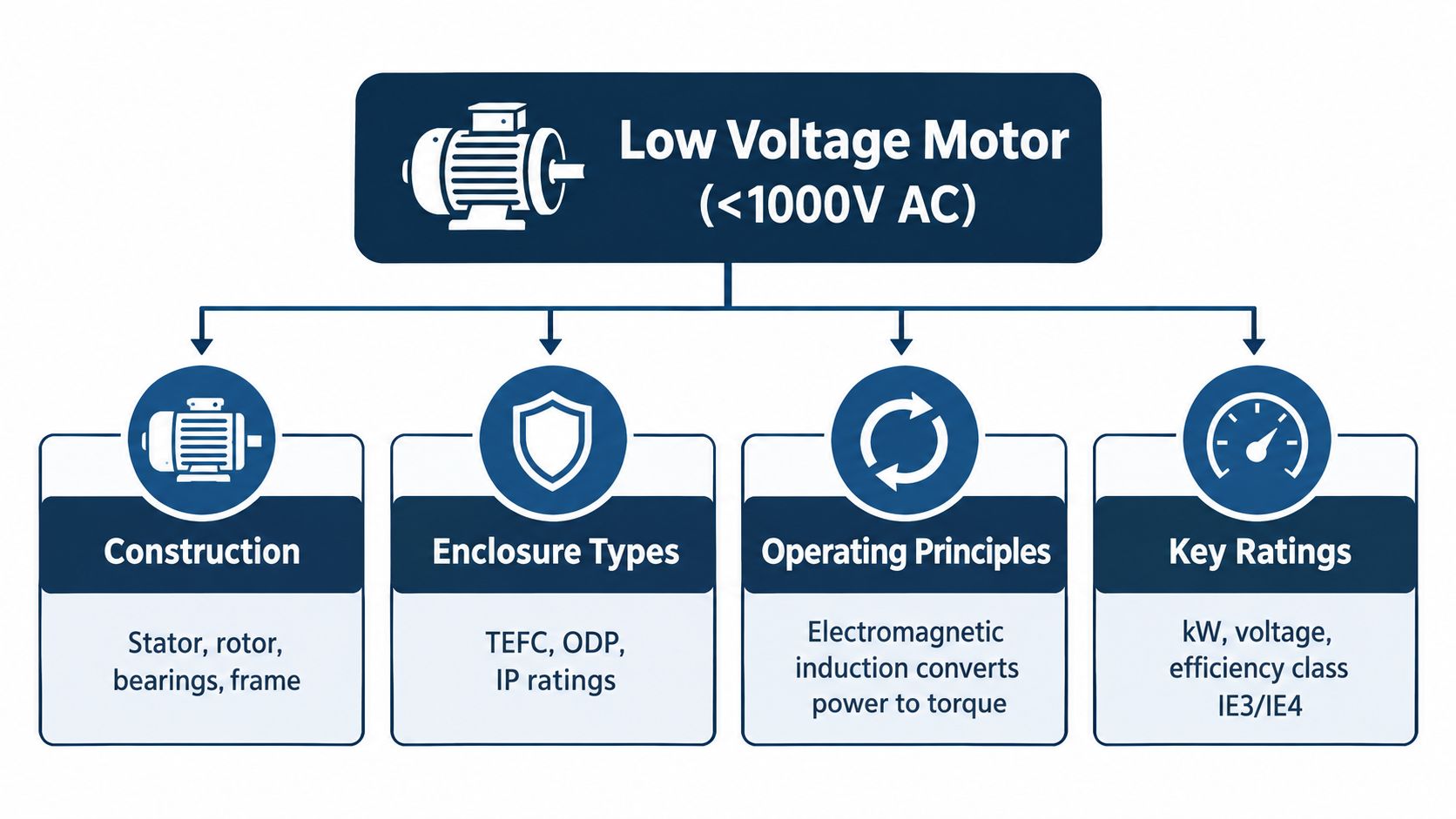
A low voltage motor is not just “a smaller motor.” In industrial practice, it means a machine built for rated voltages above 50 V and up to 1,000 V, with efficiency, pole count, and test basis all defined more tightly than many buyers realize (IEC 60034-30-1). That definition matters because procurement mistakes often start with the assumption that any mechanically similar replacement will behave the same way.
What belongs on the nameplate
When I'm checking a replacement, I don't start with the catalog picture. I start with rated output, pole count, voltage, frequency, and the test basis, because those are the details that determine whether the new unit really matches the old one electrically. A motor that bolts into place can still run wrong, overheat, or misbehave on a VFD if those details don't line up.
The efficiency class is part of that check, but it's not the whole decision. IEC 60034-30-1 defines internationally harmonized efficiency classes for single-speed low voltage motors operating from sinusoidal 50 Hz or 60 Hz supplies, and the 2025 edition adds IE5 to the class set (IEC 60034-30-1). That helps comparison, but it doesn't tell you whether the motor fits the duty cycle, load shape, or inverter environment.
A mechanically interchangeable motor isn't automatically electrically equivalent.
Why a better class doesn't solve everything
A lot of plants focus too hard on the efficiency label and too little on the operating reality. If the driven load runs lightly loaded, sees long idle periods, or spends much of its life below the point where cooling is effective, the motor class alone won't tell you whether a replacement makes sense. The same is true when the unit sits on a VFD, because the drive changes thermal stress, insulation stress, and bearing risk.
That's why a nameplate should be read as a starting point, not a finish line. A good maintenance team treats the motor as a component inside a process, not a standalone asset.
How Low Voltage Motors Interact with VFDs
The first failure I see is treating the motor and the VFD as separate purchases. On the shop floor, they behave like one system, and the driven load decides whether that system runs cleanly or slowly eats itself through heat, stress, and poor control choices.
The system is what pays the power bill
Motor efficiency, VFD losses, oversizing, duty cycle, harmonics, voltage imbalance, and load profile all interact at the operating point that matters. That is the part many buyers miss, because the nameplate does not show how the equipment behaves at part load, during starts, or across a full production week. The practical question is whether the whole drive system is efficient where the process runs.
A higher class motor also does not automatically justify replacement. An IE4 motor has roughly 15% lower losses than IE3, but that figure alone does not decide the business case. Low annual running hours, light loading, or a poorly matched VFD can wipe out the benefit fast.
What to measure before you touch the BOM
Before anyone signs off on retrofit, replacement, or a combined renewal, capture the operating data that shows what the system is really doing.
- Current and power: Measure actual electrical demand at the operating points that matter.
- Speed and load: Record where the process spends most of its time, not where the motor is rated to run.
- Operating hours: Separate continuous service from intermittent use.
- Duty pattern: Note starts, stops, idle periods, and low-speed operation.
- Process demand: Check whether the load needs fixed speed, throttled control, or variable speed.
That sequence prevents expensive optimism. It also keeps teams from replacing a sound motor when the actual issue is poor control logic, wrong sizing, or a drive that is not matched to the load.
The EU ecodesign framework gives a useful benchmark here, because it ties motor efficiency to application rules instead of treating the motor as a standalone object. From 1 July 2021, three-phase motors from 0.75 kW to 1,000 kW generally had to meet IE3, while motors from 0.12 kW to below 0.75 kW had to meet IE2. From 1 July 2023, three-phase, two-, four-, and six-pole motors rated from 75 kW up to 200 kW were required to meet IE4, within scope and exclusions (EU electric motors ecodesign).
For drive work, the useful habit is to check the motor, VFD, and load together. The drive changes thermal stress, insulation stress, and bearing risk, and the operating details behind that are laid out in how a variable frequency drive works.
Essential Maintenance Tasks for Plant Teams
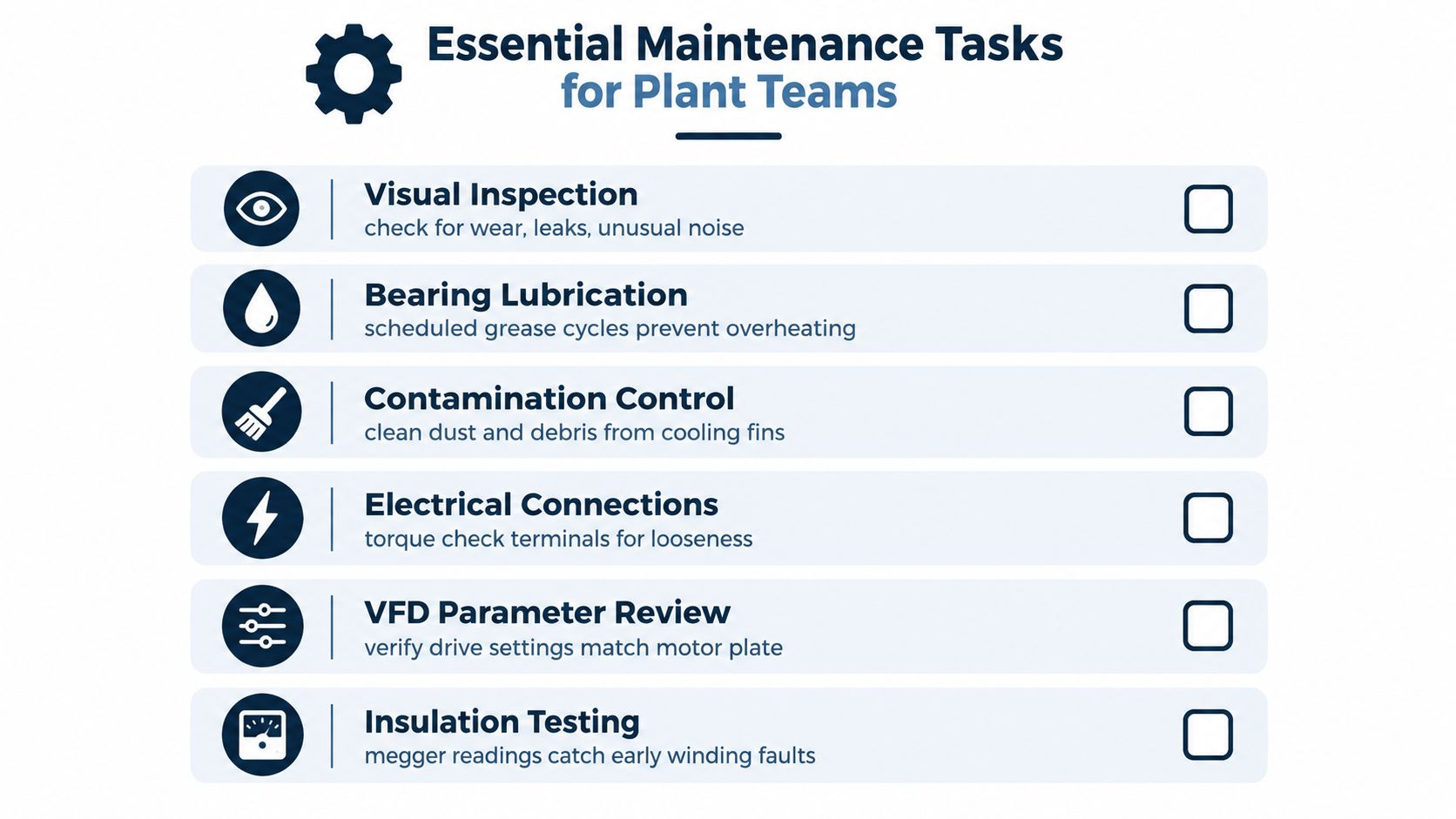
Maintenance teams don't lose motors because they forget one heroic fix. They lose them because small stresses stack up, especially contamination, heat, and bad assumptions about what the enclosure is protecting.
The routine that actually extends service life
Start with visual condition, but don't stop there. Look for contamination on cooling surfaces, signs of looseness at terminals, discoloration around connections, and any change in sound or smell that signals the unit is working harder than it should. On sites with high salinity or carbon black, that first look matters even more because surface deposits don't just look bad, they interfere with cooling and accelerate aging.
Cooling system care is not optional. If fins, fan paths, or cabinet ventilation are blocked, the motor loses its thermal margin long before the alarm trips. The same is true for bearing care and insulation checks, both of which belong in a planned maintenance window rather than a reactive outage.
Keep the motor clean enough that the cooling path still works, and dry enough that insulation still matters.
What to verify during a shutdown
Use shutdowns to verify the things that are hardest to check once the line is live again. That includes terminal tightness, drive parameter consistency, and any signs of insulation stress that have started to show up in trend data. If the plant uses a VFD, confirm the settings still match the motor plate and the process, because a good motor can be made to look bad by a bad drive setup.
A voltage complaint should be investigated at the motor terminals while starting and under load, not only at the switchboard. That approach catches cable drop, connection issues, contactor wear, and drive output behavior that wouldn't be visible from a distant panel reading. It's a small change in discipline that saves a lot of guessing.
Document what you find
Inspection notes only help if they can be compared later. Record heat marks, contamination level, vibration changes, and restart behavior in the same format every time, then trend them across outages. That record usually shows the failure before the failure shows itself.
If your site needs outside support for commissioning, controlled restarts, workshop repair, or spare-parts verification, one option is DUCHENG Industrial, which provides multi-brand lifecycle services for drive assets across commissioning, troubleshooting, repair, and preventive care.
Common Failure Modes and Troubleshooting Steps
Low supply voltage is one of the fastest ways to turn a healthy motor into a repeat problem. NEMA guidance identifies reduced starting torque and reduced running torque under low voltage, and it notes that locked-rotor current is typically 600% to 700% of full-load current with approximately plus or minus 10% voltage variation permitted at constant frequency (NEMA motor terminology and performance characteristics). That combination explains why a motor can appear "weak" while being starved at the terminals.
The failure loop that keeps repeating
Once current rises to make up for lost torque, heat rises with it. More heat means more copper loss, and more copper loss pushes insulation closer to failure. If the motor stays in that state, insulation deterioration raises the chance of phase-to-phase or phase-to-ground faults, so the problem becomes self-reinforcing rather than self-correcting.
That's why a unit that repeatedly trips during acceleration deserves more than a reset. The fault could be insufficient terminal voltage, excessive mechanical torque, the wrong VFD acceleration setting, or a mix of the three. The symptom is the trip, but the cause is in the relationship between supply, control, and load.
The checks that separate symptoms from causes
The fastest field test sequence is simple and disciplined.
- Measure terminal voltage first. Check what the motor sees during start and under load.
- Check phase-to-phase balance. A motor can suffer even when the average voltage looks acceptable.
- Inspect the cable and connections. Drop across long runs and loose terminations often hides the actual loss.
- Review contactor condition. A worn contactor can create intermittent behavior that looks like a drive issue.
- Read VFD output behavior. Confirm whether the drive is limiting, ramping too slowly, or reporting a protection event.
Don't diagnose a motor at the switchboard when the problem lives at the terminals.
The cleanest troubleshooting habits pay off here. If the same machine keeps faulting after resets, the team should stop treating it as a nuisance and start treating it as a condition report. Repeated trips are usually telling you where the system is weak, not just that the motor is tired.
Repair, Replacement, and Spare Parts Decisions
The repair-versus-replacement decision should be made with more discipline than emotion. A motor or drive that has survived one outage can still be a bad asset if it's been eating contamination, running outside its thermal comfort zone, or surviving on parts that no one can confidently match again.
Compare the options by risk, not habit
A workshop deep repair makes sense when the core machine is still sound and the fault is local. If the damage is broad, the contamination history is ugly, or the installed unit has been patched too many times, replacement often buys more certainty than another round of repair. In between those extremes sits reconditioning, which can be the right answer when shipping risk, site access, or downtime windows make removal expensive.
The decision also needs to account for compatibility. A replacement motor that looks acceptable on paper can still clash with the existing VFD, protection settings, cable length, cooling conditions, or process control logic. If you skip that check, you may fix the failed unit and create the next one.
Spare parts are part of reliability, not procurement trivia
A lot of repeat outages start with poor identification. The wrong module, a mismatched fan, or an unverified exchange unit can turn a planned return to service into another fault call. Pre-dispatch verification matters because the team needs confidence before the truck leaves, not after the machine is already back in the line.
For lifecycle decisions, the practical questions are straightforward:
- Is the asset still compatible? Match the motor class, the drive, and the operating environment.
- Has contamination history become a liability? Repeated exposure changes the economics of repair.
- Is the part still supportable? If sourcing is uncertain, downtime risk rises.
- Will the process forgive another failure? Critical loads usually won't.
Choose the path that protects the installed base
Some facilities benefit from a formal service partner that can diagnose, repair, and verify the exchange path in one workflow. Industrial motor repair guidance is most useful when it's tied to the actual installed base, because the practical decision isn't “repair or replace” in the abstract. It's whether the next choice lowers total cost of ownership while preserving reliability, safety, and speed of recovery.
If your team is dealing with recurring motor trips, uncertain spare-part matches, or drive assets that need commissioning, repair, or preventive care, DUCHENG Industrial can help with lifecycle support across low-voltage drive systems. Visit DUCHENG Industrial to review field services, spare-parts support, and repair options that fit the way plant teams work.