
Plant reliability engineering explained with real methods, KPIs, and examples for drive systems. Learn RBI, FMEA, RCA, and RCM that actually cut downtime.
The call came from the floor, not from a report. A line was sitting dead after a VFD trip, operators were waiting, production was slipping, and everyone in the room had the same question, why does the same cabinet keep failing after it was already “fixed” last time? That's the part many plants get wrong. The alarm is the symptom, but the problem usually started earlier, sometimes months earlier, with a skipped commissioning check, a missing parameter record, or a cabinet that never had a clean baseline to begin with.
Plant reliability engineering is the discipline that stops that pattern from repeating. It treats failures as evidence, not surprise, and it looks at the whole asset life cycle, from startup quality to late-life operation, because weak field records and poor handover can lock in bad behavior before the plant even settles in. That's why the work is never just “maintenance,” even if maintenance feels like the front line.
Table of Contents
- The Moment Reliability Stops Being Optional
- Core Methodologies Every Reliability Engineer Uses
- Building the Field Data Foundation
- Why Commissioning Quality Is the Hidden Reliability Problem
- Matched Intensity Monitoring for Auxiliary Assets
- KPIs That Actually Move Reliability
- A Steel Plant Drive Cabinet Story
- A 90 Day Starter Plan for Your Reliability Program
The Moment Reliability Stops Being Optional
A VFD trips. The line coasts down. The operator calls electrical, maintenance checks the obvious suspects, and somebody reaches for a spare part before the root cause is even understood. That's the moment a plant finds out whether it has a maintenance habit or a reliability discipline.
A reactive response can get the line moving again, but it doesn't answer the harder question, why did this happen here, and why will it happen again unless something changes? Reliability engineering exists because the same alarm can come from completely different causes, a heat problem, a cabling issue, a control parameter drift, a contamination path, or a handover mistake that was never documented properly. The work is to separate symptom from mechanism.
Reliability starts before the breakdown
The practical trap is that teams often think in terms of repairs after start-up, while the actual failure path may have been set during project closeout. A plant can have decent technicians and still inherit a weak asset if commissioning was rushed, as-built documents are thin, or the first operating baseline was never recorded. That's not a maintenance failure alone, it's a project-quality failure that becomes a maintenance burden later.
Practical rule: if the first clean baseline never gets captured, every future diagnosis starts from guesswork.
That's why reliability engineering has to reach across commissioning, handover, operations, and maintenance. If the asset history begins with missing context, the plant spends years trying to recover information that should have been collected on day one.
Core Methodologies Every Reliability Engineer Uses
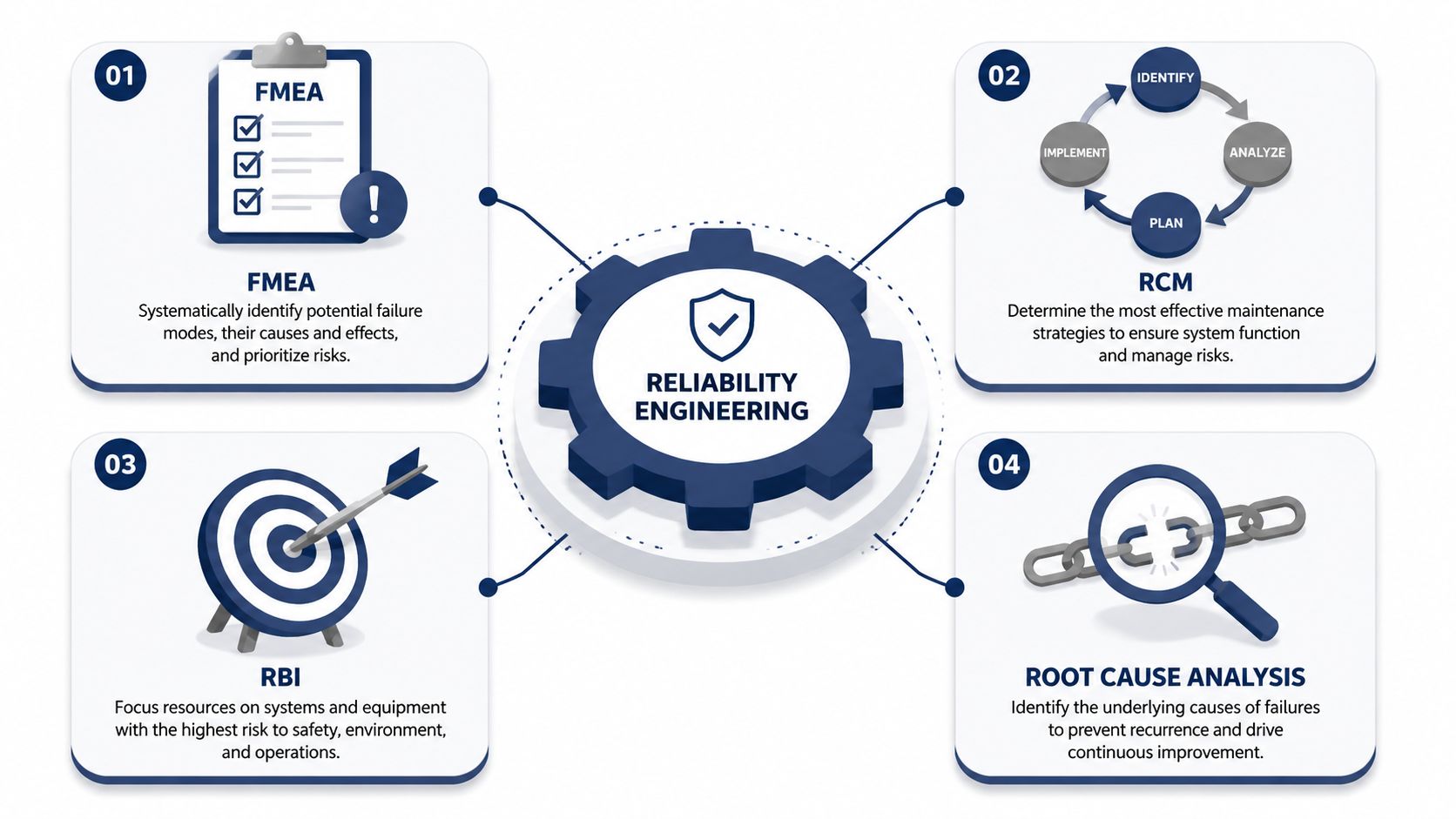
Reliability work gets clearer once you stop treating every problem as a unique snowflake. The same small set of methods keeps showing up because each one answers a different question. The trick is knowing which question you're asking.
FMEA tells you what can go wrong
FMEA, failure modes and effects analysis, is the pre-job meeting where the team asks, “What fails, how does it fail, and what happens next?” On the plant floor, that looks less like a spreadsheet exercise and more like a disciplined walk-through of each likely failure mode, then a judgment on consequence and detectability. It works best before the failure happens, while you still have time to design out the weak point.
RCM decides how to manage the failure
RCM, reliability-centered maintenance, is the decision rule that separates the failures you prevent, the failures you detect, and the failures you accept. It keeps you from over-maintaining low-risk assets and under-serving the assets that stop production. That's why it belongs in maintenance planning, not just in engineering workshops.
RBI focuses effort where risk matters
RBI, risk-based inspection, trims a long inspection list down to the equipment that really deserves attention. If a plant has hundreds of points to check, RBI helps rank the work so the limited hours go where a missed fault would hurt most. It's the practical answer to “What do we inspect first when time and labor are short?”
RCA closes the loop
Root cause analysis is the post-mortem that keeps the same failure from returning in a new costume. Good RCA doesn't stop at “the part failed,” it asks why the part failed, why the condition wasn't caught earlier, and what evidence would have exposed the problem sooner. That's what makes it useful after a trip, a nuisance alarm, or a repeated repair.
| Method | Best use | What it prevents |
|---|---|---|
| FMEA | Before a project, shutdown, or redesign | Missed failure modes |
| RCM | When choosing maintenance strategy | Over-maintaining or neglecting assets |
| RBI | When inspection capacity is limited | Wasting effort on low-risk items |
| RCA | After a recurring or high-impact failure | Repeating the same mistake |
The core idea is simple, even if the vocabulary sounds formal. Each method answers a different operational question, and together they keep the plant from arguing about symptoms while the cause keeps sitting in the cabinet.
Building the Field Data Foundation
Reliability analysis falls apart fast when the records are sloppy. A usable field data system has to capture basic system information, operating context, environmental context, and failure data, with common nomenclature and consistent units so the records can be parsed and tied to maintenance decisions, failure trends, and bad-actor analysis.
Clean data beats more data
A plant does not need a flashy dashboard before it needs a shared language. If one log says “high temperature,” another says “hot,” and a third uses an undocumented shorthand, nobody can trend the problem with confidence. The same problem shows up when temperature, current, or vibration values live in different units or inconsistent naming conventions.
The minimum useful record set should include the asset identity, the service duty, the operating state, the environment around the asset, the failure description, and the corrective action taken. Without that structure, even a strong analyst is forced to translate the history before any conclusion can be trusted.
Records must support decisions, not decorate them
That is why many plants stall at the dashboard stage. They collect readings, but they do not standardize them well enough to answer the maintenance question that matters, “Which asset is trending toward repeat failure, and what evidence do we have?” The difference between a report and a reliability tool is whether the data can change a decision.
When the field record is inconsistent, the failure trend looks random even when it is not.
The same discipline that supports a good reliability program also supports predictive maintenance manufacturing, where the record structure has to carry maintenance history, operating context, and the condition details that explain why an alarm matters. A plant that keeps that data clean can work from facts instead of memory, and that lowers the cost of every investigation that follows.
Why Commissioning Quality Is the Hidden Reliability Problem
Some of the worst reliability debt is created before the plant ever enters normal operation. Weak startup data, incomplete documentation, and shallow initial condition checks can embed problems that stay hidden until they turn into chronic failures later. Poor commissioning and incomplete handover can lock in systemic issues that persist for years and drag on availability and maintenance cost.
Handovers should prove the asset is ready
For drive systems, this shows up immediately. A VFD can leave commissioning with undocumented parameters, weak grounding verification, or incomplete as-built records, and the plant may not notice until the first abnormal trip sequence arrives. That is why handover has to be treated as an evidence package, not a signature page.
The checks that matter most are the ones that make later troubleshooting possible. If the project team cannot prove the parameter set, confirm cabling and grounding, and establish an initial condition baseline, then the operating team inherits a mystery instead of an asset.
What to demand before sign-off
A strong commissioning package for a drive should include parameter records, insulation resistance baselines, verification of cabling and grounding, and current as-built documentation. If those items feel tedious, that is usually because they are doing the work reliability needs. A plant that skips them is choosing to spend the time later in repeated faults and unstable restarts.
You can turn that expectation into a formal requirement with a commissioning checklist such as the one used for VFD commissioning checklist. That kind of discipline matters when the plant wants reliability to start at project closeout, not after the first outage.
Good handover makes troubleshooting boring. Bad handover makes every repair feel new.
The larger point is that reliability is not only a maintenance problem. It is also a project-quality problem, and the bill from a poor handover usually arrives in production, not in engineering.
Matched Intensity Monitoring for Auxiliary Assets
A lot of plants monitor the headline machines and barely look at the systems that trip them. That's a bad trade. The production stop often comes from the auxiliary asset nobody wanted to spend time on, such as a drive cabinet, cooling path, power-quality support, or instrumentation subsystem.
Not every asset deserves the same monitoring depth
The right answer is matched intensity monitoring, where the inspection effort follows the asset's role in the process. A critical asset needs a deeper, faster feedback loop. A support asset may only need periodic checks, but it still needs enough visibility to catch low-frequency, high-impact faults before they take the line down.
| Asset Tier | Example Assets | Monitoring Approach | Reliability Outcome |
|---|---|---|---|
| Critical | Primary production drives, main process control assets | Continuous online monitoring and frequent review | Faster fault detection and better containment |
| Important | VFD cabinets, cooling systems, power-quality equipment | Periodic portable checks and targeted trending | Earlier notice of drift before shutdown |
| Support | Ancillary panels, non-core auxiliaries, standby items | Walk-by inspection and condition verification | Basic coverage without over-spending effort |
That structure helps stop the expensive mistake of blanket inspection cycles. If every asset gets the same attention, the plant usually over-monitors low-risk equipment and still misses the cabinet that causes the trip.
Use the right depth for the right failure path
A cabinet with contamination risk, fan degradation, or thermal stress needs more than a casual walk-through. The monitoring plan should reflect the actual failure path, not a generic maintenance calendar. For plants that need field support across drive lifecycle work, DUCHENG Industrial is one option for commissioning, rapid fault recovery, preventive care, and on-site reconditioning of VFD assets.
The question isn't whether to monitor everything equally. It's whether the monitoring effort is matched to the failure consequence, because that's what keeps hidden systems from becoming expensive surprises.
KPIs That Actually Move Reliability
The wrong KPI makes a busy plant look healthy. The right KPI tells you whether the team is really reducing repeat failures or just cleaning up faster after them. MTBF, MTTR, availability, and failure-trend rate are the numbers worth putting on the weekly slide.
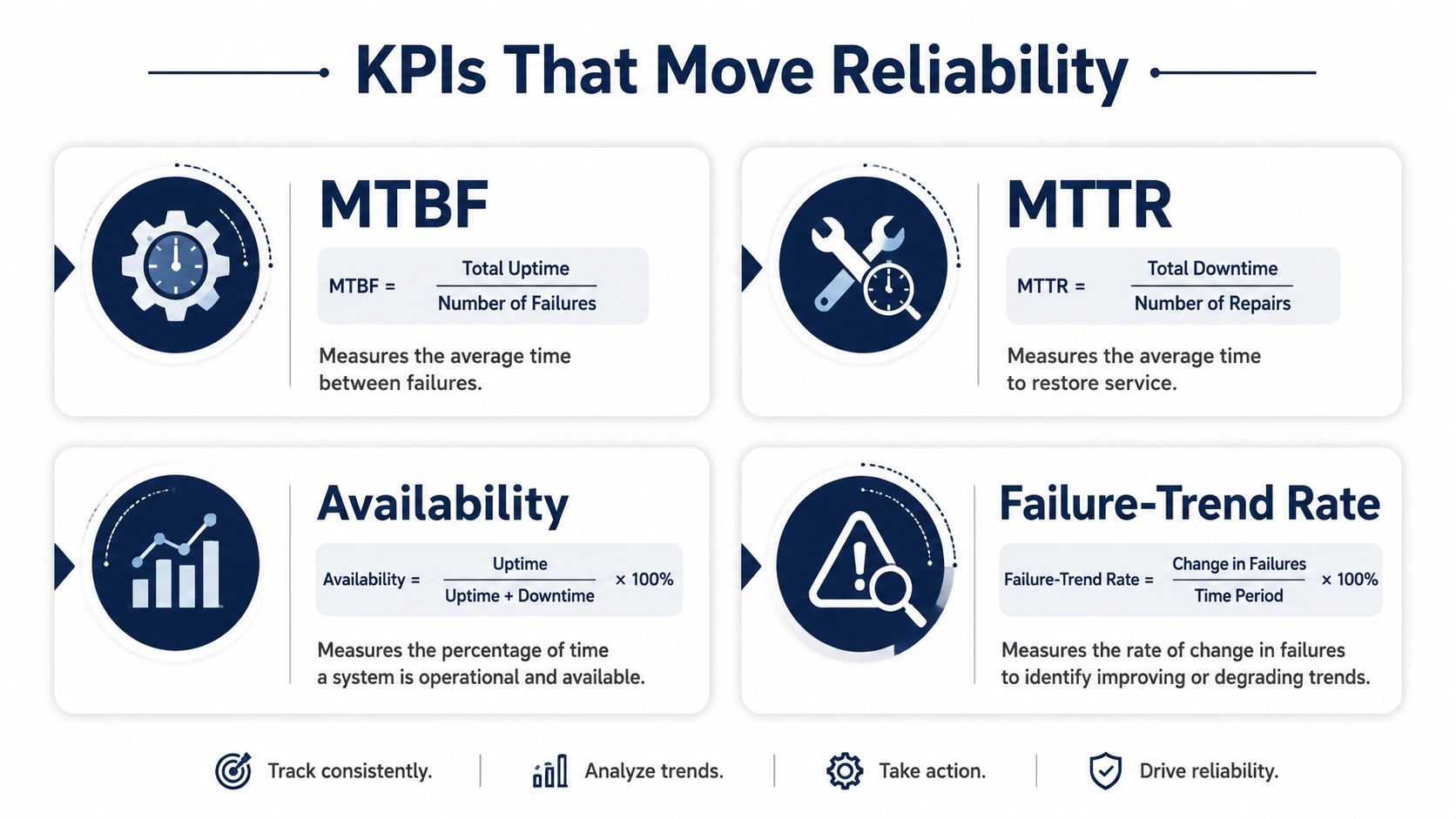
The four numbers that matter
MTBF is mean time between failures, the average uptime between one failure and the next. MTTR is mean time to repair, the time needed to restore the asset after a failure. Availability is uptime divided by total time, which shows whether the equipment is supporting production.
Failure-trend rate is less glamorous but very useful, because it shows whether a bad actor is improving, staying flat, or getting worse. That matters when a team keeps fixing the same cabinet in different ways and wants proof that the cycle is changing.
Read the numbers together
A plant can celebrate rising MTBF and still be losing ground if MTTR is climbing too. That usually means the repair got more complicated, the fault is harder to isolate, or the fix depends on specialist intervention. The KPI review should catch that trade-off before it gets normalized.
| Program Type | Typical KPI Pattern | What It Usually Means |
|---|---|---|
| Reactive | Low MTBF, high MTTR, erratic availability | Firefighting dominates the schedule |
| Proactive | More stable MTBF, shorter MTTR, clearer failure trends | The plant is learning from faults |
The practical rule is to watch the trend, not the vanity metric. If the line is still being interrupted for the same reasons, the scorecard is telling the wrong story.
A Steel Plant Drive Cabinet Story
A steel plant kept seeing the same medium-voltage VFD cabinet trip every few weeks. Parts were replaced, alarms were cleared, and the cabinet came back to life just long enough to fail again. The maintenance team had action, but it didn't yet have a structured diagnosis.
The fault was not in one place
The turning point came when the cabinet was opened and the inside was mapped for contamination, thermal hot spots were checked under peak load, parameter history was compared against commissioning records, and the restart was controlled instead of rushed. That sequence exposed a combination problem, carbon-black ingress, cooling-fan degradation, and a drift in the acceleration ramp. None of those issues looked decisive on its own, which is exactly why the trips kept repeating.
A deeper on-site reconditioning then broke the pattern. The cabinet was disassembled, cleaned, repaired at component level, and functionally tested before return to service. In practice, that kind of work sits between routine preventive care and full replacement, and it's often the right answer when shipping a large drive to a workshop would add risk or delay.
Repair strategy has to match the failure pattern
That's where lifecycle service matters. Preventive Care handles contamination and aging before failure becomes chronic. Deep Repair is the right choice when the cabinet needs disassembly and bench-level diagnosis. Rapid Restore makes sense when the plant needs structured triage and controlled restart after an unplanned fault.
The important lesson from the steel plant wasn't just that the cabinet was fixed. It was that the repeat-trip cycle stopped only after the team treated the cabinet as a system, not as a box of replaceable parts. That's the mindset shift reliability engineering is supposed to force.
A 90 Day Starter Plan for Your Reliability Program
A small team can make real progress in three months without buying software or asking for new headcount. The first 30 days should standardize asset naming and failure records, the second should tighten commissioning evidence and monitoring depth by asset tier, and the third should put MTBF, MTTR, availability, and failure trends on one review page. Each phase should end with a visible deliverable the plant manager can inspect.
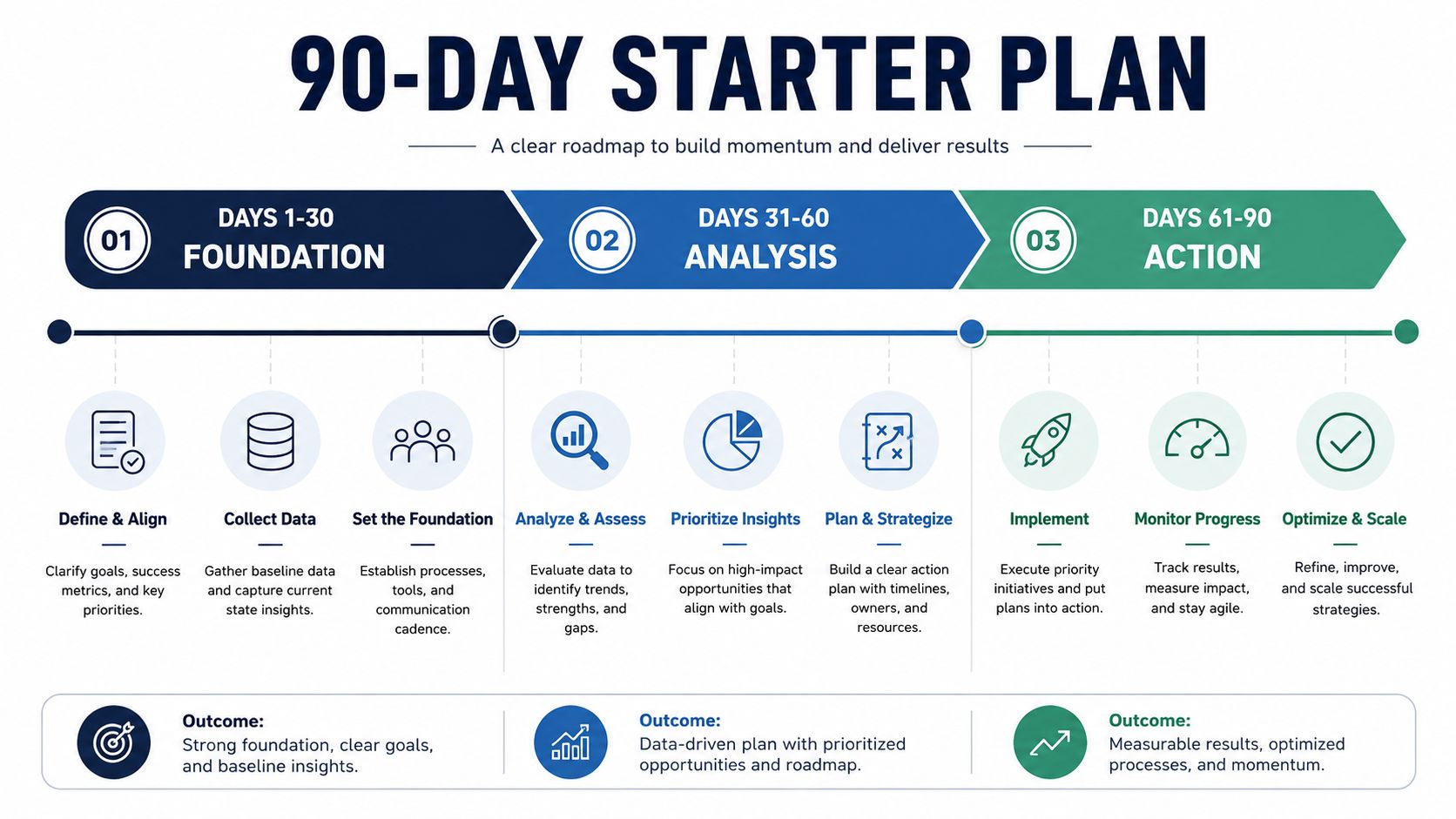
By day 30, you should have a data dictionary. By day 60, you should have a commissioning checklist and a tiered monitoring plan for auxiliary assets. By day 90, you should have a KPI dashboard and the first quarterly RCA review tied to real failures, not opinions.
The work compounds from there. Better records sharpen the analysis, better handover prevents avoidable defects, and better monitoring catches the hidden faults before they take production down. If your team wants practical VFD lifecycle support, on-site diagnostics, reconditioning, commissioning checks, and field repair planning, visit DUCHENG Industrial and look at how their drive services fit into a reliability program built for heavy-industry assets.