
Learn how preventive maintenance and corrective maintenance keep VFDs reliable, cut unplanned downtime, and protect MTBF in harsh industrial environments.
Your line is down, the operator has already killed the feed, and everyone is staring at a tripped VFD cabinet that was running fine an hour ago. Production wants the line back, maintenance wants to know whether this is a reset-and-run issue or a real failure, and you need a decision before the next shift window closes. That's where preventive maintenance and corrective maintenance stop being abstract terms and start becoming a real operating choice.
In VFD work, the wrong answer usually costs more than the repair. A clean cabinet with healthy fans and stable bus capacitors can often be kept out of trouble with planned upkeep, while a hot, dusty, salt-exposed drive can punish anyone who treats maintenance like a calendar exercise. The practical job is to know which faults you can prevent, which ones you can only recover from, and where the maintenance mix should change by asset.
Table of Contents
- What a Tripped Drive Teaches Us About Maintenance Strategy
- Defining Preventive and Corrective Maintenance for Drive Systems
- How VFDs Fail in Harsh Industrial Environments
- Preventive Versus Corrective Maintenance Side by Side
- The Corrective Maintenance Workflow on a Live Drive
- Field Examples from Steel Plants and High-Salinity Sites
- Preventive Maintenance Checklists and Schedules for VFDs
- Choosing the Right Maintenance Mix for Your Drive Fleet
What a Tripped Drive Teaches Us About Maintenance Strategy
A rolling-mill stand trips mid-shift, the operator stops the line, and the maintenance lead gets one question that matters more than the fault code: how fast can we restore production without making the problem worse? If the cabinet is a known trouble spot, the answer is rarely “just reset it.” If the drive has been clean, cool, and stable, the answer may be a straightforward controlled restart after proper checks.
That moment captures the entire maintenance debate. Preventive maintenance is the work you do before the trip, while corrective maintenance is what starts after the fault has already stopped the asset. In drive systems, both are part of the same reliability program, because a plant that runs everything to failure usually ends up paying for it in lost time, rushed parts, and repeat outages.
A useful way to read this article is as a cabinet-level brief, not a theory lesson. The focus is on what fails inside VFDs, what scheduled work catches, what reactive repair can and can't fix, and how a field diagnosis should flow when production is waiting. It also includes a steel-plant MTBF example, harsh-environment checklists, and a simple way to decide which drives deserve more scheduled attention.
Practical rule: if the next trip could stop a critical process, you don't want to be discovering the root cause at the same time you're losing output.
Historical maintenance practice helps explain why this matters. Corrective maintenance was the default model early on, with preventive maintenance emerging as factories shifted toward scheduled upkeep, and the technical terms settled into common use in the late 1950s and early 1960s. A maintenance history review notes “Corrective Maintenance” appearing in 1957 and “Preventive Maintenance” already established by then as planned practice, which lines up with the long shift from breakdown repair to scheduled control (maintenance history review).
Defining Preventive and Corrective Maintenance for Drive Systems
What preventive maintenance means on a VFD
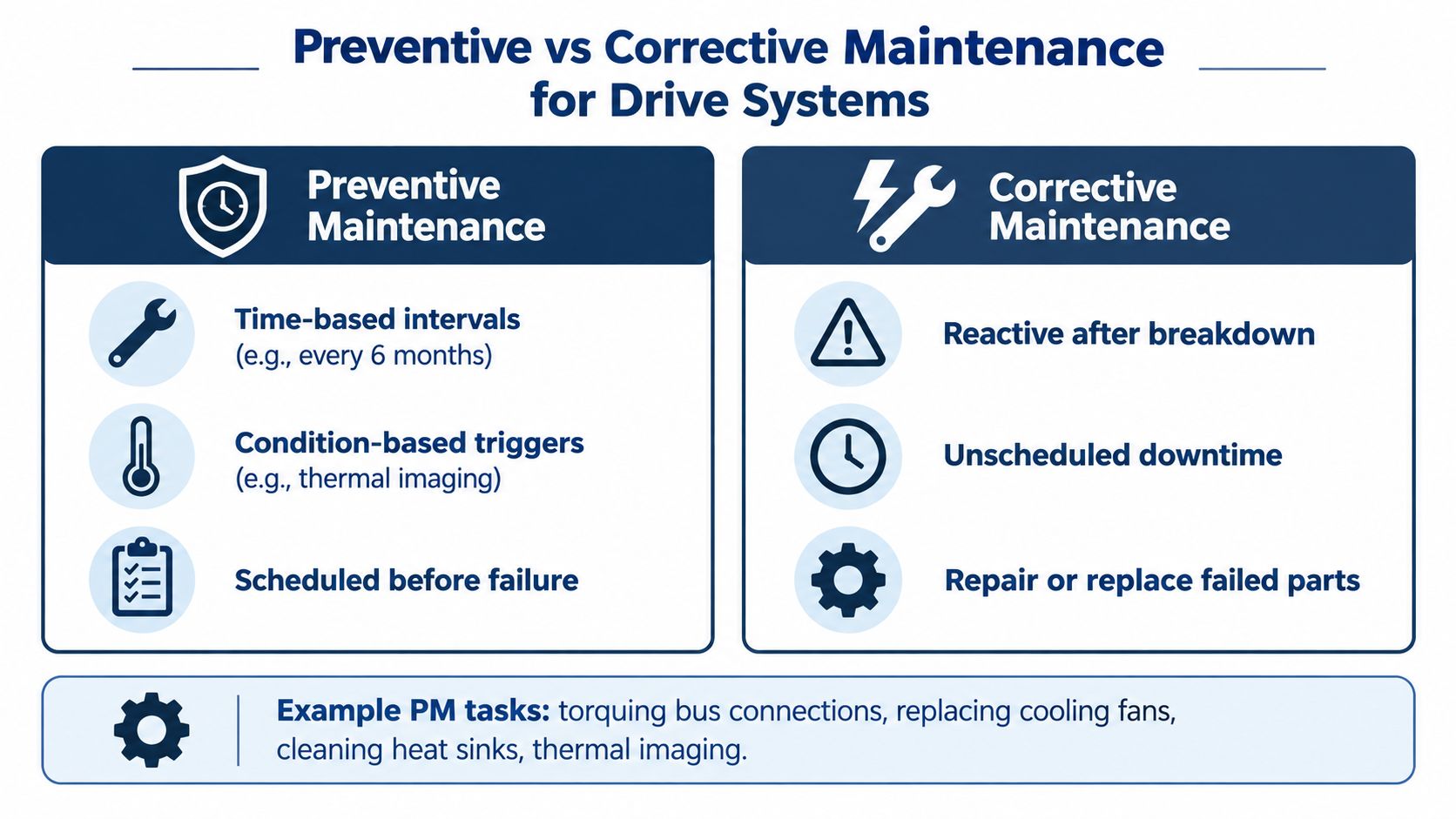
Preventive maintenance is planned, proactive work done before failure. In a drive cabinet, that usually means scheduled cleaning, torque checks on bus and power terminations, cooling-fan inspection or replacement, thermal imaging, and checks on capacitor health. The goal is to stop fault progression while the asset is still running normally.
For VFDs, PM protects the parts that age in predictable ways. That includes rectifier sections, DC bus capacitors, gate drivers, fan assemblies, filters, heatsinks, and wiring that loosens under vibration and thermal cycling. Industrial reliability literature treats this approach as a way to reduce unplanned downtime and improve uptime by intervening before the fault shows up at the production level (industrial reliability review).
What corrective maintenance means on a VFD
Corrective maintenance starts after a fault or malfunction has already been declared. The job is to isolate the failure, restore operation, and return the drive to its intended function. In practice, that means pulling the fault log, checking the power stage, testing the control board or gate-drive section, replacing failed parts, loading parameters if needed, and recommissioning the unit safely.
The difference is operational, not philosophical. Preventive work aims at failure prevention. Corrective work aims at restoration after interruption. On a drive, CM often begins with a trip, but the root cause may sit deeper in power electronics, connectors, fans, or the cabinet environment. A reset alone is a weak recovery plan when the underlying defect is still present (fault-driven maintenance review).
How the two modes fit together
The fastest way to make a plant unreliable is to treat PM and CM like rival teams. They are not. PM reduces the number of trips you have to chase, and CM gives you a controlled way to recover when a trip still happens. A good drive program uses PM to reduce exposure and CM to close the loop on actual failures.
A second problem is that PM is often reduced to a checklist that gets stamped and filed. That still leaves blind spots in real-time asset health because it does not continuously monitor condition. Maintenance benchmarking also shows a gap between belief and execution. Many facilities say preventive maintenance is a core strategy, yet a much smaller share of their maintenance time goes to it, while a large share still goes to breakdown response (maintenance benchmarking overview). The point for plant teams is simple, PM works when it is executed, measured, and tied back to failure modes.
How VFDs Fail in Harsh Industrial Environments
The cabinet tells you what the process is doing to the drive
A drive in a dirty, hot, or humid plant usually fails in pieces long before it fails outright. Conductive dust from steel or cement work settles into heatsinks and fans. Salt air works its way into coastal cabinets. Heat cycles loosen terminations, then stress capacitors and boards until the next trip finally exposes the damage.
The failure chain is usually mechanical and electrical at the same time. Rising temperature and contamination raise electrical stress and partial-discharge risk, which increases trip probability and shortens component life. In the field, the highest-value PM task is often not a special diagnostic. It is shutdown-window cleaning, torque verification, thermal inspection, and replacing wear-out parts before they cross the line.
What preventive work targets in real cabinets
The same failure accelerants show up again and again during service calls. Fan bearings wear under continuous operation, especially when airflow is restricted and cabinet temperature stays high. Electrolytic capacitors dry out faster under sustained heat. Loose lugs and bus connections worsen under thermal cycling. Dust on heatsinks and clogged filters reduce cooling margin, and the temperature rise shows up as nuisance trips or shortened component life.
Preventive maintenance works best when it targets those accelerants, not just the fault code on the display. Cabinet pressurization or filtration helps where dust is persistent. Scheduled fan replacement avoids waiting for a seized rotor. ESR trending on capacitors helps catch aging before ripple and heat get out of hand. Torque checks on power terminations reduce the chance that a minor loosened connection becomes a high-heat failure.
In harsh service, the cabinet environment is part of the load. If the environment is wrong, the drive's life curve gets shorter no matter how good the nameplate looks.
Industrial drive service work follows a familiar pattern. The visible failure may be a trip code, but the root cause is usually one of a few repeat offenders, contamination, heat stress, loose connections, capacitor wear, or fan degradation. A preventive program that ignores the cabinet only covers part of the risk. It can keep the schedule full while missing the failure path that matters.
Preventive Versus Corrective Maintenance Side by Side
The cleanest way to compare the two is to stop talking about theory and look at what each mode does to the plant floor. Preventive maintenance buys planning control. Corrective maintenance buys flexibility on spend but leaves you exposed to surprise downtime.
| Criterion | Preventive Maintenance | Corrective Maintenance |
|---|---|---|
| Scheduled outage | Yes, planned into shutdown windows | No, the outage happens after failure |
| Downtime risk | Lower surprise risk, but some planned downtime still exists | Higher surprise risk, especially if the drive trips in production |
| Parts inventory | Spares can be staged in advance | Parts are often pulled urgently after the fault is known |
| Technician effort | More planning, more routine labor, less firefighting | Less routine labor, more diagnostic pressure when things fail |
| MTBF impact | Usually improves reliability when it targets the right failure modes | MTBF only improves if the root cause is found and fixed |
| Mean time to repair | Often shorter because spares and procedure are ready | Often longer because diagnosis starts under pressure |
| Documentation load | Higher on the front end, better for trend tracking | Higher during the incident, but useful only if captured well |
| Best fit | Critical drives, harsh environments, repeat-failure cabinets | Low-criticality assets, redundant drives, known spare units |
The trade-off is honest. Preventive work costs labor and shutdown time on a schedule. Corrective work avoids some planned effort, but it puts the plant at the mercy of the next failure. The right answer depends on criticality, the failure history of the asset, and how much unplanned downtime the process can absorb.
For many plants, the mistake isn't choosing PM over CM or the other way around. The mistake is applying the same rule to every drive in the fleet. A clean utility-room cabinet feeding a non-critical pump doesn't need the same treatment as a dusty high-load drive on a hot-strip line.
The Corrective Maintenance Workflow on a Live Drive
When a drive faults during production, the first job is to make the intervention controlled. Safety comes first, but speed still matters, because the clock starts as soon as the line stops. The first ninety minutes should be about isolating the issue, not swapping parts blindly.
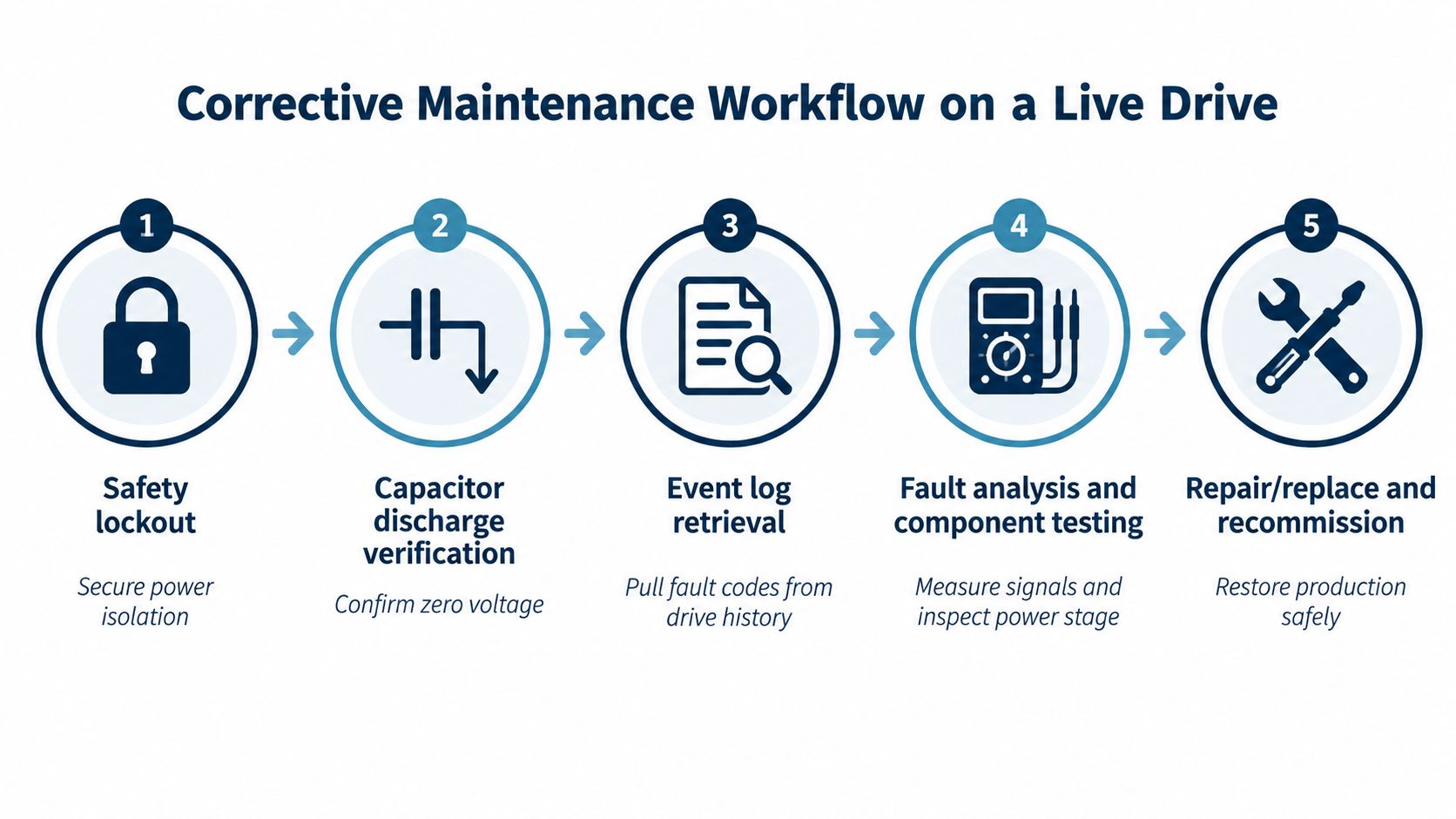
The sequence below is the one that saves time later.
- Safety lockout. Lock out the supply, verify isolation, and confirm the drive can't re-energize unexpectedly.
- Capacitor discharge verification. Confirm the DC bus is at zero before anyone puts hands inside the cabinet.
- Event log retrieval. Pull fault history, trip codes, and the last operating state before the shutdown.
- Fault analysis and component testing. Check the power stage, control board, feedback devices, fans, and associated wiring.
- Repair, replace, and recommission. Restore the failed section, verify parameters, and bring the drive back under controlled conditions.
The biggest mistake in CM is to treat every trip as a parts-swap event. A drive can trip because of a true power-section failure, but it can also trip because of loose connections, a failing fan, a contaminated board, or environmental stress outside the cabinet. If the technician doesn't isolate the actual cause, the same fault code comes back after restart and the shutdown gets longer.
A structured diagnosis is where corrective work becomes useful to preventive planning. Record the trip code, cabinet temperature, humidity if relevant, visible contamination, load conditions, and whether the failure happened under peak demand or steady operation. That record is what helps the next PM cycle catch the same pattern earlier. For a related repair workflow reference, see the field repair process described in this motor drive repair guide.
<iframe width="100%" style="aspect-ratio: 16 / 9;" src="https://www.youtube.com/embed/sKbO6ghAO8o" frameborder="0" allow="autoplay; encrypted-media" allowfullscreen></iframe>Field Examples from Steel Plants and High-Salinity Sites
A hot-strip mill is hard on a VFD. Heat, vibration, dust, and long duty cycles push the cabinet toward the same failures again and again, especially fan wear, capacitor aging, and thermal stress. In one steel-plant engagement our service team documented, a quarterly program centered on capacitor and fan replacement lifted VFD MTBF from roughly 11,000 hours to 28,000 hours across 14 drives on the mill. The point was not theory. The plant was replacing the parts that were wearing out before they took the drive down.
What changed was simple. Fans were not left in service until they seized, and capacitors were not allowed to stay in place until a trip exposed them. Heat and aging were treated as predictable risks, not random surprises. That is where preventive maintenance earns its place, because the work targets the dominant failure mode instead of waiting for the symptom.
The coastal case followed the same logic under a different failure pattern. In a high-salinity pump station, chloride-laden air drove recurring gate-driver problems until cabinet sealing and wash-down intervals were added. The load profile was not the main issue. The environment was. Once the cabinet was protected better, the repeat failures showed up less often because the maintenance plan matched the exposure that was causing the trouble.
The useful lesson from both sites is straightforward. Reactive repair exposed the pattern, then preventive work attacked that pattern before the next outage. In harsh service, maintenance gets smarter one failed cabinet at a time.
Preventive Maintenance Checklists and Schedules for VFDs
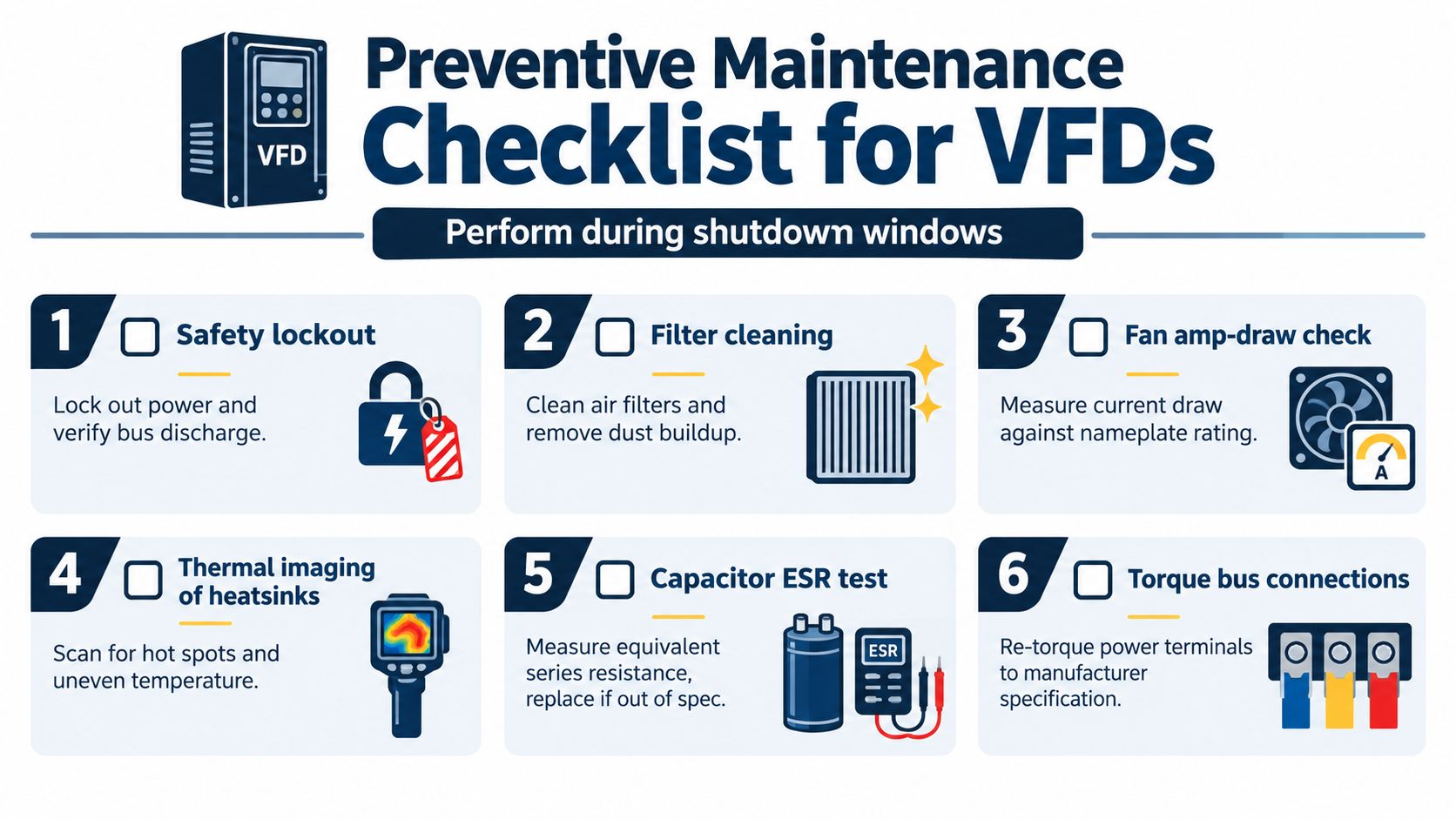
A useful PM checklist should fit inside a shutdown window and produce data you can compare next time. It also needs to change by environment. A drive room that stays cool and clean can tolerate longer intervals than a cabinet exposed to dust, moisture, or high ambient heat.
A shutdown-window sequence that actually works
Start with lockout and bus discharge verification, then move into the cabinet itself. Clean or replace filters, remove dust buildup from heatsinks, and check fan amp draw against the expected range for that unit. After that, use thermal imaging to look for hot spots and uneven temperatures across the cooling path.
The last part of the job is where the trend value lives. Test capacitor ESR, torque power terminals to specification, and inspect control wiring for heat damage, abrasion, or loose terminations. If anything is drifting, record it in a way the next technician can compare against during the next outage.
Record this every visit: fan current, heatsink delta-T, bus ripple, insulation resistance, visible contamination, and any changed fault codes.
A practical cadence for harsh environments
Quarterly checks make sense on drives exposed to dust, salt, or high heat, especially where the cabinet seals or cooling path are already under pressure. Semi-annual work is a better fit for cleaner plants or less punishing duty cycles, and annual inspections are the minimum you'd want to rely on for lower-risk cabinets. The more aggressive the environment, the less you should trust a long calendar interval.
A simple way to assign tasks is by failure mode. Fan checks catch airflow loss. Thermal scans catch cooling imbalance and loose terminations. ESR trending helps identify capacitor aging. Torque verification catches thermal cycling and vibration effects before they turn into visible faults. That's the logic behind a PM schedule that does more than mark time on a calendar.
For teams building a formal checklist, a preventive maintenance checklist for VFDs can be adapted to the cabinet's exposure, service history, and downtime windows. The best version is the one your crew can repeat without guessing.
Choosing the Right Maintenance Mix for Your Drive Fleet
A drive trips during a hot production run, and the cabinet inspection reveals salt film, blocked airflow, and a fan nearing the end of its service life. The failure may be corrective work today, but the maintenance decision started earlier. Choose the mix by assessing four factors: asset criticality, load profile, available redundancy, and operating environment.
Critical drives in harsh service should use a preventive-dominant plan. Scheduled inspections can target contamination, thermal stress, capacitor aging, and fan wear before those conditions stop production. A redundant pair can often use condition-based intervention with selective preventive work, because the process has some operating cushion while one unit receives attention.
A non-critical spare or low-consequence pump drive may remain on a corrective plan when replacement parts are already available and downtime has little process impact. The decision still depends on failure history. Repeated trips, rising repair effort, or long parts lead times justify moving that drive toward scheduled care.
| Asset Profile | Recommended Mode | MTBF Impact | Planning Effort |
|---|---|---|---|
| Critical production drive in harsh service | Preventive-dominant | Highest improvement potential when failure modes are targeted | Highest |
| Redundant pair with load sharing | Condition-based with selective PM | Moderate to strong, depending on monitoring quality | Moderate |
| Non-critical utility drive | Corrective-acceptable | Limited unless failures are repeated and analyzed | Low |
| Spare drive held for swap-out | Corrective with periodic verification | Indirect, mainly through readiness | Low to moderate |
The steel-plant and coastal examples support this approach. Hot-strip drives faced both severe exposure and high production consequences, so scheduled care had a clear purpose. The high-salinity site required inspection intervals and tasks that reflected environmental loading rather than a calendar alone. A non-essential pump motor in a low-risk area can stay corrective when spares, access, and process tolerance are all favorable.
Use a simple cost-and-consequence test. If unplanned downtime costs more than the PM labor by an order of magnitude, favor preventive work. If the asset has low consequences and a replacement is already on the shelf, corrective spending is easier to justify. Use this rule to stop over-maintaining the wrong drive and under-maintaining the one that will hurt you.
DUCHENG Industrial supports drive-specific planning through VFD commissioning, preventive care during shutdowns, structured fault diagnosis, repair, and on-site reconditioning for harsh industrial environments. Review the service approach against cabinet conditions, spare strategy, and workable shutdown windows.