
Variable speed drive compressor payback depends on part-load duty. Compare measured savings, control modes, integration risks and restart checks.
A variable speed drive compressor doesn't automatically cut energy use by a headline percentage. The key question is whether the compressor spends enough time at part load for speed control to beat unloading, cycling, or a staged bank, and whether the equipment can operate safely across that speed range.
Start with the duty profile, not the motor nameplate. Then check the compressor's control mode, package efficiency at part load, and the fault protections that keep a drive-related problem from becoming an unsafe restart.
Table of Contents
- Measured Savings and Payback by Duty
- How Speed Tracks Demand Across Duties
- Control Modes for Real Air Demand
- Integration Traps That Cancel the Savings
- Checks Before Restarting a Tripped Drive
- Choose Retrofit, Recondition or Replacement
Measured Savings and Payback by Duty
A drive can look attractive on a savings estimate and still disappoint on the plant floor. Payback depends on how many hours the compressor runs at part load and on the complete package's efficiency at 40%, 70%, and 100% load. The cases below show why broad results are useful for comparison, but not a substitute for a duty-specific calculation.
| Case | Scope | Energy change | Payback or cost effect | Applies when |
|---|---|---|---|---|
| DOE typical rotary | Weighted average versus fixed speed | 35% less electricity | 22% lower five-year life-cycle cost | Air demand fluctuates |
| Thai plant measured | 100 hp air-cooled screw after VSD installation | 32.18% less electricity | 0.86 years, about 10.3 months | Result measured at the plant |
| Thai forecast method A | Same compressor before installation | 9.42% estimated savings | 2.94 years | One estimation method |
| Thai forecast method B | Same compressor before installation | 28.53% estimated savings | 0.97 years | Alternative estimation method |
| ACEEE motor systems | Adjustable-speed drives across sectors | 15% to 40% energy reduction | Not reported as a compressor-specific payback | Sector average, not a guarantee |
| Compressor experiment | Electrical versus mechanical speed control | 43.6% to 60.5% reduction | Not reported | Tested discharge pressures |
| Hydrogen pipeline model | Variable versus fixed speed | About 20% less compression energy | 8% higher capital cost; 15% to 20% lower levelized cost | Largest savings at low flow; about 8% at 97% of reference flow |
| Near-constant full load | Drive losses can offset speed control | Little or no saving | Payback may not be attractive | Most hours near rated capacity |
The Thai pilot shows how much a forecast can differ from a measured result. Before installation, one method estimated 9.42% savings and a 2.94-year payback, while another estimated 28.53% savings and a 0.97-year payback. After installation, the study measured 32.18% electricity savings and calculated a 0.86-year payback for the 100 hp air-cooled screw compressor. The Thai industrial study reports one machine under its operating conditions, not a result that transfers automatically to another plant.
The table's broad figures also describe different applications and test conditions. ACEEE reports average energy reductions of 15% to 40% for adjustable-speed drives across industrial sectors. A compressor experiment found 43.6% to 60.5% reductions under its tested discharge pressures. Neither range determines a compressor's payback on its own.
Before quoting savings: Measure the load profile first. A percentage without operating hours behind it is not a payback case.
Record flow, pressure, operating hours, unloaded kilowatts, and time spent in each load bin for several weeks. Then compare the baseline with the proposed package's efficiency at 40%, 70%, and 100% load, accounting for installation and lifecycle costs. A variable speed drive efficiency assessment can start with a simple question: how much electricity does the existing unit use when it produces little or no useful air?
How Speed Tracks Demand Across Duties
Speed control is most useful when compressor demand changes often enough for the machine to spend substantial time below full output. A variable speed drive adjusts motor speed, which changes the compressor's flow and power draw. The savings depend on how the package performs across the actual load profile, not on motor rating alone.
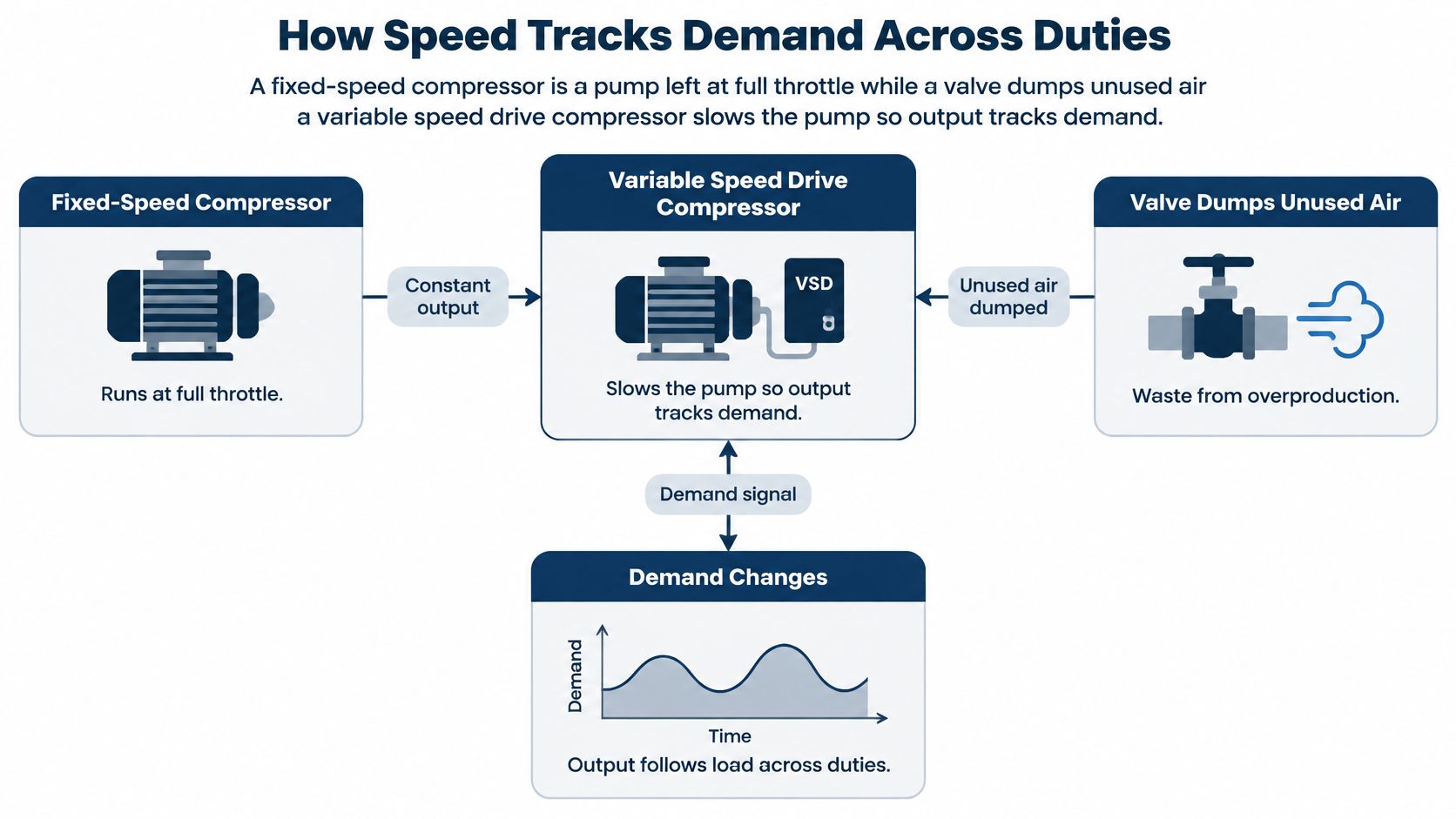
At part load, lower speed can reduce the air produced and the power needed to produce it. The relationship is not a simple one-to-one rule: motor and drive losses remain, and compressor efficiency changes with operating point. Compare the complete package at 40%, 70% and 100% load, rather than assuming that a given reduction in flow produces the same reduction in electrical input.
A useful analogy is a car climbing a hill: changing speed affects the work being done, but the engine still has a range where it operates properly. Compressors have similar limits. An oil-injected screw must stay above the speed needed for oil circulation and cooling. A centrifugal compressor must maintain adequate flow to avoid surge, often using anti-surge or minimum-flow control. Below those limits, slowing the motor can threaten safe operation instead of saving energy.
The key operating question is how many hours the machine spends at each point on its load curve. A screw compressor that repeatedly unloads as production demand rises and falls may have room for speed control, provided its pressure controls and minimum-speed limit allow stable operation. A machine that runs close to full capacity for most of its hours may have less opportunity to benefit. Part-load hours and package efficiency determine whether the investment makes sense.
Different duties also behave differently. Factory compressed air and pipeline compression have distinct operating profiles, so their results cannot be transferred directly from one application to another. The hydrogen pipeline technoeconomic model illustrates how operating flow affects the case for speed control; use its findings as application-specific context, not as a forecast for an air-compressor room.
After commissioning or maintenance, trend input power alongside delivered flow and pressure. If the compressor draws more power while delivering the same service, check sensor readings, fouling, valves, setpoints, and drive or motor condition. That change may indicate an equipment or control issue, not a normal cost of operation.
Control Modes for Real Air Demand
Compare compressor package efficiency at 40%, 70%, and 100% load before choosing a control mode. U.S. compressor standards evaluate variable-speed units at these load points, giving a clearer view of part-load performance than a full-load nameplate figure alone. The payback depends on how many hours the compressor spends at each load and how efficiently the whole package operates there.
| Mode | What it varies | Best duty | Risk if mis-set |
|---|---|---|---|
| Pressure PID on speed | Motor speed to hold discharge pressure | Demand that swings through the day | Hunting and short cycling |
| Load-unload fixed speed | Inlet or slide valve while the motor stays at full speed | Hours near full capacity | Unloaded power with little air delivered |
| Start-stop | Motor on and off | Very few operating hours | Inrush, thermal stress, and frequent starts |
| Inlet throttle | Restriction ahead of the air end | Legacy fixed-speed control | Poor part-load efficiency |
| One VSD trim in a bank | Trim speed while fixed-speed units carry base load | Multi-compressor plants | Setpoints fighting across machines |
| Minimum-speed floor | Lowest allowed screw-compressor speed | Oil-injected screw operation | Lost lubrication or overheating |
| Anti-surge or minimum flow | Recycle or blow-off flow on a centrifugal | Low-flow centrifugal duty | Surge if speed is pushed too low |
For a single compressor, pressure PID control can track changing demand by adjusting motor speed to hold discharge pressure. The control band must be tuned to the system. If it is too narrow, or if neighboring machines use conflicting targets, the compressors may hunt rather than share the load smoothly.
In a staged bank, let one machine carry the stable base load and use one VSD trim unit to follow the remaining demand. That arrangement gives the variable-speed machine a clear job. Overlapping pressure targets can make machines chase each other, defeating orderly load sharing.
Fixed-speed load-unload control can still suit a compressor that runs near full capacity most of the time. It uses power while unloaded, but a drive also has conversion losses and adds equipment. If there are few part-load hours, those factors may outweigh the energy saved by changing speed. Start-stop control is better suited to very short, infrequent operating periods, since repeated starts can stress the motor and plant electrical system.
The operating point matters as much as the control mode. A compressor with a narrow useful speed range, or meaningful cooling, filtering, and maintenance losses, may not benefit from a drive even when demand varies. Compare performance across the actual duty profile, rather than assuming that lower speed always means lower energy use.
The same principle applies beyond air compressors. A hybrid chiller strategy reported 32.2% to 33.0% energy savings by coordinating variable-speed and variable-displacement compressors to avoid inefficient low-load operation. That figure describes the chiller strategy, not an air-compressor result. The useful lesson is that keeping equipment in an efficient operating region can outperform slowing every machine.
Ask the buyer's question directly: for this duty, when does speed control outperform cycling, unloading, or a staged bank, and when does another mode fit better?
Integration Traps That Cancel the Savings
A favorable load profile can still produce a poor result if the drive is integrated badly. The maintenance supervisor should account for power quality, motor cabling, cooling, compressor limits, and control interactions before approving the installation.
The input rectifier can draw non-sinusoidal current. A line reactor or harmonic filter may be appropriate when a site power-quality study shows the electrical bus needs it, but adding one by default can add cost and losses without solving a demonstrated problem.
Long motor cables also need attention. They can increase reflected voltage and bearing-current risk, so specify the cable length and follow the motor and drive design requirements for output filtering, shaft grounding, or insulated bearings. Don't leave those details until the equipment is on site.
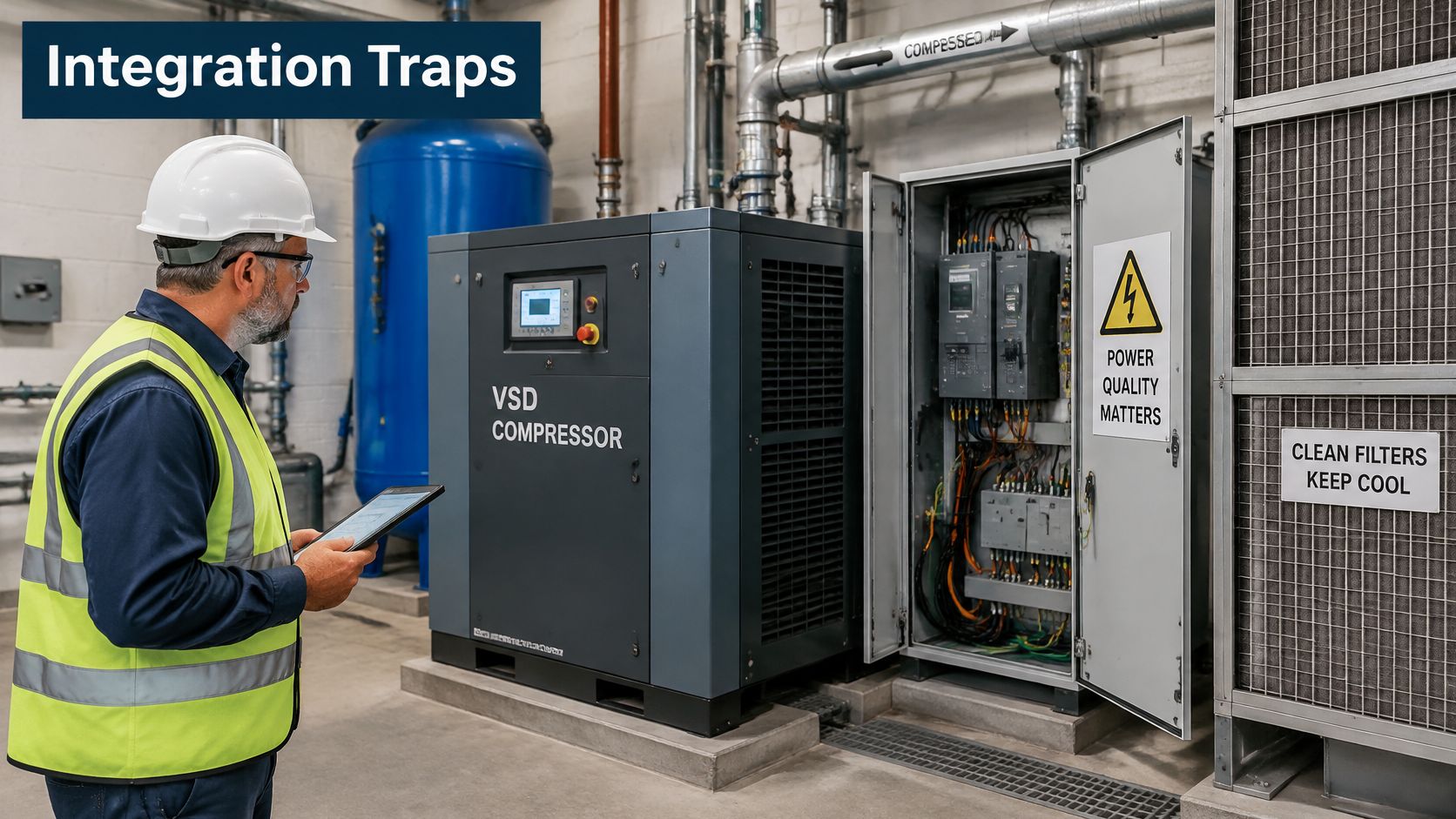
Heat is another quiet cause of trouble. The drive adds losses inside an electrical cabinet that may already sit in a hot compressor room. Dust-clogged filters or failed fans can push temperatures up and trigger nuisance trips, so include cabinet ventilation and a routine cleaning and inspection plan.
Control settings must respect the compressor's operating limits. Set the screw's minimum speed high enough to preserve oil flow and cooling, and prevent its pressure loop from fighting a neighboring fixed-speed machine. Centrifugals need working anti-surge protection, while reciprocating compressors may have speed ranges that create torsional vibration. Neither risk is solved by lowering the drive command.
At handover, require a flow-pressure map and recorded speed limits. Check motor current, discharge temperature, and vibration, then establish a baseline trend of input kilowatts per unit of delivered air. That trend gives maintenance a way to spot declining performance from sensor drift, fouling, valve problems, or inappropriate setpoints before the condition becomes a trip.
Checks Before Restarting a Tripped Drive
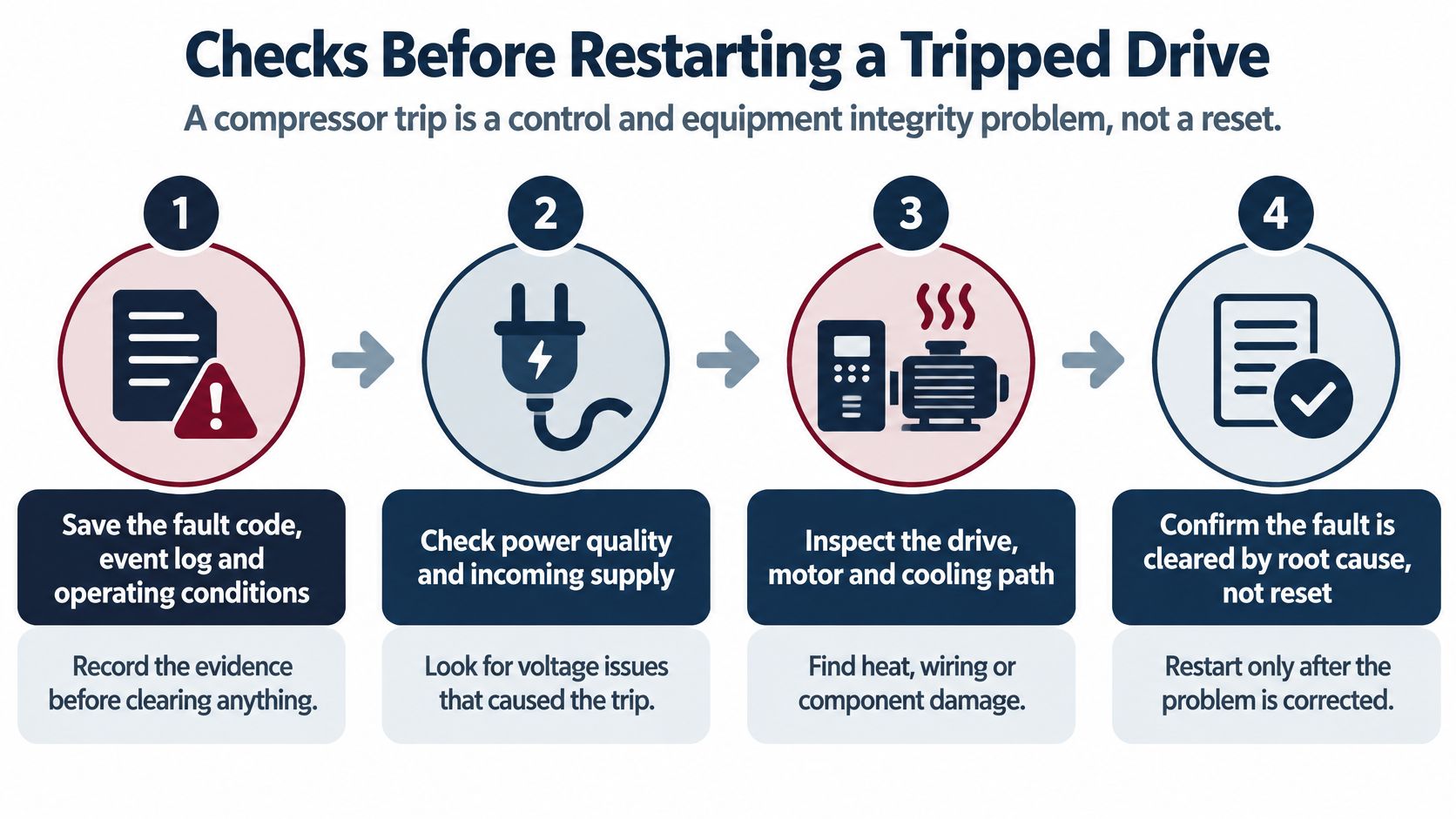
A compressor trip is a control-and-equipment integrity problem, not a reset problem. A reset can clear the display without correcting the cause. Preserve the evidence, diagnose the fault, and restart only when the compressor and its protections are ready.
-
Save the fault evidence. Record the fault code, event log, operating conditions, and available waveform before clearing the alarm. The sequence and conditions around a trip may identify a power event or process instability that a reset would obscure.
-
Check the incoming supply and DC bus. Verify phase and bus conditions before restarting. If a supply disturbance damaged a rectifier or another drive component, restarting without diagnosis can make the failure worse.
-
Inspect the cabinet and cooling path. Check filters, fans, heat sinks, and contamination. Blocked cooling or conductive dust can create an overtemperature or component fault; Pacific Northwest National Laboratory VFD guidance recommends trending operating and ambient temperatures and diagnosing a tripped drive before reset.
-
Confirm motor and compressor permissives. Check the motor condition, insulation concerns, and bearing-current provisions. Verify that the compressor is ready to start, not just that the drive is ready to run.
-
Verify machine-specific protections. A centrifugal unit needs functioning anti-surge or minimum-flow logic. For a reciprocating machine, confirm the commanded speed doesn't sit in a torsional vibration range.
-
Test under controlled conditions. Start at no load or a safe process condition, then monitor current, temperature, and vibration. Stop if any reading is abnormal or the fault reappears.
-
Set a firm stop rule. A repeated trip ends the restart attempt and moves the job to fault diagnosis. Use a structured VFD overcurrent fault diagnostic process to keep troubleshooting focused on the cause rather than repeated resets.
Low-voltage packages may be practical to remove for workshop diagnosis. For large medium-voltage equipment, shipping can introduce its own risks, so compare it with qualified on-site diagnosis and repair. Either way, collect the fault record and operating conditions first.
The restart decision needs evidence: the fault record must point to a corrected cause, and a controlled no-load or safe-condition run must show stable operation. A dark alarm screen alone doesn't prove the compressor is safe to return to service.
Choose Retrofit, Recondition or Replacement
Turn the operating logs into one decision. If a compressor spends long hours below about 70% load while unloading or short-cycling, assess a VSD retrofit or one variable-speed trim unit in a fixed-speed bank. Then compare energy use in the same load bins after commissioning, rather than judging success from a single overall bill.
If the unit operates near full capacity for most of its duty, retain fixed speed or consider staged capacity. Drive losses and a narrow useful speed range can erase the projected benefit. If an installed drive trips, preserve the fault record and complete the recovery checks before buying a replacement.
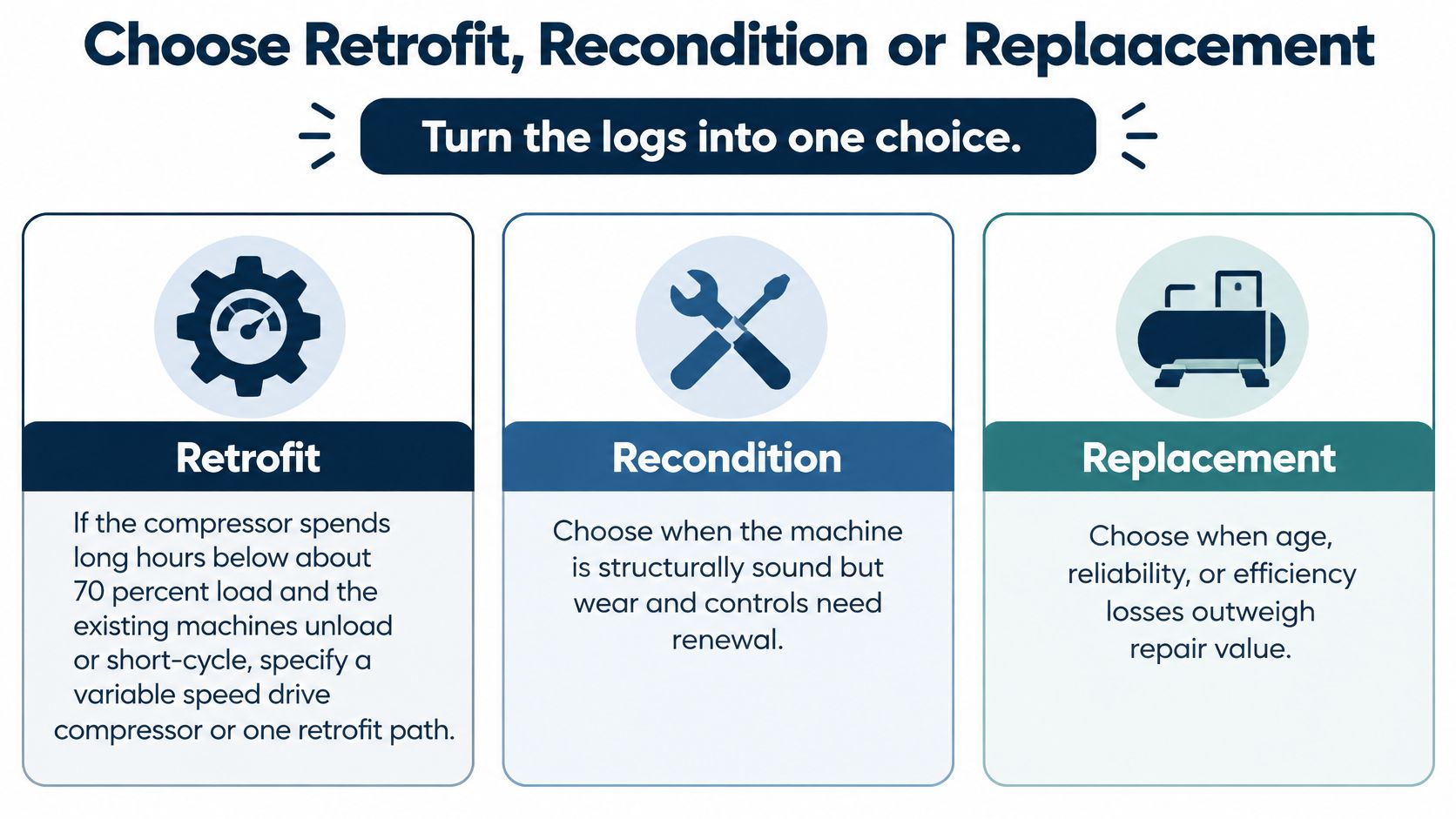
For an aging medium- or high-voltage drive that's difficult to ship, on-site reconditioning during a planned shutdown can be an alternative to replacing the whole system. DUCHENG Industrial has reconditioned medium-voltage drives with nearly ten years of service fully on site during a planned maintenance shutdown at a tire manufacturer in Rayong, Thailand. The choice should follow inspection of the drive's condition and the compressor's measured duty, not the alarm history alone.
If you're assessing a compressor retrofit, gather the drive brand and exact model, rated power and voltage, fault code if applicable, and a multi-week demand log. DUCHENG Industrial provides multi-brand VFD commissioning, troubleshooting, repair, and on-site reconditioning for industrial drive systems; visit DUCHENG Industrial to discuss a measured retrofit study or a controlled recovery.