
A VFD soft start holds inrush near 100–150% of FLA. See volts-per-hertz, torque versus a soft starter, and commissioning checks.
You're standing at a conveyor panel after a drive replacement. The motor starts empty, the operator sees no alarm, and production wants the machine back. Before you sign off, you need to know what happens when the belt is full: how much current the motor draws, whether it follows the acceleration ramp, and whether the installation exposes the motor to avoidable electrical stress.
A VFD soft start is a commissioned sequence, not a gentler start command. The drive must establish the motor's magnetic field, deliver enough torque to move the load, and increase speed without exceeding the electrical and mechanical limits of the system.
Table of Contents
- Starting Current a VFD Soft Start Actually Draws
- How Frequency and Voltage Rise Together
- When a VFD Beats a Soft Starter
- How to Commission the Soft Start
- Pumps Fans Conveyors and Compressors
- Trips Heat and Cable Stress to Catch
- Prove the Loaded Start Before Handover
Starting Current a VFD Soft Start Actually Draws
For a 100 A induction motor, the starting-current comparison is substantial: the motor-starting technical note describes typical NEMA Design B or C across-the-line starting at approximately 5–7 times full-load amperage, versus roughly 100–150% of rated FLA with a modern PWM VFD. That means approximately 500–700 A versus 100–150 A for this example; the same comparison also gives a broader, application-dependent reduction of approximately 30–70% in starting current and starting torque for VFDs and reduced-voltage soft starters versus across-the-line starting.
Starting current and outcome by method
| Method | Typical starting current | How torque arrives | After the start |
|---|---|---|---|
| Direct-on-line | About 5–7× FLA; 500–700 A on a 100 A motor | Full line voltage is applied immediately, producing an abrupt torque response | Fixed line frequency; operating speed follows load and slip |
| Reduced-voltage soft starter | Often about 30–70% less starting current and torque than across-the-line | Voltage is limited, so available starting torque falls | Usually bypassed to line-frequency operation |
| VFD soft start | About 100–150% of FLA; 100–150 A on a 100 A motor | Voltage and frequency are coordinated to establish flux and controlled torque | Speed remains under drive control at the commanded setpoint |
These are typical comparisons, not guaranteed acceptance limits. Motor design, breakaway torque, load inertia, drive sizing, acceleration time, and control settings all affect the result. A heavily loaded machine may require a different current allowance from an unloaded fan.
Also distinguish motor output current from drive input current. The motor nameplate and drive's motor-current display are the relevant starting points for judging motor acceleration. Don't compare an upstream reading casually with an output-current trend and assume they describe the same electrical condition.
What the lower current changes in the plant
A smaller starting demand generally means less disturbance on the plant supply. Contactors on neighboring equipment are less likely to drop out during a voltage dip, and transformers and switchgear experience less starting stress. Motor windings also avoid the severe thermal loading associated with an uncontrolled inrush.
The mechanical benefit matters just as much. Instead of applying an abrupt torque impulse through a coupling, gearbox, or belt, the drive lets the commissioning engineer shape acceleration. That doesn't eliminate the torque needed to move the machine. It controls how the motor delivers it.
The distinction becomes especially important on:
- Long conveyors, where the motor must accelerate both the belt and its material.
- High-inertia equipment, where reaching speed takes sustained accelerating torque.
- Pumps, fans, and compressors, where the process condition changes the starting duty.
- Weak electrical networks, where a motor start can disturb other connected equipment.
Acceptance principle: A running motor proves that a start occurred. A loaded current trend and acceleration record show whether the start was properly commissioned.
Check the ramp, current limit, nameplate entries, and fault history together. A drive that reaches speed only after spending most of the start in current limit hasn't necessarily passed, even if the operator never sees a trip.
How Frequency and Voltage Rise Together
Think first about the speed command, not the electronics. An induction motor's speed follows the frequency supplied to it, allowing for slip under load. To start gently, the drive begins with a low-frequency output and increases it progressively rather than applying full-frequency power immediately.
The motor can be pictured taking small speed steps. At each step, it needs enough voltage to maintain a useful magnetic field, but not so much that it draws excessive magnetizing current. Magnetic flux is the working magnetic field that allows the motor to develop torque.
Keeping the magnetic field useful
The technical paper on induction-motor starting describes coordinated voltage and frequency increases that maintain an approximately constant volts-per-hertz ratio and preserve motor flux. In practical terms, the drive raises voltage as frequency rises, rather than treating voltage reduction alone as the starting method.
The relationship is illustrated below.
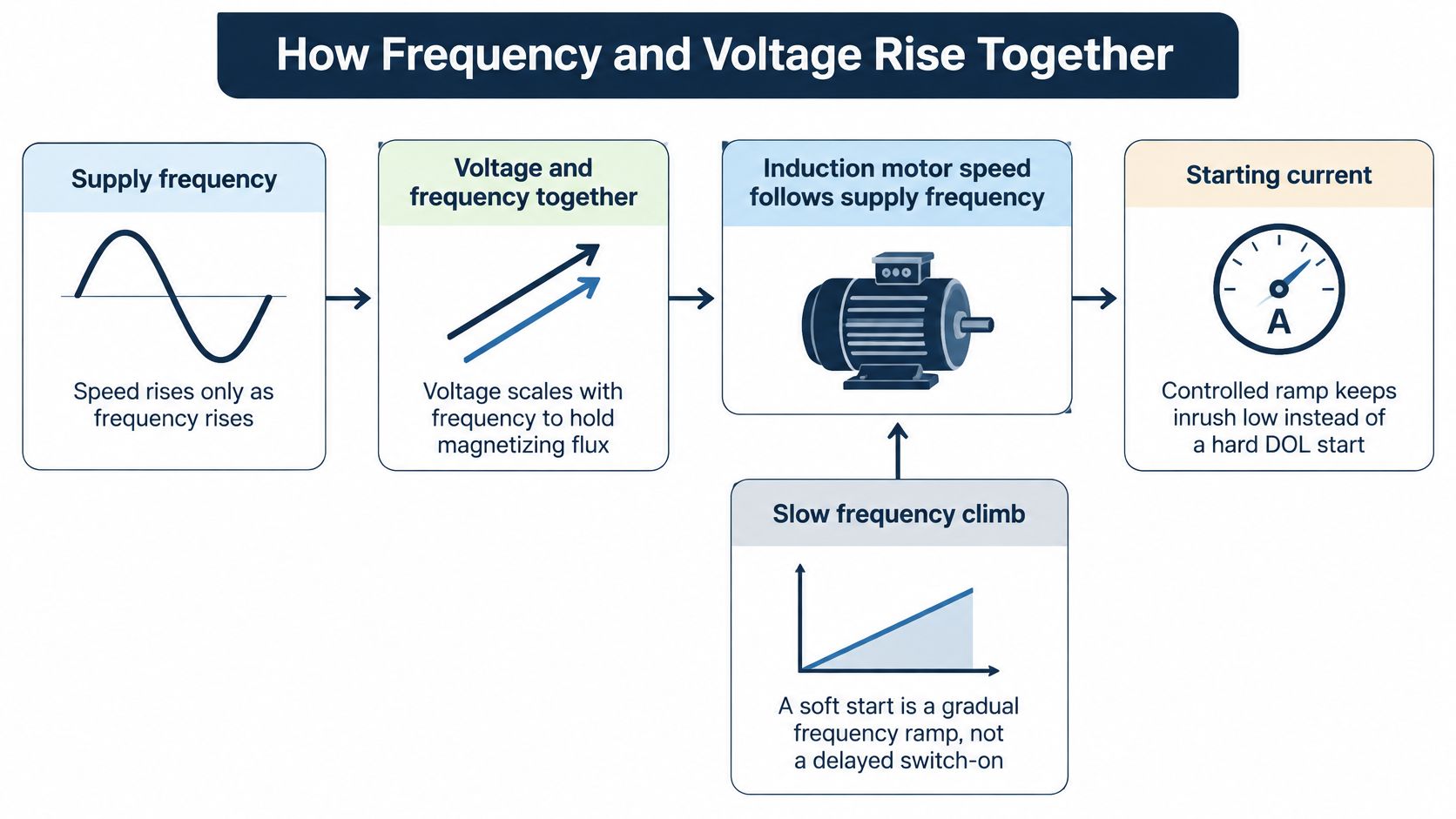
If full voltage were applied while frequency remained low, the magnetic circuit could become overexcited and current could rise sharply. If voltage were reduced while frequency stayed high, the motor would lose flux and available torque. Coordinating the two avoids those extremes.
A simple volts-per-hertz description is useful for understanding the sequence, but it isn't the complete control algorithm of every drive. Vector-control modes also manage flux and torque, using a motor model and feedback or estimation. Low-speed voltage compensation may be necessary because winding resistance becomes significant at low output frequency.
Why the ramp still needs engineering
Say a loaded conveyor needs a sustained pull to overcome friction and accelerate its material. A very short acceleration setting asks the motor to produce that pull and build speed almost immediately. The drive may reach its current limit, extend acceleration, or trip before the commanded speed is reached.
A much longer ramp isn't automatically safer. A shaft-mounted cooling fan moves less air at low motor speed, so prolonged acceleration can leave a self-cooled motor carrying substantial current with limited cooling.
A useful ramp gets the load moving predictably without forcing the drive against its current limit or leaving the motor dwelling hot at low speed.
The technician therefore needs to observe actual acceleration, not just the entered ramp parameter. Confirm the minimum starting frequency, control mode, and motor data, then watch whether the loaded machine follows the intended speed rise. The correct setting is the one the motor, load, and process can all tolerate.
When a VFD Beats a Soft Starter
Choose a VFD when the process needs controlled speed, torque, or acceleration, not merely fewer starting amps. A conventional soft starter can be appropriate when the machine runs at fixed speed and only needs a gentler transition onto the supply.
The torque distinction explains why reducing current doesn't always produce a satisfactory start. The AC drives and soft starters application guide explains that starting torque falls approximately with voltage squared, so applying 70% voltage can leave about 49% of the approximate voltage-dependent starting torque. A machine with significant breakaway resistance may not move reliably under that reduced torque.
Compare the duty, not just the starting current
Soft starter versus VFD on the start
| Criterion | Reduced-voltage soft starter | VFD |
|---|---|---|
| Frequency during start | Stays at line frequency | Rises from a low starting frequency |
| Voltage | Reduced, then restored to line voltage | Coordinated with frequency to maintain suitable flux |
| Low-speed torque | Falls approximately with voltage squared | Useful low-speed torque is available with appropriate control and sizing |
| After start | Motor runs at line frequency; starter is often bypassed | Continuous speed control and torque management |
| Extra electrical burden | Mainly during starting, especially with bypass operation | Input harmonics, output switching effects, reflected waves, bearing currents, and EMC considerations |
A VFD doesn't remove the need to size for torque. It gives the engineer more control over how torque is produced. For demanding low-speed operation, verify the selected control mode, motor cooling, and drive overload capability rather than assuming every drive behaves identically.
The additional installation work is real
The rectifier creates supply-side harmonic considerations, while inverter switching creates motor-side electrical stress. Long motor leads can produce reflected-wave voltage at the motor terminals. Common-mode effects can contribute to bearing currents, and poor cable routing or bonding can interfere with nearby instrumentation.
That makes the following part of commissioning, not optional paperwork:
- Carrier-frequency selection, balancing the manufacturer's thermal, acoustic, and application requirements.
- Motor-cable review, including actual installed length and suitability for drive operation.
- Output protection assessment, deciding whether an output reactor, dv/dt filter, or another manufacturer-specified measure is needed.
- Grounding and EMC checks, including shield termination, bonding, and separation from sensitive signals.
- Supply evaluation, particularly where generators, weak networks, or sensitive controls share the bus.
A bypassed soft starter normally stops controlling the motor after acceleration. A VFD remains the motor's power source during ordinary operation, so its installation requirements continue throughout the running duty.
For a fixed-speed load that only needs a gentler start, a soft starter may be sufficient. Where the process requires a shaped acceleration profile, useful low-speed torque, or adjustable running speed, a properly selected drive provides capabilities the starter doesn't.
How to Commission the Soft Start
Use a written sequence with a place to record observations, not just tick boxes. Before testing, authorized personnel should complete the electrical safety checks, confirm mechanical readiness, and agree who can issue a start command. Parameter changes and measurements must follow the equipment manufacturer's procedures and the site's safe-working rules.
Run the checks in a controlled order
-
Enter the motor nameplate accurately.
Copy voltage, frequency, full-load current, power, rated speed or pole information, and power factor where requested. Confirm the actual motor connection matches the configured voltage. Incorrect entries undermine the motor model and protection settings, making later adjustments difficult to interpret. -
Choose the control mode and acceleration settings.
Volts-per-hertz control may suit a straightforward application; demanding breakaway torque or low-speed performance may justify vector control. Enter the minimum frequency and acceleration ramp from the load requirements, not the factory default. This prevents an unrealistic acceleration demand or unnecessary low-speed heating. -
Set and understand the current limit.
Start from the application design and the motor and drive manufacturers' allowable ratings. Establish whether reaching the limit stretches the ramp, holds frequency, or initiates a fault. This prevents treating a current-limited acceleration as normal tracking of the programmed ramp. -
Prove direction with a permitted light-load test.
Confirm the machine can safely be uncoupled, unloaded, or briefly jogged before attempting it. Watch motor output current, DC-bus status, and actual time to speed using the drive monitor or suitable instruments. This catches reverse rotation and obvious control errors before a demanding production start. -
Repeat under the worst normal starting load.
Coordinate with operations so the test represents an allowable, realistic condition. A full conveyor or a compressor with residual pressure can behave very differently from the initial light-load run. This prevents accepting a setup that works only when the machine is easy to turn. -
Verify the motor-cable installation.
Record cable length, grounding arrangements, carrier frequency, and the decision on output reactors or filters. Resolve installation requirements before extended operation. This prevents leaving insulation, bearings, and nearby control circuits exposed to an unreviewed switching environment. -
Save the accepted configuration and evidence.
Back up parameters, archive fault history before clearing anything, and record peak current, acceleration time, and current-limit events. Keep the result with the panel documentation. This prevents the next technician from having to reconstruct an undocumented setup after a reset or replacement.
Make the test record usable
Use a VFD commissioning checklist to keep settings, observations, and outstanding actions together. Record stop behavior separately as well: an acceptable start doesn't prove that a deceleration ramp is safe for the process or the DC bus.
This overview supports the field workflow; the numbered checks above provide the acceptance detail.
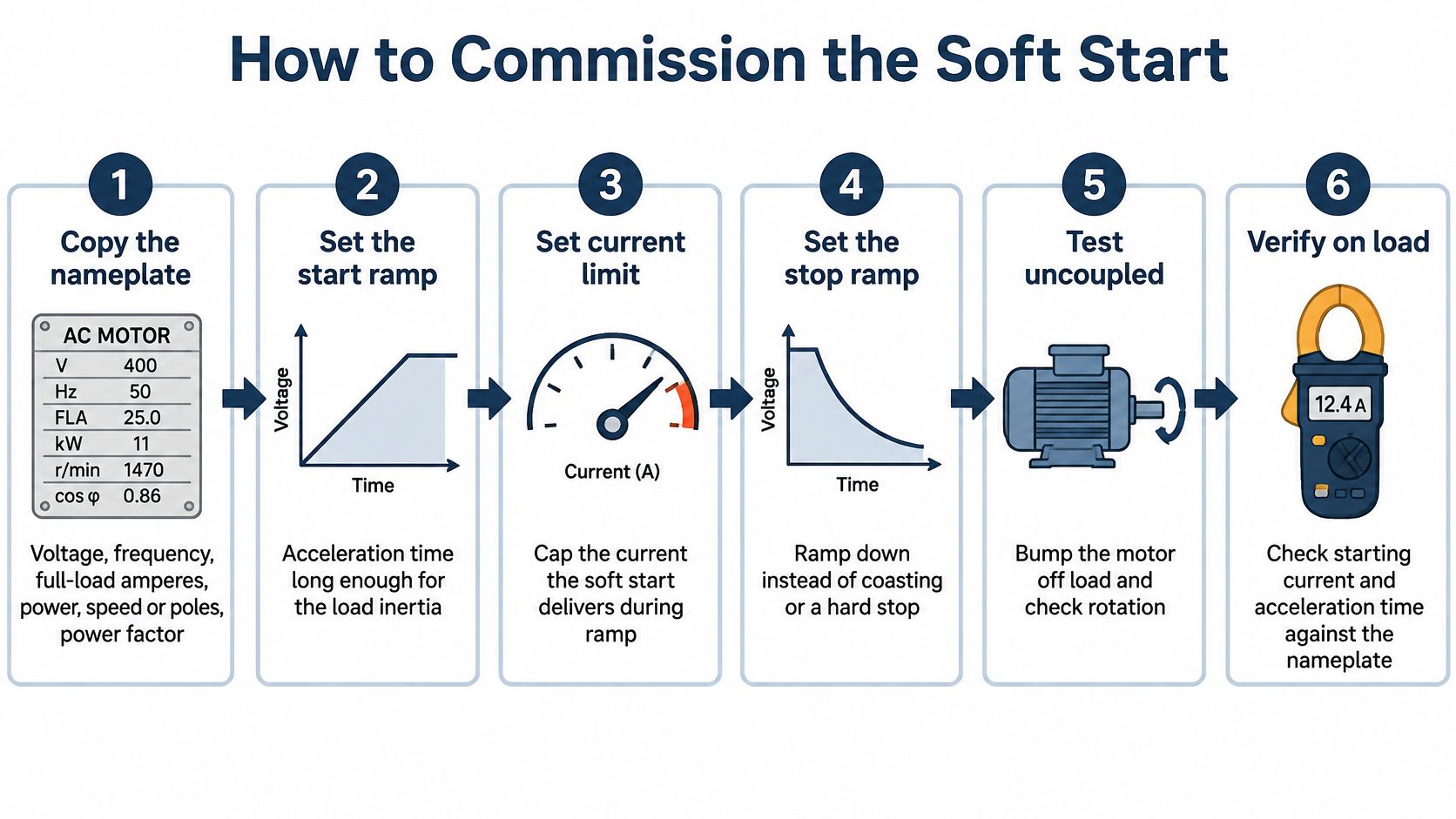
Accept the start only when the loaded current and actual acceleration meet the documented application requirements without unresolved alarms, prolonged current limiting, or mechanical distress.
Pumps Fans Conveyors and Compressors
The same drive settings won't suit every machine. Begin with the process condition that makes starting difficult, then choose an acceleration profile that respects it. A maintenance supervisor should be able to explain the limiting condition without referring to a parameter number.
The field inspection should include the driven machine, not just the panel.
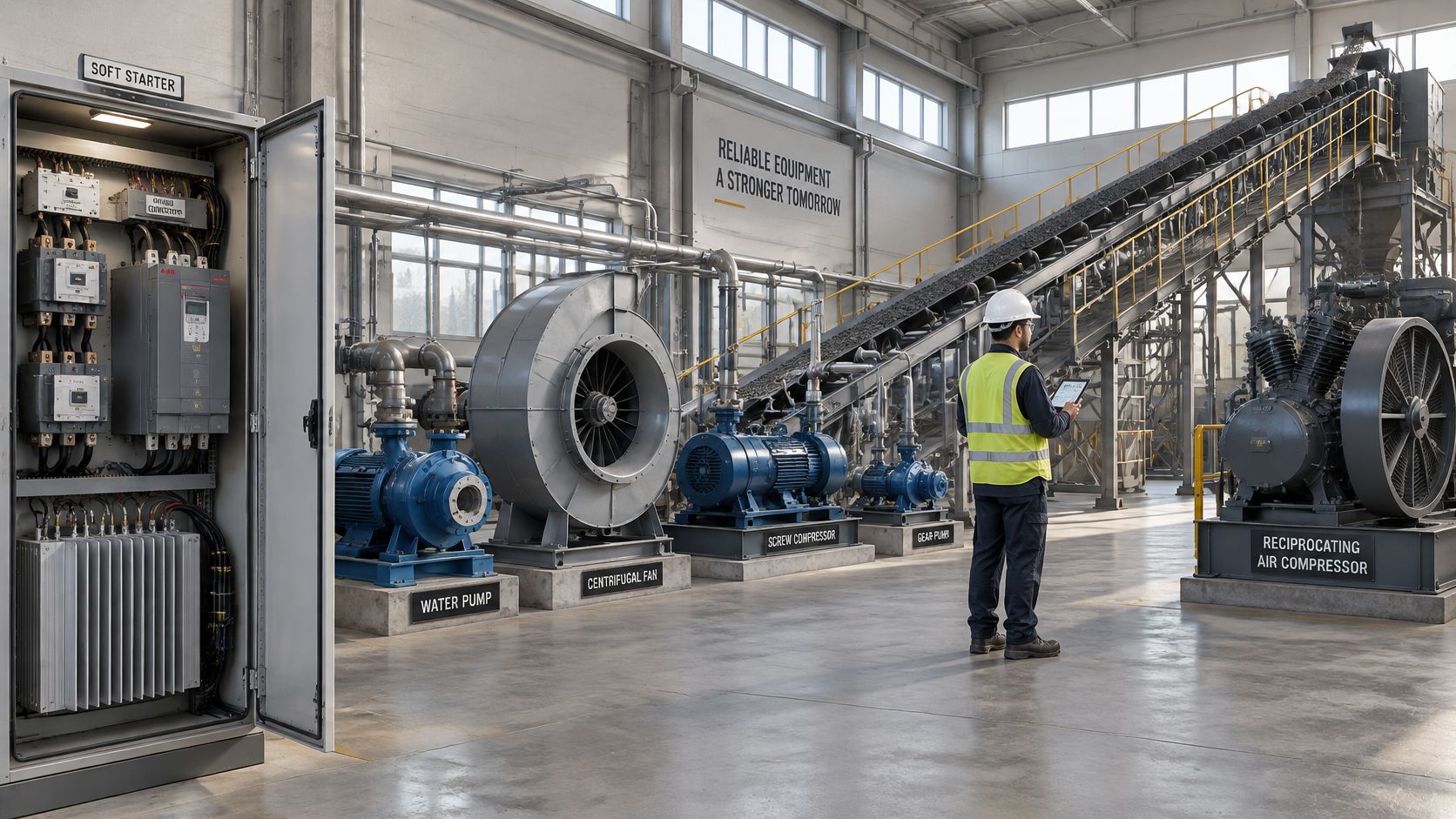
Pumps and fans need process-aware ramps
For a centrifugal pump, a smooth motor start can still produce an unacceptable pressure response. Check valve behavior, system filling, minimum flow, and the transition into pressure control. Don't lengthen the ramp blindly if the pump then struggles to establish the required flow.
Fans need similar attention to the operating condition. Confirm damper positions, airflow permissives, and whether the fan is already windmilling before the start. Where process demand permits lower running speed, the drive can continue delivering a benefit after acceleration.
IEEE's history of induction-motor drives traces the development from SCR and forced-commutation systems in the 1960s and 1970s toward more practical PWM drives, and describes centrifugal pump and fan power demand as following approximately the cube of speed. Actual savings still depend on the system and operating point, so don't promise an energy reduction solely because a drive has been installed.
Conveyors and compressors need starting-condition checks
A long conveyor needs enough early torque to overcome resistance without slipping the belt or shocking the drivetrain. An empty-belt test won't establish the required starting performance when material is present. Observe belt movement alongside the electrical trend so a slipping coupling or belt isn't mistaken for successful acceleration.
A compressor may require an unloading sequence before starting. Confirm the machine's permitted starting condition, valve sequence, and pressure state with its controls and manufacturer's instructions. Raising the drive current limit isn't a substitute for correcting a failed unloader.
The following video provides an additional visual reference for the operating discussion.
<iframe width="100%" style="aspect-ratio: 16 / 9;" src="https://www.youtube.com/embed/mgrow2dorxI" frameborder="0" allow="autoplay; encrypted-media" allowfullscreen></iframe>For each duty, record:
- Target ramp, including the actual observed acceleration.
- Expected peak current, matched to the permitted starting condition.
- Process limit, such as pressure surge, belt slip, airflow response, or compressor loading.
Those entries connect the electrical acceptance test to the machine operations needed.
Trips Heat and Cable Stress to Catch
A successful start command doesn't mean the soft start is commissioned. Some faults appear immediately; others emerge after repeated starts, a loaded restart, or extended operation. Diagnose the sequence from recorded evidence rather than changing several settings at once.
Follow the first observable failure
- Current rises and acceleration stops. Compare commanded frequency, output frequency, and motor current. Determine whether the drive is limiting acceleration or whether the load has mechanically stalled before increasing the current allowance.
- The motor gets hot during repeated starts. Record start frequency, low-speed dwell, load condition, and available temperature feedback. A longer ramp can worsen heating rather than cure it.
- The drive trips before useful movement. Preserve the exact event code and operating state. Check brake release, unloading, binding, and motor data instead of assuming the power stage is undersized.
- The motor runs but later develops electrical problems. Document installed cable length, filter type, grounding, and carrier setting. Don't treat an initially clean start as proof that the motor-terminal waveform is acceptable.
Diagnostic discipline: Preserve the fault record before resetting. A reset removes the immediate interruption, not its cause.
Use the VFD overcurrent fault guide to structure an overcurrent investigation around when the event occurs and what the machine is doing.
The checklist below is a prompt for inspection, not a substitute for the drive's fault definitions.
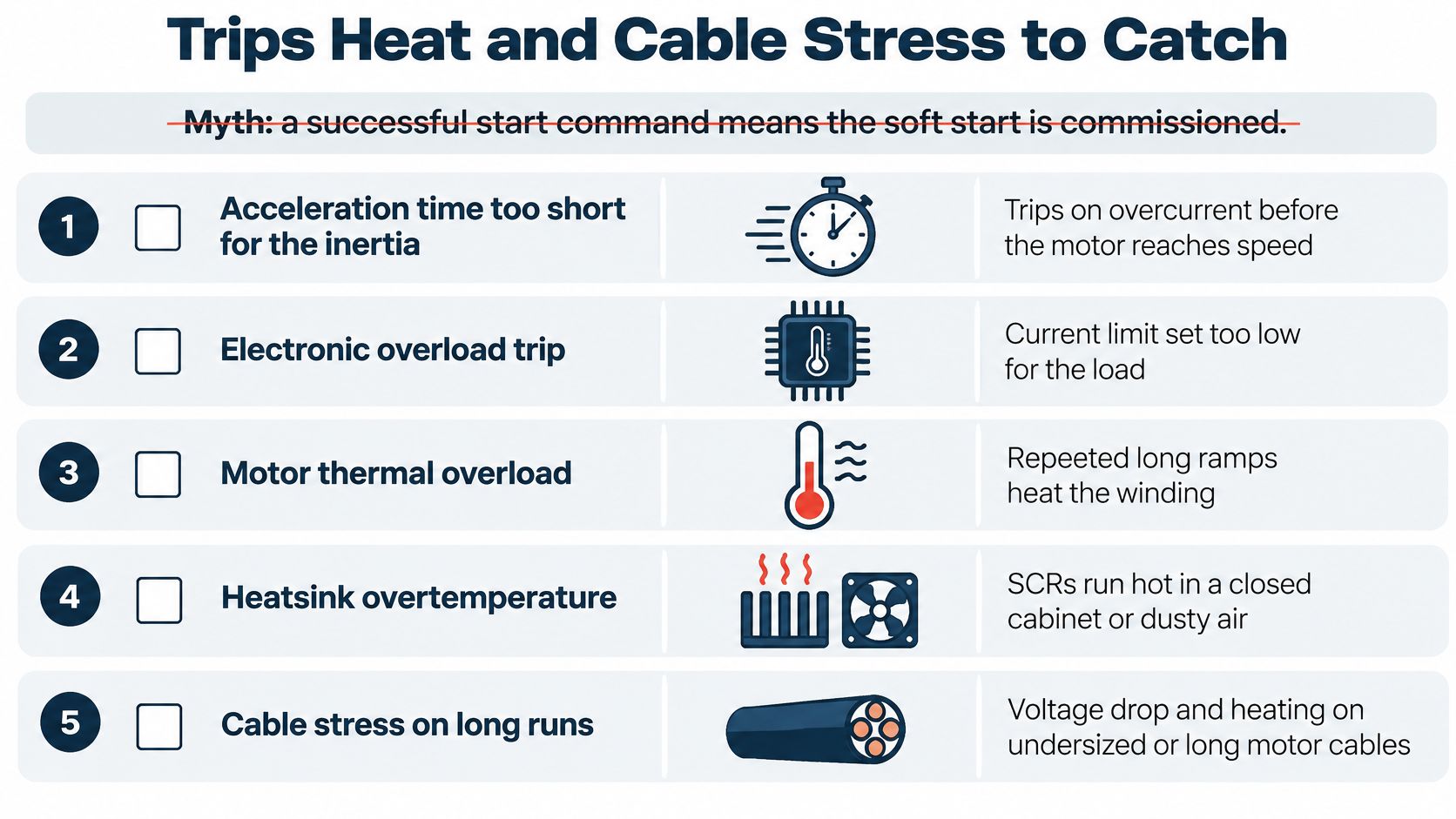
Separate supply, drive, and motor evidence
Cabinet cooling problems require inspection of fans, filters, airflow, contamination, and heatsink condition. Don't confuse a drive thermal alarm with a motor thermal problem, and don't apply conventional soft-starter component descriptions directly to a VFD's power circuit.
A generator or weak bus also deserves investigation even when the motor reaches speed. Capture supply disturbances and review harmonic compatibility where necessary.
An excessively high current limit doesn't turn a VFD into an across-the-line starter, but it can permit unnecessary thermal and mechanical stress. An excessively restrictive limit may prevent breakaway. Correct the ramp, load condition, and installation evidence before condemning or replacing power hardware.
Prove the Loaded Start Before Handover
Don't hand the drive over until a representative worst-case normal loaded start meets the agreed acceptance criteria. If the machine trips, stalls in current limit, or remains hot at low speed, stop and investigate. Repeated restart attempts can turn a settings or mechanical problem into motor damage.
Keep a short acceptance packet
Leave the following with the panel:
- Configuration, including entered nameplate values, control mode, ramp, and current limit.
- Test evidence, including load condition, peak current, time to speed, and current-limit events.
- Installation decisions, including cable length, grounding checks, and filter assessment.
- Recovery records, including the parameter backup and archived or annotated fault history.
For multi-brand fleets, we contract field commissioning alongside diagnosis, repair, preventive maintenance, and deep on-site reconditioning. That allows the loaded run and parameter backup to form part of a documented handover rather than an informal operator check.
Before construction, VFD Master supports engineering pre-selection for low-, medium-, and high-voltage drive projects with real-time sizing, a copyable summary, and print/PDF export. It supports selection; it doesn't replace verification on the installed machine.
If a later trip interrupts production, prepare the drive brand, exact model code, rated power and voltage, fault code exactly as displayed, when it occurs, and the operating environment. That gives the diagnostic team a useful starting point instead of a history of blind resets.
DUCHENG Industrial provides multi-brand field commissioning, preventive maintenance, fault diagnosis, repair, and on-site reconditioning for industrial VFD systems. Visit DUCHENG Industrial to arrange support for a witnessed loaded-start test or a controlled recovery, with your motor details, parameter backup, and fault records ready for review.