
VFD vs soft starter compared on torque, speed, energy, harmonics and lifecycle cost, with a duty-cycle pick for pumps, fans and constant-speed motors.
The usual advice on VFD vs soft starter selection, buy a VFD for energy savings and a soft starter for lower cost, skips the measurements that determine whether either choice will work. A drive that never reduces speed may add losses without reducing process energy. A starter selected only for low inrush may leave too little torque to accelerate the machine.
The better comparison is between two motor-control architectures operating over a measured duty cycle. Start with hours below full speed, prove the starting-torque margin, and price power-quality hardware, maintainable components and recovery time. Purchase price belongs in that calculation, but it shouldn't decide it.
Table of Contents
- Pick by Hours Below Full Speed
- What Each Device Does After the Start
- Energy Only When Speed Actually Falls
- Harmonics Bypass and Motor Stress
- Payback Against Lifecycle Cost
- Loads That Reward Each Choice
- Log the Duty Then Choose the Device
Pick by Hours Below Full Speed
Choose a VFD when normal operation requires meaningful time below full speed or sustained speed and torque regulation. Choose a soft starter when speed stays fixed and the objectives are reduced starting current, less mechanical shock and controlled stopping. Then verify that the selected device can accelerate the actual load, not merely the unloaded motor.
VFD versus soft starter at a glance
| Criterion | Soft starter | VFD |
|---|---|---|
| Control after start | Voltage ramp, then usually bypass to line frequency | Continuous frequency and voltage control |
| Speed control | None once at operating speed | Continuous, including low-speed operation |
| Starting torque | Falls approximately with voltage squared | Controlled torque from near zero speed, subject to drive and motor capability |
| Steady full-speed efficiency | High after bypass because power semiconductors leave the main current path | Lower because power conversion remains active |
| Steady-state harmonics | Essentially no semiconductor contribution after bypass | Continuous conversion; mitigation may require reactors, filters or an active front end |
| Relative first cost | Generally lower for starting-only duty | Generally higher, with additional power-quality hardware where required |
| Best-fit duty | Constant speed, controlled start and stop | Hours below full speed, flow matching or torque regulation |
The motor-control application comparison reports approximately 99.5–99.9% soft-starter efficiency during steady full-speed operation and explains that reducing applied voltage by 40% leaves theoretical starting torque at about 36% of the across-the-line value. Those figures describe different operating stages: low running loss doesn't prove adequate acceleration torque.
Prove torque before accepting the current limit
A centrifugal pump or fan may tolerate reduced starting torque. A loaded conveyor, crusher, compressor or high-inertia machine may not. Compare the motor's available torque throughout acceleration with the load's torque-speed curve, including breakaway requirements.
The difference between motor torque and load torque is the accelerating-torque margin. Extending the ramp won't solve a condition where the motor can't produce enough torque to accelerate. It may prolong a stalled or slow-starting condition.
Selection rule: Don't approve a reduced-current start until the motor can clear the load throughout the intended acceleration.
Ask for the starting condition explicitly: empty or loaded conveyor, unloaded or pressurized compressor, free-turning or settled process material. These conditions matter more than the equipment category printed on a quotation.
Label the application constant-speed or variable-speed on the equipment schedule. Keep that designation attached to the assessment so procurement doesn't replace a process-control requirement with a cheaper starting device, or buy continuous control for a motor that never needs it.
What Each Device Does After the Start
A soft starter controls the motor's applied voltage during acceleration. Its thyristors sit in the motor supply path and switch during part of the AC waveform, progressively increasing effective voltage according to a ramp or current-limit strategy. Supply frequency remains unchanged.
Once acceleration is complete, a bypass contactor usually closes across the thyristors. Motor current then passes through the contactor rather than through the starting semiconductors. The motor runs from the supply at line frequency, with its operating speed determined by the motor and load rather than an adjustable frequency command.
The soft starter hands over to the line
For a controlled stop, the starter can bring its thyristors back into the current path and reduce applied voltage. That can soften stopping behavior, but it isn't continuous running-speed control or a universal substitute for braking.
The bypass arrangement also needs careful interpretation. An integral bypass contactor that carries normal running current isn't automatically an independent emergency starting system. Check the schematic, interlocks, protection and permissible operating sequence before treating it as a recovery route.
The VFD remains in control
A conventional VFD has a rectifier, DC bus and inverter. The rectifier converts incoming AC to DC, the bus supports that intermediate supply, and the inverter synthesizes an output with controlled frequency and voltage.
Because the drive establishes the motor's electrical operating conditions, it can continue regulating speed or torque after acceleration. Available low-speed torque still depends on the drive's control method, motor characteristics, feedback arrangement and thermal limits. Don't translate a general capability into an unrestricted torque guarantee.
After the ramp, a soft starter is a starter. A VFD is still a controller.
That distinction also identifies the components maintenance teams must track. On the starter, record the bypass contactor and starting power circuit. On the drive, include DC-bus capacitors, cooling fans, power or gate modules and control boards.
For a constant-speed application, the remaining justification is largely about starting performance, electrical compatibility and maintainability. For a variable-speed application, the question becomes whether the process can use that ongoing control productively and reliably.
Energy Only When Speed Actually Falls
Energy saving is a load-profile result, not a nameplate feature. A VFD provides the means to reduce speed; the process and control strategy determine whether that reduction happens.
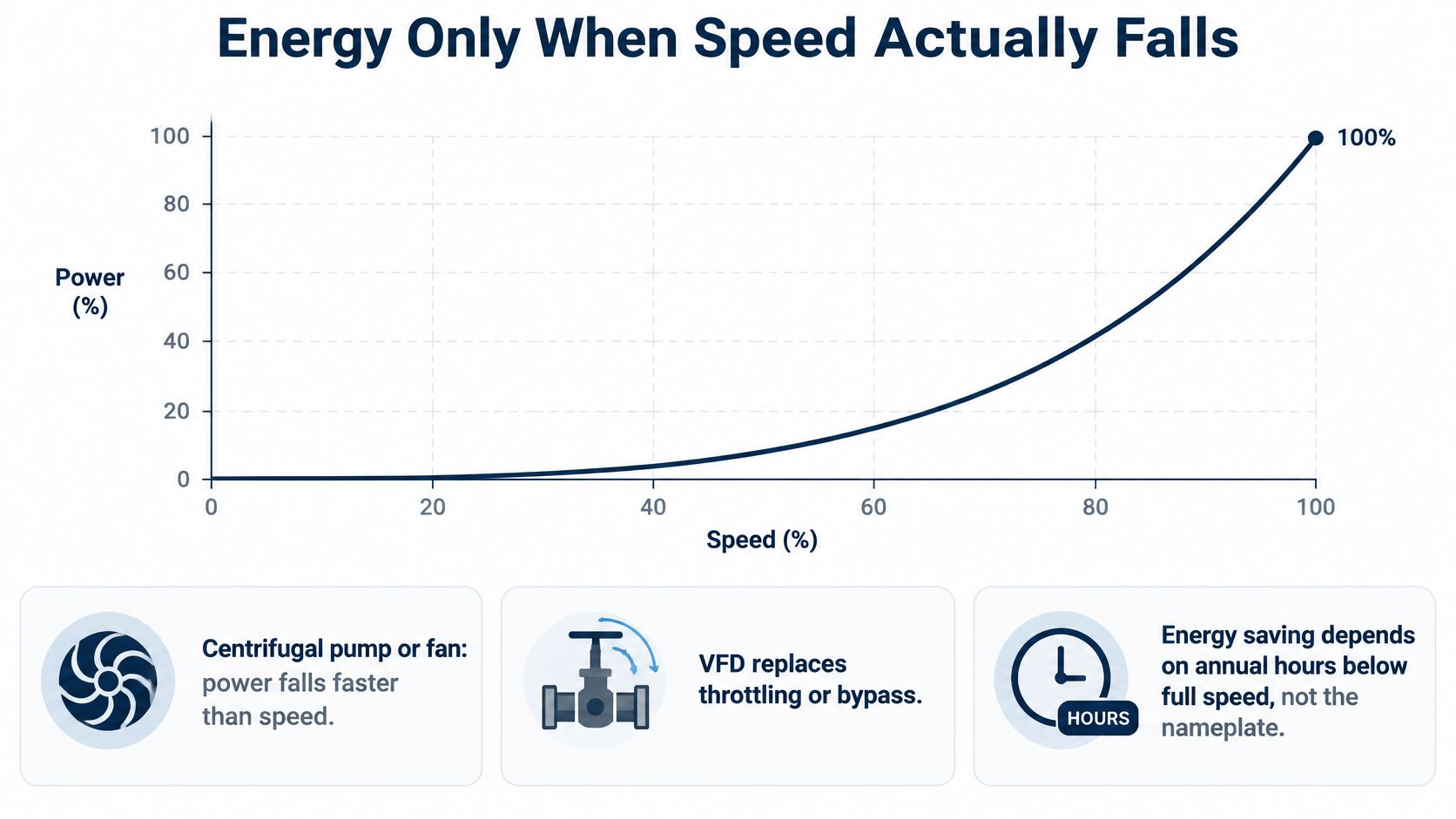
For centrifugal pumps and fans, reduced speed can lower required fluid power sharply. Replacing throttling or bypass regulation with speed control removes losses that persist whenever the motor runs at full speed.
The curve below illustrates the opportunity under stated load conditions.
Put the savings range beside its conditions
The U.S. Department of Energy/NREL pumping guide reports approximately 30% to 50% energy savings in many installations using variable-speed control of rotodynamic pumps, with results governed by the load profile, operating hours, control strategy and hydraulic system. Treat that range as a screen for candidate machines; the forecast for one motor comes from its own logged duty.
A process may need less flow without permitting a proportional speed reduction. Static head, minimum circulation requirements, cooling needs and process interlocks can all constrain the operating range. An emergency or habitual bypass mode can also hold the motor at line frequency despite the presence of a drive. Each constraint removes hours from the pool where savings can accrue.
Consider a pump whose operator regulates delivery with a discharge valve. Before specifying a VFD, trend flow, pressure, valve position and incoming electrical power together. Then determine whether reduced speed can still satisfy the required pressure and minimum-flow conditions.
Don't apply a centrifugal-load power curve to every motor. A conveyor's useful work and a pump's hydraulic duty are not interchangeable. Evaluate energy against the actual driven load and required production output.
Separate kilowatt-hours from starting demand
A soft starter changes the starting event. Once it bypasses, a full-speed pump operating against a throttle carries the same continuing flow-control loss it carried before.
Reduced starting current may not lower billed demand either. Check how the utility measures demand and whether starting events affect that measurement. Any demand-charge benefit belongs on its own line, separate from annual kilowatt-hour savings.
The operating distinction is also useful when reviewing control demonstrations.
<iframe width="100%" style="aspect-ratio: 16 / 9;" src="https://www.youtube.com/embed/rYw3Pky-6AM" frameborder="0" allow="autoplay; encrypted-media" allowfullscreen></iframe>Drive electronics consume power while operating. If a motor stays at full speed, no load-energy reduction exists to offset that conversion loss. Include auxiliary cooling and mitigation equipment inside the measurement boundary rather than comparing only motor output.
The decisive plant record is the share of annual operating hours during which speed can fall, paired with measured power at those duties. Record why speed cannot fall as well: minimum flow, process pressure, interlock restrictions or bypass operation. Constraints of that kind convert an attractive theoretical curve into a defensible operating forecast.
Harmonics Bypass and Motor Stress
Power quality belongs in the selection specification. It affects installed hardware, motor compatibility and the work needed to restore production after a failure.
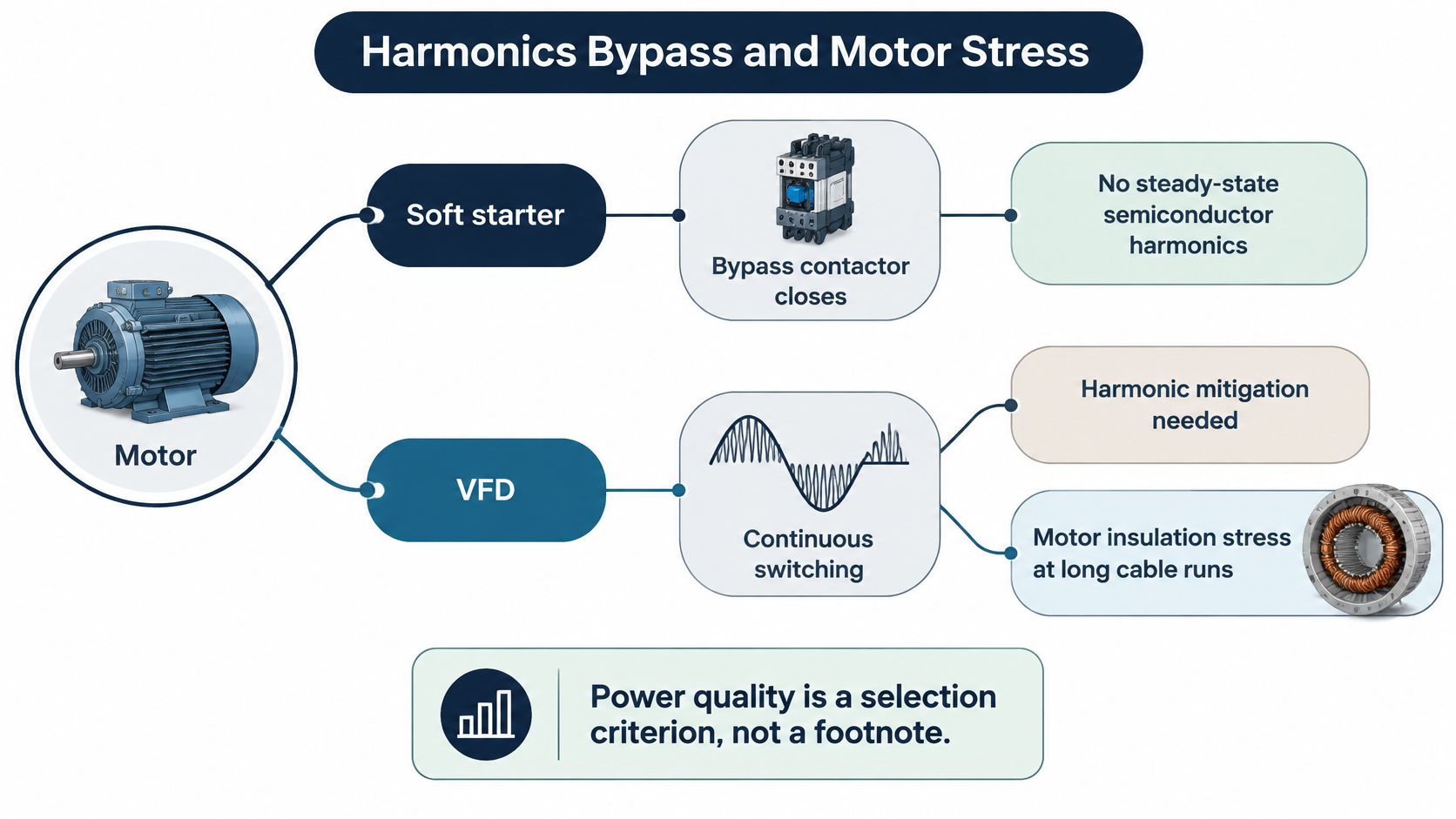
A bypassed soft starter places the motor on the line without continuous semiconductor switching in its normal running path. During acceleration, however, thyristor switching distorts the waveform. Saying that soft starters have no harmonics leaves out the operating period when they actively control voltage.
The motor-control primer distinguishes this bypassed operating state from a conventional VFD's continuous rectifier-and-inverter operation, while identifying common-mode voltage, bearing-current risk, cable reflections and insulation stress as motor-side considerations.
The architecture comparison below should be read as a screening aid, not a requirement to fit identical mitigation to every drive.
Specify mitigation from the installation
A VFD doesn't automatically require an active front end. Review the site's applicable distortion limits, transformer and supply characteristics, existing nonlinear loads and the number of drives sharing the bus.
Keep supply-side and motor-side remedies separate:
- Supply side: Assess whether line reactors, passive filtering or another input architecture is needed to meet the site requirement.
- Motor side: Review cable length, motor insulation suitability and bearing protection before choosing output mitigation.
- Existing assets: Check older motors and undocumented cable routes rather than assuming a successful starter installation proves VFD compatibility.
Long motor leads deserve particular attention because reflected switching pulses can increase terminal stress. A line reactor doesn't, by itself, settle every motor-side concern. Specify the remedy against the identified electrical mechanism.
Connect every failure path to a recovery plan
The starter's bypass contactor is a wear component, not a maintenance exemption. A failed contactor can prevent normal transfer or continued operation, so stores needs the correct replacement and maintenance needs a verified switching sequence.
For a VFD, identify the cooling fan, capacitor bank, power module and control board that can stop the asset. Confirm which parts can be replaced locally, which require workshop diagnosis and which need parameter restoration or functional testing before restart.
Recovery test: If the electronics are unavailable, can this process safely run at full speed through an engineered bypass?
That question matters especially at remote, contaminated and medium-voltage installations. An electrically possible bypass may still violate process limits or starting-current constraints.
The commercial comparison should therefore include filters, inspections, bypass availability, repair lead time and production exposure. The architecture with the lowest quotation isn't necessarily the one with the lowest risk-adjusted cost.
Payback Against Lifecycle Cost
Published VFD projects demonstrate what running-duty changes can achieve, but they don't establish a universal payback. The NREL variable-frequency-drive evaluation document records a Long Beach waste-to-energy fan retrofit saving 3,661,200 kWh annually, about 1% of generated energy, against a $663,368 project cost and reported two-year payback.
Published VFD project results
| Site and load | Reported saving | Project cost or value | Payback note |
|---|---|---|---|
| Long Beach waste-to-energy, induced-draft fans serving three boilers | Annual energy reduction described above | Reported installed project cost described above | Reported project payback, not a guarantee for another site |
| Pumping guide, primary-feed and product-transfer pumps | Reduced flow-control losses | Drive savings formed part of a broader project | Benefit came from running-duty changes, not starting alone |
These cases support a mechanism: matching operating speed to process demand can remove continuing losses. They don't justify transferring a historical project's economics to a different tariff, operating schedule or system.
Price the complete operating obligation
Build the comparison from a common production duty and measurement boundary. Our guide to variable-speed-drive energy savings can support that assessment, but the approval calculation should use the plant's own operating records.
Include:
- Net energy benefit: Measured baseline consumption minus forecast consumption, including conversion losses and auxiliaries.
- Demand charges: A separate tariff calculation, not an assumed consequence of reduced inrush.
- Installed mitigation: Required reactors, filters, cooling, motor-side protection and commissioning.
- Maintenance and spares: Inspectable components, available replacements and diagnostic access.
- Outage exposure: Planned intervention time, repair lead time and the production consequence of losing the asset.
Avoid comparing a fully engineered VFD installation against a bare starter price, or a maintained starter against a drive with no maintenance allowance.
Maintenance changes the cost outcome
At Hangzhou Iron & Steel, repeated failures in a group of ABB drives aged 7–12 years decreased from 2–3 times per month to about once every six months after a two-month maintenance contract. That result describes a specific fleet, not a reliability guarantee for every drive installation.
It does demonstrate why maintenance scope belongs in the economic model. We also provide fully on-site reconditioning for aging medium- and high-voltage drives that are difficult to ship, scheduled within a planned shutdown.
A constant-speed motor may favor a bypassed starter because the plant gains little from continuous conversion. A variable-duty motor may justify a drive despite greater maintenance obligations. Compare the whole operating period and credible failure scenarios, not merely the purchase order.
Loads That Reward Each Choice
Equipment names alone don't select motor controls. A pump can be a strong VFD candidate or a straightforward starter application, depending on the process envelope.
For variable-flow pumping, use the hydraulic requirements to establish the allowable speed range before estimating savings. Our variable-speed-drive water-pump guide provides supporting application context, but a logged operating profile remains the basis for selection.
Which device fits the load
| Load | Pick | Why the other loses |
|---|---|---|
| Centrifugal pump or fan, many hours throttled or bypassed | VFD | A soft starter leaves full-speed throttle loss |
| Constant-speed pump or compressor, adequate starting torque | Soft starter | A VFD adds conversion losses, electrical considerations and spares without a usable speed benefit |
| Conveyor, crusher or high-inertia start | VFD, or a proven soft-start ramp | Inadequate reduced-voltage torque can stall the load |
| Process needing low speed, braking or torque control | VFD | A soft starter has no running-speed authority after the ramp |
| Aging medium-voltage drive in a dirty or remote plant | Decide on service access, not sticker price | Neither a cheap starter nor an inaccessible replacement drive resolves an unsupported recovery plan |
Treat difficult starts as engineering cases
A high-inertia load doesn't automatically belong on a soft starter or a VFD. Check accelerating torque, ramp duration, thermal duty and the device's overload capability.
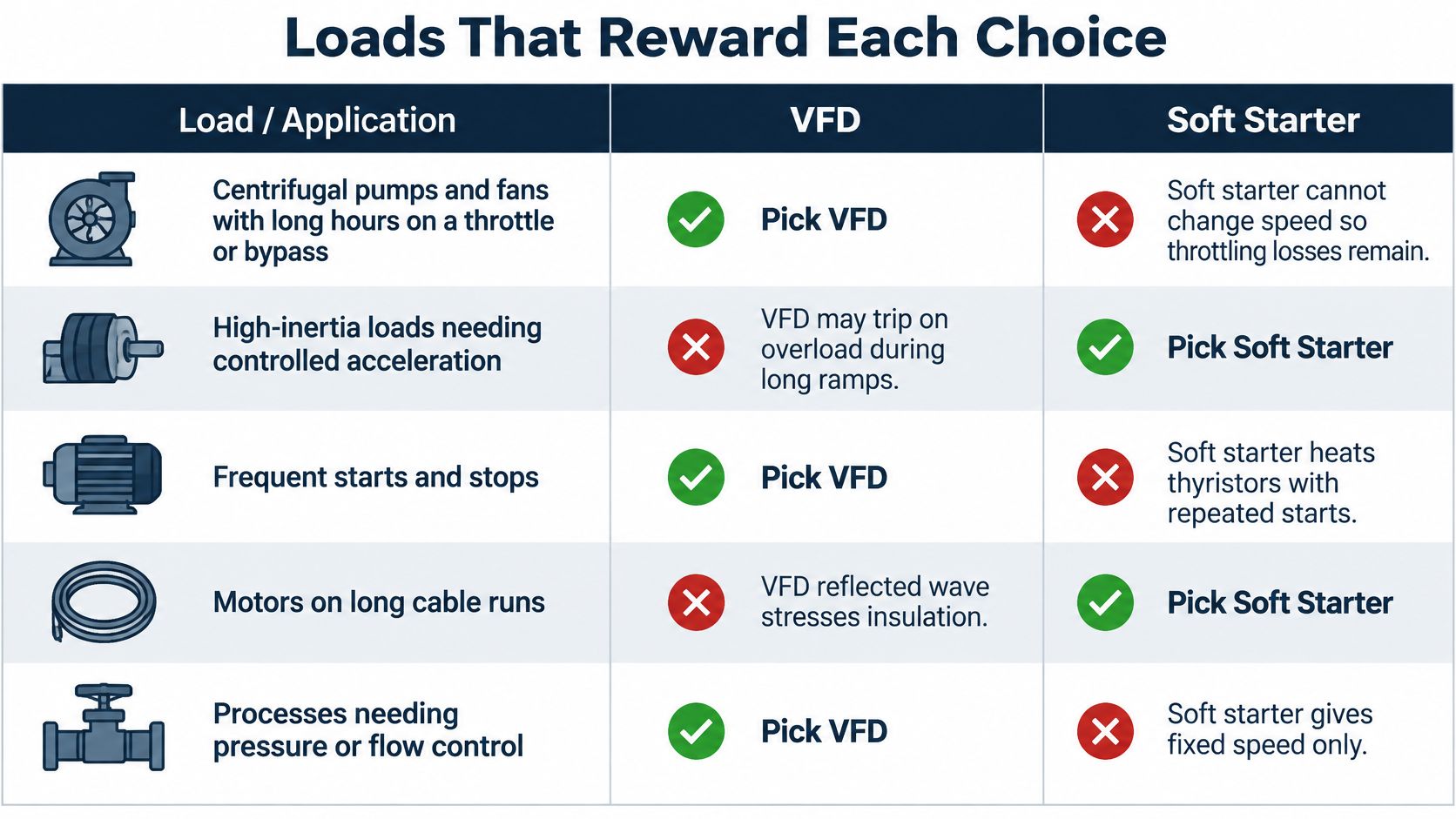
Likewise, frequent starts require review of the selected equipment's starting duty rather than a universal rule based on device category. A long cable run calls for compatibility assessment, not an automatic rejection of speed control when the process requires it.
Use the visual below as an application prompt; the measured duty and manufacturer's operating limits take precedence over categorical picks.
Keep modeled savings subordinate to plant evidence
A 2025 peer-reviewed energy study reported modeled savings of up to 36.1% from variable-speed control and up to 42.9% when combined with soft-start operation, using synthetic operating profiles that still require real-world validation. Those results aren't a reason to install separate starting hardware ahead of every drive.
For mixers and mills, specify the required operating behavior first: low-speed processing, controlled torque, braking or fixed-speed production. For aging medium-voltage installations, determine whether the existing architecture can be maintained before replacing it.
We assess what can be maintained or refurbished before recommending whole-system replacement. That keeps the decision focused on the serviceable asset and process requirement, rather than assuming that new equipment alone resolves environmental or recovery constraints.
Log the Duty Then Choose the Device
Give the electrical supervisor a record that procurement and operations can both approve. Use a power logger, operating trends, event history and the motor-load documentation rather than relying on nameplate power or operator recollection alone.
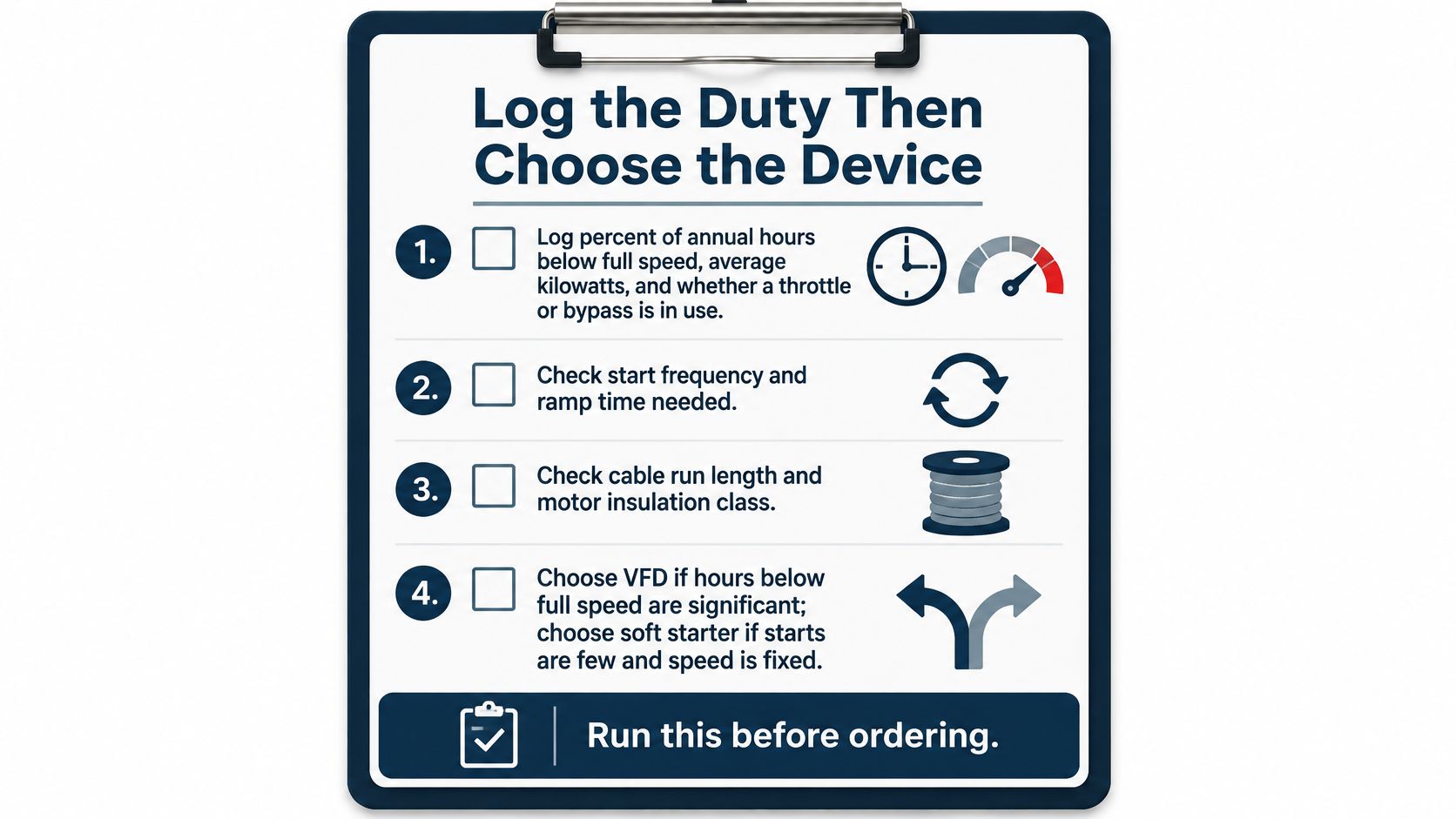
Run the checks before issuing the purchase order.
Record duty and electrical constraints
- Log useful operating demand. Record the share of annual hours below full speed, average input kilowatts, flow or throughput, and whether throttling or bypass regulation is active. Include representative production and standby conditions.
- Verify the start. Count starts, record acceleration time and compare available motor torque at the proposed current limit with the load's torque-speed requirement.
- Document installation limits. Record the applicable harmonic requirement, cable length, motor suitability, environmental conditions and whether full-speed bypass operation is permitted.
- Price restoration. Identify required filters, spare modules, diagnostic access and the outage consequence if a replacement part isn't locally available.
Approve the appropriate path
Choose a soft starter when useful hours below full speed are negligible and reduced-voltage starting provides adequate torque. Specify its bypass arrangement, starting duty and protection without purchasing drive-specific mitigation for a process that doesn't require a drive.
Choose a VFD when normal production requires speed, flow or torque to change. Complete a sizing assessment against the logged profile, including overload duty and installation constraints.
Our VFD Master supports engineering pre-selection for low-, medium- and high-voltage projects, with real-time sizing, a copyable summary and print/PDF export. Treat pre-selection as an engineering input, not a substitute for confirming the complete installation.
For an existing drive requiring service, record the brand, exact model code, rated power and voltage, fault code exactly as displayed, when the fault occurs and operating environment. Those details allow us to establish the service scope instead of beginning with an unsupported replacement assumption.
DUCHENG Industrial provides multi-brand VFD commissioning, preventive maintenance, troubleshooting, workshop repair and on-site reconditioning. Visit DUCHENG Industrial with your duty log and equipment details to discuss drive pre-selection or a maintenance and recovery scope matched to the process.