
Master industrial electrical troubleshooting for drives and controls with structured fault isolation, safe restart checks, and proven prevention tactics.
It's 1:40 a.m. A process line is down, the operator says the drive “just tripped again,” and someone is already reaching for the reset key. That moment decides whether the next hour is disciplined fault isolation or expensive confusion.
In drive-heavy plants, speed matters. But speed without method usually makes the outage longer. A 2024 industrial-maintenance survey on downtime costs reported that the average hour of unplanned downtime costs about $25,000, while larger organizations can exceed $500,000 per hour. The same survey said over two-thirds of industrial businesses experience unplanned outages at least once a month. In practice, that means industrial electrical troubleshooting isn't just about clearing an alarm. It's about restoring equipment correctly, protecting the next production window, and avoiding a second trip five minutes after restart.
The trouble is that many recurring electrical faults aren't single faults at all. They're lifecycle faults. A contaminated cabinet, a weak cooling path, an aging capacitor bank, a loose termination, or an intermittent supply event can all produce alarms that look isolated when they aren't. If you treat every trip as a simple reset event, you lose the evidence that tells you whether to clean, recondition, monitor, or replace.
Table of Contents
- Why Industrial Electrical Troubleshooting Fails Without a Method
- Preserve Evidence and Classify the Fault Before You Reset
- Isolating the Four Faults That Cause Most Drive Trips
- When Electrical Faults Are Really Lifecycle and Environment Failures
- Controlled Restart and Verification That Prevents Repeat Trips
- A Repeatable Troubleshooting Routine You Can Apply Today
Why Industrial Electrical Troubleshooting Fails Without a Method
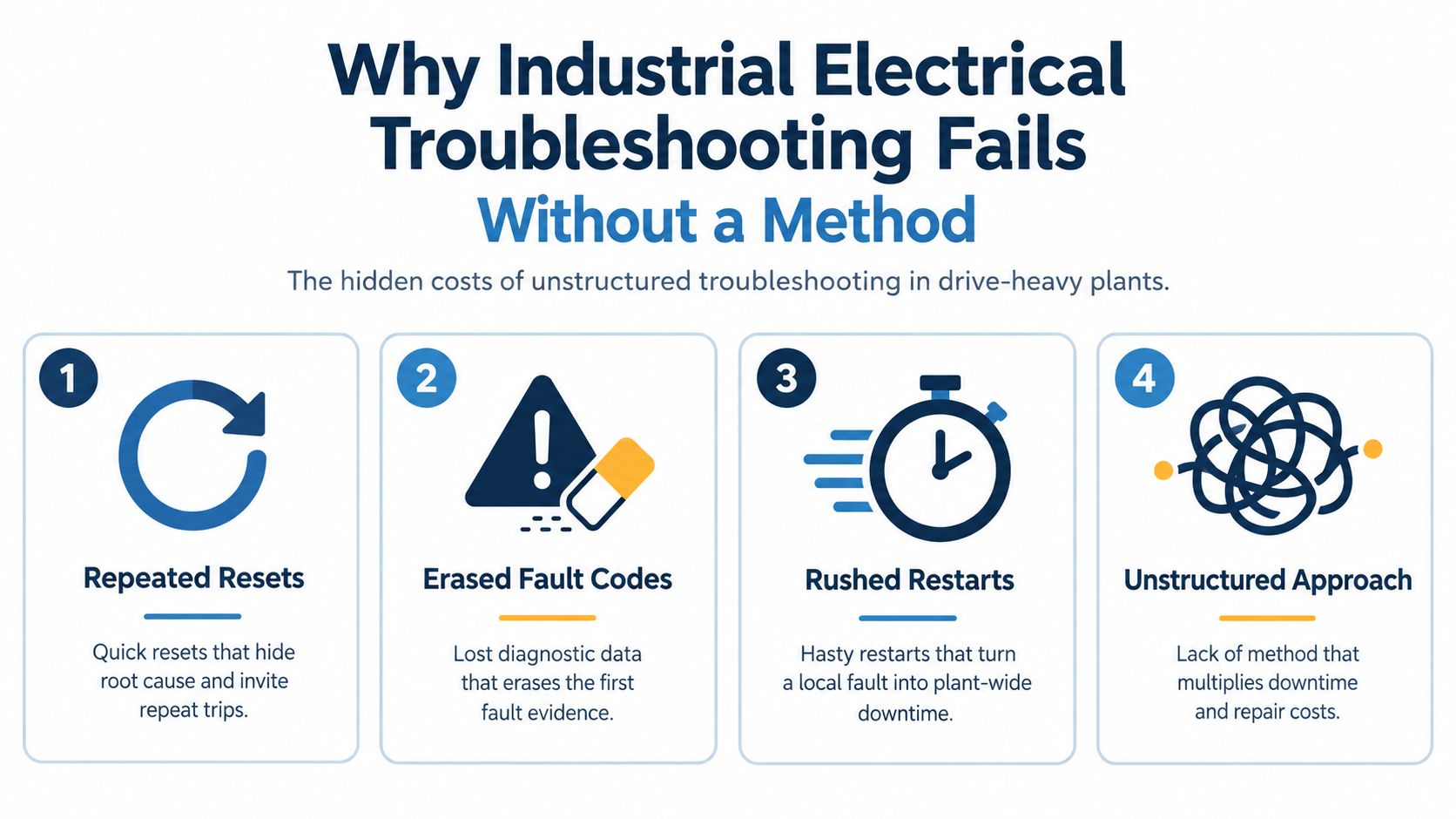
The failure usually starts with good intentions. Production wants the line back. Maintenance wants to help. An electrician sees a familiar trip, clears it, restarts, and hopes it holds. Sometimes it does. More often, that first reset erases the cleanest evidence you had.
At midnight, a drive trip rarely stays local for long. A rushed restart can bring in control interlocks, upset upstream equipment, and load a motor before anyone has confirmed whether the original cause was supply-side, thermal, or mechanical. What looked like one fault becomes three work orders, a hot cabinet, and a handoff between shifts with half the story missing.
What the reset-first habit gets wrong
The biggest mistake is treating the alarm as the problem. The alarm is only the symptom exposed by the drive. The problem may sit at the incoming power, in the motor circuit, in the load, or inside an enclosure that's been running too hot for months.
Three bad habits show up again and again:
- Repeated resets: Each reset removes context. You lose the first fault, the sequence, and the operating condition that caused it.
- Rushed restart under load: Teams re-energize before checking whether the machine is free, the references are sane, and the cooling path is intact.
- Undocumented changes: Someone swapped a fan, changed a parameter, landed a wire, or opened a panel last shift, and nobody wrote it down.
Practical rule: If you haven't isolated the fault family, you haven't earned the reset.
Method protects more than the drive
A documented troubleshooting method does more than shorten the immediate outage. It protects motors, brakes, cables, contactors, and the process itself. It also protects the next shift from inheriting a half-solved fault.
That matters even more in modern plants because drives now sit at the center of operation. One industry source estimates that variable frequency drives control about 60 to 70% of motors in a modern plant, and it notes that 40% of VFD faults are linked to heat-related issues such as blocked filters, failed fans, or dirty heatsinks. The same source says typical DC bus capacitors reach a 5 to 7 year service life before aging can trigger trips, which is why a drive fault often points to thermal stress and lifecycle condition, not just an electrical event.
Good industrial electrical troubleshooting starts with one principle. Isolate before you act. That principle carries from the first fault capture to the final loaded restart.
Preserve Evidence and Classify the Fault Before You Reset
The first few minutes after a trip matter more than the next hour of testing. If you miss that window, the drive may still be repairable, but the story of why it tripped gets much harder to reconstruct.
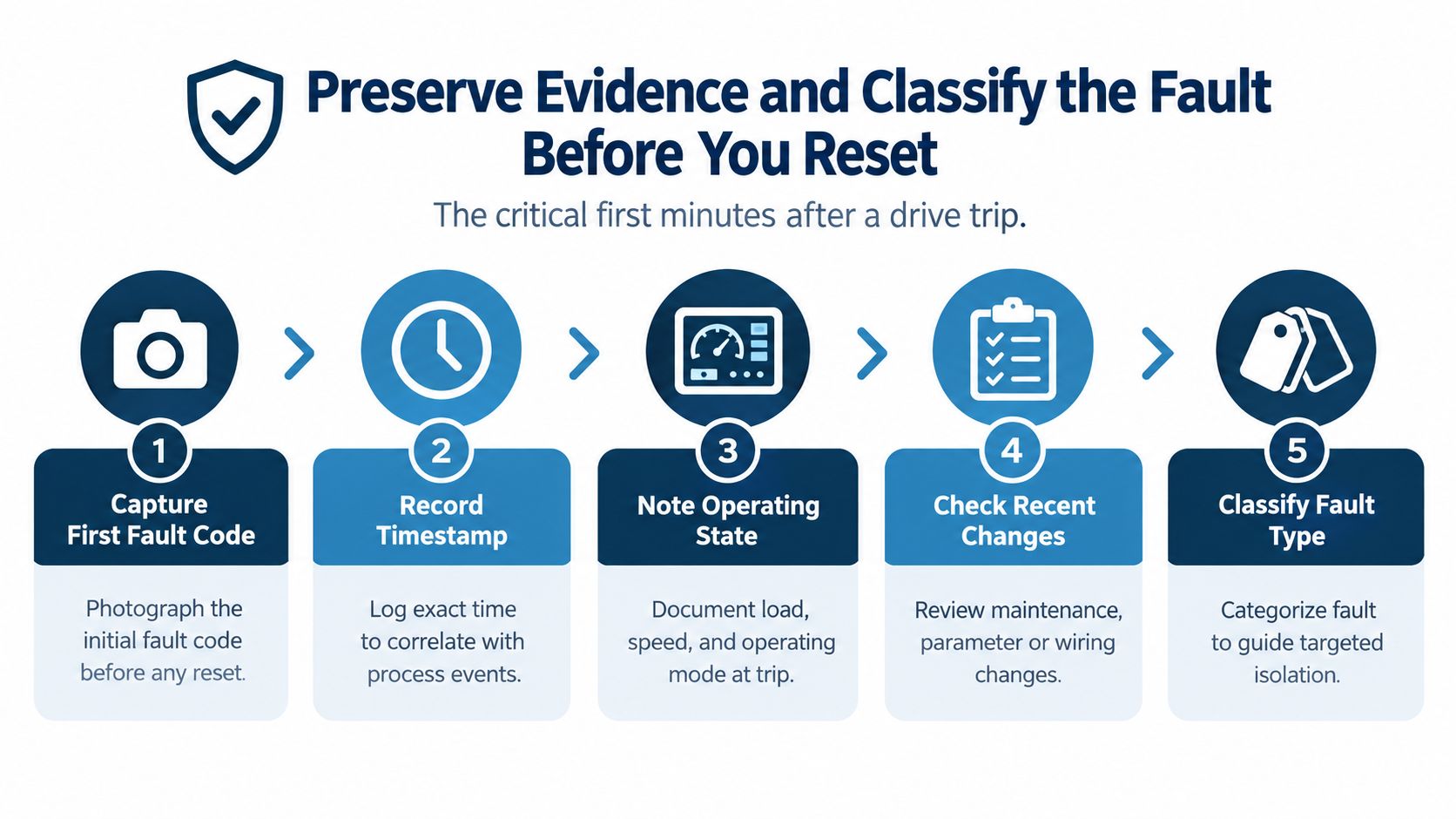
Start by treating the first fault as evidence, not as an inconvenience. Capture it before anyone touches reset.
What to record immediately
A practical fault record should include the pieces that let you correlate the trip to process conditions and recent intervention:
- First fault code and screen state: Photograph the HMI or keypad before power cycling or resetting.
- Exact time of trip: Match it against line events, utility disturbance, load change, or upstream equipment action.
- Operating state: Note speed, load, run mode, direction, and whether the machine was accelerating, decelerating, idling, or fully loaded.
- Recent changes: Ask what changed. Parameters, maintenance work, cable movement, cleaning, fan replacement, brake adjustment, and even door-open time all matter.
- Environment at the moment: Was the cabinet hot, dusty, damp, vibrating, or missing airflow?
A structured guide to VFD fault handling recommends preserving the first fault code, timestamp, operating state, and recent changes before any reset, then classifying the failure into fault families and proving the energy state before a single verified restart attempt (evidence-first VFD fault workflow).
Classify the fault before touching reset
Before you decide what to test, place the event in the right family. In the field, that classification narrows your first checks fast:
| Fault family | What it often points to first |
|---|---|
| Input-supply | Voltage disturbance, phase issue, loose line-side connection |
| DC-bus | Charge circuit issue, capacitor condition, braking problem |
| Output-stage | Inverter section fault, shorted output path, internal power device issue |
| Motor and cable | Insulation breakdown, damaged cable, terminal box contamination |
| Mechanical-load | Jam, binding, high inertia, sudden torque demand |
| Thermal | Blocked filter, failed fan, dirty heatsink, enclosure heat |
| Control and reference | Bad speed command, unstable reference, logic mismatch |
| Communications | Lost network, stale command, controller interruption |
| Internal-drive | Board-level defect, aging component, internal sensing failure |
That classification does two things. It keeps the team from testing everything at once, and it stops the common drift where a mechanical load issue gets chased as a pure electrical failure.
A short training clip can help align a team on the evidence-first mindset before fault-finding begins.
<iframe width="100%" style="aspect-ratio: 16 / 9;" src="https://www.youtube.com/embed/1ELgDCgxoM4" frameborder="0" allow="autoplay; encrypted-media" allowfullscreen></iframe>Repeated resets don't fix intermittent faults. They erase the timeline you needed to separate a supply event from a drive event.
The one-reset rule
Once you've captured the evidence, prove the energy state, correct the demonstrated cause you can verify, and then reset once. Not three times. Not until “it takes.” Once.
If the fault clears and the drive runs through an approved test, you've learned something. If it returns immediately, you've confirmed the cause wasn't addressed. That's useful. Blind reset cycles only create noise.
Isolating the Four Faults That Cause Most Drive Trips
A midnight drive trip in a mill or chemical unit usually arrives as a single alarm, but the failure started earlier. Moisture in a terminal box, a fan that lost airflow weeks ago, a conveyor that is tightening up on startup, or a bus event the drive only reports after the fact can all land in the same fault history. Good troubleshooting isolates the fault path first, then decides whether the right correction is cleaning, reconditioning, parameter change, or replacement.
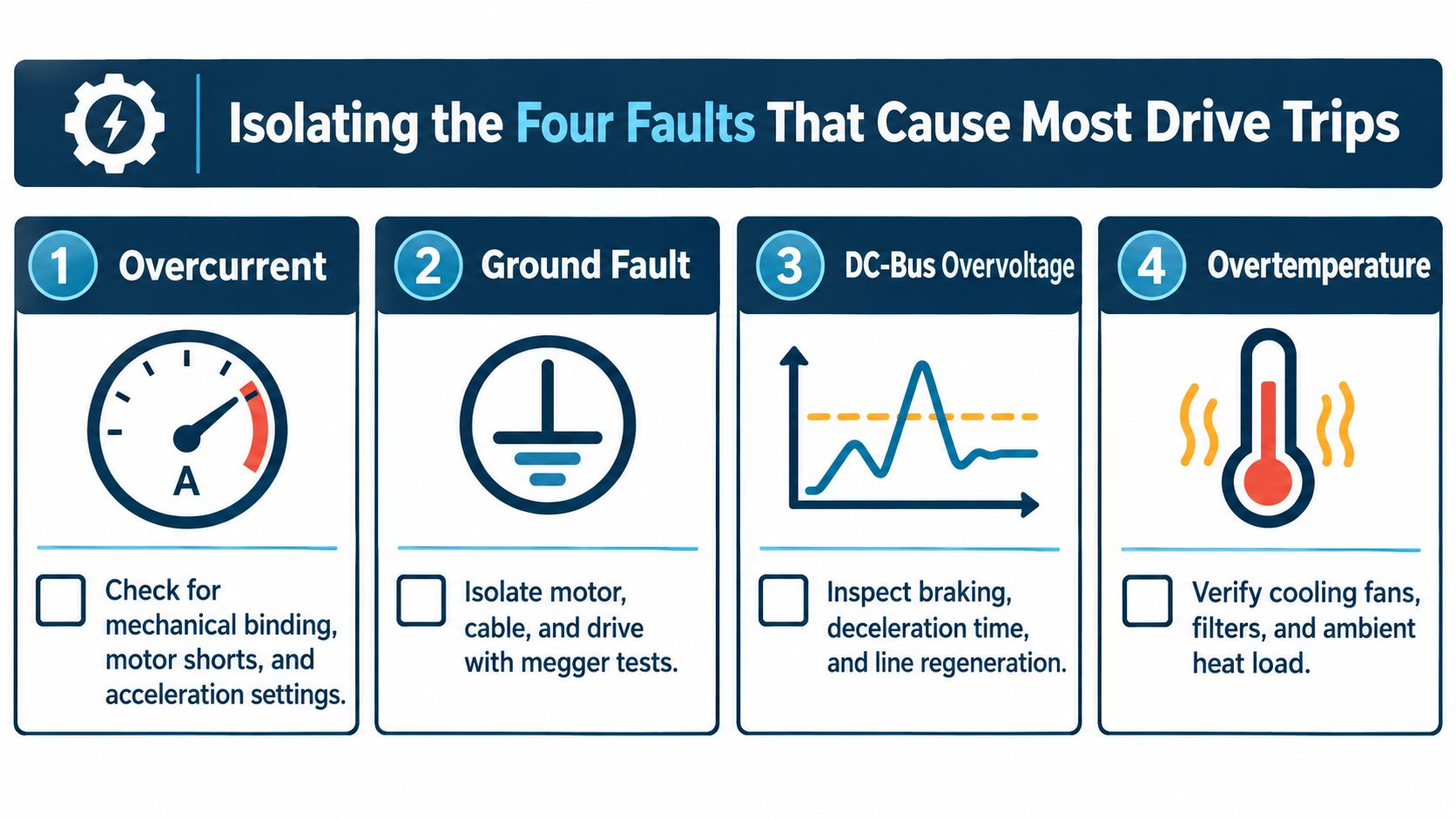
Across major VFD platforms, overcurrent, ground fault, DC-bus overvoltage, and overtemperature account for over 80% of field trips. Start there. These four families give the fastest path to a cause you can prove.
Overcurrent
Overcurrent is often a load problem before it is a drive problem. Check the machine first, with power isolated and the equipment made safe. Confirm the train will turn freely. Look for seized bearings, brake drag, packed product, misalignment, or a process condition that raised starting torque beyond what the last successful run required.
Then compare when it trips. A drive that trips only on acceleration under load is pointing toward mechanical demand, short accel time, or a torque setting that changed. A drive that trips instantly at enable with the motor disconnected points somewhere else entirely.
Use this order:
- Mechanical freedom first: Verify the driven equipment rotates as it should and no external bind exists.
- Motor circuit next: Check terminations, phase balance, visible insulation damage, and signs of tracking or heat at the motor and junction points.
- Application settings last: Review acceleration, current limit, flying start, and torque-related parameters after physical causes have been checked.
That sequence saves drives. It also catches lifecycle problems early, especially motors and couplings that still run but need more torque each month to do the same work.
Ground fault
Ground-fault isolation has to stay clean and separate. Testing the entire path at once usually gives a result that cannot tell you whether the leakage is in the cable, the motor, contamination in the terminal box, or damage in the output stage.
Disconnect the motor leads at the drive output. Then test in sequence with a 500 V or 1000 V DC insulation tester, following site practice and the motor or cable rating. Test the cable by itself with both ends isolated. Test the motor by itself with the cable removed. Test the drive output stage only after the motor and cable are fully disconnected.
A better isolation sequence
- Cable only with both ends isolated.
- Motor only with cable removed from the equation.
- Drive output stage with motor and cable disconnected.
Testing the whole circuit at once hides the failed component. Separate the cable, motor, and inverter or you are guessing.
If you need help sorting the alarm family before you meter anything, this VFD fault code reference can help organize the fault path.
One field note matters here. A marginal insulation result is not always a replace-now result. In dirty or wet plants, contamination in a peckerhead, terminal box, or cable gland can produce repeat trips that look like winding failure. Clean and dry what you can prove is contaminated. Replace what stays low after cleaning, drying, and re-test.
DC-bus overvoltage
DC-bus overvoltage often shows up during deceleration, speed reduction, or any process upset that drives the motor faster than the command. The incoming line can be part of it, but many nuisance resets happen because the load is feeding energy back and the braking path has lost margin.
Start with the event timing. Did it trip during a fast stop, a descending load, an unwind, a fan overrun, or a change from coast to ramp stop? Then check the braking hardware and parameters. A weak brake resistor connection, failed braking unit, or decel time that looked acceptable when the equipment was new may no longer be acceptable after process changes or inertia increases.
A quick field comparison helps:
| Symptom | More likely direction |
|---|---|
| Trips during decel | Braking path or deceleration profile |
| Trips during process overrun | Load-driven regeneration |
| Trips during unstable incoming power event | Line-side investigation |
Overtemperature
Overtemperature faults are usually evidence of lost cooling margin. The question is rarely whether the drive got hot. The question is why it now gets hot in normal duty.
Check fan operation, filter loading, heatsink condition, cabinet airflow path, and hot air recirculation from nearby equipment. Then look harder at the age of the installation. Dust that was harmless last year may now be conductive. A fan that still spins may have lost enough flow to matter. A cabinet that was acceptable at commissioning may now be heat-soaked every afternoon because the room load changed.
A drive that cools down and restarts is still in failure mode. If contamination is light, clean it. If the board surfaces, cooling passages, or terminals show embedded contamination, corrosion, or repeated thermal stress, reconditioning or replacement is usually a better call than another reset.
When Electrical Faults Are Really Lifecycle and Environment Failures
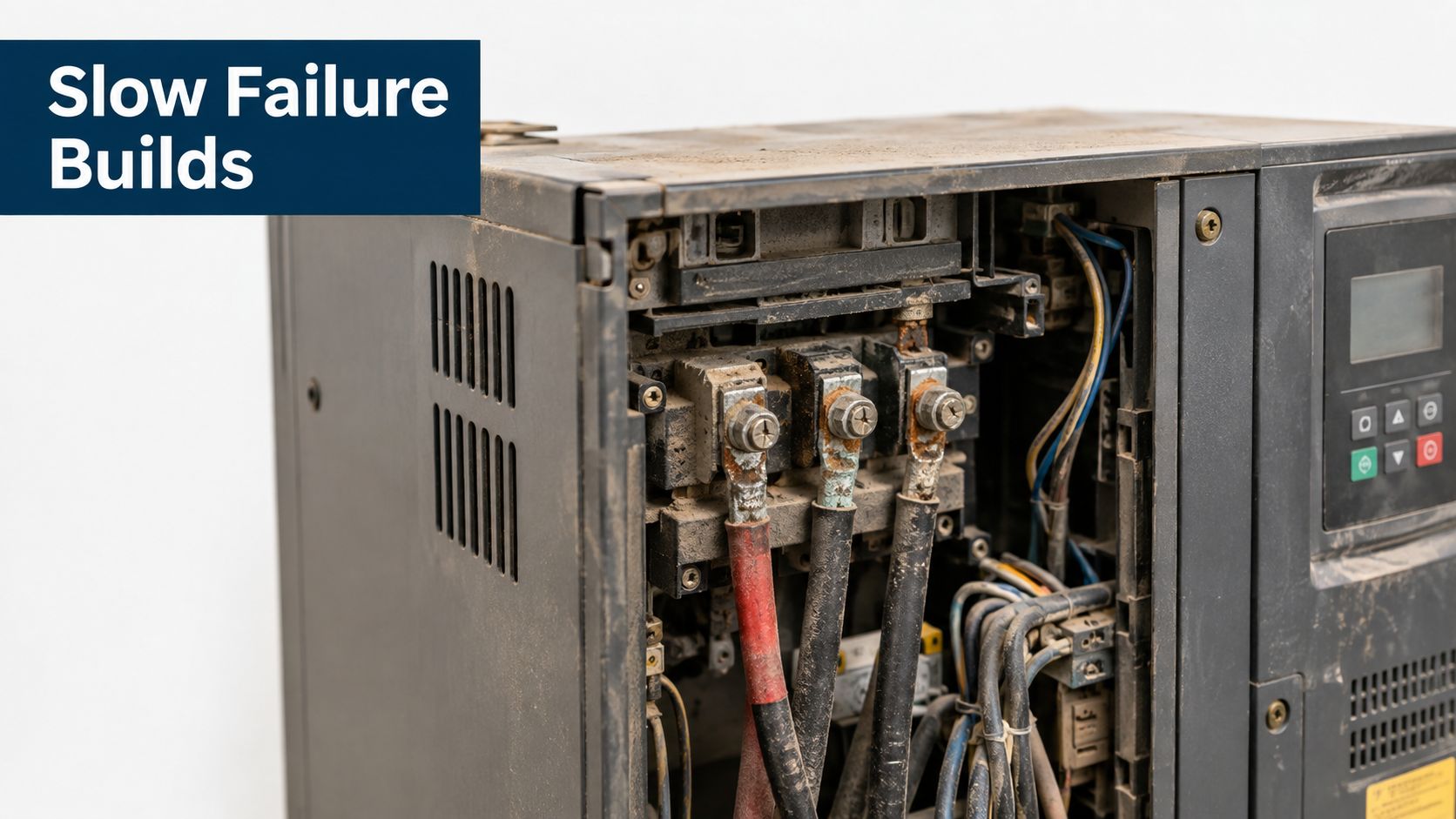
Some of the hardest recurring trips don't come from dramatic failures. They come from slow degradation that keeps crossing the trip threshold and then disappearing before anyone sees the pattern clearly.
That's why industrial electrical troubleshooting has to move beyond alarm clearing. In harsh plants, the question often isn't “What fault code did we get?” It's “What condition has been getting worse for months?”
The same alarm means different things in different environments
A hot cabinet in a steel plant doesn't age the same way as a cabinet in a chemical unit or a tire plant. Dust loading, salinity, moisture, vibration, and thermal cycling all change how faults develop.
A checklist approach usually asks whether the fan runs and whether the filter looks dirty. A lifecycle approach asks harder questions:
- Is contamination superficial or conductive? Surface dirt can be cleaned. Embedded contamination on boards and cooling paths may justify reconditioning.
- Is thermal stress occasional or chronic? One hot day is different from a cabinet that has been heat-soaked every shift.
- Is the trip random or patterned? Intermittent faults often follow temperature, humidity, washdown, or production duty.
- Is the asset aging into unreliability? Capacitors, fans, terminations, and insulation all tell a different story as the drive gets older.
One underserved area in VFD troubleshooting is exactly this environment and lifecycle view. Harsh conditions such as heat, contamination, moisture, salinity, vibration, and aging-related degradation often drive recurring faults, while many guides stay focused on the immediate code rather than the recurring failure mode behind it.
Clean, recondition, monitor, or replace
Here's the trade-off most plants face. If you only clean what's visible and reset, the drive may survive the shift but fail again in the next production window. If you replace too early, you spend capital on an asset that may still be serviceable with targeted work.
A useful field comparison looks like this:
| Condition found | Usually the better action |
|---|---|
| Light dust, intact cooling, stable terminals | Clean and inspect |
| Heat stress, aging fans, contamination inside airflow path | Recondition during shutdown |
| Intermittent trips tied to environment or duty cycle | Monitor condition and schedule intervention |
| Board damage, repeated internal faults, degraded subsystems across the drive | Assess replacement or subsystem renewal |
Documented preventive work matters. A preventive maintenance checklist for industrial equipment helps teams move known weak points into shutdown planning instead of waiting for another 2 a.m. trip.
The fault code is often the last symptom. The failure started earlier, usually in heat, dirt, moisture, vibration, or aging parts.
What works in harsh sites
What works is targeted intervention tied to evidence. Pull the covers during a planned stop. Inspect the heatsink path. Check fan condition, not just fan rotation. Re-torque where the environment justifies it. Look for discoloration, corrosive residue, insulation distress, and signs of thermal cycling.
What doesn't work is treating contamination and age as housekeeping issues. In old cabinets, they're electrical reliability issues.
Controlled Restart and Verification That Prevents Repeat Trips
After you've found and corrected the demonstrated cause, the restart has to be controlled. Many recoveries fail. The repair may be adequate, but the verification is sloppy.
A proper restart is staged. You don't throw the drive back into full production and hope the trend stays green.
Before re-energizing
Confirm the basics in a deliberate order:
- Energy state verified: Make sure isolation has been removed correctly, covers are back in place, and no temporary safety boundary remains in conflict with startup.
- Visual condition checked: Look for loose tools, displaced wiring, disconnected feedbacks, and signs of arcing or heat.
- Electrical condition confirmed: Verify continuity and insulation status where those checks were part of the diagnosis.
- Control references reviewed: Confirm speed command, direction, permissives, and interlocks match the intended test mode.
If the trip involved environment or aging, add a quick thermal and airflow check before power-up. A clean fault reset on a hot, poorly ventilated cabinet only starts the countdown again.
Bring the system back in stages
A sound restart sequence usually looks like this:
- Energize with no run command and observe the drive's idle state.
- Run unloaded or at minimum practical load if the process allows it.
- Increase duty in steps while watching current behavior, thermal condition, and process response.
- Return to normal operating range only after the equipment stays stable through the duty points that previously triggered the trip.
One body of guidance that aligns well with field practice is to prove the energy state, correct the demonstrated cause, then reset once and verify under an approved operating test. That discipline is what prevents a false recovery from becoming a second outage.
Document the restart like it matters
The handback note should answer three questions clearly:
| Question | What to record |
|---|---|
| What was found | Fault code, operating condition, physical evidence, affected components |
| What was corrected | Cleaning, tightening, part replacement, parameter correction, isolation result |
| What needs watching | Temperature trend, repeat condition, next shutdown task, spare need |
For critical production windows, some sites also keep standby support and condition checks in place for the first return-to-service period. That's sensible when the line can't tolerate another interruption and the fault history suggests hidden degradation.
If outside field support is needed, DUCHENG Industrial provides structured on-site diagnosis, controlled restart support, workshop repair, and on-site reconditioning for multi-brand drive assets in harsh industrial service.
A Repeatable Troubleshooting Routine You Can Apply Today
The most reliable plants treat troubleshooting as part of asset lifecycle management, not as emergency alarm handling. That shift changes how teams respond under pressure.
A routine that works in the field is simple enough to follow at 2 a.m. and disciplined enough to support reliability planning later. Use this one:
The field routine
- Hold the first fault: Capture the alarm, time, operating state, and recent changes before anyone resets.
- Classify the event: Put it in the right fault family so the first tests are targeted instead of scattered.
- Attack the dominant trip types first: For common drive trips, start with the isolation path that gives the most information early.
- Look past the alarm: Decide whether the fault is immediate, intermittent, or lifecycle-driven by heat, contamination, moisture, vibration, or age.
- Restart in stages: Verify, energize carefully, load gradually, and document what must be monitored next.
What teams should change after the outage
The outage is only half the job. The better question is what the trip should change in your maintenance routine.
That usually means tightening three things:
- Shutdown scope: Add cleaning, airflow checks, fan condition review, capacitor-age awareness, and enclosure inspection where the environment justifies it.
- Spare readiness: Confirm that critical replacement parts and exchange units are correctly identified before the next failure.
- Decision discipline: Stop arguing in general terms about repair versus replacement. Base it on condition, repeat history, environment, and production risk.
Takeaway: Good industrial electrical troubleshooting restores operation once. Great troubleshooting changes the failure pattern afterward.
Plants that get this right don't necessarily have fewer alarms on day one. They recover better, learn faster, and stop repeating the same night-shift mistakes. That's the upgrade. Troubleshooting becomes a reliability function, not just a repair task.
DUCHENG Industrial supports this kind of lifecycle-driven troubleshooting with VFD commissioning, fault isolation, controlled restart, workshop repair, shutdown preventive care, and on-site reconditioning for harsh industrial environments. If your team is dealing with recurring drive trips, aging cabinets, or uncertain repair-versus-replace calls, visit DUCHENG Industrial to review its service approach and engineering resources.